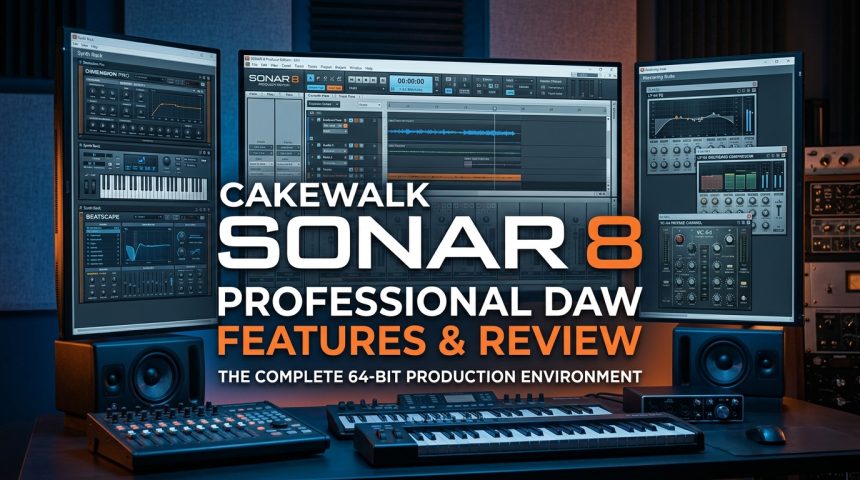
In the ever-evolving landscape of digital audio workstations (DAWs), certain versions stand out as pivotal moments, defining eras and setting new standards. Cakewalk SONAR 8, released in late 2008, is undeniably one such legend.
This article delves deep into what made Cakewalk SONAR 8 a significant release, exploring its core features, innovative tools, and lasting impact on the world of music production.
Introduction: Cakewalk SONAR 8’s Place in History
Cakewalk, a company with roots stretching back to the MIDI sequencing days of the late 1980s, had steadily built a reputation for powerful and innovative music software. Their SONAR line, first introduced in 2001 as the successor to their flagship Cakewalk Pro Audio, had consistently pushed boundaries, particularly in integrating audio and MIDI seamlessly within a Windows environment. For a deeper look into earlier versions, you might be interested in our Cakewalk Sonar 4 Full Reviews: Features, Performance & User Opinions.
By 2008, the DAW market was intensely competitive. Avid Pro Tools dominated professional studios, while Apple Logic Pro catered to Mac users, and Steinberg Cubase held a strong presence across platforms. Ableton Live was gaining traction with its unique performance-oriented workflow, and Propellerhead Reason offered a self-contained virtual studio. Cakewalk SONAR 8 entered this arena with a clear mission: to provide a complete, high-performance production environment for Windows users, leveraging the burgeoning power of 64-bit computing.
Cakewalk SONAR 8 wasn’t just an incremental update; it represented a significant leap forward, particularly in its embrace of 64-bit architecture, its robust suite of included instruments and effects, and its innovative workflow enhancements. Cakewalk SONAR 8 aimed to be the single solution for recording, editing, mixing, mastering, and even live performance, all within a highly customizable interface.
The Core Philosophy: Power, Performance, and Workflow
Cakewalk’s development philosophy for Cakewalk SONAR 8 revolved around three pillars: power, performance, and an intuitive workflow. They understood that modern music production demanded a DAW that could handle massive track counts, complex virtual instrument arrangements, and a multitude of effects, all while remaining stable and responsive.
A key differentiator was Cakewalk’s early and strong commitment to 64-bit computing. While other DAWs were still primarily 32-bit, Cakewalk SONAR 8 was designed from the ground up to take full advantage of 64-bit Windows operating systems, unlocking access to vast amounts of RAM. This was crucial for handling memory-intensive virtual instruments and large sample libraries, which were becoming increasingly common.
Beyond raw power, Cakewalk focused on refining the user experience. They introduced tools and features aimed at streamlining common tasks, fostering creativity, and providing a flexible environment that could adapt to individual working styles. From intelligent controller mapping to advanced looping capabilities, Cakewalk SONAR 8 sought to empower users at every stage of the production process.
Unpacking the Engine: Audio, MIDI, and Performance in Cakewalk SONAR 8
At the heart of Cakewalk SONAR 8 was a sophisticated engine designed for high-fidelity audio processing and robust MIDI handling.
The 64-bit Revolution
Cakewalk SONAR 8 was one of the first major DAWs to offer full 64-bit native support on Windows. This wasn’t merely a marketing gimmick; it had profound practical implications:
- Expanded RAM Access: 32-bit applications are limited to accessing approximately 4GB of RAM. In contrast, 64-bit applications can theoretically access terabytes of RAM. For music producers, this meant they could load significantly more virtual instruments, larger sample libraries (e.g., orchestral libraries, complex drum kits), and more memory-hungry plugins without hitting memory limits or resorting to complex workarounds. This directly translated to larger, more intricate projects being manageable within a single session.
- Improved Performance: While not a direct speed boost for every operation, the ability to keep more data in RAM reduced reliance on disk streaming, leading to smoother playback and faster loading times for large projects.
- Future-Proofing: Cakewalk recognized that the industry was moving towards 64-bit, and by embracing it early, they positioned Cakewalk SONAR 8 as a forward-thinking platform.
Pristine Audio Engine
Cakewalk SONAR 8 boasted a high-resolution audio engine capable of handling up to 64-bit floating-point processing and sample rates up to 192 kHz. This ensured pristine audio quality throughout the entire signal chain, from recording to mixing and mastering. Key audio features included:
- Low Latency Monitoring: Essential for recording, Cakewalk SONAR 8 offered efficient drivers (ASIO, WDM) to minimize latency, allowing musicians to monitor their input with effects in real-time without noticeable delay.
- AudioSnap 2.0: This was a significant enhancement to SONAR’s non-destructive time and pitch correction capabilities. AudioSnap 2.0 allowed users to:
- Quantize Audio: Easily snap audio transients to a grid, correcting timing issues in recorded performances.
- Stretch and Shrink Audio: Change the tempo of audio clips without altering their pitch.
- Extract Groove: Analyze the rhythmic feel of an audio clip and apply it to other audio or MIDI tracks, fostering cohesive grooves across an entire song.
- Multi-Clip Editing: Edit multiple audio clips simultaneously, making complex rhythmic corrections much faster.
- Sidechaining: Advanced sidechaining capabilities allowed for creative effects like ducking (e.g., bass pumping with the kick drum) and dynamic processing across tracks.
MIDI Mastery
Cakewalk’s heritage in MIDI sequencing shone brightly in Cakewalk SONAR 8. It offered a comprehensive suite of MIDI editing tools that catered to every level of detail:
- Piano Roll View: The industry-standard for MIDI editing, offering intuitive note placement, velocity editing, and controller automation.
- Event List View: For precise, numerical editing of every MIDI event.
- Staff View: For traditional music notation, allowing composers to write and edit MIDI data using standard musical symbols.
- Step Sequencer: A classic grid-based sequencer for creating drum patterns and rhythmic loops quickly.
- MIDI FX: A range of real-time MIDI effects like arpeggiators, chord generators, and quantizers to inspire creativity and streamline workflow.
- ACT (Active Controller Technology): More on this later, but it significantly enhanced MIDI controller integration.
Performance Enhancements
Beyond 64-bit, Cakewalk SONAR 8 included several optimizations to improve overall performance and stability:
- Multi-core Processing: Efficiently distributed processing loads across multiple CPU cores, allowing for more tracks, plugins, and complex projects.
- Improved Disk I/O: Optimized handling of audio files to reduce disk bottlenecks, especially important for projects with many tracks streaming from disk.
- Enhanced Stability: Cakewalk focused on refining the core engine for greater reliability, minimizing crashes and interruptions during critical production sessions.
A Studio in a Box: Cakewalk SONAR 8’s Included Instruments and Effects
One of Cakewalk SONAR 8’s most compelling aspects was its generous bundle of high-quality virtual instruments and effects. This allowed users to start producing music immediately without needing to purchase additional software, providing a complete “studio in a box” experience.
Virtual Instruments
Cakewalk SONAR 8 came packed with a diverse range of virtual instruments, covering everything from classic synthesis to realistic drum patterns and versatile sample playback:
- Rapture LE: A powerful wavetable synthesizer derived from Cakewalk’s acclaimed Rapture synth, included with Cakewalk SONAR 8. Rapture LE offered a vast array of sounds, from lush pads and soaring leads to aggressive basses and intricate textures. Its intuitive interface made it accessible for sound design, while its deep synthesis engine provided endless possibilities.
- Dimension LE: A versatile sample playback and synthesis workstation. Dimension LE could load multisamples, create complex layered sounds, and even incorporate elements of granular synthesis. It was excellent for realistic instrument emulations, atmospheric soundscapes, and unique hybrid sounds.
- Session Drummer 2: An intelligent drum machine and groove creator. Session Drummer 2 featured high-quality drum kits and an extensive library of MIDI grooves, allowing users to quickly build realistic drum tracks. Its intuitive pattern editor and drag-and-drop functionality made it a go-to for rhythm creation.
- DropZone: A powerful drag-and-drop sampler and loop player. DropZone was ideal for manipulating audio loops, creating custom instruments from samples, and experimenting with sound design. It supported various loop formats, including Acidized WAVs and REX files.
- TTS-1: A General MIDI 2 compliant synthesizer, perfect for sketching out ideas, playing back MIDI files, and providing a wide range of standard instrument sounds (pianos, strings, brass, drums, etc.). While not a high-end synth, its reliability and comprehensive sound set made it invaluable for foundational work.
Professional Effects Suite
Cakewalk SONAR 8’s effects arsenal was equally impressive, providing a comprehensive toolkit for mixing, mastering, and creative sound design:
- Sonitus:fx Suite: A core collection of professional-grade mixing effects, including:
- EQ: Parametric and graphic equalizers for precise tonal shaping.
- Compressor: Essential for dynamic control, adding punch and evening out levels.
- Gate: For noise reduction and creative rhythmic effects.
- Reverb: Algorithmic reverb for adding space and ambience.
- Delay: For echoes and slapback effects.
- Modulator: For chorus, flanger, and phaser effects.
- Multiband Compressor: For advanced dynamic control over specific frequency ranges.
- Phase: For phase correction and creative manipulation.
- Surround Compressor: For dynamic control in surround mixes (Producer version).
- Perfect Space: A high-quality convolution reverb. Perfect Space allowed users to load impulse responses (IRs) of real-world spaces (concert halls, rooms, plates, springs) and classic hardware reverbs, providing incredibly realistic and nuanced spatial effects.
- Boost 11 Peak Limiter: (Producer version only) A transparent and powerful peak limiter designed for mastering. Boost 11 allowed users to maximize the loudness of their tracks without introducing unwanted distortion, making mixes radio-ready.
- Linear Phase EQ & Multiband Compressor: (Producer version only) These mastering-grade tools offered unparalleled precision. Linear Phase EQ allowed for equalization without introducing phase shifts, crucial for maintaining the integrity of the stereo image and transient response. The Linear Phase Multiband Compressor provided surgical dynamic control across multiple frequency bands, ideal for polishing final masters.
- VC-64 Vintage Channel: (Producer version only) An analog console emulation plugin that added warmth, character, and subtle harmonic distortion reminiscent of classic mixing desks.
- Native VST and DirectX Support: Beyond its included effects, Cakewalk SONAR 8 provided robust support for third-party VST and DirectX plugins, ensuring compatibility with a vast ecosystem of commercial and free effects.
Innovative Workflow and Creative Tools
Cakewalk SONAR 8 wasn’t just about raw power; it also introduced or significantly enhanced several workflow features designed to boost creativity and efficiency.
Matrix View: The Performance Powerhouse
Perhaps one of the most innovative additions in Cakewalk SONAR 8 was the Matrix View. Inspired by clip-launching DAWs like Ableton Live, the Matrix View transformed SONAR into a powerful tool for live performance and non-linear composition.
- Clip-Based Launching: Users could arrange audio and MIDI clips in a grid, triggering them individually or in groups to create dynamic arrangements on the fly.
- Real-time Performance: Ideal for electronic musicians, DJs, and experimental artists, the Matrix View allowed for spontaneous improvisation and arrangement changes during live sets.
- Non-linear Composition: It offered an alternative to traditional linear timeline editing, enabling users to experiment with different song sections and arrangements quickly.
- Integrated Effects and Instruments: Clips in the Matrix View could route to SONAR’s instruments and effects, allowing for complex, evolving sonic textures.
Loop Explorer 2.0
Building on previous versions, Loop Explorer 2.0 made working with loops more intuitive and powerful:
- Enhanced Browsing: A streamlined browser for quickly finding and previewing loops.
- Automatic Tempo Sync: Loops would automatically conform to the project’s tempo, regardless of their original speed.
- Direct Manipulation: Drag-and-drop functionality for placing loops directly into tracks or the Matrix View.
- Support for Acidized WAVs and REX files: Broad compatibility with industry-standard loop formats.
Active Controller Technology (ACT)
ACT was a groundbreaking feature that simplified the process of mapping hardware MIDI controllers to software parameters.
- Intelligent Mapping: ACT would automatically map common controller functions (e.g., faders, knobs) to parameters in Cakewalk SONAR 8’s mixer, plugins, and instruments.
- Context-Sensitive: The mappings would intelligently change depending on the currently focused track or plugin, meaning a single controller could control different parameters without constant re-mapping.
- Streamlined Workflow: This significantly reduced setup time and allowed musicians to focus more on performance and less on configuration, making hardware controllers feel more integrated and intuitive.
Smart Tools and Customizable UI
Cakewalk SONAR 8 continued Cakewalk’s tradition of offering a highly flexible and user-friendly interface:
- Smart Tools: Context-sensitive tools that automatically changed functionality based on where the mouse cursor was placed, reducing the need to constantly switch tools.
- Dockable Windows: Users could arrange and dock various windows (e.g., Console View, Piano Roll, Browser) to create personalized screen layouts.
- Themes and Screen Sets: Customizable visual themes and the ability to save and recall different screen layouts catered to individual preferences and workflows.
- Track Folders: For organizing large projects, track folders allowed users to group related tracks, simplifying navigation and management.
Surround Sound Production
(Producer version only) For those working in film, television, or immersive audio, SONAR 8 Producer offered comprehensive surround sound capabilities:
- 5.1 and 7.1 Mixing: Support for various surround formats, allowing for multi-channel audio production.
- Surround Panner: An intuitive visual panner for precisely positioning sounds within a surround field.
- Surround Bus Architecture: Dedicated surround buses and effects for processing multi-channel audio.
SONAR 8 Producer vs. Studio: Choosing Your Weapon
Cakewalk offered Cakewalk SONAR 8 in two main versions: Producer and Studio. While both were powerful DAWs, the Producer version provided a more comprehensive suite of tools aimed at professional users and mastering engineers.
SONAR 8 Producer Edition
This was the flagship version, designed for the most demanding audio professionals. It included everything in the Studio version, plus:
- Boost 11 Peak Limiter: Essential for mastering and achieving commercial loudness.
- Linear Phase EQ & Multiband Compressor: Mastering-grade tools for surgical audio refinement.
- VC-64 Vintage Channel: Analog console emulation for adding warmth and character.
- Surround Sound Capabilities: Full 5.1 and 7.1 mixing, including the Surround Panner and Surround Compressor.
- Additional Content: More loops, samples, and instrument presets.
SONAR 8 Studio Edition
A more affordable yet still highly capable version, targeting home studio users, musicians, and project studios. It provided a robust set of features for recording, editing, mixing, and producing music, including:
- All core audio and MIDI recording and editing features.
- AudioSnap 2.0 and Matrix View.
- Rapture LE, Dimension LE, Session Drummer 2, DropZone, TTS-1.
- Sonitus:fx Suite and Perfect Space convolution reverb.
- Active Controller Technology (ACT).
- Standard mixing and automation features.
The choice between Producer and Studio depended on the user’s specific needs and budget for Cakewalk SONAR 8. Producer offered the ultimate toolkit for professional-grade mastering, surround sound work, and the most advanced processing, while Studio provided an excellent foundation for virtually any music production task with Cakewalk SONAR 8.
The Legacy and Impact of SONAR 8
Cakewalk SONAR 8 left an indelible mark on the DAW landscape. Its early adoption of 64-bit architecture was a significant step forward, forcing other developers to follow suit and fundamentally changing how DAWs handled large, complex projects. It demonstrated that a Windows-based DAW could compete at the highest level, offering stability, power, and innovative features comparable to, and in some cases exceeding, its competitors.
Cakewalk SONAR 8 solidified Cakewalk’s reputation as a leader in digital audio innovation. Its included instruments and effects were not just fillers but genuinely useful, high-quality tools that empowered users to create professional-sounding music out of the box. The Matrix View, in particular, showcased Cakewalk’s willingness to embrace new paradigms in music creation and performance.
The features introduced or refined in Cakewalk SONAR 8 continued to evolve in subsequent versions (SONAR X1, X2, X3, Platinum) and influenced the broader DAW market. Concepts like intelligent controller mapping, advanced audio quantization, and integrated loop-based performance views became more common across the industry.
SONAR 8 in the Modern Era: A Nostalgic Look Back
Today, Cakewalk SONAR 8 is a relic, albeit a revered one. Cakewalk itself underwent significant changes, eventually being acquired by BandLab Technologies and rebranding its flagship DAW as Cakewalk by BandLab, which is now free. While Cakewalk SONAR 8 is no longer officially supported or sold, its legacy continues to resonate.
Compatibility Challenges
- Operating System Support: Cakewalk SONAR 8 was primarily designed for Windows XP, Vista, and early versions of Windows 7. While it might install on newer OS versions, stability and full functionality are not guaranteed. Driver compatibility for audio interfaces can also be an issue.
- Hardware: Modern hardware might not always be fully compatible with older drivers or software architectures.
Plugin Ecosystem
- Older VST/DXi Plugins: While Cakewalk SONAR 8 supported VST and DirectX