
Table of Contents
SEO vs AEO: Why Digital Marketing Students Need to Understand the Difference
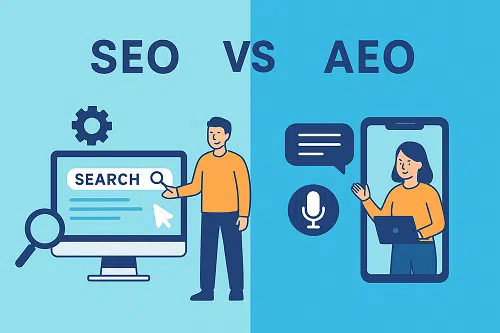
The digital landscape is a dynamic, ever-evolving ecosystem. For aspiring digital marketing professionals, staying ahead of the curve isn’t just an advantage; it’s a necessity. While Search Engine Optimization (SEO) has long been the bedrock of online visibility, a new, equally critical player has emerged: Answer Engine Optimization (AEO). These two disciplines, though related, serve distinct purposes and demand different strategic approaches.
For digital marketing students, understanding the nuances between SEO and AEO is no longer optional. It’s fundamental to crafting comprehensive, future-proof strategies that resonate with how users interact with information today and how they will in the years to come. This article will delve deep into both SEO and AEO, highlight their key differences, and explain why mastering both is essential for success in the modern digital marketing arena.
The Foundation: Understanding SEO (Search Engine Optimization)
At its core, SEO is the practice of increasing the quantity and quality of traffic to your website through organic search engine results. It’s about making your website more visible when people search for products or services related to your business on search engines like Google, Bing, and Yahoo. The ultimate goal of SEO is to rank highly on Search Engine Results Pages (SERPs), driving more potential customers to your site.
SEO is a multifaceted discipline, typically broken down into several key pillars:
On-Page SEO
This refers to all the optimization efforts you can make directly on your website. It’s about optimizing the content and HTML source code of a page to make it more appealing to search engines and users.
- Keyword Research and Usage: Identifying relevant keywords that users search for and strategically incorporating them into content, titles, and meta descriptions.
- High-Quality Content: Creating valuable, informative, and engaging content that genuinely helps users and demonstrates expertise, experience, authoritativeness, and trustworthiness (E-E-A-T).
- Title Tags and Meta Descriptions: Crafting compelling and keyword-rich titles and descriptions that appear in SERPs, enticing users to click.
- Header Tags (H1, H2, H3, etc.): Structuring content logically with clear headings that improve readability and signal content hierarchy to search engines.
- Image Optimization: Using descriptive alt text for images, compressing file sizes, and ensuring they are relevant to the content.
- Internal Linking: Creating a logical link structure within your website to help search engines discover pages and pass “link juice” (authority) between them.
- URL Structure: Using clean, descriptive, and keyword-rich URLs that are easy for both users and search engines to understand.
Technical SEO
Technical SEO focuses on the backend elements of your website that influence how search engines crawl, index, and render your site. It ensures your site is technically sound and accessible to search engine bots.
- Site Speed and Performance: Optimizing loading times for a better user experience and improved search rankings.
- Mobile-Friendliness: Ensuring your website is responsive and performs well on all devices, especially smartphones, given Google’s mobile-first indexing.
- Crawlability and Indexability: Making sure search engine bots can easily access and understand your website’s content. This involves using sitemaps, robots.txt files, and checking for crawl errors.
- HTTPS: Implementing a secure connection (SSL certificate) to protect user data and signal trustworthiness.
- Structured Data (Schema Markup): Adding specific code to your website that helps search engines understand the context of your content, leading to rich results (e.g., star ratings, recipes, event details) in SERPs.
Off-Page SEO
Off-page SEO refers to actions taken outside of your website to impact your rankings within search engine results pages. These efforts build your site’s authority, relevance, and trustworthiness.
- Backlink Building: Acquiring high-quality backlinks from reputable websites. Backlinks act as “votes of confidence” from other sites, signaling to search engines that your content is valuable.
- Domain Authority: A metric (though not directly used by Google) that reflects the overall strength and credibility of your domain, heavily influenced by the quantity and quality of backlinks.
- Social Signals: While not a direct ranking factor, social media engagement can increase content visibility, leading to more shares and potential backlinks.
- Local SEO: Optimizing your online presence to attract more local customers, often involving Google My Business optimization, local citations, and localized content.
Why SEO Matters
SEO remains critical because it’s the primary driver of organic traffic, which is often the most qualified and cost-effective source of leads. A strong SEO strategy builds long-term visibility, enhances brand credibility, and provides a sustainable competitive advantage in the crowded digital marketplace. It helps businesses connect with users who are actively searching for their offerings, translating into higher conversion rates and a healthier bottom line.
The Evolution: Understanding AEO (Answer Engine Optimization)
While SEO focuses on getting your website to rank, Answer Engine Optimization (AEO) takes it a step further. AEO is the practice of optimizing content to directly answer user queries, particularly in the context of voice search, featured snippets, knowledge panels, and conversational AI. The goal of AEO isn’t just to be found; it’s to provide the most direct, concise, and accurate answer possible, often without the user ever needing to click through to a website.
Fix “Crawled – Currently Not Indexed” in Google Search Console
Ultimate Guide to Becoming aRemote Smart Contract Developer
Windows 11: Optimizations for Windowed Games & Better Performance
The rise of AEO is inextricably linked to fundamental shifts in user behavior and search engine capabilities:
The Rise of AEO Drivers
- Voice Search: With the proliferation of smart speakers (Amazon Echo, Google Home), virtual assistants (Siri, Alexa, Google Assistant), and voice-enabled devices, users are increasingly asking questions directly. These queries are typically longer, more conversational, and question-based (e.g., “Hey Google, what’s the capital of France?”).
- Featured Snippets (Position Zero): These prominent boxes appear at the very top of Google’s search results, directly answering a user’s question with a snippet of content pulled from a webpage. They often include a link to the source but provide the answer upfront.
- Knowledge Panels: These information boxes appear on the right side of Google’s search results (on desktop) and provide comprehensive information about entities (people, places, organizations, things) directly from Google’s knowledge graph.
- Direct Answers/Rich Results: Google increasingly provides direct answers for simple queries (e.g., weather, definitions, calculations) without displaying traditional search results.
- Conversational AI: The emergence of large language models (LLMs) like ChatGPT and Google Bard further emphasizes the need for direct, accurate answers. These AI models synthesize information to provide comprehensive responses, mimicking the “answer engine” concept.
Key Characteristics of AEO
Optimizing for AEO requires a different mindset and approach compared to traditional SEO:
- Natural Language Processing (NLP): AEO heavily relies on understanding how users ask questions in natural, conversational language, rather than just keyword matching.
- User Intent Beyond Keywords: It’s not just about what keywords are used, but why the user is asking the question and what kind of answer they expect.
- Conciseness and Clarity: Answers need to be direct, to the point, and easy to understand. Voice assistants, in particular, favor brevity.
- Contextual Understanding: Answer engines strive to understand the broader context of a query to provide the most relevant information.
- Accuracy and Authority: Since answers are delivered directly, their accuracy and the authority of the source are paramount. Misinformation can be detrimental.
Why AEO Matters
AEO is crucial because it caters to the growing demand for instant gratification and convenience. Users want answers quickly, and they often prefer to receive them directly, whether through voice or a featured snippet, without navigating multiple websites. For businesses, optimizing for AEO means:
- Enhanced Visibility: Dominating “position zero” or being the source for a voice answer provides unparalleled visibility and brand recognition.
- Direct User Engagement: You’re providing value directly to the user at their moment of need.
- Future-Proofing: As search technology evolves towards more conversational and direct answer formats, AEO ensures your content remains relevant and discoverable.
- Competitive Edge: Being the go-to source for direct answers can differentiate your brand from competitors who are still solely focused on traditional SEO.
Key Differences Between SEO and AEO
While both SEO and AEO aim to improve online visibility, their fundamental approaches, goals, and metrics diverge significantly. Understanding these differences is crucial for students to develop a nuanced digital marketing strategy.
- Goal:
- SEO: To rank high on SERPs, drive organic traffic to a website, and increase clicks.
- AEO: To provide direct, concise answers to user queries, often without requiring a click-through to a website.
- Focus:
- SEO: Primarily focuses on keywords, backlinks, site structure, and technical elements to improve overall website authority and relevance for broad search terms.
- AEO: Concentrates on understanding user intent behind question-based queries, natural language processing, and structuring content to provide immediate, specific answers.
- Output:
- SEO: A link to your website within a list of search results.
- AEO: A direct answer (e.g., featured snippet, knowledge panel, voice response) that may or may not include a link to your site.
- Content Strategy:
- SEO: Often involves creating comprehensive, long-form content that covers a broad topic in depth, optimized with a variety of keywords.
- AEO: Requires creating highly focused, concise content that directly addresses specific questions, often using a Q&A format or clear summary paragraphs.
- Metrics of Success:
- SEO: Measured by organic traffic, keyword rankings, click-through rates (CTR), bounce rate, and conversion rates from organic search.
- AEO: Measured by the appearance in featured snippets, knowledge panels, voice search results, and the accuracy/completeness of the direct answer provided. While clicks might still be a factor, direct answers often bypass clicks.
- User Interaction:
- SEO: Users typically browse a list of results, click on a link, and then navigate a website to find information.
- AEO: Users ask a question and receive an immediate, direct answer, often through voice or a prominent snippet, requiring minimal further interaction.
Why Digital Marketing Students MUST Understand Both
The digital marketing landscape is not a binary choice between SEO and AEO; it’s a spectrum that demands mastery of both. For students entering this field, a comprehensive understanding of both disciplines is paramount for several reasons:
1. Holistic Strategy Development
Relying solely on SEO might get your website found, but it won’t guarantee you’re providing the best possible user experience in an “answer-first” world. Conversely, focusing only on AEO might get you featured snippets but neglect broader organic visibility. A holistic strategy integrates both, ensuring your brand is discoverable through traditional search and provides immediate value through direct answers. Students need to be able to craft strategies that encompass both discovery and direct utility.
2. Future-Proofing Skills
Search engines are continuously evolving. Google’s shift towards understanding user intent, natural language, and providing direct answers is not a trend; it’s the future. As AI and machine learning become more sophisticated, the ability to optimize for conversational queries and direct answers will only become more critical. Students who understand AEO are equipping themselves with skills that will remain relevant and in high demand.
3. Meeting Evolving User Expectations
Modern users are accustomed to instant gratification. They expect quick, accurate answers to their questions, whether they type them into a search bar or speak them into a device. Digital marketing professionals must meet these expectations. Understanding AEO allows students to design content that directly satisfies this need, enhancing user satisfaction and brand loyalty.
4. Gaining a Competitive Advantage
Agencies and in-house marketing teams are increasingly seeking professionals who can navigate the complexities of both SEO and AEO. Students who can articulate the differences, explain their importance, and implement strategies for both will stand out in a competitive job market. This dual expertise signals a forward-thinking, adaptable marketer.
5. Adapting to New Technologies
The rise of AI-powered search, multimodal search (combining text, voice, and visual elements), and personalized search experiences means that the way users find information is becoming more complex. A solid grasp of AEO principles, alongside traditional SEO, prepares students to adapt to these emerging technologies and leverage them for marketing success.
6. Delivering Comprehensive Client Success
Clients want results. A truly effective digital marketing strategy delivers maximum visibility and engagement. By understanding both SEO and AEO, students can offer clients a more robust and complete solution, ensuring their brand not only ranks but also serves as an authoritative source of information, leading to better ROI and stronger client relationships.
Strategies for Optimizing for Both SEO and AEO
Integrating SEO and AEO into a cohesive strategy requires a thoughtful approach to content creation, technical implementation, and keyword research.
1. Content Creation
Your content is the cornerstone of both SEO and AEO.
- Long-Form, Authoritative Content (SEO): Continue to produce in-depth articles, guides, and blog posts that cover topics comprehensively. This builds domain authority and allows you to target a wide range of keywords.
- Clearly Defined Q&A Sections (AEO): Within your long-form content, create dedicated sections that explicitly answer common questions related to the topic. Use clear headings (e.g., “FAQs,” “Common Questions About X”) and provide concise, direct answers.
- Natural Language and Conversational Tones (AEO): Write content as if you’re having a conversation. Use full sentences and natural phrasing, mirroring how people speak their queries into voice assistants.
- Structure with Clear Headings and Summaries (Both): Use H1, H2, H3 tags to break down your content logically. For AEO, ensure key answers are summarized in the first paragraph or two of a section, making them easily digestible for snippets.
- Answer Common Questions Directly and Concisely (AEO): For every question you identify, provide a definitive, short answer (around 40-60 words is often ideal for featured snippets) followed by more detailed explanations.
2. Technical Implementation
Technical aspects play a crucial role in how search engines understand and present your content.
- Schema Markup (AEO): Implement structured data, especially for FAQs, How-To articles, recipes, products, and local businesses. Schema helps search engines understand the context of your content, making it more likely to appear in rich results and featured snippets.
- Mobile-First Indexing (SEO): Ensure your site is fully responsive and optimized for mobile devices. Google primarily uses the mobile version of your content for indexing and ranking.
- Site Speed and Performance (Both): A fast-loading website is essential for both user experience and search engine rankings. It also ensures voice assistants can quickly retrieve information.
- HTTPS (SEO): A secure website (SSL certificate) is a basic requirement for trust and ranking.
3. Keyword Research & Intent
The way you approach keyword research needs to evolve.
- Traditional Keywords (SEO): Continue to research high-volume, relevant keywords for your industry.
- Long-Tail, Question-Based Keywords (AEO): Focus heavily on identifying questions users are asking. Use tools like AnswerThePublic, Google’s “People Also Ask” section, and keyword research tools that show question-based queries. Think about “who, what, when, where, why, how” questions.
- Understanding User Intent (Both): Go beyond the keywords to understand the underlying intent. Is the user looking for information, a transaction, navigation, or a direct answer? Tailor your content accordingly.
4. Authority & Trust (E-E-A-T)
Google’s emphasis on E-E-A-T (Experience, Expertise, Authoritativeness, Trustworthiness) is vital for both.
- Build Strong Backlinks (SEO): Continue to earn high-quality backlinks from reputable sources to boost your domain authority.
- Demonstrate Expertise (Both): Ensure your content is written by or reviewed by experts. Include author bios, credentials, and citations where appropriate.
- Provide Accurate, Verifiable Information (AEO): Since direct answers are often presented without context, their accuracy is paramount. Back up your claims with data, studies, and reliable sources.
Challenges and Opportunities
Navigating the combined landscape of SEO and AEO presents both challenges and exciting opportunities for digital marketing students.
Challenges:
- Keeping Up with Algorithm Changes: Search engine algorithms are constantly updated, requiring continuous learning and adaptation for both SEO and AEO strategies.
- Balancing Broad and Specific Content: Striking the right balance between comprehensive, long-form content for SEO and concise, direct answers for AEO can be tricky.
- Measuring AEO Success: Quantifying the direct impact of AEO (e.g., how often your content is chosen for a voice answer) can be more challenging than measuring traditional SEO metrics like clicks.
- “No-Click” Searches: The rise of direct answers means users might get their answer without ever visiting your site, potentially reducing direct traffic, even if your brand is the source.
Opportunities:
- New Avenues for Visibility: AEO opens up entirely new ways for brands to be discovered and recognized, particularly through voice search and prominent featured snippets.
- Connecting with Users More Directly: Being the source of a direct answer positions your brand as an authority and provides value precisely when users need it most.
- Innovation in Content Delivery: The need for AEO encourages marketers to think creatively about how they structure and present information, leading to more user-friendly and effective content.
- Increased Brand Authority: Consistently providing accurate and helpful direct answers builds significant brand authority and trust over time.
Conclusion
The distinction between SEO and AEO is not merely academic; it’s a practical reality that shapes the success of modern digital marketing campaigns. For digital marketing students, understanding this difference and mastering both disciplines is non-negotiable.
SEO remains the fundamental practice for establishing online presence, driving organic traffic, and building long-term authority. AEO, however, is the forward-looking strategy that addresses the evolving demands of users for instant, direct answers, particularly in the age of voice search and AI-driven information retrieval.
By embracing both SEO and AEO, future digital marketing professionals will be equipped to craft comprehensive strategies that not only get content found but also ensure it provides immediate, valuable answers. The digital landscape will continue to evolve, but those who understand the full spectrum of search optimization – from ranking to answering – will be best positioned to lead and innovate. Adaptability, continuous learning, and a dual focus on discovery and direct utility are the hallmarks of a successful digital marketer in this exciting, ever-changing era.
Have any thoughts?
Share your reaction or leave a quick response — we’d love to hear what you think!
-
 0
0
-
 0
0
-
 0
0
-
 0
0
-
 0
0
-
 0
0
