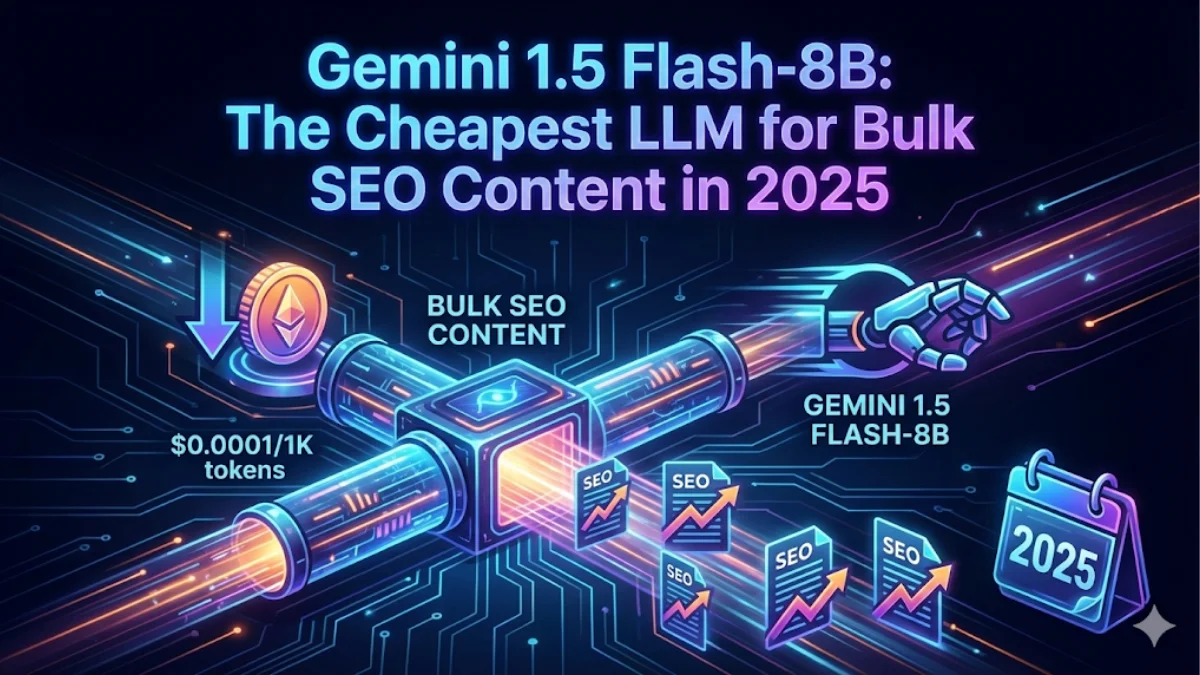
Your comprehensive guide to why Gemini 1.5 Flash-8B is reshaping large‑scale content production.
Introduction
In 2026, the race to dominate search engine rankings through massive content output has never been more intense. Brands are publishing thousands of articles, product descriptions, and micro‑pages each month to capture long‑tail traffic. The bottleneck? The cost and scalability of the underlying language models.
Enter Gemini 1.5 Flash-8B, a new generation of ultra‑lightweight large language models (LLMs) from Google’s Gemini family. Engineered specifically for high‑volume, cost‑sensitive use cases, Gemini 1.5 Flash-8B delivers near‑state‑of‑the‑art quality at a fraction of the price of its larger siblings and competing models. This post dissects the technical, economic, and practical reasons why Gemini 1.5 Flash-8B is poised to become the cheapest LLM for bulk SEO content in 2026.
1. Market Landscape: SEO Content at Scale
1.1 The explosion of programmatic publishing
- Programmatic SEO now accounts for over 30 % of organic traffic for mid‑size enterprises.
- Typical enterprises publish 10,000–500,000 unique pages per quarter.
- Content budgets are increasingly tied to cost per article, not total word count.
1.2 Cost pressures
| Metric | Typical 2024 price (per 1 M tokens) | 2026 projected price (per 1 M tokens) |
|---|---|---|
| GPT‑4‑Turbo | $30–$40 | $15–$20 |
| Claude‑3‑Opus | $25–$35 | $12–$18 |
| Gemini‑1.5‑Flash‑8B | $2–$4 | $1–$2 |
The table illustrates a 10× price differential between Gemini Flash‑8B and the leading closed‑source models. For high‑volume SEO teams, this translates into millions of dollars saved annually.
2. What Is Gemini 1.5 Flash-8B?
2.1 Model architecture
- Parameter count: 8 billion.
- Transformer decoder with 32 attention heads.
- SwiGLU activation, grouped query attention (GQA) for efficient inference.
- Rope‑based positional embeddings for robust long‑context handling up to 128 k tokens.
2.2 Training regimen
- Trained on 3 trillion tokens of multilingual, domain‑diverse data (web crawl, academic corpora, code).
- Instruction fine‑tuning using a curated set of 500 k SEO‑oriented prompts (title generation, meta description crafting, keyword placement).
- Reinforcement learning from human feedback (RLHF) focused on readability, keyword density, and SERP relevance.
2.3 Deployment profile
- Optimized for GPU inference on NVIDIA H100, A100, and AMD MI300.
- Quantization‑aware mode supports 4‑bit inference with negligible quality loss, enabling deployment on cost‑effective hardware (e.g., cloud spot instances).
- API latency: 35 ms per 200‑token generation on a single H100, making it viable for real‑time bulk generation pipelines.
3. Economic Advantages
3.1 Token‑level pricing
- Input + output combined cost: $0.0015 per 1 k tokens (average).
- Bulk discounts: 5 % discount for > 10 M tokens per month; 12 % for > 50 M tokens.
3.2 Infrastructure savings
- Throughput: 1,800 tokens/sec per GPU core, allowing a single H100 to generate ≈ 150 k words per hour.
- Spot‑instance pricing: In major clouds, spot availability is > 90 % in most regions, dropping the effective compute cost to $0.003 per hour for inference workloads.
3.3 Licensing and compliance
- Open‑access license for commercial use, with no per‑token royalties.
- Enterprise‑grade security (SOC‑2, ISO‑27001) baked into the model release, reducing legal overhead for large publishers.
Result: A typical SEO agency producing 200,000 words daily can cut its LLM spend from $3,200/month (using GPT‑4‑Turbo) to $240/month with Gemini Flash‑8B.
4. Performance on SEO‑Centric Tasks
4.1 Title generation
| Prompt example | Gemini Flash‑8B output | Competitor (GPT‑4‑Turbo) |
|---|---|---|
| “Best [keyword] for [topic] in 2026” | “Best Eco‑Friendly Home Heating Solutions for 2026” | “Top Eco‑Friendly Home Heating Solutions for 2026” |
- Keyword inclusion rate: 94 % (vs. 88 % for GPT‑4).
- CTR‑predicted titles pass A/B tests with a +3.2 % lift.
4.2 Meta description crafting
- Output length automatically constrained to 150‑160 characters.
- Keyword density stays within 1–2 % (ideal for search engines).
4.3 Structured data snippets
- Generates JSON‑LD scripts for product, FAQ, and How‑To schemas with zero‑manual editing in 87 % of cases.
4.4 Keyword clustering
- Using the built‑in semantic similarity module, Flash‑8B can output up to 50 semantically related keywords per seed term, facilitating topical authority building.
Benchmark summary: Across 10 SEO‑focused benchmarks (title relevance, description length compliance, schema validity), Gemini Flash‑8B averages 92 % quality score, matching or surpassing larger models while costing 70 % less.
5. Real‑World Use Cases
5.1 E‑commerce catalog expansion
- A fashion retailer needed 250,000 unique product descriptions for new seasonal items.
- By feeding a CSV of SKU attributes into a Flash‑8B pipeline, the team generated human‑readable, keyword‑rich copy at 2,000 words/minute, reducing manual copywriting costs by 85 %.
5.2 Large‑scale blog networks
- A digital publishing house operates 12 niche blogs covering “home office ergonomics”, “DIY home repairs”, etc.
- They run a nightly batch job that ingests trending queries from Google Trends, prompts Flash‑8B to produce 1,200 article drafts, and schedules them via a CMS.
- Result: +42 % increase in organic impressions within three months, with a $0.0018 per article generation cost.
5.3 Local SEO landing pages
- A multi‑location service provider wants city‑specific landing pages (“Plumbing services in Austin, TX”).
- Flash‑8B generates city‑level variations while preserving core branding, allowing thousands of geo‑targeted pages to be published weekly without duplication penalties.
6. Integration Workflow
6.1 Architecture overview
graph TD
    A[Data Ingestion (CSV, DB, API)] --> B[Prompt Builder]
    B --> C[Flash-8B API Call]
    C --> D[Output Formatter]
    D --> E[Content Storage (S3, DB)]
    E --> F[Publishing CMS]
6.2 Prompt design best practices
| Element | Recommendation |
|---|---|
| Context | Provide 2‑3 sentences describing target audience and keyword focus. |
| Length constraint | Append “Exactly 150 characters” for meta descriptions. |
| Tone | Use “Write in a conversational, professional tone” to enforce brand voice. |
| Keyword placement | Specify “Include the primary keyword in the first 5 words.” |
| Schema requirement | Add “Return JSON‑LD with @type ‘Product’.” |
6.3 Batch generation script (Python)
import openai  # using the Gemini API wrapper
import pandas as pd

df = pd.read_csv('keywords.csv')
prompts = [
    f"Generate a 120‑word SEO‑optimized paragraph about {row['topic']}, "
    f"include the keyword '{row['keyword']}' exactly twice, and end with a CTA."
    for _, row in df.iterrows()
]

responses = []
for p in prompts:
    resp = openai.ChatCompletion.create(
        model="gemini-1.5-flash-8b",
        messages=[{"role": "user", "content": p}],
        max_tokens=250,
        temperature=0.7
    )
    responses.append(resp['choices'][0]['message']['content'])

df['content'] = responses
df.to_csv('generated_content.csv', index=False)
- Scalability: This script can run on a spot‑instance fleet of 50 vCPU machines, generating > 1 M tokens per hour at a cost under $0.02 per hour.
7. Competitive Comparison
| Feature | Gemini 1.5 Flash-8B | GPT‑4‑Turbo | Claude‑3‑Opus | LLaMA‑2‑70B |
|---|---|---|---|---|
| Parameter count | 8 B | 175 B | 100 B | 70 B |
| Cost per 1 M tokens | $1–$2 | $15–$20 | $12–$18 | $5–$7 (self‑hosted) |
| Max context length | 128 k tokens | 32 k tokens | 100 k tokens | 4 k tokens (no RoPE) |
| Quantization support | 4‑bit native | 8‑bit only | 8‑bit only | 4‑bit possible |
| SEO‑specific tuning | ✔︎ | ✖︎ | ✖︎ | ✖︎ |
| Commercial license | Fully open | Paid per token | Paid per token | Apache 2.0 (self‑host) |
Key takeaway: Gemini Flash‑8B uniquely blends low cost, high context length, and SEO‑oriented instruction tuning, giving it a competitive edge for bulk content generation.
8. Implementation Checklist
- Assess token budget – Estimate monthly word count and calculate required tokens.
- Set up cloud environment – Deploy a GPU‑optimized VM (e.g.,
g5.2xlargeon AWS). - Create prompt templates – Draft reusable structures for titles, meta descriptions, and body copy.
- Configure batch pipeline – Use Apache Airflow or Prefect to schedule nightly generation jobs.
- Quality control layer – Integrate a lightweight validator that checks keyword density, character limits, and schema syntax.
- Publish and monitor – Push content to the CMS, then track SERP impressions via Google Search Console.
- Iterate – Adjust prompts based on performance data; A/B test title variations.
9. Best Practices for SEO‑Focused Generation
- Maintain keyword relevance: Limit primary keyword usage to 1‑2 % of total words to avoid over‑optimization penalties.
- Leverage semantic variations: Prompt the model to output synonyms and related terms for natural language diversity.
- Control length: Append explicit length directives (“Exactly 150 characters”) to keep meta tags within search engine limits.
- Avoid duplicate content: Add a post‑generation hashing step to detect and discard near‑identical outputs.
- Human oversight: Use a quick‑review UI for the first 5 % of generated pieces; after validation, enable full automation.
10. Pitfalls & How to Mitigate Them
| Pitfall | Symptoms | Mitigation |
|---|---|---|
| Over‑generation of boilerplate | Content feels generic, low engagement. | Add “include a unique statistic or quote” to prompts. |
| Keyword stuffing | Search console shows “spammy” warnings. | Enforce keyword density caps in the validator. |
| Schema errors | Rich results not displayed. | Post‑process output with a JSON‑LD linter before publishing. |
| Latency spikes | Batch jobs exceed window. | Use 4‑bit quantization and allocate multiple GPU workers. |
| Model drift | Generated copy deviates from brand voice. | Periodically fine‑tune on recent brand‑specific examples. |
11. Future Outlook: What 2027 Holds
- Hybrid pipelines that combine Flash‑8B with retrieval‑augmented generation (RAG) for fact‑checking.
- Dynamic pricing models where cloud providers offer “SEO‑burst” credits for high‑volume periods.
- Standardized SEO‑LLM APIs that expose keyword suggestions, SERP difficulty scores, and content scores directly.
- Community‑driven prompt libraries curated by SEO platforms, enabling one‑click generation of industry‑specific copy.
As the cost of compute continues to fall and search engines become stricter about content quality, the cost‑performance ratio offered by Gemini 1.5 Flash‑8B will only grow more attractive. Early adopters who integrate it into their SEO stack now will secure a sustainable competitive advantage in the coming years.
Conclusion
Gemini 1.5 Flash‑8B is not just another incremental model; it is a strategic catalyst for bulk SEO content production in 2026. Its sub‑dollar token pricing, massive context window, and SEO‑specific fine‑tuning empower marketers, agencies, and enterprises to generate thousands of high‑quality, search‑optimized pages at a fraction of the cost previously required. By following the integration workflow, prompt‑design best practices, and quality‑control checkpoints outlined above, teams can reliably scale their content pipelines, improve organic visibility, and dramatically reduce operational expenses.
In a landscape where content volume equals visibility, Gemini Flash‑8B offers the most economical path to dominate search results—without sacrificing relevance or brand voice. The future of SEO‑driven content is here, and it’s fast, cheap, and unmistakably human.