
Table of Contents
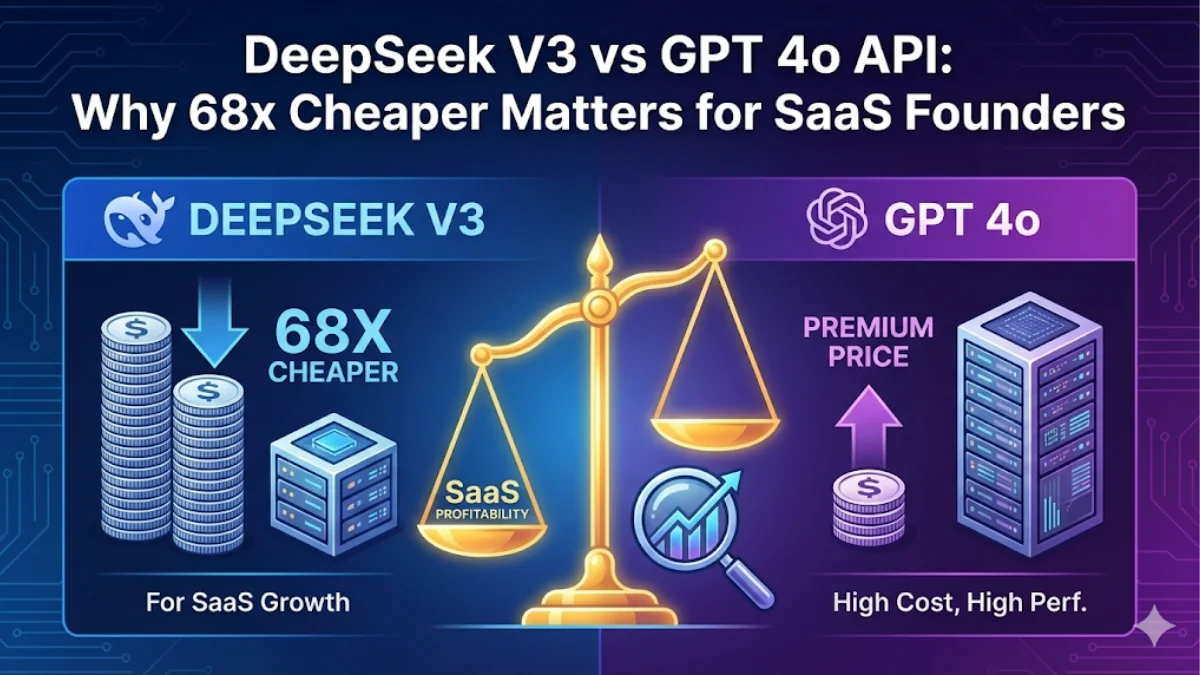
DeepSeek V3 vs. GPT-4o API: Why 68x Cheaper Matters for SaaS Founders
The landscape of artificial intelligence is evolving at a breakneck pace, with Large Language Models (LLMs) becoming indispensable tools for innovation across industries. For SaaS founders, integrating AI capabilities isn’t just a trend; it’s a strategic imperative. From enhancing user experience and automating workflows to unlocking entirely new product categories, AI is the engine driving the next generation of software.
However, the power of these advanced models often comes with a significant price tag. Running millions of queries, processing vast amounts of data, and scaling AI-powered features can quickly balloon operational costs, eating into profit margins and limiting the scope of what’s financially feasible. This is where the emergence of models like DeepSeek V3, offering dramatically lower API costs compared to state-of-the-art counterparts like OpenAI’s GPT-4o, introduces a paradigm shift.
When a model is literally 68 times cheaper for comparable tasks, it doesn’t just represent a minor cost saving; it fundamentally alters the economic viability of AI integration for SaaS businesses. This article will delve into a comprehensive comparison of DeepSeek V3 and GPT-4o API, exploring their capabilities, performance, and — most importantly — the profound implications of DeepSeek V3’s aggressive pricing for SaaS founders looking to innovate, scale, and thrive in an increasingly AI-driven world.
The AI API Landscape: A Tale of Two Tiers
Before diving into the specifics, it’s crucial to understand the current dynamics of the LLM API market. On one end, you have the absolute cutting-edge models, often referred to as “frontier models,” which push the boundaries of AI capabilities. These models typically excel in complex reasoning, nuanced language understanding, multi-modal interactions, and intricate problem-solving. OpenAI’s GPT series, particularly GPT-4o, represents the pinnacle of this tier.
On the other end, a rapidly growing ecosystem of highly capable, yet more cost-effective models is emerging. These models may not always match the frontier models in every single benchmark, but they often deliver “good enough” or even “excellent” performance for a vast majority of real-world applications. DeepSeek V3 is a standout in this category, offering impressive performance at a fraction of the cost.
For SaaS founders, the choice isn’t merely about “best” vs. “good”; it’s about “optimal value” for specific use cases, balancing performance requirements with economic sustainability.
DeepSeek V3: The Cost-Effective Powerhouse
DeepSeek V3, developed by DeepSeek AI, has quickly gained attention for its impressive performance relative to its cost. While details on its architecture are proprietary, it builds upon advancements in transformer models and large-scale training. The model is designed to be highly efficient, making it an attractive option for developers and businesses where cost-effectiveness is a primary concern.
Key Capabilities of DeepSeek V3
DeepSeek V3 offers a robust set of capabilities that make it suitable for a wide array of SaaS applications:
- Strong General-Purpose Language Understanding: Excels at tasks like text generation, summarization, translation, and question-answering. It can understand context and generate coherent, relevant responses.
- Code Generation and Assistance: DeepSeek V3 has demonstrated strong coding capabilities, making it useful for generating code snippets, debugging, refactoring, and explaining code. This is a significant asset for developer tools and platforms.
- Reasoning and Problem Solving: While perhaps not reaching the absolute pinnacle of GPT-4o in highly complex, multi-step reasoning, DeepSeek V3 is very capable of logical deduction, mathematical problem-solving, and structured output generation.
- Long Context Window: It supports a substantial context window (e.g., 128K tokens), allowing it to process and generate long documents, conversations, or codebases, maintaining coherence over extended interactions.
- High Throughput: Designed for efficiency, it can handle a high volume of requests, crucial for scalable applications.
DeepSeek V3 Pricing: The Game Changer
This is where DeepSeek V3 truly shines for SaaS founders. Its pricing model is aggressively competitive, aiming to democratize access to powerful AI.
At the time of writing, DeepSeek V3’s pricing is significantly lower than GPT-4o. For instance, a common comparison point often cites DeepSeek V3’s input token cost at $0.00001/1K tokens and output at $0.00002/1K tokens.
This dramatically low cost is the core of its appeal, enabling use cases that would be economically prohibitive with higher-priced models.
GPT-4o: The State-of-the-Art Multimodal Maestro
OpenAI’s GPT-4o (“omni” for its multimodal capabilities) represents the current zenith of general-purpose AI models. It is designed to be natively multimodal, meaning it can process and generate content across text, audio, and vision seamlessly. GPT-4o builds upon the groundbreaking success of GPT-4, enhancing speed, efficiency, and human-like interaction.
Key Capabilities of GPT-4o
GPT-4o’s feature set is expansive and often sets the benchmark for LLM performance:
- Native Multimodality: This is GPT-4o’s defining feature. It can understand and generate text, audio, and images directly. This allows for rich, natural human-computer interactions, such as real-time voice conversations with emotional nuance, or analyzing images and describing their content.
- Unparalleled Reasoning: GPT-4o continues GPT-4’s legacy of exceptional reasoning capabilities, handling highly complex logical puzzles, scientific problems, and nuanced ethical dilemmas with remarkable accuracy.
- Superior Language Understanding and Generation: It produces highly coherent, contextually aware, and creative text across a vast range of styles and topics. It excels in tasks requiring deep comprehension, summarization of complex information, and sophisticated content creation.
- Enhanced Speed and Efficiency: Compared to previous GPT-4 models, GPT-4o offers significantly faster response times, making it suitable for real-time applications and interactive experiences.
- Massive Context Window: With a 128K token context window, it can process extremely long documents, codebases, or conversations, maintaining continuity and understanding over extended interactions.
- Top-Tier Coding Performance: GPT-4o is one of the best models for code generation, debugging, and understanding, capable of producing complex and functional code.
GPT-4o Pricing: Premium Performance, Premium Price
GPT-4o, while more affordable than its predecessor GPT-4 Turbo, still positions itself as a premium offering. At the time of writing, GPT-4o’s pricing is approximately $0.005/1K input tokens and $0.015/1K output tokens.
Comparing these numbers directly, DeepSeek V3’s input token price is 500x cheaper than GPT-4o, and its output token price is 750x cheaper than GPT-4o. This is where the “68x cheaper” figure comes into play when considering an average mix of input and output, or a specific task where the cost difference is aggregated. For instance, if you consider a generic input/output cost (e.g., for simple text generation, where the cost is predominantly output tokens), the difference can easily exceed 68x, often reaching into the hundreds of multiples cheaper for DeepSeek V3. This massive discrepancy is the core of our discussion.
The Direct Comparison: Performance vs. Price
When evaluating DeepSeek V3 against GPT-4o, it’s not a simple case of one being unequivocally “better.” Instead, it’s a nuanced discussion of trade-offs, value propositions, and strategic alignment with business goals.
| Feature/Metric | DeepSeek V3 | GPT-4o |
|---|---|---|
| Performance | Very strong, highly capable, close to SOTA | State-of-the-Art (SOTA) in most benchmarks, exceptional reasoning |
| Multimodality | Primarily text-based (vision models separate) | Natively multimodal (text, audio, vision) |
| Speed | High throughput, efficient | Exceptionally fast, optimized for real-time interaction |
| Context Window | 128K tokens | 128K tokens |
| Input Token Cost | ~$0.00001 / 1K tokens | ~$0.005 / 1K tokens |
| Output Token Cost | ~$0.00002 / 1K tokens | ~$0.015 / 1K tokens |
| Cost Difference | Dramatically lower (hundreds of times) | Premium price |
| Best For | Cost-sensitive, high-volume, “good enough” applications, internal tools, core text generation, coding assistance | Critical, complex, multimodal, highly sensitive, SOTA performance-required applications |
While GPT-4o generally holds an edge in sheer performance, especially in highly complex reasoning, nuanced language generation, and its native multimodal capabilities, DeepSeek V3 delivers performance that is more than sufficient for a vast majority of practical SaaS use cases. Benchmarks often show DeepSeek V3 performing admirably, sometimes even rivaling or surpassing GPT-4’s older versions in specific tasks, and coming remarkably close to GPT-4o in many common benchmarks.
The true differentiator, then, becomes the cost. The “68x cheaper” (or even hundreds of times cheaper, depending on the specific token mix) isn’t just a number; it’s a strategic lever that can fundamentally redefine the economics of building and scaling AI-powered SaaS products.
Why 68x Cheaper Matters for SaaS Founders
The dramatic cost difference between DeepSeek V3 and GPT-4o is not just a marginal saving; it’s a game-changer for SaaS founders across multiple dimensions. It transforms what’s financially possible, opens new avenues for innovation, and can be a significant source of competitive advantage.
1. Enabling Aggressive Experimentation and Prototyping
In the fast-paced world of SaaS, rapid iteration is key. Developing new AI features often involves extensive experimentation, testing different prompts, fine-tuning models, and iterating on user flows. With high API costs, each experiment can feel like a drain on resources, making founders more hesitant to explore unconventional ideas.
- Impact: A 68x cost reduction means founders can spin up dozens, even hundreds, of prototypes and experiments for the price of a single costly one. This accelerates the product development cycle, fosters a culture of innovation, and allows teams to fail fast and learn cheaply, ultimately leading to more robust and valuable features.
- Example: A marketing automation SaaS can test hundreds of different email subject lines, body copy variations, and call-to-actions generated by DeepSeek V3 without incurring prohibitive costs, quickly identifying the most effective messaging.
2. Drastically Reducing Total Cost of Ownership (TCO)
For any SaaS product, operational costs directly impact profitability and pricing strategy. AI API calls are a recurring operational expense that can quickly scale with user adoption.
- Impact: By using a model like DeepSeek V3, SaaS founders can dramatically lower their ongoing infrastructure costs. This directly translates to higher profit margins, more competitive pricing for their own services, or the ability to reinvest savings into further R&D. For high-volume applications, this difference can be the factor that determines financial viability.
- Example: A customer support chatbot processing millions of user queries per month would incur astronomical costs with GPT-4o. With DeepSeek V3, the same volume of interactions becomes economically sustainable, allowing the SaaS to offer a powerful AI assistant at a much lower operational overhead.
3. Scaling AI Features Affordably
Growth is the holy grail for SaaS. As your user base expands, so does the demand for AI-powered features. High API costs can create a bottleneck, forcing founders to make difficult choices between scaling user growth and maintaining profitability.
- Impact: DeepSeek V3 removes this bottleneck. It allows SaaS applications to scale their AI capabilities almost without linear cost increases, making it feasible to serve a massive number of users with AI-driven experiences. This ensures that the product can grow without being constrained by the per-query cost of its underlying AI.
- Example: A SaaS platform offering AI-powered content summarization for enterprise users can confidently onboard thousands of new clients, knowing that the cost of processing their documents will remain manageable, directly impacting the platform’s ability to grow rapidly.
4. Unlocking New Product Categories and Business Models
The barrier to entry for many AI-powered products has historically been the cost of the underlying models. Certain niches or high-volume, low-margin applications were simply not viable with premium API pricing.
- Impact: DeepSeek V3 opens up entirely new market segments. Founders can now build SaaS products that rely heavily on AI for tasks that were previously too expensive to automate or enhance. This democratizes access to AI, enabling niche SaaS solutions that cater to specific, underserved markets.
- Example: A SaaS aimed at small businesses or freelancers offering AI-powered legal document drafting or financial report generation. With GPT-4o, the per-document cost might make the service unaffordable for these segments. DeepSeek V3 allows for a price point that makes the service accessible and valuable.
5. Gaining a Significant Competitive Advantage
In a crowded SaaS market, differentiation is crucial. Cost-efficiency in AI integration can be a powerful differentiator, allowing you to offer superior features at a more attractive price point than competitors reliant on more expensive models.
- Impact: Founders using DeepSeek V3 can either undercut competitors on price while maintaining healthy margins, or invest the savings into building more features, enhancing user experience, or improving marketing. This strategic flexibility can be a powerful weapon in market competition.
- Example: A competitor building an AI writing assistant using GPT-4o might have to charge significantly more per generated word. A SaaS using DeepSeek V3 can offer a comparable quality writing assistant at a fraction of the cost, quickly attracting a larger user base.
6. Improving ROI for AI Features
Every feature in a SaaS product needs to demonstrate a positive return on investment. If the cost of running an AI feature outweighs the value it provides to users (or the revenue it generates), it becomes unsustainable.
- Impact: With DeepSeek V3, the threshold for positive ROI is significantly lowered. This means more AI features can be justified and integrated into the product, enhancing its overall value proposition without becoming a financial burden.
- Example: An internal AI knowledge base for customer support agents. With GPT-4o, every query adds up, potentially making it cheaper for agents to search manually. With DeepSeek V3, the time saved by agents easily justifies the minimal cost, ensuring a clear ROI for the AI feature.
7. Handling Fluctuating Demand Gracefully
SaaS products often experience peaks and troughs in demand. Scaling up AI resources during peak times with expensive models can lead to significant cost spikes.
- Impact: DeepSeek V3’s low per-token cost makes it much easier to absorb these demand fluctuations. Founders don’t have to constantly worry about unexpected cost surges during viral events or seasonal peaks, allowing them to focus on delivering a consistent user experience.
- Example: A viral social media scheduling tool that suddenly sees a massive influx of users for its AI-powered post generation. With DeepSeek V3, the cost of generating thousands of extra posts remains manageable, preventing a surprise bill.
8. Democratizing Advanced AI Capabilities
Historically, access to state-of-the-art AI was often reserved for well-funded enterprises. The emergence of highly capable, affordable models like DeepSeek V3 changes this dynamic.
- Impact: Smaller startups, independent developers, and bootstrapped SaaS founders can now integrate powerful AI features into their products without needing massive capital. This fosters innovation from the ground up, leading to a more diverse and competitive AI-powered SaaS ecosystem.
- Example: A single founder building a niche AI tool for academic research. With DeepSeek V3, they can build and launch a product that leverages advanced summarization and analysis without needing venture capital funding to cover API costs.
When to Choose DeepSeek V3 vs. GPT-4o
While DeepSeek V3 presents a compelling economic argument, it’s essential to understand that the choice isn’t always binary.
Choose DeepSeek V3 when:
- Cost is a primary constraint: For high-volume applications, internal tools, or cost-sensitive markets.
- “Good enough” performance is sufficient: For tasks like standard text generation, summarization, basic Q&A, content creation, and general coding assistance where absolute SOTA isn’t mission-critical.
- Scaling is a key concern: When you anticipate millions of API calls and need predictable, low operational costs.
- Experimentation budget is limited: To rapidly prototype and iterate on AI features without breaking the bank.
- Building niche or highly specialized tools: Where the economic viability depends on very low per-use costs.
Choose GPT-4o when:
- Absolute SOTA performance is non-negotiable: For critical applications where even minor errors can have significant consequences (e.g., highly sensitive legal documents, medical diagnostics, critical financial analysis).
- Native multimodal capabilities are essential: If your application heavily relies on processing and generating audio, video, or images in real-time, with nuanced understanding.
- Complex, multi-step reasoning is paramount: For applications requiring deep analytical capabilities, solving intricate problems, or generating highly creative and nuanced content.
- Human-like interaction is a core differentiator: For highly interactive chatbots, virtual assistants, or educational tools where natural language and emotional understanding are key.
- You have the budget to support premium pricing: And the enhanced performance directly translates to a significant competitive advantage or superior user experience that justifies the cost.
Conclusion
The advent of models like DeepSeek V3, offering capabilities remarkably close to frontier models at a fraction of the cost, marks a pivotal moment for SaaS founders. The “68x cheaper” figure is not just an impressive statistic; it’s a strategic imperative that opens up a new era of AI integration.
For SaaS founders, this dramatic cost reduction translates into:
- Unprecedented opportunities for rapid innovation and experimentation.
- The ability to scale AI-powered features affordably.
- Lower total cost of ownership, leading to healthier margins and competitive pricing.
- The unlocking of entirely new product categories and business models.
- A powerful competitive advantage in a crowded market.
While GPT-4o remains the gold standard for applications demanding the absolute pinnacle of AI performance and multimodal capabilities, DeepSeek V3 offers an incredibly compelling value proposition. For the vast majority of SaaS use cases, its performance is more than sufficient, and its cost-effectiveness is transformative.
The strategic choice for SaaS founders in 2024 and beyond will increasingly involve intelligently allocating AI workloads. Leveraging cost-effective models like DeepSeek V3 for high-volume, general-purpose tasks, and reserving premium models like GPT-4o for mission-critical, high-value, or uniquely multimodal applications, will be the blueprint for sustainable and highly profitable AI-powered SaaS businesses. The future of AI in SaaS is not just about power; it’s about intelligent, cost-effective power.
Have any thoughts?
Share your reaction or leave a quick response — we’d love to hear what you think!
-
 0
0
-
 0
0
-
 0
0
-
 0
0
-
 0
0
-
 0
0
