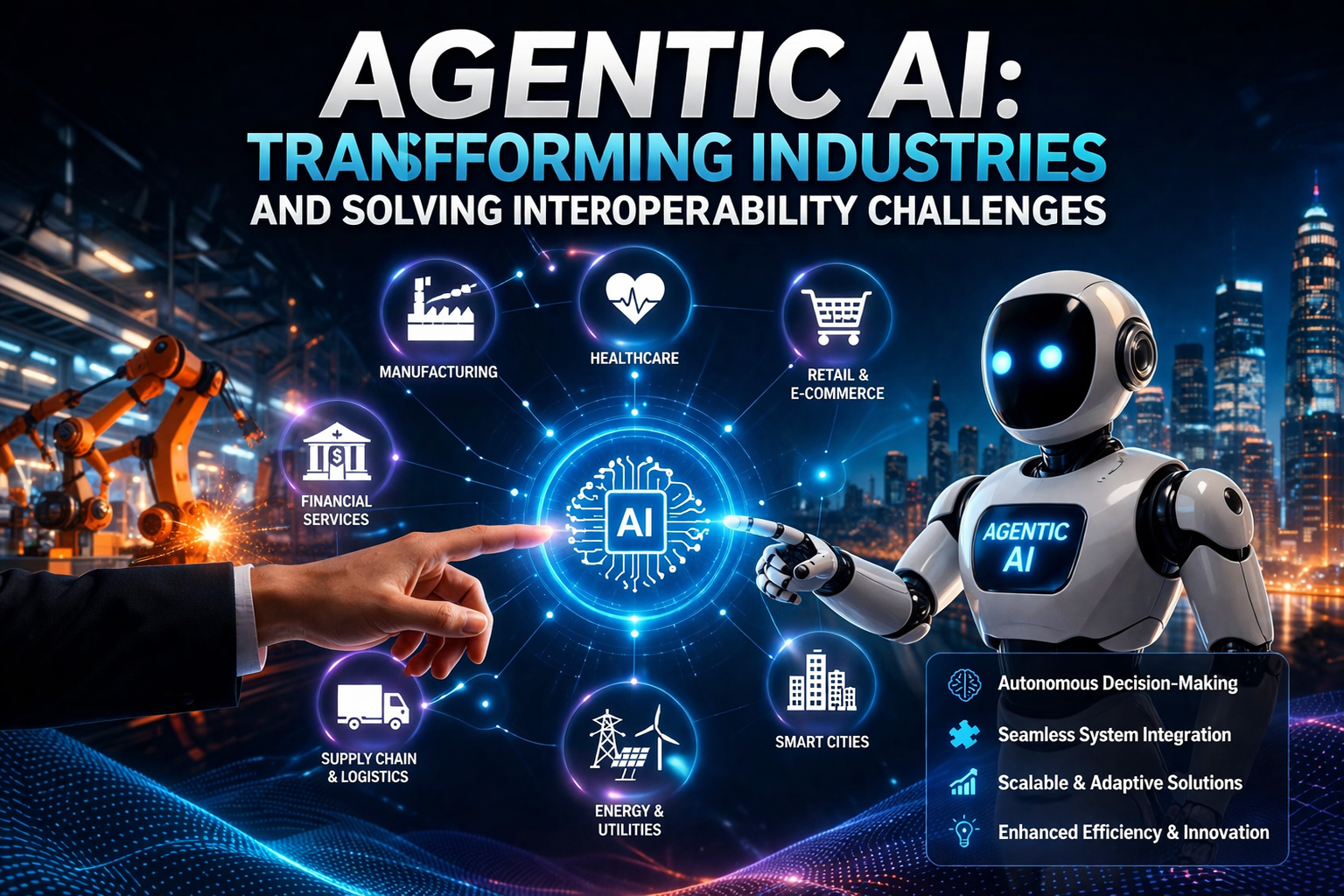
Agentic AI: Transforming Industries and Tackling the Interoperability Imperative
The landscape of artificial intelligence is evolving at an unprecedented pace, moving beyond mere pattern recognition and predictive analytics into an era of autonomous action and sophisticated problem-solving. At the forefront of this revolution is Agentic AI – a paradigm shift that empowers AI systems to not just process information, but to set goals, plan actions, execute tasks, and adapt to dynamic environments with minimal human intervention. This next generation of AI promises to unlock efficiencies, drive innovation, and solve complex challenges across virtually every industry.
However, the full, transformative potential of Agentic AI hinges on a critical, often overlooked, challenge: interoperability. For these intelligent agents to truly thrive and deliver on their promise, they must be able to seamlessly communicate, share data, and collaborate with diverse systems, applications, and other agents, both human and artificial. Without robust interoperability, Agentic AI risks becoming a collection of powerful but isolated silos, unable to weave its magic across the interconnected fabric of modern business and society.
This article delves into the essence of Agentic AI, explores its profound impact across various sectors, and critically examines why interoperability is not merely a desirable feature but an absolute imperative for its successful widespread adoption and continued evolution.
Understanding Agentic AI
To appreciate the significance of Agentic AI, it’s crucial to understand what distinguishes it from previous iterations of artificial intelligence.
Anthropic Issues Copyright Takedowns Over Claude AI Code Leak
Top 10 African Tech Innovators & Entrepreneurs to Watch 2026
Decentralized Startups: Future Ecosystems and VC Investment Strategies
What is Agentic AI?
At its core, an agentic AI system is designed to be autonomous, goal-oriented, and capable of operating persistently in an environment. Unlike traditional AI models that often perform specific, pre-defined tasks (like classifying images or predicting stock prices), agentic AI systems exhibit a higher degree of intelligence and initiative. Key characteristics include:
- Goal-setting and Planning: Agents can interpret high-level objectives and break them down into a series of actionable steps or sub-goals. They can devise strategies to achieve these goals.
- Task Decomposition: Complex problems are broken down into smaller, manageable tasks that can be executed sequentially or in parallel.
- Tool Utilization: Agents can intelligently select and use various tools – APIs, databases, external software, web services, or even other AI models – to gather information, perform actions, or process data.
- Memory and Learning: They possess both short-term memory (context of current tasks) and long-term memory (learned experiences, past interactions, knowledge base) to inform future decisions and improve performance over time.
- Self-Correction and Adaptation: Agents can monitor their own progress, identify failures or inefficiencies, and adjust their plans or actions accordingly. They learn from mistakes and adapt to changing conditions.
- Autonomous Execution: Once a plan is formulated, the agent can execute it without constant human oversight, reporting back on progress or issues.
Think of an agentic AI not just as a calculator that performs computations, but as a personal assistant who understands your objectives, figures out how to achieve them, uses various apps and tools on your behalf, and course-corrects when encountering obstacles.
How Agentic AI Differs from Traditional AI
The distinction between agentic AI and traditional AI lies primarily in their scope of operation and level of autonomy:
- Traditional AI (e.g., Machine Learning, Deep Learning): Primarily focused on pattern recognition, prediction, classification, and data analysis. These systems are typically reactive, responding to specific inputs with pre-trained outputs. Examples include image recognition algorithms, recommendation engines, and sentiment analysis tools. They excel at specific, well-defined problems within a constrained domain.
- Agentic AI: Extends beyond prediction to proactive action, decision-making, and problem-solving in dynamic, open-ended environments. It integrates multiple AI capabilities (like natural language understanding, planning, reasoning, and tool use) to achieve complex goals. While traditional AI might be a component within an agentic system (e.g., an agent using a predictive model as a tool), the agent itself is the orchestrator of actions.
This shift from passive analysis to active agency marks a profound evolution in AI’s capabilities and its potential impact on the world.
The Transformative Power of Agentic AI Across Industries
Agentic AI is poised to revolutionize operations, create new value streams, and redefine human-machine collaboration across a multitude of sectors.
Healthcare
In healthcare, Agentic AI promises to enhance patient care, accelerate research, and optimize operational efficiencies:
- Drug Discovery and Development: Agentic systems can autonomously sift through vast scientific literature, propose novel molecular structures, simulate drug interactions, design experimental protocols, and analyze results, drastically shortening the drug discovery timeline.
- Personalized Medicine: Agents can continuously monitor patient data (wearables, EHR, genetic profiles), identify subtle changes, and dynamically adjust treatment plans, medication dosages, or lifestyle recommendations in real-time, leading to highly personalized and adaptive care.
- Medical Diagnostics: By integrating data from various sources – imaging scans (X-rays, MRIs), lab results, patient history, and even genomic data – agentic AI can provide comprehensive diagnostic support, identify complex disease patterns, and flag potential issues that might be missed by human eyes.
- Hospital Operations: Agents can optimize resource allocation, predict patient flow, manage supply chains for medical equipment and pharmaceuticals, and even assist in scheduling and staffing, leading to more efficient and cost-effective hospital management.
Manufacturing and Robotics
The factory floor and supply chain are ripe for agentic transformation, leading to smarter, more agile, and resilient operations:
- Smart Factories: Agentic AI can orchestrate entire production lines, autonomously managing robotic arms, optimizing machine parameters, performing predictive maintenance to prevent breakdowns, and ensuring quality control through continuous inspection.
- Supply Chain Optimization: Agents can monitor global supply chain conditions (weather, geopolitical events, demand fluctuations) in real-time, anticipate disruptions, and autonomously re-route shipments, adjust inventory levels, and negotiate with alternative suppliers to maintain continuity.
- Collaborative Robotics: Multiple robotic agents can coordinate complex assembly tasks, learn from each other, and adapt to changes in product design or material availability, moving beyond simple repetitive tasks to intelligent, flexible manufacturing.
- Generative Design and R&D: Agents can explore millions of design permutations for new products or materials, optimizing for specific performance criteria (e.g., strength, weight, cost), significantly accelerating the R&D cycle.
Finance
The financial sector, with its data-intensive nature and need for rapid decision-making, is a prime candidate for agentic AI:
- Algorithmic Trading: Agentic systems can develop and execute highly sophisticated trading strategies, adapting to market volatility, identifying arbitrage opportunities, and managing risk with greater precision and speed than current systems.
- Fraud Detection and Prevention: Beyond identifying known fraud patterns, agentic AI can proactively detect novel fraudulent schemes by analyzing anomalous behaviors across vast transaction networks, learning and adapting its detection methods in real-time.
- Personalized Financial Advice: Agents can act as intelligent financial advisors, managing portfolios, optimizing tax strategies, planning for retirement, and offering personalized investment recommendations based on individual risk tolerance, goals, and market conditions.
- Risk Management: By continuously monitoring global economic indicators, geopolitical events, and market sentiment, agentic AI can provide dynamic risk assessments, identify emerging threats, and recommend proactive mitigation strategies for financial institutions.
Software Development and IT Operations
Agentic AI promises to revolutionize how software is built, deployed, and maintained, ushering in an era of self-managing IT:
- Autonomous Code Generation and Debugging: Agents can understand high-level requirements, generate code, identify and fix bugs, and even refactor existing codebases, significantly accelerating the development lifecycle.
- Automated DevOps: From continuous integration and deployment to automated testing and infrastructure provisioning, agents can manage the entire software delivery pipeline, ensuring faster, more reliable releases.
- Proactive System Monitoring and Self-Healing Infrastructure: Agentic systems can monitor IT infrastructure for anomalies, predict potential failures, and autonomously initiate corrective actions (e.g., scaling resources, restarting services, deploying patches) before human operators are even aware of an issue.
- Cybersecurity: Autonomous agents can detect sophisticated cyber threats, analyze attack patterns, and orchestrate defensive responses (e.g., isolating compromised systems, patching vulnerabilities) in real-time, significantly enhancing an organization’s security posture.
Customer Service and Sales
Agentic AI can transform customer interactions from reactive support to proactive engagement and hyper-personalized experiences:
- Proactive Customer Engagement: Agents can anticipate customer needs or potential issues based on usage patterns, purchase history, or external events, reaching out with relevant information or solutions before the customer even initiates contact.
- Hyper-Personalized Sales Funnels: By analyzing customer behavior across various touchpoints, agents can dynamically tailor product recommendations, marketing messages, and sales offers, guiding customers through a highly personalized purchasing journey.
- Complex Query Resolution: Moving beyond simple chatbots, agentic systems can integrate data from CRM, knowledge bases, order systems, and external sources to resolve complex customer queries, troubleshoot issues, and even process returns or exchanges autonomously.
- Sentiment Analysis and Feedback Loop: Agents can continuously monitor customer sentiment across channels, identify emerging trends or pain points, and feed this intelligence back into product development or service improvement processes.
Education
In education, agentic AI can create highly adaptive and engaging learning environments:
- Personalized Learning Paths: Agents can assess a student’s learning style, knowledge gaps, and progress, then dynamically adapt curriculum, recommend resources, and provide tailored exercises to optimize their learning experience.
- Automated Tutoring and Assessment: Intelligent agents can provide one-on-one tutoring, answer student questions, offer instant feedback on assignments, and even generate personalized assessments to gauge understanding.
- Research Assistance: Agents can autonomously gather, synthesize, and summarize information from vast academic databases, helping students and researchers conduct literature reviews, identify key themes, and formulate hypotheses more efficiently.
The Interoperability Imperative
While the potential of Agentic AI is immense, its widespread adoption and ability to deliver on these promises are critically dependent on its capacity to operate within and across existing digital ecosystems. This brings us to the interoperability imperative.
Why Interoperability is Crucial for Agentic AI
Agentic AI systems are inherently designed to interact with their environment. This environment is rarely a single, monolithic system; rather, it’s a complex tapestry of diverse applications, databases, cloud services, legacy systems, and human users. For an agent to be truly effective, it must be able to:
- Access and Understand Diverse Data Sources: Agents need to pull information from various structured and unstructured data repositories, each potentially using different formats, schemas, and semantic interpretations.
- Utilize a Wide Array of Tools and APIs: To perform tasks, agents rely on external tools – from enterprise software like ERP and CRM systems to specialized APIs for weather data, financial transactions, or geospatial mapping.
- Collaborate with Other Agents (Human and AI): In complex scenarios, an agent may need to delegate tasks to other specialized AI agents or coordinate actions with human colleagues, requiring seamless communication and shared understanding.
- Integrate with Legacy Systems: Many industries still rely on older, proprietary systems that are not designed for modern API-driven interaction. Agentic AI must be able to bridge these gaps.
- Scale and Adapt: Without interoperability, each new integration becomes a bespoke engineering effort, hindering scalability and limiting the agent’s ability to adapt to new tools or data sources.
Without robust interoperability, agentic AI systems become isolated islands of intelligence, unable to fully leverage the data, tools, and collective intelligence available across an organization or the broader digital world.
Key Challenges to Interoperability
Achieving seamless interoperability for agentic AI is fraught with challenges:
- Data Heterogeneity: Data exists in countless formats (JSON, XML, CSV, proprietary binary), schemas (different field names for the same concept), and semantic interpretations (e.g., “customer” might mean different things in sales vs. support systems). Agents need to normalize and understand this diversity.
- System Fragmentation and Silos: Organizations often use a multitude of disparate systems, many of which are proprietary or legacy, lacking open APIs or standardized communication protocols.
- API Proliferation and Inconsistency: While APIs are crucial tools for agents, the sheer number and lack of standardization across different APIs make integration complex. Each API might have unique authentication methods, data structures, and error handling.
- Security and Privacy Concerns: Exposing data and functionality to autonomous agents raises significant security risks. Ensuring secure data exchange, granular access control, and compliance with privacy regulations (GDPR, HIPAA) is paramount.
- Orchestration Complexity: Managing the interactions between multiple agents, each using different tools and accessing various systems, requires sophisticated orchestration frameworks to ensure tasks are completed correctly and conflicts are resolved.
- Lack of Common Ontologies and Standards: For agents to truly “understand” each other and the data they exchange, there’s a need for shared conceptual models (ontologies) and industry-wide standards that define terms, relationships, and behaviors.
Strategies for Achieving Interoperability
Addressing these challenges requires a multi-faceted approach, combining technological solutions with strategic organizational shifts:
- Standardized APIs and Protocols: Adopting industry-standard API specifications (e.g., OpenAPI/Swagger for REST APIs, GraphQL) promotes consistency and simplifies integration. Event-driven architectures (e.g., Kafka, RabbitMQ) can facilitate real-time data exchange.
- Semantic Web Technologies: Leveraging ontologies and knowledge graphs (e.g., using RDF, OWL) can provide agents with a shared understanding of data and concepts across different systems, enabling more intelligent data interpretation and reasoning.
- Middleware and Integration Platforms: Utilizing Integration Platform as a Service (iPaaS) solutions, Enterprise Service Buses (ESBs), or custom integration layers can abstract away complexity, translate data formats, and route communications between disparate systems.
- Data Virtualization and Federation: Creating a unified, virtual layer over distributed data sources allows agents to query data as if it resides in a single location, without needing to understand the underlying physical storage or format.
- Agent Communication Languages (ACLs): Developing or adopting standardized languages for agents to communicate intentions, requests, and information (e.g., FIPA-ACL) can enable seamless collaboration between different agent systems.
- Open Standards and Industry Collaboration: Encouraging industry-wide initiatives to define common data models, communication protocols, and ethical guidelines for agentic AI will be crucial for fostering a collaborative ecosystem.
- Blockchain for Secure and Transparent Data Exchange: Distributed ledger technology can provide a secure, immutable, and transparent way for agents to exchange data and verify transactions, particularly in multi-party scenarios.
- Low-Code/No-Code Integration Tools: Empowering business users and citizen developers to configure integrations can accelerate the adoption of agentic AI by reducing reliance on specialized IT teams for every connection.
The Future Landscape: Collaborative Agent Ecosystems
The ultimate vision for Agentic AI is not just individual agents performing tasks, but vast, collaborative ecosystems where specialized agents work together seamlessly across domains. Imagine a healthcare agent coordinating with a pharmaceutical agent for drug procurement, which then interacts with a logistics agent for delivery, all while a financial agent manages payments and compliance.
This future promises an exponential increase in efficiency, innovation, and our collective ability to solve problems that are currently intractable. However, realizing this vision demands more than just technological prowess; it requires robust governance frameworks, ethical guidelines, and a commitment to transparency and human oversight. The ability of these agents to interact, share knowledge, and collectively reason will unlock unprecedented levels of automation and intelligence, but only if they can speak the same language and navigate a shared digital landscape.
Conclusion
Agentic AI represents a profound leap forward in the capabilities of artificial intelligence, promising to transform industries from healthcare to finance, manufacturing to software development. By empowering systems to set goals, plan, execute, and adapt autonomously, we stand on the cusp of an era of unprecedented productivity and innovation.
However, this transformative potential is inextricably linked to the imperative of interoperability. Without the ability to seamlessly connect, communicate, and collaborate with diverse data sources, tools, and other intelligent entities, agentic AI systems will remain constrained and unable to deliver on their full promise. The challenges are significant, ranging from data heterogeneity and system fragmentation to security concerns and the lack of common standards.
Addressing these challenges requires a concerted effort involving standardized APIs, semantic technologies, robust integration platforms, and a commitment to open standards and collaboration. The future of Agentic AI is not just about building smarter agents; it’s about building a smarter, more interconnected ecosystem where these agents can thrive. Strategic investment in interoperability is not merely a technical consideration; it is a fundamental enabler for unlocking the next wave of AI-driven transformation. The future is agentic, and it must be interconnected.