

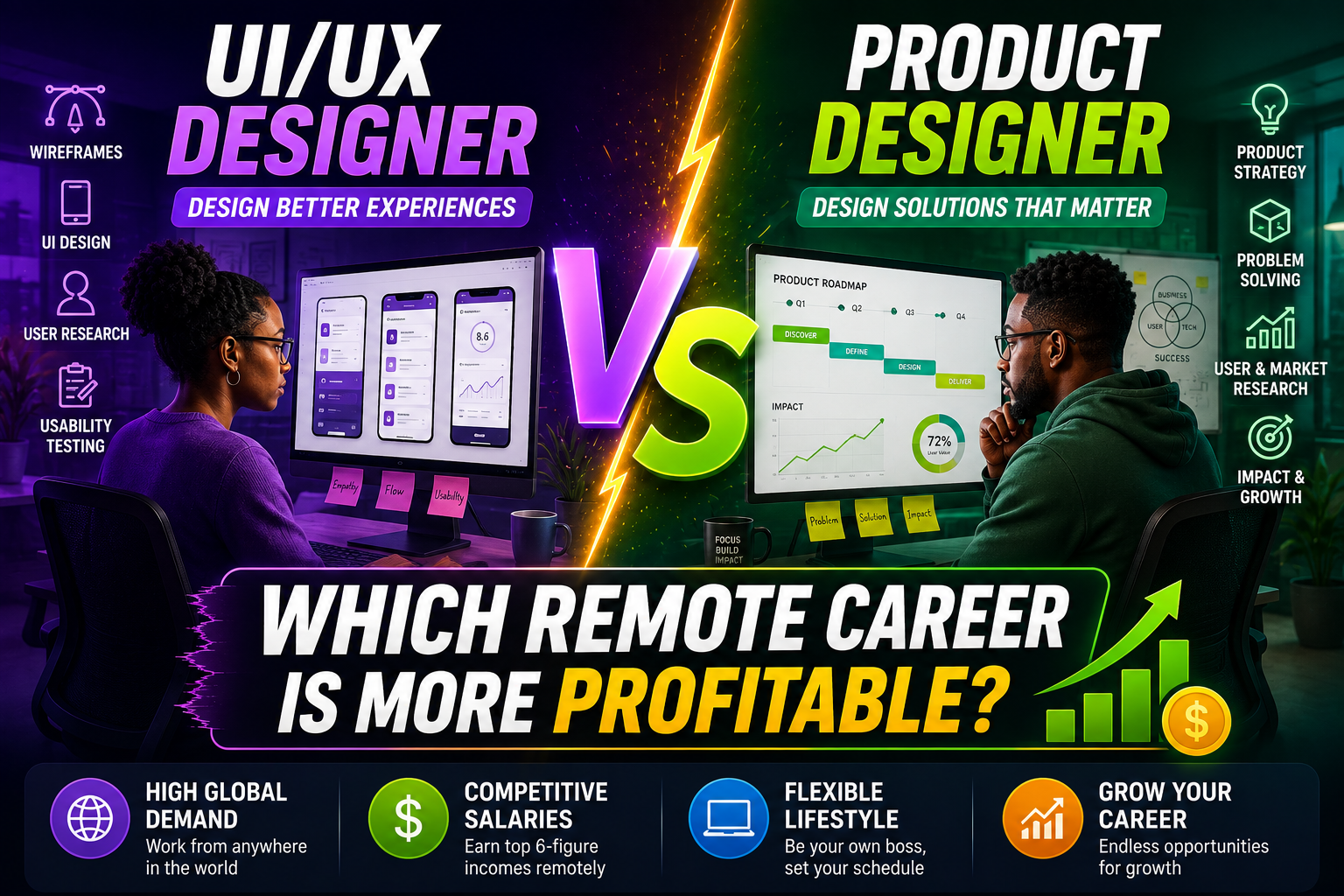
UI/UX Designer vs. Product Designer: Which Remote Career Is More Profitable?
The digital landscape is booming, and with it, the demand for skilled design professionals who can craft intuitive, engaging, and effective digital experiences. Among the most sought-after roles are UI/UX Designers and Product Designers. While often used interchangeably, these two career paths, especially in the remote work context, have distinct responsibilities, skill sets, and, crucially, different profitability potentials.
For aspiring designers and seasoned professionals looking to pivot, understanding these nuances is critical. The rise of remote work has democratized access to global talent pools and diverse opportunities, making the choice between a UI/UX focus and a Product Design focus even more impactful on one’s long-term earning potential and career trajectory.
This comprehensive guide will dissect both roles, highlight their key differences, explore the remote work landscape for each, and ultimately help you determine which remote career path might be more profitable for you.
Understanding the Core Roles
Before diving into profitability, it’s essential to establish a clear understanding of what each role entails. While there’s significant overlap, their primary focus and scope often diverge.
What is a UI/UX Designer?
A UI/UX Designer is a professional dedicated to creating digital products that are both aesthetically pleasing (UI) and easy to use, efficient, and enjoyable (UX). This role is fundamentally user-centric, focusing on the interaction between the user and the product.
The UI (User Interface) Aspect
User Interface (UI) design is all about the visual and interactive elements of a product. It’s what the user sees and interacts with directly.
- Definition: UI design focuses on the look and feel, presentation, and interactivity of a digital product. It’s concerned with how the product is laid out and how users interact with it visually.
- Responsibilities:
- Visual Design: Crafting the aesthetics, including color palettes, typography, iconography, and imagery.
- Layout and Grids: Organizing content and interactive elements in a logical and visually appealing manner.
- Interactive Elements: Designing buttons, toggles, forms, and other components users interact with.
- Branding Consistency: Ensuring the interface aligns with the brand’s identity and guidelines.
- Prototyping: Creating high-fidelity mockups and interactive prototypes to demonstrate the product’s visual and interactive flow.
- Design Systems: Contributing to or maintaining a library of reusable components and guidelines to ensure consistency and efficiency.
- Key Skills: Visual design principles, typography, color theory, graphic design software (Figma, Sketch, Adobe XD), prototyping tools, attention to detail, understanding of accessibility standards.
- Remote Aspects: UI designers often work with shared design files in cloud-based tools, collaborating asynchronously on visual specifications and component libraries. Clear documentation and detailed mockups are crucial for remote handoffs to development teams.
The UX (User Experience) Aspect
User Experience (UX) design, on the other hand, is about the overall experience a user has when interacting with a product or service. It’s less about how it looks and more about how it feels and functions.
- Definition: UX design encompasses the entire journey a user takes with a product, ensuring it’s logical, intuitive, and satisfies their needs. It’s about problem-solving and understanding human behavior.
- Responsibilities:
- User Research: Conducting interviews, surveys, usability testing, and analyzing data to understand user behaviors, needs, and pain points.
- Information Architecture (IA): Structuring and organizing content in a way that is easy for users to navigate and understand.
- Wireframing and User Flows: Creating low-fidelity blueprints and diagrams to map out the user’s journey through the product.
- Usability Testing: Planning and executing tests to identify areas of friction and validate design solutions.
- Persona Development: Creating fictional representations of target users to guide design decisions.
- Interaction Design: Defining how users interact with the product, including gestures, animations, and transitions.
- Key Skills: User research methodologies, empathy, analytical thinking, problem-solving, information architecture, wireframing tools, communication, psychology, data analysis.
- Remote Aspects: Remote UX research often involves online surveys, remote usability testing platforms, and virtual interviews. Collaboration tools are vital for sharing research findings, user flows, and wireframes with remote teams.
What is a Product Designer?
A Product Designer is a more holistic role, encompassing many aspects of UI/UX design but extending further into product strategy, business goals, and the entire product lifecycle. They are often seen as mini-CEOs of their product area, driving both user value and business value.
- Definition: A Product Designer is responsible for the end-to-end design process of a product, from initial concept and strategy to launch and post-launch iteration. They bridge the gap between user needs, business objectives, and technical feasibility.
- Responsibilities:
- Product Strategy: Collaborating with product managers and stakeholders to define the product vision, roadmap, and key performance indicators (KPIs).
- User Research & Analysis: Similar to UX designers, but often with a broader scope, tying insights directly to product market fit and business opportunities.
- Concept Development: Ideating and sketching solutions that address both user needs and business goals.
- UI/UX Design: Performing all the tasks of a UI/UX designer, including wireframing, prototyping, visual design, and interaction design.
- Testing & Iteration: Conducting usability tests, A/B tests, and analyzing data to refine and improve the product.
- Cross-functional Collaboration: Working closely with product managers, engineers, marketers, and other teams throughout the product lifecycle.
- Feature Prioritization: Helping to decide which features to build based on user value, business impact, and technical constraints.
- Measuring Success: Defining and tracking metrics to evaluate the impact of design decisions on product performance.
- Key Skills: All UI/UX skills, plus product strategy, business acumen, data analysis, leadership, communication, project management, technical understanding, stakeholder management, storytelling.
- Remote Aspects: Remote Product Designers require strong self-management and exceptional communication skills. They often lead virtual meetings, facilitate remote workshops (using tools like Miro), and are adept at documenting decisions and progress for distributed teams. Their ability to influence and align stakeholders remotely is paramount.
Key Differences Highlighted
While the lines can blur, especially in smaller companies, understanding the core distinctions is crucial for career planning.
Scope and Breadth of Responsibility
- UI/UX Designer: Typically focuses on the “how” – how a user interacts with a product and how it looks. Their scope is generally confined to the user interface and user experience aspects of a specific feature or product area.
- Product Designer: Focuses on the “what” and “why” in addition to the “how.” They are involved in defining what the product should be, why it should exist, and how it aligns with broader business objectives, encompassing the entire product lifecycle.
Focus (User vs. Business/Product Vision)
- UI/UX Designer: Primarily advocates for the user. Their success is measured by user satisfaction, usability, and aesthetic appeal.
- Product Designer: Balances user needs with business goals, technical feasibility, and market opportunities. They advocate for the product’s overall success, which includes user satisfaction but also revenue, retention, and market share.
Position in the Product Lifecycle
- UI/UX Designer: Often comes into play once a product idea is somewhat defined, focusing on executing the design. They are heavily involved in the design and testing phases.
- Product Designer: Involved from the very inception of a product idea, through discovery, definition, design, development, launch, and post-launch iteration. They influence the product roadmap and strategy.
Skill Set Overlap and Divergence
- Overlap: Both roles share core design skills like user research, wireframing, prototyping, visual design, and usability testing.
- Divergence: Product Designers require a stronger emphasis on business acumen, product strategy, data analysis, cross-functional leadership, and understanding market dynamics. UI/UX Designers might specialize more deeply in specific areas like animation, accessibility, or visual branding.
Collaboration Dynamics
- UI/UX Designer: Primarily collaborates with other designers, researchers, and front-end developers.
- Product Designer: Collaborates extensively with product managers, engineers, data scientists, marketing, sales, and executive leadership, acting as a central hub for product development.
Remote Work Landscape for Both Roles
Remote work has reshaped the design industry, offering unprecedented flexibility and access to global talent. Both UI/UX and Product Designers thrive in remote environments, but they also face unique challenges.
Advantages of Remote Design Work
- Flexibility: Designers can often set their own hours, leading to better work-life balance.
- Global Talent Pool: Companies can hire the best talent regardless of location, and designers can access opportunities worldwide.
- Reduced Commute & Costs: Saves time and money on travel, office attire, and meals.
- Access to Diverse Projects: Remote designers, especially freelancers, can work on a wider variety of projects and industries.
- Autonomy: Greater control over one’s work environment and processes.
Challenges of Remote Design Work
- Communication Barriers: Misunderstandings can arise without face-to-face interactions.
- Collaboration Tools Overload: Relying heavily on digital tools requires discipline and good practices.
- Maintaining Team Cohesion: Building rapport and a sense of team can be harder remotely.
- Work-Life Balance: The lines between work and personal life can blur, leading to burnout.
- Self-Discipline: Requires strong self-motivation and time management skills.
- Time Zone Differences: Coordinating meetings and collaboration across multiple time zones can be complex.
Tools and Technologies for Remote Design
Both roles heavily rely on a suite of digital tools to facilitate remote collaboration and design execution:
- Design & Prototyping: Figma (dominant), Sketch, Adobe XD, InVision.
- Whiteboarding & Collaboration: Miro, Mural, FigJam.
- Communication: Slack, Microsoft Teams, Zoom, Google Meet.
- Project Management: Asana, Jira, Trello, Monday.com.
- User Research: UserTesting, Maze, Optimal Workshop, Qualtrics.
- Documentation: Notion, Confluence, Google Docs.
Profitability Analysis: Remote Salaries and Career Growth
Now, let’s address the core question: which remote career is more profitable? Profitability isn’t just about the immediate salary; it also encompasses long-term career growth, demand, and potential for leadership or specialized roles.
Salary Expectations (Remote)
It’s important to note that remote salaries can vary significantly based on factors like the company’s location (even if the employee is remote, some companies pay based on the employee’s location or the company’s HQ), company size, industry, experience level, and specific skill set. However, general trends can be observed.
Remote UI/UX Designer Salaries
- Entry-Level (0-2 years): $50,000 – $80,000 USD per year. These roles focus on learning the ropes, assisting senior designers, and executing defined tasks.
- Mid-Level (2-5 years): $80,000 – $120,000 USD per year. Mid-level designers can work independently on projects, lead smaller initiatives, and contribute significantly to design systems and user research.
- Senior-Level (5+ years): $120,000 – $160,000+ USD per year. Senior designers often lead projects, mentor junior designers, and have a strong influence on design strategy and best practices.
- Lead/Manager (8+ years): $150,000 – $200,000+ USD per year. These roles involve managing teams, setting design vision, and collaborating closely with product leadership.
Factors Influencing UI/UX Salary: Specialization (e.g., highly skilled in animation, accessibility, or specific research methodologies), strong portfolio, experience in high-growth industries (e.g., FinTech, AI), and leadership potential.
Remote Product Designer Salaries
- Entry-Level (0-2 years): $60,000 – $90,000 USD per year. Entry-level product designers learn the product development lifecycle, contribute to research, and execute design tasks under guidance.
- Mid-Level (2-5 years): $90,000 – $140,000 USD per year. Mid-level product designers manage features end-to-end, collaborate with cross-functional teams, and contribute to product strategy.
- Senior-Level (5+ years): $140,000 – $190,000+ USD per year. Senior product designers own significant product areas, drive strategic initiatives, mentor others, and influence the product roadmap.
- Lead/Principal (8+ years): $180,000 – $250,000+ USD per year. These roles involve setting the design vision for entire product lines, leading multiple teams, and having a direct impact on business outcomes.
- Head of Product Design/VP of Design: $250,000 – $400,000+ USD per year (and often equity). These are executive-level roles responsible for the entire design organization and strategy.
Factors Influencing Product Designer Salary: Direct impact on business metrics (e.g., revenue, conversion), strong strategic thinking, leadership experience, ability to navigate complex stakeholder relationships, and experience with successful product launches.
Career Growth and Advancement
Both paths offer robust career growth, but the trajectory and ultimate ceiling can differ.
UI/UX Career Growth
- Specialization: Many UI/UX designers choose to specialize deeply in one area, becoming an expert UX Researcher, UI Specialist, Interaction Designer, or Accessibility Expert. Highly specialized roles can command premium salaries.
- Lead UI/UX Designer: Leading a team of UI/UX designers, overseeing projects, and ensuring design quality.
- Design Manager: Managing design teams, setting processes, and contributing to broader design operations.
- Design Director/Head of UX: Overseeing multiple design teams or the entire UX function within an organization.
Product Design Career Growth
- Senior/Principal Product Designer: Taking on increasingly complex product areas, driving strategic initiatives, and mentoring junior designers. Principal designers often act as individual contributors with significant strategic influence.
- Lead Product Designer: Leading a team of product designers, defining design systems, and ensuring alignment with product vision.
- Product Manager: A common pivot, leveraging their understanding of users, business, and technology to own the product roadmap and strategy.
- Head of Product Design/VP of Product Design: Overseeing the entire product design organization, shaping design culture, and influencing company-wide product strategy.
- Chief Product Officer (CPO): An executive role responsible for all aspects of product strategy and development.
Freelance and Consulting Opportunities
Both UI/UX and Product Designers can pursue lucrative freelance and consulting careers remotely.
- UI/UX Freelancers: Often hired for specific projects like website redesigns, app UI overhauls, or usability audits. Rates can range from $50-$150+ per hour depending on experience and specialization.
- Product Design Consultants: Tend to command higher rates due to their strategic involvement. They might be brought in to help define a new product, establish a design process, or provide strategic guidance on product roadmap and market fit. Rates can range from $100-$300+ per hour, especially for senior consultants with proven track records.
Product designers, with their broader business acumen, are often better positioned to offer high-value strategic consulting services, which typically yield higher hourly or project rates than purely execution-focused UI/UX tasks.
- Ethical Hacker vs Cloud Engineer: 2 Incredibly Valuable Remote Tech Skills
- 2026 Generative AI Landscape: The Evolution of AI Search
- Fix LinkedIn Login: 7 Proven Ways to Successfully Resolve “Something Unexpected Happened” Error on Laptop
Which Remote Career Path is More Profitable?
Based on current market trends and the scope of responsibilities, Product Design generally tends to be the more profitable remote career path, especially at mid-to-senior and leadership levels.
Here’s why:
- Broader Impact on Business Outcomes: Product Designers are directly involved in defining the “what” and “why” of a product, tying their work directly to revenue, user acquisition, and retention. This strategic influence makes them more valuable to companies, which often translates to higher compensation.
- Strategic Scope: Their involvement from concept to launch, including product strategy and business objectives, positions them closer to executive decision-making and the overall success of the company.
- Leadership Potential: The career path for Product Designers often leads directly into product leadership (Head of Product Design, CPO) or product management, roles that typically command higher salaries and equity.
- Demand for T-shaped Skills: Companies increasingly seek designers who possess both deep design skills and broad business/technical understanding. Product Designers embody this “T-shaped” profile, making them highly sought after.
- Higher Freelance/Consulting Rates: For independent professionals, the ability to offer strategic product guidance in addition to design execution allows Product Designers to charge premium rates.
However, it’s crucial to add a caveat: Highly specialized and senior UI/UX roles can also be exceptionally lucrative. A top-tier UX researcher with deep expertise in a niche industry, or a UI designer who is a master of animation and interaction design for complex interfaces, can also command very high salaries. The distinction often lies in the depth of specialization versus the breadth of strategic involvement.
How to Choose Your Path
The “more profitable” path isn’t always the “right” path for everyone. Your passion, natural aptitudes, and long-term career goals should heavily influence your decision.
- Self-Assessment:
- Are you passionate about user psychology and research, or more about visual aesthetics and interaction details? (Leans UI/UX)
- Do you enjoy solving complex business problems and influencing product strategy, or do you prefer to focus on crafting perfect user experiences and interfaces? (Leans Product Design)
- Are you comfortable with ambiguity and leading cross-functional discussions, or do you prefer a more defined scope of work? (Leans Product Design)
- Do you thrive on data analysis and understanding market trends, or are you more driven by user empathy and usability? (Leans Product Design vs. UI/UX)
- Skill Development:
- For UI/UX: Deepen your expertise in specific areas like animation, accessibility, content strategy, or advanced user research methodologies. Master design tools and stay updated on visual trends.
- For Product Design: Cultivate strong business acumen, learn about product management frameworks, practice data-driven decision making, and hone your leadership and communication skills. Take courses on product strategy or entrepreneurship.
- Learning Resources: Both fields have abundant online courses, bootcamps, and degree programs. Look for programs that align with your desired focus.
- UI/UX: Google UX Design Professional Certificate, Interaction Design Foundation, various bootcamps focusing on visual design or UX research.
- Product Design: Reforge, Product School, specific university programs in Human-Computer Interaction (HCI) with a product focus.
- Networking and Mentorship: Connect with professionals in both fields. Informational interviews can provide invaluable insights into day-to-day responsibilities, challenges, and growth opportunities.
- Portfolio Building: Regardless of your chosen path, a strong portfolio showcasing your skills, process, and impact is paramount for remote job applications. For Product Designers, emphasize your strategic thinking and business impact. For UI/UX, highlight your craft, user understanding, and problem-solving.
Conclusion
Both UI/UX Designer and Product Designer are incredibly rewarding and in-demand remote careers within the digital product space. While a Product Designer role generally offers a higher earning potential and more direct pathways to leadership and strategic influence due to its broader scope and direct tie to business outcomes, a highly specialized and experienced UI/UX Designer can also achieve significant profitability.
Ultimately, the most profitable career for you will be the one that aligns best with your innate talents, passions, and long-term aspirations. By understanding the distinct responsibilities and growth trajectories of each, you can make an informed decision that not only maximizes your remote earning potential but also leads to a fulfilling and impactful career. Invest in developing the skills that excite you most, build a compelling portfolio, and continuously adapt to the evolving demands of the digital world.


