

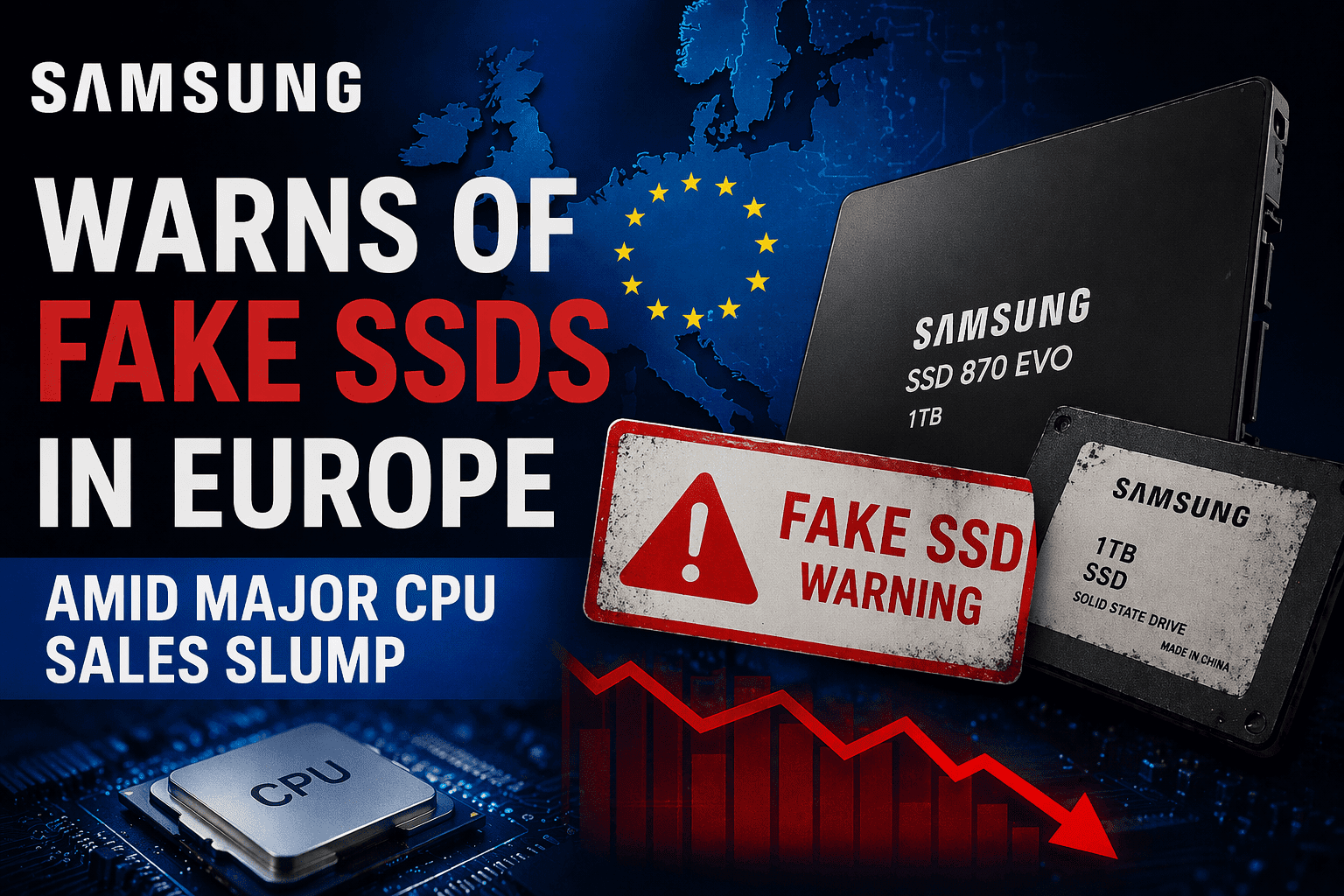
Samsung Issues Warning About Fake SSDs in Europe — As the PC Crisis Sparks a Massive Slump in CPU Sales
The global PC hardware market is currently navigating a perfect storm of economic volatility, shifting consumer behavior, and a disturbing rise in sophisticated hardware scams. In recent weeks, two major stories have converged to paint a complex picture of the industry: Samsung has issued a high-priority warning regarding a surge of counterfeit high-performance SSDs circulating in the European market, while simultaneously, the broader PC industry is grappling with a historic slump in CPU sales that has left giants like Intel and AMD reeling.
This convergence is not accidental. As the “post-pandemic hangover” continues to suppress demand for new computers, consumers are increasingly looking for ways to upgrade existing systems on a budget. This desperation for deals has created a vacuum that counterfeiters are more than happy to fill, even as the primary manufacturers of the components themselves face multi-billion dollar revenue gaps.
The Samsung Counterfeit Crisis: A Warning to European Consumers
Samsung’s semiconductor division is widely regarded as the gold standard for consumer and enterprise storage. Their NVMe drives, particularly the 980 Pro and 990 Pro series, are staples in gaming rigs and professional workstations. However, this prestige has made them a primary target for sophisticated counterfeit operations.
The Rise of the “Super-Fake” SSD
Reports began surfacing from major European tech hubs—most notably Germany—concerning Samsung 990 Pro 2TB drives that appeared authentic but performed significantly below specifications. These aren’t the crude fakes of a decade ago; these are “super-fakes” that utilize high-quality packaging, convincing thermal labels, and even spoofed firmware that can initially trick a computer’s BIOS into identifying the drive as a genuine Samsung product.
According to technical teardowns by European hardware outlets and independent researchers, these counterfeit drives often swap out Samsung’s proprietary “Pascal” or “Elpis” controllers for cheaper, third-party alternatives like those from Maxio. Furthermore, the high-grade Samsung 176-layer or 236-layer V-NAND is replaced with inferior, lower-density NAND flash that has a much shorter lifespan and significantly slower read/write speeds.
Why This Matters for Your Data
The danger of a fake SSD goes far beyond slower loading screens in a video game. The risks include:
- Data Corruption: Inferior NAND flash is prone to “bit rot” and premature failure.
- Firmware Instability: Because the firmware is often a hacked version of a generic controller’s software, it lacks the sophisticated wear-leveling and error-correction algorithms found in genuine Samsung drives.
- No Warranty Support: Samsung’s warranty is tied to the serial number and the authenticity of the hardware. If you buy a fake, you have zero recourse when it inevitably fails.
How to Identify a Fake Samsung SSD
Samsung has urged customers to use their proprietary software, Samsung Magician, as the primary line of defense. A counterfeit drive will almost always be flagged as “Unsupported” or “N/A” within the software, even if Windows File Explorer identifies it as a Samsung drive.
Physical Red Flags to Watch For:
- The Sticker Quality: Genuine Samsung stickers often have a metallic sheen or specific texture. Fakes often use flat, matte paper.
- The PCB Color: Samsung typically uses a specific shade of deep black for their Printed Circuit Boards. Many fakes use a slightly greenish or brownish-black PCB.
- Component Layout: If you compare the drive to high-resolution photos on Samsung’s official website, the placement of the controller and the NAND chips should be identical. Any deviation is a sign of a forgery.
The PC Market Crisis: A Historic Slump in CPU Sales
While Samsung battles counterfeiters, the architects of the PC world—Intel and AMD—are battling a much larger economic foe. The latest industry data shows a massive slump in Central Processing Unit (CPU) sales, reaching levels not seen in nearly three decades.
The Post-Pandemic Hangover
To understand the current crisis, one must look back at 2020 and 2021. During the global lockdowns, demand for PCs skyrocketed as the world transitioned to remote work and digital learning. This led to a “pull-forward” effect: millions of people who might have bought a computer in 2023 or 2024 bought one in 2021 instead.
Now, the market is facing the inevitable correction. Most consumers have relatively new hardware and see little reason to upgrade, especially as inflation eats into discretionary spending.
Intel and AMD: The Financial Fallout
The numbers are staggering. Intel recently reported one of the most significant quarterly losses in its corporate history, with its Client Computing Group (the division responsible for desktop and laptop CPUs) seeing revenue drops of over 30% year-over-year.
AMD has not been immune either. While their EPYC server chips continue to perform well in the data center market, their “Client” segment—which includes Ryzen desktop and laptop processors—has seen similar double-digit declines. The transition to the AM5 platform, while technologically impressive, was initially hampered by the high cost of DDR5 memory and expensive motherboards, deterring budget-conscious builders.
The Inventory Glut
During the chip shortage of 2021, manufacturers and retailers over-ordered to ensure they had stock. As demand evaporated in late 2022 and throughout 2023, the industry was left with a massive surplus of “last-gen” hardware. This inventory glut has forced retailers to slash prices on older models (like the Intel 12th Gen and AMD Ryzen 5000 series), which in turn cannibalizes the sales of the newer, more expensive 13th/14th Gen and Ryzen 7000/9000 series chips.
The Intersection: Why the Slump Fuels the Scams
There is a direct correlation between the slump in the PC market and the rise in counterfeit components. When the economy is tight, consumers are more likely to hunt for bargains on third-party marketplaces like eBay, AliExpress, or the Amazon Marketplace.
The “Too Good to Be True” Trap
In a healthy market, a Samsung 990 Pro 2TB has a relatively stable MSRP. However, in a market where people are desperate to save every Euro, a listing that is 40% cheaper than the retail price becomes incredibly tempting. Counterfeiters exploit this by setting prices just low enough to look like a “great deal” but not so low that they immediately trigger suspicion.
The Shift to Component Upgrades
Because many users are choosing not to buy entirely new PCs (contributing to the CPU sales slump), they are instead opting for “maintenance upgrades.” This usually involves adding more RAM or a larger, faster SSD. This shift in consumer behavior has made the SSD market a more lucrative target for scammers than the CPU market, as CPUs are significantly harder to counterfeit due to their complex architecture and integrated heat spreaders (IHS).
The Technical Challenges of the New Era
The current crisis isn’t just about sales numbers; it’s about a fundamental shift in how hardware is perceived and sold.
The DDR5 and PCIe 5.0 Barrier
One reason for the CPU sales slump is the “platform cost” barrier. For a user to upgrade to the latest Intel or AMD processors, they often need:
- A new motherboard (often costing $200+).
- New DDR5 RAM (which, until recently, was twice the price of DDR4).
- Potentially a new power supply or cooler.
When faced with a $600+ bill for a platform upgrade, many consumers are choosing to stay on their older AM4 or LGA1200 systems. This stagnation in the “new build” market is what has led to the revenue craters at Intel and AMD.
The Sophistication of Modern Fakes
Counterfeiters have moved beyond simply putting a fake sticker on a drive. They are now engaging in “Firmware Spoofing.” By modifying the controller’s firmware, they can make a 512GB drive report to Windows that it has 2TB of capacity. The user won’t notice a problem until they try to write more than 512GB of data, at which point the drive will begin overwriting old data or simply crash, leading to total data loss.
Google Cloud Platform Tutorial: Essential Steps forBeginners
What is Docker? A Beginner’s Guide to Container Technology
Brendan Eich Biography: JavaScript Inventor, Mozilla Pioneer, Brave Founder
How the Industry is Responding
The industry is not sitting idly by as these two crises unfold.
Samsung’s Counter-Measures
In response to the European fakes, Samsung is reportedly looking into more robust holographic packaging and enhanced digital verification methods. They are also pushing more frequent updates to Samsung Magician to ensure it can stay ahead of the latest firmware spoofing techniques used by counterfeiters.
Intel and AMD’s Strategy Shift
To combat the CPU slump, both Intel and AMD are shifting their focus:
- Price Cuts: We are seeing more aggressive MSRPs and bundle deals (e.g., free RAM with a CPU purchase) than ever before.
- Focus on AI: Both companies are pivoting their marketing toward “AI PCs,” integrating Neural Processing Units (NPUs) into their latest chips to give consumers a “must-have” reason to upgrade.
- Efficiency over Raw Power: Recognizing that the “more cores, more heat” race is reaching a point of diminishing returns for average users, there is a renewed focus on power efficiency and integrated graphics performance.
Consumer Guide: How to Navigate the Current Hardware Landscape
If you are looking to upgrade your PC during this volatile period, follow these guidelines to protect your money and your data.
1. Buy from Authorized Retailers
The most effective way to avoid a fake Samsung SSD is to buy directly from reputable vendors (e.g., Amazon—shipped and sold by Amazon, Mindfactory in Germany, Scan in the UK, or Newegg in the US). Avoid third-party sellers with “Just Launched” status or those shipping from regions known for counterfeit production.
2. Verify Immediately
Upon receiving a new component, perform the following checks:
- For SSDs: Install Samsung Magician (for Samsung drives) or the manufacturer’s equivalent tool (Western Digital Dashboard, Crucial Storage Executive). If the tool doesn’t recognize the drive, return it immediately.
- For CPUs: Use CPU-Z to verify the clock speeds, core count, and architecture. While fake CPUs are rare, “re-lidded” CPUs (where a cheap CPU’s lid is placed on a high-end chip) do exist.
3. Be Realistic About Pricing
If the market price for a high-end CPU or SSD is $200, and you see it for $120 on a random marketplace, it is almost certainly a scam. Hardware margins are razor-thin; no legitimate retailer can afford to sell components at a 40-50% discount unless it is a clearance of very old stock.
4. Monitor the “Used” Market Carefully
With the CPU slump, the used market is flooded with great deals on Ryzen 5000 and Intel 12th Gen parts. While these are excellent values, ensure you are buying from platforms with buyer protection (like eBay or PayPal Goods and Services) to avoid being sent a “dead on arrival” (DOA) component.
The Future Outlook: Recovery or Long-Term Decline?
The PC market is cyclical, but the current downturn is particularly severe because it is being hit by both a natural cycle and a global economic slowdown.
Analysts predict that the CPU market will begin to stabilize in late 2024 and 2025 as the “Windows 10 End of Life” approaches. With Microsoft ending support for Windows 10 in October 2025, millions of enterprise and consumer PCs that don’t meet the hardware requirements for Windows 11 will finally be forced into an upgrade cycle. This could provide the “shot in the arm” that Intel and AMD desperately need.
As for the counterfeit SSD issue, it serves as a reminder that as technology becomes more essential, it also becomes a more attractive target for criminals. The battle between hardware manufacturers and counterfeiters is an arms race that shows no signs of slowing down.
Conclusion
The warning from Samsung regarding fake SSDs in Europe and the massive slump in CPU sales are two sides of the same coin. They represent an industry in transition—one where the explosive growth of the past few years has been replaced by caution, economic pressure, and the emergence of sophisticated bad actors.
For the consumer, the current landscape offers both risk and opportunity. There are incredible deals to be had on genuine, high-performance hardware as manufacturers struggle to clear inventory. However, these deals must be approached with a critical eye. By sticking to authorized retailers, utilizing verification software, and remaining skeptical of “too good to be true” prices, you can take advantage of the market slump to upgrade your system without falling victim to the surge in counterfeit components.
The PC industry has survived many “crises” before, from the dot-com bubble to the 2008 financial crash. While the current slump is historic in scale, the fundamental need for high-performance computing remains. As we move toward an AI-driven future, the demand for genuine, reliable silicon will eventually return—but for now, the watchword for every PC enthusiast is vigilance.


