
Table of Contents
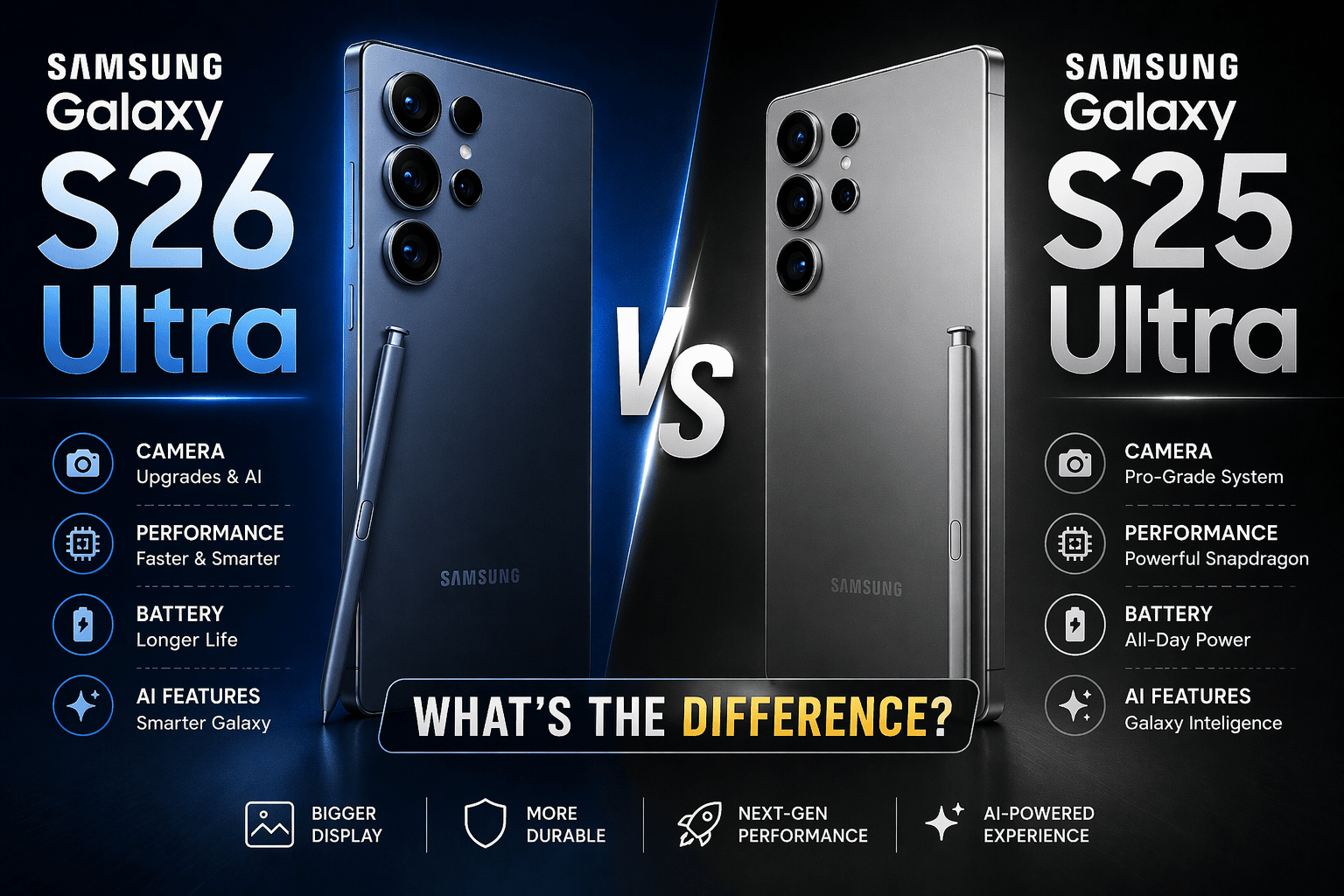
Samsung Galaxy S26 Ultra vs. Samsung Galaxy S25 Ultra: The Ultimate Flagship Showdown
For over a decade, Samsung’s Galaxy S series has represented the pinnacle of Android engineering. With the “Ultra” moniker, Samsung pushed the boundaries of what a smartphone could be—a professional-grade camera, a productivity powerhouse with the S-Pen, and a gaming beast all rolled into one.
As we look at the transition from the Samsung Galaxy S25 Ultra to the anticipated Samsung Galaxy S26 Ultra, we are witnessing a pivotal moment in mobile technology. This isn’t just a jump in model numbers; it is a shift from the refinement of the “Ultra” identity to the integration of next-generation 2nm silicon and advanced AI-driven hardware.
In this comprehensive comparison, we break down every nuance between the S25 Ultra and the S26 Ultra to help you decide whether to upgrade now or wait for the next big leap.
1. Design and Build Quality: Ergonomics vs. Aesthetics
The Galaxy S24 Ultra marked a significant shift with its flat display and titanium frame. The S25 Ultra and S26 Ultra continue this evolution, but with distinct philosophies regarding hand-feel and durability.
The Galaxy S25 Ultra: The “Softened” Powerhouse
For years, users complained about the sharp corners of the Ultra series digging into their palms. The S25 Ultra addresses this by introducing slightly rounded corners while maintaining the large, rectangular silhouette. It is rumored to be the thinnest and lightest Ultra model to date, thanks to a reduction in bezel size and a more efficient internal layout.
- Materials: Grade 2 Titanium.
- Bezels: Record-breaking thinness, providing a nearly “all-screen” experience.
The Galaxy S26 Ultra: Refinement and New Materials
The S26 Ultra is expected to take the “Thin and Light” philosophy even further. Rumors suggest Samsung may move to a higher grade of Titanium (Grade 5) to increase structural rigidity while shaving off more weight. There are also whispers of a “seamless” design where the transition between the frame and the glass is even more imperceptible.
- Materials: Potential Grade 5 Titanium or a new alloy.
- Ergonomics: Further refinement of the rounded corners to ensure the 6.9-inch device remains pocketable.
2. Display Technology: The Battle of Brightness and Efficiency
Samsung is the world leader in OLED technology, and the Ultra series always showcases their best panels.
S25 Ultra: The M14 OLED Era
The S25 Ultra utilizes the M14 OLED material set. This panel focuses on two things: peak brightness and longevity.
- Peak Brightness: Expected to hit 2,800 to 3,000 nits.
- Anti-Reflective Coating: An improved version of the Gorilla Armor found on the S24 Ultra, which reduces reflections by up to 75%.
S26 Ultra: Tandem OLED and 2nm Efficiency
The S26 Ultra is rumored to be the first Samsung phone to potentially adopt Tandem OLED technology (similar to the latest iPad Pros). This involves stacking two layers of organic light-emitting diodes, which doubles the brightness potential while significantly increasing the lifespan of the screen and reducing power consumption.
- Peak Brightness: Could exceed 3,500 nits.
- Refresh Rate: A more granular LTPO panel capable of scaling from 0.1Hz to 144Hz (up from 1Hz-120Hz).
3. Performance: The 3nm vs. 2nm Revolution
This is perhaps the most significant differentiator between the two generations. The chipset is the heart of the phone, and we are currently in a period of rapid architectural shifts.
Galaxy S25 Ultra: Snapdragon 8 Elite (3nm)
The S25 Ultra is powered by the Qualcomm Snapdragon 8 Elite (formerly known as the 8 Gen 4). Built on a 3nm process, this chip moves away from standard ARM designs to Qualcomm’s custom Oryon CPU cores.
- Performance Gain: A 30-35% jump in multi-core performance compared to the S24 Ultra.
- AI Processing: A dedicated NPU (Neural Processing Unit) designed specifically for on-device generative AI.
Galaxy S26 Ultra: Snapdragon 8 Gen 5 (2nm)
The S26 Ultra will likely debut the Snapdragon 8 Gen 5, which is expected to be built on a 2nm process. The jump from 3nm to 2nm is a massive leap in transistor density.
- Efficiency: 2nm chips are expected to provide a 20-25% improvement in power efficiency over 3nm chips. This means the S26 Ultra could offer significantly longer battery life even with the same battery capacity.
- Thermal Management: Smaller transistors generate less heat, meaning the S26 Ultra can maintain peak performance during gaming for much longer without thermal throttling.
4. Camera Systems: Megapixels vs. Sensor Size
Samsung has led the “Megapixel War” for years, but the focus is shifting toward sensor size and computational photography.
S25 Ultra: The Ultrawide Upgrade
The S25 Ultra focuses on bringing parity to its secondary lenses.
- Main Sensor: 200MP ISOCELL HP2 (Refined).
- Ultrawide: A new 50MP sensor (up from 12MP), allowing for 4K macro photography and better low-light wide shots.
- Telephoto: Dual telephoto setup (10MP 3x and 50MP 5x), with improved processing for 100x Space Zoom.
S26 Ultra: The 1-Inch Sensor Dream?
Samsung Warns of Fake SSDs in Europe Amid Major CPU Sales Slump
Google Cloud Platform Tutorial: Essential Steps forBeginners
iPhone 18 Series: Complete Leak Details, Release Date, Specs & Features
For years, enthusiasts have asked Samsung to adopt a 1-inch type sensor to compete with Chinese flagships. The S26 Ultra is the prime candidate for a major sensor overhaul.
- Main Sensor: Rumors suggest a move to a 1-inch type 200MP or even a 324MP sensor. A larger sensor allows for natural “bokeh” (background blur) and vastly superior night photography.
- Variable Aperture: There are talks of Samsung re-introducing variable aperture (f/1.4 to f/4.0) to give photographers more control over depth of field.
- Video: 8K 120FPS recording capabilities, enabled by the faster 2nm processor.
5. Battery Life and Charging
Battery technology has been somewhat stagnant, but the S26 Ultra might finally break the mold.
| Feature | Galaxy S25 Ultra | Galaxy S26 Ultra (Predicted) |
|---|---|---|
| Capacity | 5,000 mAh | 5,200 – 5,500 mAh |
| Wired Charging | 45W | 65W – 80W |
| Wireless Charging | 15W (Qi2) | 25W (Qi2) |
| Battery Tech | Standard Li-ion | Stacked Battery Technology |
The S26 Ultra Advantage: Stacked Batteries
The S26 Ultra is rumored to utilize “Stacked Battery” technology, a method derived from the electric vehicle industry. This allows for higher energy density in the same physical space. This could allow Samsung to increase the capacity to 5,500 mAh without making the phone thicker, potentially offering a true “two-day” battery life.
6. Software and Galaxy AI
Samsung has committed to 7 years of OS updates for its flagship devices. Both the S25 and S26 Ultra will be supported well into the 2030s.
Galaxy AI 2.0 (S25 Ultra)
The S25 Ultra will launch with One UI 7/7.1, featuring “Galaxy AI 2.0.” This includes:
- Live Translation for Video: Real-time dubbing for YouTube and streaming apps.
- Circle to Search Evolution: Identifying objects in videos and providing shopping links or historical context instantly.
- AI Sketch to Image: Turning rough S-Pen sketches into photorealistic renders.
Galaxy AI 3.0 (S26 Ultra)
By the time the S26 Ultra arrives, AI will likely move from “generative” to “agentic.”
- AI Agents: The S26 Ultra may be able to perform complex tasks across apps (e.g., “Book a flight to London for next Tuesday and find a hotel near the city center that fits my budget”).
- On-Device Video Editing: Using the power of the 2nm chip to remove objects from videos in real-time or change the lighting of a recorded clip.
7. Connectivity and Future-Proofing
Wi-Fi 7 vs. Wi-Fi 8
The S25 Ultra will fully utilize Wi-Fi 7, offering speeds up to 46 Gbps. The S26 Ultra, however, might be among the first devices to support early drafts of Wi-Fi 8 or specialized “Ultra-Wideband” enhancements for better spatial awareness within the Samsung SmartThings ecosystem.
Satellite Connectivity
While the S25 Ultra will feature emergency satellite messaging, the S26 Ultra is expected to expand this to “Satellite Data,” allowing for basic text messaging (non-emergency) in areas with zero cellular coverage.
8. Comparison Summary Table
| Specification | Samsung Galaxy S25 Ultra | Samsung Galaxy S26 Ultra |
|---|---|---|
| Display | 6.8″ Dynamic AMOLED 2X (M14) | 6.9″ Tandem OLED (M15/New) |
| Processor | Snapdragon 8 Elite (3nm) | Snapdragon 8 Gen 5 (2nm) |
| RAM | 12GB / 16GB LPDDR5X | 16GB / 24GB LPDDR6 |
| Main Camera | 200MP (ISOCELL HP2) | 200MP/324MP (1-inch type) |
| Ultrawide | 50MP | 50MP (Improved AF) |
| Battery | 5,000 mAh | 5,500 mAh (Stacked) |
| Charging | 45W Wired | 65W+ Wired |
| Software | Android 15 (7 years support) | Android 16 (7 years support) |
| AI Features | Galaxy AI 2.0 | Galaxy AI 3.0 (Agentic AI) |
9. Real-World Use Cases: Which is for you?
Choose the Galaxy S25 Ultra if…
- You are coming from an S21 or S22 Ultra: The jump in efficiency, screen brightness, and the new rounded design will feel like a massive upgrade.
- You want the best value: Once the S26 Ultra launches, the S25 Ultra will see significant price cuts while still remaining more powerful than 99% of other smartphones.
- You prioritize weight: The S25 Ultra is expected to be the “sweet spot” for ergonomics before Samsung potentially increases sensor sizes (and weight) again in the S26.
Wait for the Galaxy S26 Ultra if…
- You are a mobile photographer: The potential jump to a 1-inch sensor is the single biggest camera hardware upgrade in five years.
- You are a power user/gamer: The 2nm Snapdragon 8 Gen 5 will be a generational leap in sustained performance and battery efficiency.
- You keep your phones for 5+ years: The S26 Ultra will likely introduce LPDDR6 RAM and more advanced AI hardware that will stay relevant longer as AI software becomes more demanding.
10. Pricing and Availability
- Samsung Galaxy S25 Ultra: Expected launch in January 2025. Pricing is anticipated to start at $1,299.
- Samsung Galaxy S26 Ultra: Expected launch in January 2026. Given the move to 2nm chips (which are more expensive to produce) and potential 1-inch sensors, we could see a price hike to $1,399.
Conclusion
The difference between the Samsung Galaxy S25 Ultra and the S26 Ultra represents the difference between refinement and revolution.
The S25 Ultra is the ultimate version of the current “Ultra” formula. It fixes the ergonomic issues of its predecessors, upgrades the ultrawide camera, and utilizes a highly efficient 3nm chip. It is a safe, powerful, and polished choice for anyone needing a new phone today.
The S26 Ultra, however, is shaping up to be a “spec-beast” that introduces entirely new technologies: 2nm processing, stacked batteries, and a potential 1-inch camera sensor. If you are currently holding an S23 Ultra or S24 Ultra, the S25 Ultra might feel like an incremental step. In that case, waiting for the S26 Ultra could provide the “wow factor” you’ve been looking for.
Regardless of which you choose, Samsung continues to prove that the “Ultra” series is the gold standard for what a modern smartphone can achieve.
Have any thoughts?
Share your reaction or leave a quick response — we’d love to hear what you think!
-
 0
0
-
 0
0
-
 0
0
-
 0
0
-
 0
0
-
 0
0
