The Future of Humanoid Robots and Human‑AI Collaboration
Introduction
The image of a humanoid robot — an android‑like machine that walks, gestures, and interacts much like a human — has long been a staple of science‑fiction. In the past decade, advances in artificial intelligence, materials science, and manufacturing have turned that fiction into a tangible reality. Today, a growing number of companies and research labs are fielding robots that can lift boxes in a warehouse, assist surgeons in an operating room, or guide visitors through a museum.
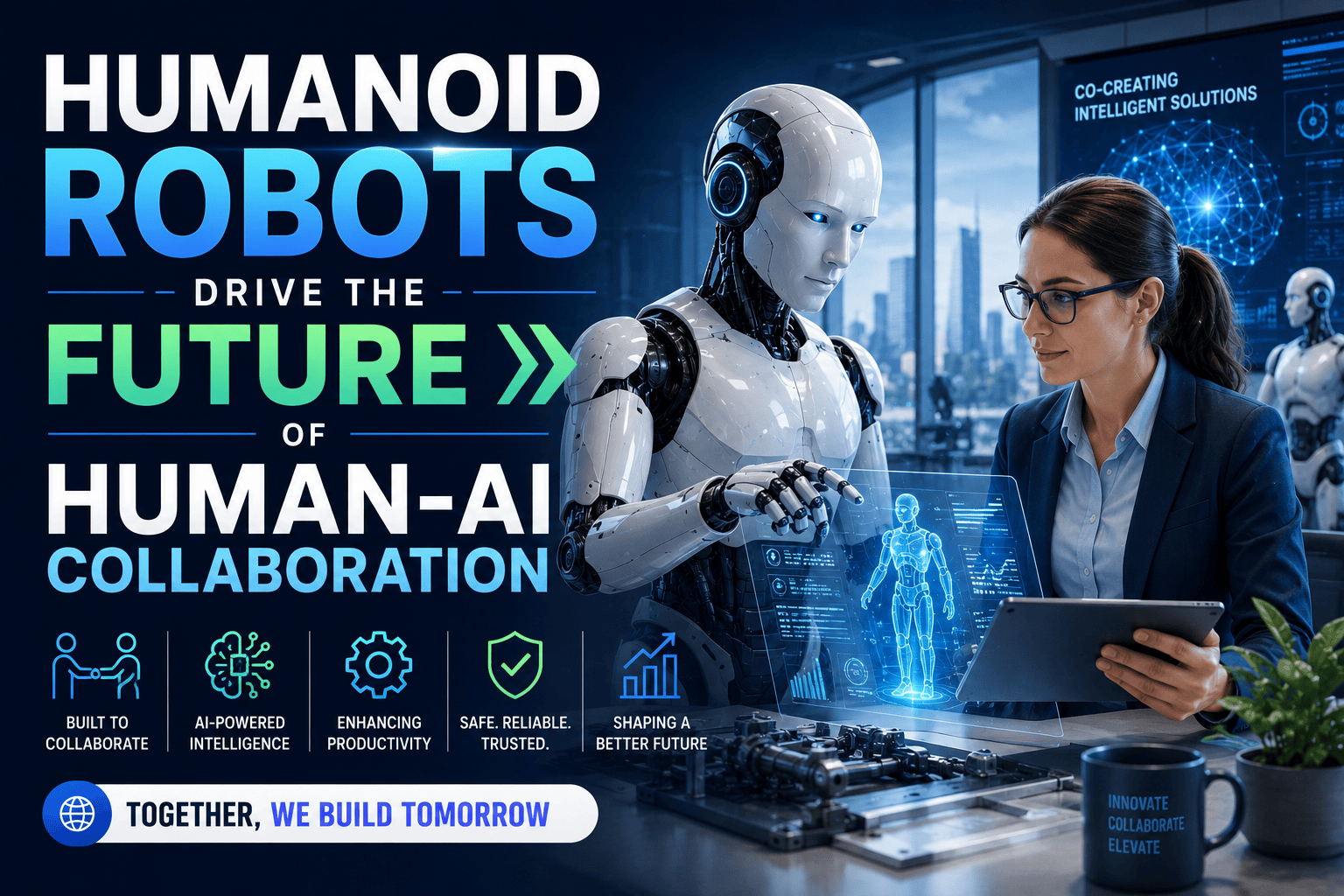
But the true promise of these machines lies not in their ability to replace humans, but in how they can collaborate with us. The next wave of humanoid robotics will be defined by a symbiotic relationship between human ingenuity and artificial intelligence, where each party amplifies the other’s strengths. This article explores the technological drivers behind humanoid robots, examines the current state of the field, outlines how human‑AI collaboration will evolve, and highlights the challenges that must be addressed to realize a future where humans and robots work side‑by‑side.
Defining Humanoid Robots
What Makes a Robot “Humanoid”?
A humanoid robot is characterized by a kinematic structure that mirrors the human body: a torso, a pair of arms, legs, and a head that can house sensors and processing units. While the term often evokes a near‑human appearance, the essential definition focuses on functionality rather than aesthetics. Key attributes include:
- Bipedal locomotion – walking on two legs, enabling navigation of human‑engineered environments.
- Dexterous manipulation – hands or end‑effectors capable of fine motor tasks.
- Human‑scale interaction – ability to operate in spaces designed for people (e.g., doors, stairs, workstations).
These capabilities distinguish humanoids from industrial arms or wheeled service robots, positioning them as versatile agents for tasks that require human‑like mobility and interaction.
Humanoid vs. Non‑Humanoid Robots
| Feature | Humanoid Robots | Non‑Humanoid Robots |
|---|---|---|
| Mobility | Bipedal, often dynamic walking | Wheeled, tracked, or legged (e.g., quadruped) |
| Manipulation | Two‑armed, human‑like grasps | Specialized grippers or manipulators |
| Interaction Space | Designed for human environments | May require adapted spaces |
| Social Perception | Can leverage human‑centric cues (gestures, eye contact) | Limited social cues |
Understanding these distinctions helps clarify why humanoid platforms are uniquely suited for collaborative roles that demand both physical presence and social interaction.
Technological Drivers
AI and Machine Learning
Modern humanoid robots rely heavily on deep learning, reinforcement learning, and probabilistic reasoning to interpret sensory data, plan actions, and adapt to dynamic environments. Key AI components include:
- Perception pipelines – convolutional neural networks (CNNs) for visual recognition, combined with sensor fusion algorithms that integrate lidar, depth cameras, and inertial measurement units (IMUs).
- Motor control – model‑predictive control (MPC) and adaptive gait synthesis that enable stable walking on uneven terrain.
- Natural language processing – transformer‑based models that allow robots to understand and generate human‑like speech, facilitating intuitive communication.
These AI modules are increasingly edge‑optimized, running on specialized accelerators (e.g., NVIDIA Jetson, Intel Movidius) to meet real‑time latency requirements.
Advanced Materials & Manufacturing
The mechanical robustness of humanoid robots is no longer limited to heavy steel frames. Innovations such as:
- Carbon‑fiber composites and high‑strength polymers reduce weight while maintaining rigidity.
- Soft robotics components (e.g., silicone skins, pneumatic actuators) improve safety during physical interaction with humans.
- Additive manufacturing (3D printing) enables rapid prototyping of complex geometries, including integrated joints and sensor housings.
These materials allow designers to create robots that are both lightweight and durable, essential for prolonged human interaction.
Sensing and Actuation Accurate perception and precise motion are the backbone of any humanoid system. Recent breakthroughs include:
- Event‑based vision sensors that capture motion with microsecond latency, improving dynamic obstacle avoidance.
- Tactile skin with distributed pressure sensors that provide feedback for delicate grasping and human‑safe contact.
- High‑frequency joint actuators employing series elastic actuators (SEA) to modulate stiffness on the fly, enhancing compliance during collaborative tasks.
Together, these technologies create a feedback loop where the robot can sense, interpret, and respond in milliseconds — a prerequisite for safe collaboration.
Current State of Humanoid Robotics
Notable Platforms
| Platform | Developer | Key Capabilities |
|---|---|---|
| Atlas | Boston Dynamics | Dynamic bipedal locomotion, obstacle negotiation, payload handling |
| Pepper | SoftBank Robotics | Facial expression recognition, SDK for developers, retail assistance |
| iCub | Italian Institute of Technology | Child‑size humanoid, cognitive development research, fine motor tasks |
| EMIEW2 | Mitsubishi Electric | Autonomous navigation, voice interaction, service delivery in offices |
| Tesla Optimus (Prototype) | Tesla | Integrated AI pipeline, manufacturing and logistics use cases |
These platforms illustrate a spectrum of maturity, from research‑grade prototypes to commercially deployed assistants. While Atlas showcases cutting‑edge locomotion, Pepper demonstrates the market readiness of socially aware humanoids in customer‑facing roles.
Real‑World Deployments
- Manufacturing floors: Companies such as Ford and BMW have piloted humanoid robots for tasks like bolt tightening and quality inspection, leveraging their ability to navigate existing factory layouts without extensive re‑engineering.
- Healthcare: The Da Vinci Surgical System is not a humanoid in form, but its kinematic similarity has inspired research into humanoid assistants that can hand instruments to surgeons or manage sterile supplies.
- Retail and hospitality: Pepper and SoftBank’s Whisper robots greet customers, answer FAQs, and guide visitors, proving that social interaction can be monetized.
- Logistics: Amazon and DHL are testing humanoid pick‑and‑place robots in warehouses, aiming to combine the flexibility of human workers with the speed of automation.
These deployments underscore a shift from experimental labs to operational environments, where reliability, safety, and cost‑effectiveness are paramount.
The Landscape of Human‑AI Collaboration
Complementary Strengths
| Human Strength | Humanoid Robot Strength |
|---|---|
| Creativity, abstract reasoning | Repetitive precision, endurance |
| Empathy, moral judgment | 24/7 availability, consistent performance |
| Contextual understanding | Rapid data processing, pattern recognition |
| Adaptive problem‑solving | Ability to lift heavy loads or work in hazardous conditions |
When these strengths are aligned, the resulting workflow can achieve productivity levels unattainable by either party alone. For example, a robot can handle the physical aspects of assembling a device while a human focuses on design iteration and troubleshooting.
Workflow Integration
- Task Allocation – Using AI planners, the system assigns subtasks based on each agent’s current capabilities and workload.
- Communication Layer – Natural language or gesture‑based interfaces enable seamless instruction exchange.
- Safety Monitoring – Real‑time sensor fusion detects proximity to humans, automatically adjusting robot speed or stopping motion.
- Feedback Loop – Humans provide corrective demonstrations; robots learn from these inputs via imitation learning, refining future performance.
Such pipelines are already being implemented in collaborative assembly lines, where a humanoid robot hands tools to a technician, who then performs the final calibration.
Ethical and Safety Considerations
- Transparency – Robots should expose their intent (e.g., via LED cues or verbal announcements) to avoid surprise interactions.
- Responsibility – Clear lines of accountability must be established for errors or accidents involving autonomous actions.
- Privacy – Sensors that capture facial or biometric data raise concerns about surveillance and data ownership.
Addressing these issues is essential to build trust and ensure that collaboration remains human‑centric.
Future Scenarios
1. Co‑Working Environments (2030‑2040)
By the early 2030s, humanoid assistants are expected to become standard fixtures in offices, co‑working spaces, and research labs. Their roles will include:
- Meeting facilitation – scheduling, note‑taking, and summarizing discussions.
- Ergonomic support – adjusting lighting, temperature, or furniture based on real‑time posture analysis.
- Knowledge retrieval – instantly accessing internal databases or the internet to answer queries during meetings. These robots will operate under privacy‑preserving architectures, processing data locally and only transmitting anonymized aggregates.
2. Service and Healthcare (2040‑2050)
In hospitals and elder‑care facilities, humanoids will evolve from assistive devices to clinical partners:
- Patient monitoring – continuously measuring vitals and predicting deterioration.
- Rehabilitation – guiding patients through exercises with adaptive difficulty levels. – Surgical assistance – handing instruments, providing real‑time anatomical overlays, and performing suturing under surgeon supervision.
The integration of explainable AI will be crucial, allowing clinicians to understand why a robot recommends a particular intervention.
3. Education & Training
Humanoid tutors will personalize learning experiences by:
- Adapting teaching style to each student’s cognitive profile.
- Simulating lab environments for safe, hands‑on practice in chemistry or engineering.
- Providing instant feedback on language pronunciation or coding syntax.
Such systems will rely on federated learning, enabling continuous improvement without compromising student data.
4. Exploration & Disaster Response
In scenarios where human presence is hazardous — deep‑sea mining, space missions, or earthquake zones — humanoids will act as remote avatars:
- Tele‑operation – humans control a robot’s movements from a safe distance, receiving haptic feedback.
- Autonomous scouting – robots explore unknown terrain, relaying visual and sensor data for human decision‑making.
- Infrastructure assessment – evaluating structural integrity of collapsed buildings without risking rescuers.
Advances in energy‑efficient actuation and modular design will extend mission durations and enable rapid reconfiguration for diverse tasks.
Challenges and Risks
Technical Hurdles
- Robust locomotion on unstructured terrain remains difficult; slippery or uneven surfaces can cause falls.
- Real‑time perception under poor lighting or occlusions still leads to errors in object detection.
- Energy consumption of bipedal motion limits operational time, especially in remote deployments.
Societal Impact
- Job displacement concerns may arise if humanoids replace certain manual roles.
- Over‑reliance on automation could erode essential human skills, such as manual dexterity or situational judgment.
- Bias in AI models may lead to unfair treatment of individuals, especially in socially interactive contexts.
Regulatory Landscape
Governments are beginning to draft safety standards for human‑robot interaction (e.g., ISO 15066 for collaborative robot safety). However, a global regulatory framework that addresses liability, data protection, and ethical AI use is still nascent. Harmonizing these regulations will be essential for cross‑border deployment.
- Top AI Startups Transforming Healthcareand Medical Research
- AI Tools Accelerating Small BusinessGrowth – Top Solutions 2024
- Business Development: The Ultimate Tool for Organizational Growth
Path Forward: Building Trustworthy Collaboration
Design Principles
- Human‑Centric Ergonomics – Interfaces should be intuitive, with predictable motion patterns and clear feedback.
- Modularity – Components (e.g., arms, sensors) should be interchangeable to adapt to evolving task requirements.
- Fail‑Safe Mechanisms – Redundant sensors and emergency stop protocols must be built into every system. ### Training & Upskilling
- Human‑in‑the‑Loop Programs – Workers receive training on robot programming, troubleshooting, and safety procedures.
- Lifelong Learning Platforms – AI‑driven curricula help employees stay current with emerging robotic capabilities.
Policy & Governance
- Ethics Boards – Multi‑stakeholder groups (engineers, ethicists, end‑users) should review deployment plans.
- Transparent Reporting – Companies must disclose performance metrics, incident logs, and data usage policies.
- Inclusive Design – Robots should be engineered to accommodate diverse physical abilities and cultural norms.
By embedding these practices into the development lifecycle, organizations can mitigate risks while maximizing the benefits of human‑AI collaboration.
Conclusion
The trajectory of humanoid robotics points toward a future where machines embody human‑like form and function, yet remain fundamentally partners rather than replacements. Advances in AI, materials, and sensing are converging to produce robots capable of walking, grasping, and interacting with the same nuance expected of a human colleague.
When these capabilities are paired with thoughtful collaboration frameworks, the resulting ecosystems can achieve productivity gains, improve safety, and open new frontiers in healthcare, education, and exploration. Yet the path forward is not without obstacles; technical reliability, ethical considerations, and regulatory alignment must be addressed in parallel.
Ultimately, the success of humanoid robots will hinge on a shared vision — one where humans and machines co‑create value, each leveraging the other’s strengths. By investing in robust technology, transparent governance, and inclusive design, society can ensure that the next generation of humanoid robots becomes a trusted ally in every facet of daily life.