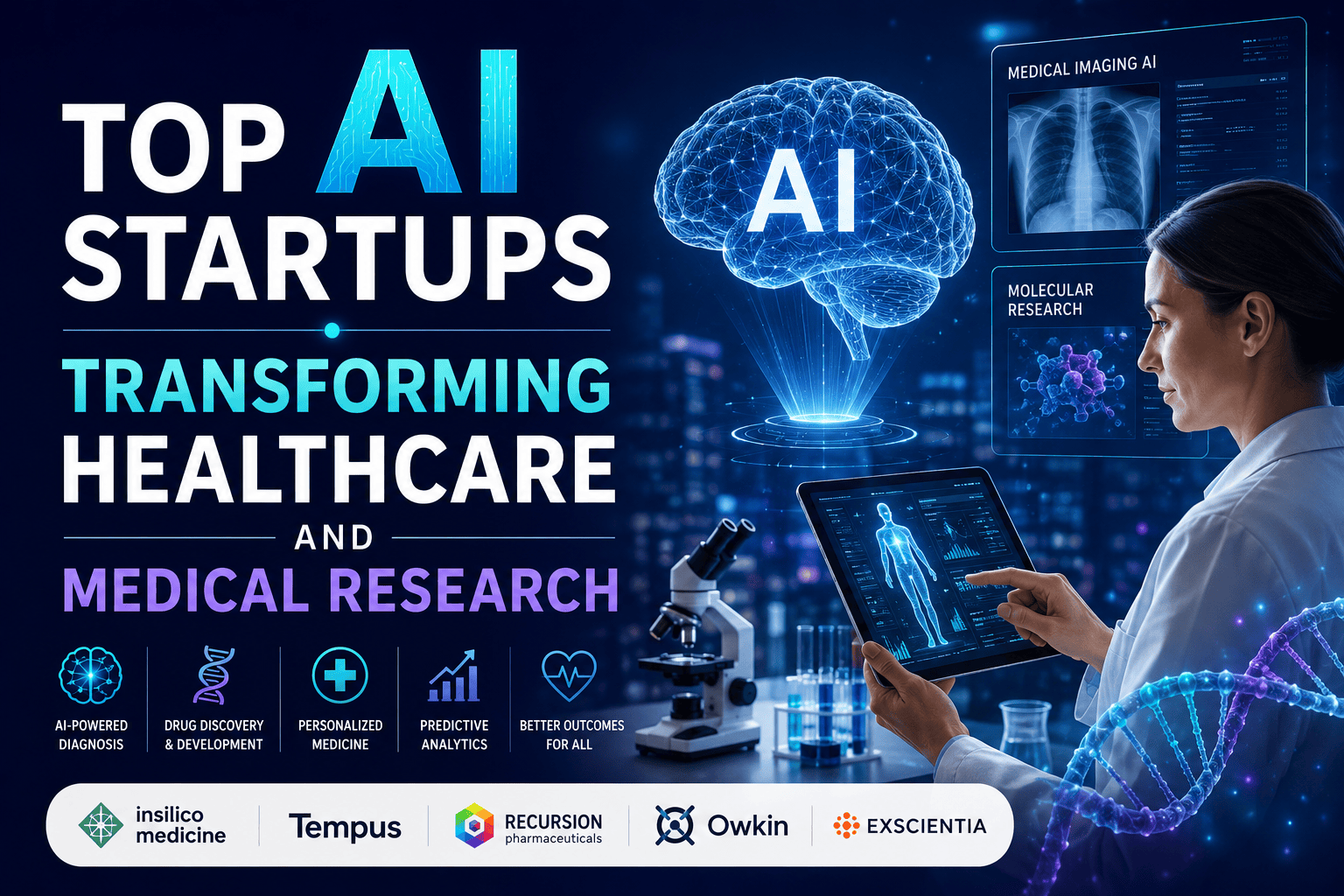
Top AI Startups Revolutionizing Healthcare and Medical Research
Introduction
The convergence of artificial intelligence and the life sciences has ushered in a new era of innovation, reshaping how diseases are diagnosed, treated, and studied. From accelerating drug discovery to personalizing patient care, AI startups are leveraging advanced machine learning, computer vision, and natural language processing to solve problems that once seemed insurmountable. This article explores the most influential AI‑driven startups that are redefining healthcare and medical research, examines the technologies they employ, and highlights the tangible impact they are already delivering. By dissecting concrete examples and real‑world applications, we aim to provide a comprehensive view of how these emerging companies are not only pushing the boundaries of scientific discovery but also improving outcomes for patients worldwide.
Key Areas of Impact AI startups are concentrating their efforts on several high‑impact domains within healthcare and medical research. Understanding these focal points helps illustrate why their contributions matter and where the most significant breakthroughs are occurring.
1. Drug Discovery and Development Traditional drug discovery can take over a decade and cost billions of dollars, with a high failure rate. AI startups are compressing timelines by predicting molecular interactions, optimizing clinical trial designs, and repurposing existing compounds. Their tools can screen millions of chemical entities in silico, prioritize candidates with the highest probability of success, and even generate novel molecular structures from scratch.
2. Precision Medicine and Diagnostics
Machine learning models excel at extracting patterns from complex biomedical data — genomic sequences, imaging scans, electronic health records (EHRs), and wearable sensor outputs. Startups in this space are building AI‑powered diagnostic assistants, risk stratification tools, and treatment recommendation engines that enable clinicians to deliver more accurate, individualized care.
3. Clinical Trial Optimization
Recruiting suitable participants and managing trial logistics are major bottlenecks. AI startups use predictive analytics to identify patients who meet trial criteria, forecast enrollment rates, and monitor trial safety in real time. These capabilities reduce costs, shorten study durations, and improve the statistical power of clinical research.
4. Real‑World Evidence and Health Analytics By aggregating and analyzing data from hospitals, insurers, and public health systems, AI startups generate actionable insights for policymakers, pharma companies, and providers. Their platforms can detect adverse drug reactions, monitor population health trends, and support value‑based care initiatives.
- AI Tools Accelerating Small BusinessGrowth – Top Solutions 2024
- 10Things to Know About Nigeria Revenue Service (NRS) Rev360 Explained
- Top Web3 Trends for Crypto Investors This Year
Promising AI Startups
Below is a curated list of AI startups that have demonstrated notable traction, secured substantial funding, and are delivering measurable results in healthcare and medical research. Each company is presented with a brief overview of its technology, key achievements, and strategic relevance.
1. Insilico Medicine
Focus: End‑to‑end drug discovery platform powered by deep generative models.
Key Technology: Reinforcement learning for molecule generation, AI‑driven target identification, and in‑silico clinical trial simulation.
Achievements: – Successfully designed a novel drug candidate for fibrosis in under 46 days, moving from target selection to pre‑clinical validation.
- Secured $400 M in Series C financing, underscoring investor confidence in AI‑accelerated pipelines.
- Partnered with major pharmaceutical firms to integrate AI‑generated molecules into their R&D pipelines.
Impact: Insilico’s approach dramatically reduces the time and cost associated with early‑stage drug discovery, enabling rapid response to emerging therapeutic needs such as pandemic‑related disease modifiers.
2. PathAI
Focus: AI‑enhanced pathology and diagnostic imaging.
Key Technology: Convolutional neural networks (CNNs) for slide image analysis, multi‑modal data fusion (histopathology + genomic data).
Achievements:
- Demonstrated 99 % concordance with expert pathologists in detecting breast cancer subtypes, reducing false‑negative rates by 30 %.
- FDA clearance for AI‑assisted detection of prostate cancer in biopsy slides.
- Integration with over 200 hospital labs worldwide, processing more than 10 M pathology images annually.
Impact: PathAI’s tools improve diagnostic accuracy, streamline pathologist workflows, and facilitate early detection of aggressive cancers, ultimately supporting more timely treatment decisions.
3. Owkin
Focus: Federated learning and AI for biomedical research.
Key Technology: Secure multi‑party computation, differential privacy, and explainable AI models.
Achievements:
- Enabled collaborative research across 30+ European hospitals to predict oncology treatment response without sharing raw patient data. – Developed “Owkin Studio,” a no‑code platform allowing researchers to build and deploy AI models on protected datasets.
- Raised $200 M to expand its federated learning network, targeting oncology, immunology, and rare disease studies.
Impact: By preserving data privacy while harnessing large, distributed datasets, Owkin empowers researchers to uncover biomarkers and therapeutic insights that would be impossible under traditional data‑sharing constraints.
4. Freenome
Focus: Blood‑based cancer detection using AI‑driven proteomics and genomics.
Key Technology: Machine learning pipelines that integrate cfDNA, protein, and methylation signals.
Achievements:
- Validated a multi‑omics assay that detects stage I colorectal cancer with 85 % sensitivity and 95 % specificity.
- Received Breakthrough Device designation from the FDA for its early‑detection platform.
- Partnered with major health systems to pilot population‑wide screening programs.
Impact: Freenome’s non‑invasive test offers a less invasive alternative to traditional colonoscopy screening, potentially increasing early‑diagnosis rates and reducing healthcare costs.
5. Tempus
Focus: AI‑powered precision medicine platform for oncology and chronic disease.
Key Technology: Natural language processing (NLP) for EHR mining, AI‑driven treatment recommendation engines, and real‑world evidence analytics.
Achievements:
- Processed over 10 M clinical notes, extracting actionable biomarkers for 200+ cancer types.
- Integrated with over 50 hospital networks, providing clinicians with personalized therapy suggestions based on genomic and treatment outcomes data.
- Secured $600 M in funding to expand its AI research labs and accelerate drug‑development collaborations. Impact: Tempus bridges the gap between data generation and clinical decision‑making, enabling oncologists to select therapies tailored to each patient’s molecular profile and historical treatment responses.
6. Atomwise
Focus: AI‑driven virtual screening for drug discovery.
Key Technology: Deep convolutional neural networks that predict binding affinity of millions of compounds to target proteins.
Achievements:
- Identified promising lead compounds for Ebola, multiple sclerosis, and antiviral resistance in under 48 hours.
- Established collaborations with over 30 pharmaceutical companies, resulting in three clinical‑stage candidates.
- Raised $150 M to expand its AI platform and accelerate early‑stage collaborations.
Impact: Atomwise’s rapid virtual screening capability shortens the hit‑to‑lead phase, allowing researchers to explore chemical space that was previously inaccessible, thereby increasing the odds of discovering viable drug candidates.
7. Cyclica
Focus: Proteomics‑centric drug discovery using AI.
Key Technology: AI‑based protein‑ligand interaction prediction, combined with large‑scale proteomics profiling.
Achievements:
- Developed a proprietary “Proteome AI” platform that maps drug‑target interactions across the entire human proteome.
- Identified novel targets for neurodegenerative diseases, leading to two pre‑clinical programs in partnership with biotech firms.
- Secured $120 M in Series B financing to expand its AI infrastructure and clinical collaborations.
Impact: Cyclica’s proteome‑wide approach uncovers hidden disease mechanisms, offering fresh targets for therapeutic intervention and reducing reliance on traditional, narrow‑focused screening methods.
8. Zebra Medical Vision
Focus: AI‑driven radiology analytics for chronic disease detection.
Key Technology: Deep learning models for chest X‑ray, CT, and MRI image interpretation.
Achievements:
- Deployed AI tools that detect early signs of cardiovascular disease, osteoporosis, and liver fibrosis from routine imaging.
- Integrated with over 300 hospitals and imaging centers, processing more than 200 M scans annually.
- Received CE marking and FDA clearance for multiple disease‑specific AI algorithms.
Impact: By embedding AI into everyday radiology workflows, Zebra Medical Vision enhances early disease detection, reduces radiologist workload, and democratizes access to advanced imaging analytics.
Challenges and Ethical Considerations
While AI startups are delivering transformative breakthroughs, they also face a set of complex challenges that must be addressed to sustain long‑term impact.
1. Data Quality and Standardization
AI models thrive on large, high‑quality datasets. However, biomedical data are often fragmented, inconsistently labeled, or biased toward specific populations. Startups must invest in robust data‑cleaning pipelines, adopt standardized ontologies, and implement strategies to mitigate demographic bias, ensuring that their models generalize across diverse patient groups.
2. Regulatory Hurdles
Bringing AI‑enabled medical devices and diagnostics to market requires navigating stringent regulatory pathways. Companies must demonstrate not only efficacy but also safety, transparency, and post‑market surveillance. Close collaboration with agencies such as the FDA and EMA is essential, and many startups are hiring regulatory experts to streamline approval processes.
3. Explainability and Trust
Clinicians are understandably cautious about adopting AI recommendations that lack interpretability. Startups are increasingly incorporating explainable AI (XAI) techniques — such as attention maps, feature importance scores, and counterfactual explanations — to provide clinicians with insight into how a model arrives at a decision. Building trust through transparent model behavior is critical for widespread adoption.
4. Ethical Use of Patient Data
Federated learning and privacy‑preserving AI (e.g., differential privacy) are promising tools, but they also raise ethical questions about consent, data ownership, and algorithmic fairness. Startups must adopt clear governance frameworks, engage with ethics boards, and ensure that patient rights are respected throughout the data lifecycle.
5. Integration with Existing Clinical Workflows
Even the most accurate AI models can fail if they are not seamlessly integrated into clinicians’ daily routines. Successful startups design user‑friendly interfaces, support interoperability with EHR systems, and conduct extensive usability testing to minimize disruption and maximize acceptance.
Future Outlook
The trajectory of AI in healthcare suggests a continued acceleration of innovation, driven by both technological advances and growing investment. Several trends are likely to shape the next five years:
- Convergence of Multi‑Modal AI – Combining genomics, imaging, wearable data, and clinical notes into unified AI models will enable holistic patient profiling and more precise interventions.
- AI‑Powered Drug Repurposing – Leveraging existing AI platforms to identify new therapeutic uses for approved drugs will shorten development timelines, especially for rare and emerging diseases.
- Decentralized Clinical Trials – AI will facilitate remote patient monitoring, adaptive trial designs, and real‑time data analytics, making trials more flexible and inclusive.
- Regulatory Evolution – Agencies are expected to introduce clearer frameworks for AI‑based medical devices, emphasizing post‑deployment monitoring and continuous learning capabilities.
- Global Collaboration – Public‑private partnerships and open‑source AI initiatives will foster cross‑border data sharing (within privacy constraints), accelerating discovery for global health challenges such as antimicrobial resistance and pandemic preparedness.
As these developments unfold, AI startups will remain at the forefront of translating cutting‑edge research into tangible patient benefits, reshaping the healthcare ecosystem from reactive to proactive, and from generic to personalized care.
Conclusion
AI startups are fundamentally altering how healthcare and medical research operate, delivering faster drug discoveries, more accurate diagnostics, and personalized treatment strategies that were once the realm of science fiction. Companies like Insilico Medicine, PathAI, Owkin, Freenome, Tempus, Atomwise, Cyclica, and Zebra Medical Vision illustrate the breadth of innovation occurring across the sector. While challenges related to data quality, regulation, explainability, ethics, and workflow integration persist, the industry is actively addressing these hurdles through rigorous engineering, collaborative governance, and user‑centric design. Looking ahead, the synergy between AI technology and life‑science research promises to accelerate breakthroughs, democratize access to cutting‑edge care, and ultimately improve health outcomes for populations worldwide. The continued growth and maturation of these startups will be pivotal in realizing a future where AI not only augments medical knowledge but also empowers clinicians and patients to make smarter, faster, and more compassionate decisions.