Content AI 2.0: Revolutionizing SEO with AI Inside WordPress
The digital landscape is in a constant state of flux, and nowhere is this more apparent than in the world of Search Engine Optimization (SEO). What was once a discipline heavily reliant on keyword density and technical tweaks has evolved into a sophisticated blend of user understanding, semantic analysis, and increasingly, artificial intelligence. As search engines become more intelligent, so too must our approach to content creation and optimization.
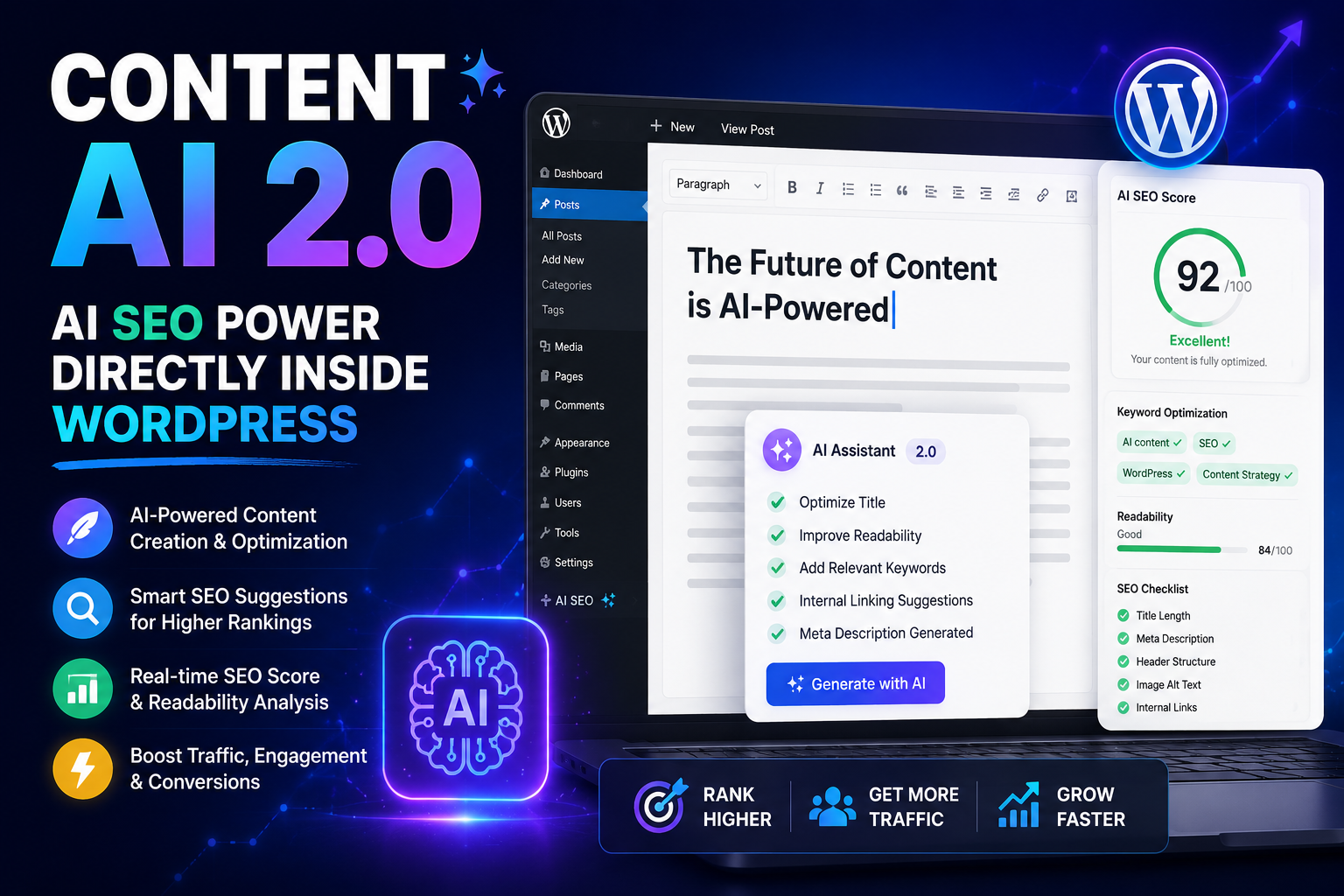
Enter Content AI 2.0 – a groundbreaking evolution that brings the power of advanced AI SEO directly into the heart of your WordPress editor. This isn’t just about generating text; it’s about integrating deep, data-driven SEO intelligence into every stage of your content workflow, making sophisticated optimization accessible, efficient, and intuitive for every WordPress user.
For years, content creators and SEO professionals have juggled multiple tools: one for keyword research, another for competitor analysis, a third for content outlines, and perhaps a separate AI writing assistant. This fragmented workflow often led to inefficiencies, inconsistencies, and a steep learning curve. Content AI 2.0 aims to dissolve these barriers, offering a unified, intelligent environment where your content is not just written, but strategically optimized from conception to publication, all without ever leaving your WordPress dashboard.
This article will delve into what Content AI 2.0 entails, explore its transformative features, highlight the immense benefits of AI SEO integration within WordPress, and outline how this innovation is poised to redefine the future of content creation and digital visibility.
The Evolution of SEO: From Keywords to Intent
To truly appreciate the significance of Content AI 2.0, it’s essential to understand the journey SEO has taken over the past two decades. What began as a relatively straightforward technical discipline has blossomed into a complex art and science, driven by ever-smarter search algorithms.
The Early Days: Keyword Stuffing and Basic Optimization
In the nascent stages of the internet, search engines were simpler. Their algorithms primarily focused on matching keywords in a user’s query with keywords present on a webpage. This led to practices like “keyword stuffing,” where webmasters would cram as many relevant keywords as possible into their content, often at the expense of readability and user experience. Basic on-page elements like title tags, meta descriptions, and heading tags were the primary levers for optimization. The focus was largely on the what – what keywords were present – rather than the why or how a user was searching.
The Rise of Semantic SEO and User Experience
As search engines matured, particularly with Google’s various algorithm updates (Panda, Penguin, Hummingbird, RankBrain, BERT, MUM), the emphasis shifted dramatically. The algorithms began to understand not just individual keywords, but the context and relationships between words. This marked the dawn of semantic SEO, where the goal was to cover a topic comprehensively, answer user questions thoroughly, and provide a superior user experience.
Factors like readability, site speed, mobile-friendliness, internal linking, external links, and user engagement metrics (bounce rate, time on page) became crucial. Search engines started to infer user intent – was the user looking for information, a product to buy, a local business, or a specific website? Content had to align with this intent, offering value beyond just a collection of keywords. The quality, authority, and trustworthiness of a website also gained significant importance, giving rise to concepts like E-E-A-T (Experience, Expertise, Authoritativeness, Trustworthiness).
The AI Revolution: Understanding Context and Intent
Today, AI is at the forefront of search engine capabilities. Large Language Models (LLMs) and advanced machine learning algorithms allow search engines to understand natural language queries with unprecedented accuracy, grasp complex relationships between entities, and even generate summaries or answer questions directly within the search results. This means that for content to rank, it must not only be relevant and high-quality but also demonstrate a deep understanding of the topic, anticipate user needs, and provide a comprehensive, authoritative answer.
This evolution has made SEO more challenging for content creators, requiring sophisticated analysis and a keen understanding of data. This is precisely where Content AI 2.0 steps in, leveraging AI to bridge the gap between human creativity and algorithmic demands.
- Web3 Staff Data Engineer Job: $400k-$500k Salary
- Pixel 11 Pro XL Review: HiLight Is Its Most Disappointing New Feature
- How to Make $1000 in a Day: Quick & Easy Methods
What is Content AI? A Primer
Before diving into the specifics of Content AI 2.0, let’s clarify what “Content AI” generally refers to in the context of SEO and content creation. It’s more than just an AI writing tool; it’s an intelligent assistant designed to enhance the entire content lifecycle.
Beyond Basic Content Generation
Many people associate “AI content” solely with automated text generation. While AI can certainly write paragraphs, articles, and marketing copy, Content AI goes much further. It encompasses a suite of AI-powered tools that assist with research, planning, optimization, and even performance analysis. Its primary goal is to help creators produce content that is not only well-written but also strategically positioned to rank well in search engines and resonate with target audiences.
The Core Promise: Data-Driven Content Creation
The fundamental promise of Content AI is to inject data and intelligence into every content decision. Instead of guessing what keywords to target, what topics to cover, or how long an article should be, Content AI leverages vast datasets – including competitor analysis, search engine results pages (SERPs), user queries, and semantic networks – to provide actionable insights. This data-driven approach minimizes guesswork and maximizes the potential for content success.
How Content AI Differs from Generic AI Writers
While generic AI writers focus on generating coherent and grammatically correct text based on a prompt, Content AI (especially in its advanced forms like Content AI 2.0) is specifically engineered with SEO in mind. It understands:
- Search Intent: Why users are searching for a particular topic.
- SERP Landscape: What types of content are already ranking and why.
- Topical Authority: What subtopics need to be covered for comprehensive understanding.
- Optimization Metrics: Readability, keyword usage, heading structure, and more.
In essence, a generic AI writer is a powerful pen; Content AI is a strategic editor, researcher, and SEO consultant rolled into one, guiding you towards content that performs.
Introducing Content AI 2.0: The Next Frontier
Content AI 2.0 represents a significant leap forward, particularly in its seamless integration of advanced AI SEO capabilities directly within the WordPress environment. It’s about moving beyond AI as a separate tool and embedding it as an intrinsic part of your content creation process.
A Deep Dive into AI SEO Integration
The core innovation of Content AI 2.0 is its ability to perform sophisticated SEO tasks using AI, not in a separate application, but right where you write and edit your posts. This means:
- Real-time Analysis: As you type, the AI analyzes your content against SEO best practices and competitor data.
- Contextual Suggestions: It provides suggestions relevant to the specific paragraph, section, or overall article you’re working on.
- Automated Workflows: Tasks that once took hours, like generating content briefs or identifying internal linking opportunities, are now automated or heavily assisted.
This deep integration transforms the WordPress editor from a simple text input field into an intelligent content command center.
Why “Inside WordPress” Matters: Streamlined Workflow
The “Inside WordPress” aspect is not just a convenience; it’s a strategic advantage. Consider the traditional workflow:
- Research: Use an SEO tool for keywords, competitor analysis.
- Outline: Manually create a content brief based on research.
- Write: Draft content in WordPress or a separate editor.
- Optimize: Copy content into an SEO analysis tool, make changes, then copy back.
- Publish: Hope for the best.
This constant switching between tabs and tools is inefficient and prone to errors. Content AI 2.0 eliminates this friction:
- Single Interface: All research, writing, and optimization happen in one place.
- Reduced Context Switching: Stay focused on your content without mental overhead.
- Faster Iteration: Make changes and see their SEO impact instantly.
- Lower Barrier to Entry: Even users less familiar with advanced SEO tools can leverage sophisticated strategies.
By embedding AI SEO directly into WordPress, Content AI 2.0 democratizes advanced optimization, making it accessible to a broader range of users, from solo bloggers to large content teams.
The Vision: Making Advanced SEO Accessible
The overarching vision behind Content AI 2.0 is to empower every WordPress user to create content that not only ranks but truly resonates with their audience. It aims to demystify complex SEO strategies, turning them into intuitive, actionable steps. By providing intelligent guidance at every turn, Content AI 2.0 allows creators to focus more on their unique voice and expertise, while the AI handles the intricate details of search engine optimization. It’s about making advanced SEO a natural extension of the content creation process, rather than a separate, daunting task.
Key Features of Content AI 2.0 for AI SEO
Content AI 2.0 isn’t a single feature; it’s a comprehensive suite of AI-powered tools designed to supercharge your SEO efforts directly within WordPress. Here are some of its most impactful capabilities:
Intelligent Keyword Research & Clustering
Traditional keyword research can be tedious and overwhelming. Content AI 2.0 leverages AI to go beyond simple keyword suggestions, identifying user intent and grouping related terms.
- How it works: The AI analyzes top-ranking content, search queries, and latent semantic indexing (LSI) keywords to uncover not just individual keywords, but entire clusters of related topics and questions that users are asking. It understands the semantic relationships between terms.
- Example: Instead of just suggesting “best coffee maker,” it might identify clusters around “espresso machine reviews,” “cold brew methods,” “aeropress vs chemex,” and “coffee grinder recommendations,” helping you build comprehensive topical authority. It can even suggest long-tail variations and questions that your competitors might be missing.
Real-time Content Optimization & Scoring
This is where the “inside WordPress” aspect truly shines. As you write, Content AI 2.0 provides continuous, actionable feedback.
- How it works: The AI compares your draft against competitor content, SEO best practices, and your target keywords/topics. It analyzes readability, keyword density (without over-optimization), topic coverage, heading structure, and even sentiment.
- Example: As you type, a sidebar might show a live score, highlighting areas where you need to expand on a subtopic, suggest a more impactful heading, or indicate if a paragraph is becoming too complex for your target audience. It might flag if you’ve used a key phrase too often or not enough, offering alternatives.
Automated Content Brief Generation
Starting a new article often involves extensive research to understand what needs to be covered. Content AI 2.0 automates much of this process.
- How it works: By analyzing the top-ranking results for your target keyword, the AI can automatically generate a comprehensive content brief. This includes suggested headings (H2s, H3s), questions to answer (from “People Also Ask” and related searches), key talking points, target word count, and even a list of entities or concepts to mention.
- Example: For an article on “vegan protein sources,” the AI might generate an outline with headings like “Why Choose Plant-Based Protein?”, “Top 10 Vegan Protein Foods,” “Complete vs. Incomplete Proteins,” “How Much Protein Do Vegans Need?”, and a list of specific foods like “lentils,” “chickpeas,” “quinoa,” and “tofu” to include.
AI-Powered Content Generation & Expansion
While Content AI 2.0 is primarily an optimization tool, it also offers intelligent assistance for generating and expanding content.
- How it works: Leveraging advanced LLMs, the AI can draft sections, rewrite paragraphs for clarity or SEO, generate compelling meta descriptions and titles, create FAQs based on common user queries, or even expand bullet points into detailed explanations. It does this with an understanding of the SEO context you’ve established.
- Example: If you’re stuck on an introduction, you can prompt the AI to generate a few options based on your target keyword. Or, if you have a bulleted list of benefits, you can ask the AI to expand each point into a concise paragraph, ensuring it naturally incorporates relevant keywords.
Competitor Analysis & Gap Identification
Understanding what your competitors are doing well (and where they fall short) is crucial for outranking them.
- How it works: The AI scrapes and analyzes the top-ranking pages for your target keyword, breaking down their structure, topics covered, media usage, and overall content strategy. It then identifies “content gaps” – topics or questions that competitors cover that you haven’t, or areas where their content is weak.
- Example: For a review article, the AI might highlight that competitors often include a comparison table or a video review, suggesting you add similar elements. It could also point out a specific common pain point or benefit that competitors don’t adequately address, giving you an opportunity to differentiate your content.
Internal Linking Suggestions
Internal links are vital for SEO, helping search engines understand your site’s structure and distributing “link juice.” However, manually finding relevant internal linking opportunities can be time-consuming.
- How it works: The AI analyzes your existing WordPress content, understanding the topics covered in each post. As you write a new article, it suggests relevant older posts to link to, along with appropriate anchor text, based on semantic similarity and topical relevance.
- Example: While writing about “email marketing strategies,” the AI might suggest linking to your older post titled “How to Build an Email List” using anchor text like “building your subscriber base” or “email list growth tactics.”
Schema Markup Generation (Automated)
Schema markup helps search engines understand the content on your page more deeply, potentially leading to rich snippets in search results. Manually adding schema can be complex.
- How it works: Content AI 2.0 can automatically suggest and generate appropriate schema markup based on the type of content you’re creating (e.g., Article schema, FAQ schema, Product schema, How-To schema). It extracts relevant information from your post to populate the schema fields.
- Example: For a recipe post, the AI could automatically generate Recipe schema, pulling in ingredients, cooking time, and instructions. For a Q&A section, it could generate FAQ schema, making your questions and answers eligible for rich snippets.
Performance Tracking & Iterative Optimization
SEO is an ongoing process. Content AI 2.0 extends its intelligence beyond initial publication.
- How it works: By integrating with analytics and search console data (or similar internal tracking), the AI can monitor the performance of your content. It tracks keyword rankings, traffic, and engagement, and then provides data-driven suggestions for content updates, expansions, or re-optimizations to improve its performance over time.
- Example: If a post starts to dip in rankings for a key term, the AI might suggest adding a new section addressing a recent development, updating statistics, or expanding on a particular subtopic that competitors are now covering more thoroughly.
The Benefits of AI SEO Inside WordPress with Content AI 2.0
The integration of advanced AI SEO capabilities directly into WordPress through Content AI 2.0 offers a multitude of benefits for content creators, marketers, and business owners alike.
Unprecedented Efficiency
By consolidating multiple SEO tasks into a single, intuitive interface, Content AI 2.0 drastically reduces the time and effort required for content creation and optimization. No more switching between tools, copying and pasting, or manually cross-referencing data. This streamlined workflow allows you to produce high-quality, SEO-optimized content faster than ever before.
Enhanced Content Quality & Relevancy
The AI’s ability to analyze search intent, competitor strategies, and semantic relationships ensures that your content is not just well-written, but also deeply relevant and comprehensive. It helps you cover topics thoroughly, answer user questions effectively, and provide the kind of value that modern search engines reward. This leads to content that truly resonates with your audience and establishes your authority.
Improved Search Engine Rankings
At its core, Content AI 2.0 is designed to help your content rank higher. By guiding you through intelligent keyword targeting, comprehensive topic coverage, optimal content structure, and technical SEO elements like schema, it ensures your content is perfectly aligned with what search engines are looking for. This translates directly into increased organic visibility and traffic.
Democratization of Advanced SEO
Complex SEO strategies, once the domain of specialized agencies and seasoned professionals, are now accessible to everyone. Content AI 2.0 acts as an intelligent co-pilot, guiding even novice users through sophisticated optimization techniques. This empowers small businesses, independent bloggers, and solopreneurs to compete effectively in crowded digital spaces.
Seamless Workflow Integration
The “inside WordPress” aspect is a game-changer. It eliminates context switching, reduces cognitive load, and creates a natural, fluid content creation process. You can research, write, optimize, and publish without ever leaving your familiar WordPress environment, fostering greater focus and productivity.
Data-Driven Decision Making
Gone are the days of guesswork. Content AI 2.0 provides actionable insights based on real-time data and sophisticated analysis. From keyword suggestions to content gaps, every recommendation is backed by intelligence, allowing you to make informed decisions that drive better results. This data-first approach minimizes wasted effort and maximizes ROI.
Who Can Benefit from Content AI 2.0?
The broad utility and accessibility of Content AI 2.0 mean that a wide range of individuals and organizations can reap its benefits.
- Bloggers & Content Creators: Whether you’re a hobbyist or a professional blogger, Content AI 2.0 can help you generate ideas, optimize your posts for better visibility, and streamline your writing process, allowing you to focus on your passion.
- Small Business Owners: For businesses with limited marketing budgets, Content AI 2.0 provides an affordable way to implement advanced SEO strategies, driving organic traffic and potential customers to their websites without needing to hire expensive consultants.
- SEO Agencies & Consultants: Agencies can leverage Content AI 2.0 to enhance their efficiency, scale their content production, and deliver even more impactful results for their clients, automating routine tasks and focusing on high-level strategy.
- E-commerce Sites: Product descriptions, category pages, and blog content are crucial for e-commerce SEO. Content AI 2.0 can help optimize these pages for relevant keywords, improve product visibility, and drive sales.
- Digital Marketers: Anyone responsible for online content marketing can use Content AI 2.0 to ensure their campaigns are not only creative but also strategically optimized for search performance, leading to better campaign ROI.
Getting Started with Content AI 2.0: A Practical Approach
Embracing Content AI 2.0 doesn’t have to be daunting. Here’s a practical roadmap to integrate this powerful tool into your workflow:
Installation and Setup
Typically, Content AI 2.0 will be available as a plugin or an integrated feature within a popular WordPress SEO plugin. The first step is to install and activate it. Follow the initial setup wizard, which might involve connecting to an API key or configuring basic preferences.
Understanding the Interface
Spend some time exploring the new AI features within your WordPress editor. Familiarize yourself with the AI sidebar, the scoring system, and where to access the various tools like keyword research, content brief generation, and content expansion. Most tools are designed to be intuitive, but a quick walkthrough will help.
Your First AI-Optimized Post
Start with a new post or an existing one that you want to optimize.
- Define your target keyword/topic: Input your primary keyword into the AI tool.
- Generate a content brief: Let the