Xiaomi Redmi Note 17 5G Hands-On Review: Redefining the Mid-Range Benchmark
The Redmi Note series from Xiaomi has long been synonymous with delivering exceptional value, often packing features typically found in more expensive flagships into an accessible mid-range package. Each iteration raises the bar, pushing the boundaries of what consumers can expect without breaking the bank. With the introduction of the Xiaomi Redmi Note 17 5G, the anticipation was palpable. Could Xiaomi once again redefine the mid-range benchmark, offering a compelling blend of performance, design, and camera prowess, all while embracing the future of connectivity?
After spending an intensive two weeks with the Redmi Note 17 5G as my daily driver, putting it through its paces across various scenarios – from demanding gaming sessions and extensive photography to everyday productivity and media consumption – I’m ready to share a comprehensive hands-on review. This isn’t just a spec sheet analysis; it’s an exploration of how the device feels, performs, and integrates into real-world usage. Does the Redmi Note 17 5G live up to the hype and its illustrious lineage? Let’s dive in.
Design and Build Quality: A Premium Touch for the Mid-Range
From the moment you unbox the Redmi Note 17 5G, it’s clear that Xiaomi has paid significant attention to its aesthetics and ergonomics. Gone are the days of purely utilitarian mid-range designs; the Note 17 5G exudes a refined elegance that could easily be mistaken for a device in a higher price bracket.
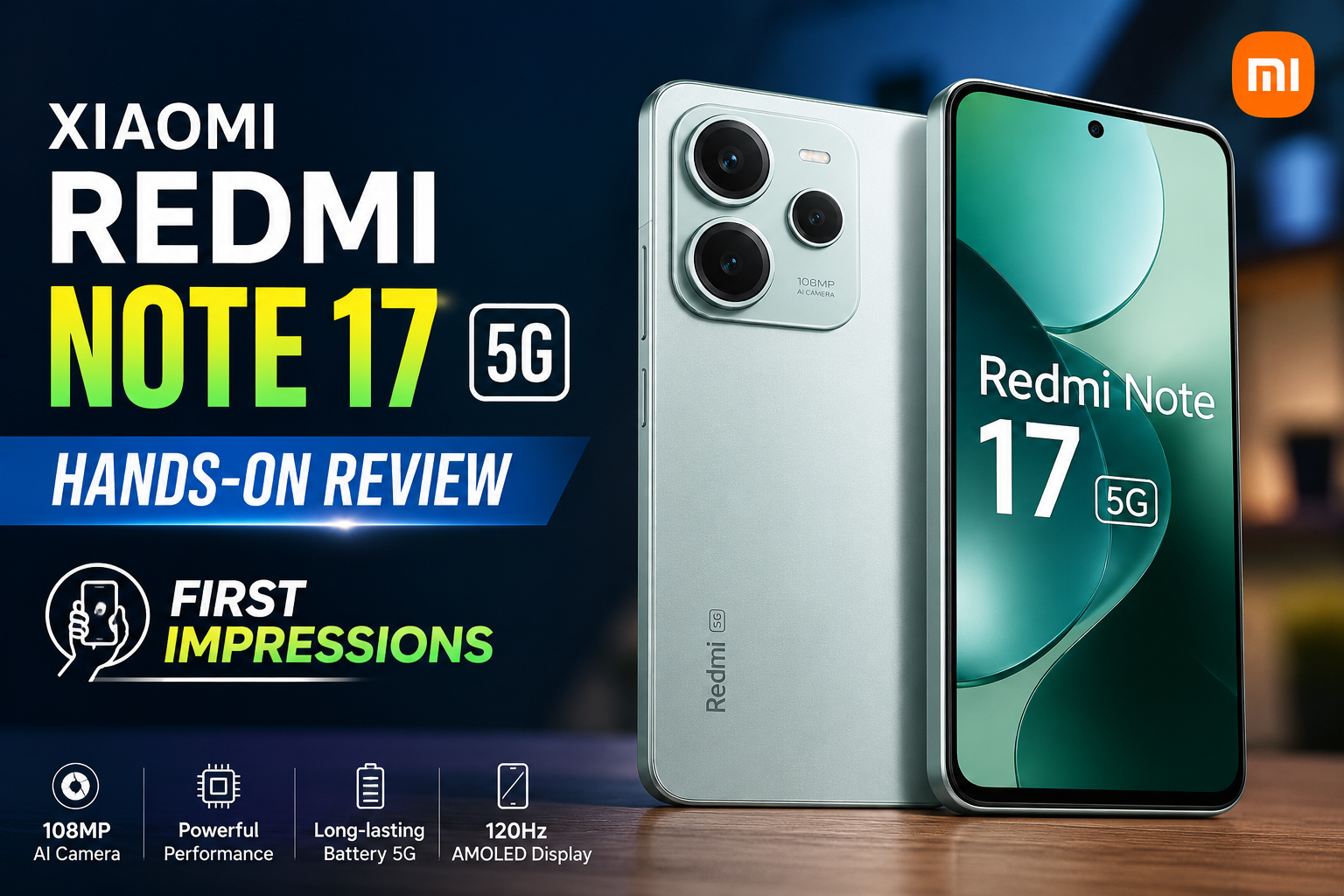
The review unit I received featured a stunning “Midnight Blue” finish, which shimmered subtly under different lighting conditions, transitioning from a deep navy to an almost royal blue. The back panel is crafted from a matte-finished glass, providing a pleasant tactile experience that resists fingerprints remarkably well – a welcome departure from glossy surfaces that often become smudge magnets. This matte finish also contributes to a more secure grip, reducing the fear of accidental slips.
The phone feels substantial yet not overly heavy in the hand, striking a good balance at approximately 190 grams. Its dimensions (around 162.5 x 75.8 x 8.0 mm) make it comfortable for one-handed use for those with average-sized hands, though reaching the top corners of the large display still requires a bit of a stretch. The flat edges, a trend we’ve seen across many recent smartphones, contribute to a modern aesthetic and provide a secure purchase when holding the device.
The camera module on the rear is a prominent, rectangular island, housing the multiple lenses and the LED flash. While it protrudes slightly, it’s tastefully integrated and doesn’t cause excessive wobbling when the phone is laid flat on a surface. The frame itself is made of a high-quality plastic, meticulously color-matched to the back panel, giving the illusion of a seamless, unibody construction.
On the right side, you’ll find the volume rocker and the power button, which also cleverly integrates a fast and accurate capacitive fingerprint sensor. The buttons offer satisfying tactile feedback and are well-positioned for easy access. The bottom edge houses the USB-C port, a speaker grille, and – to the delight of many – a 3.5mm headphone jack. The top edge features an IR blaster, a signature Xiaomi feature, allowing you to control various home appliances, and a secondary microphone for noise cancellation. Dual stereo speakers are also present, with the earpiece doubling as the second speaker.
Overall, the Redmi Note 17 5G’s design and build quality punch well above its weight class. It feels robust, looks sophisticated, and offers a level of refinement that elevates the mid-range experience. Xiaomi has clearly invested in making this device not just functional, but also desirable.
Display: A Visual Feast for the Senses
The display is arguably one of the most crucial components of any smartphone, and the Redmi Note 17 5G does not disappoint. It features a stunning 6.67-inch AMOLED DotDisplay, boasting a Full HD+ resolution (2400 x 1080 pixels). But the real star of the show is its buttery-smooth 120Hz refresh rate, which makes every interaction, from scrolling through social media feeds to navigating menus, feel incredibly fluid and responsive.
The AMOLED panel delivers vibrant colors, deep inky blacks, and excellent contrast ratios, making content consumption an absolute joy. Whether I was streaming high-definition videos on Netflix, browsing photo galleries, or simply reading articles, the visuals were consistently sharp and engaging. Xiaomi has also equipped the display with DCI-P3 wide color gamut support, ensuring accurate and rich color reproduction.
Brightness levels are impressive for a mid-range device. With a typical brightness of around 500 nits and a peak brightness that can hit 1200 nits in direct sunlight, outdoor visibility was never an issue. Even under harsh midday sun, I could comfortably read emails and view maps without squinting. The automatic brightness adjustment was also quick and intelligent, adapting seamlessly to changing lighting conditions.
The display is protected by Corning Gorilla Glass Victus, offering enhanced durability against scratches and minor drops – a significant upgrade for a phone in this segment. The punch-hole cutout for the front camera is small and unobtrusive, blending well into the overall display experience. There are also various display customization options within MIUI, including a reading mode, dark mode, and the ability to fine-tune color schemes to your preference.
Gaming on this display is particularly immersive. The high refresh rate combined with a 240Hz touch sampling rate ensures minimal input lag and incredibly smooth animations, providing a competitive edge in fast-paced titles. Media consumption, whether it’s YouTube, TikTok, or a full-length movie, is a delight thanks to the vibrant colors and deep blacks. The Redmi Note 17 5G’s display truly sets a high standard for its category.
Performance: Powering Through Daily Demands
Under the hood, the Redmi Note 17 5G is powered by the latest Qualcomm Snapdragon 7 Gen 3 processor, a formidable chipset designed to deliver a balance of raw power and energy efficiency. This is paired with either 8GB or 12GB of LPDDR5 RAM and 128GB, 256GB, or 512GB of UFS 3.1 storage, ensuring swift app launches and ample space for all your files and media. My review unit came with the 12GB RAM and 256GB storage configuration.
In daily usage, the phone is exceptionally snappy and responsive. Apps open instantly, multitasking is a breeze with multiple applications running in the background, and navigating the MIUI interface feels fluid and lag-free. The 12GB of RAM ensures that even memory-intensive apps remain in memory, allowing for quick switching without needing to reload.
Gaming performance is where the Snapdragon 7 Gen 3 truly shines in the mid-range. I tested a variety of demanding titles, including Genshin Impact, Call of Duty Mobile, and PUBG Mobile. Genshin Impact ran smoothly at medium to high settings with a stable frame rate, only showing minor dips during intense combat sequences. Call of Duty Mobile and PUBG Mobile consistently maintained high frame rates at their respective highest graphical settings, offering a console-like experience. The phone did get mildly warm during extended gaming sessions, but never to an uncomfortable degree, indicating efficient thermal management.
Synthetic benchmarks also painted a positive picture, with scores that place the Redmi Note 17 5G firmly at the top of its mid-range competitors, often encroaching on last year’s flagship territory. This level of performance ensures that the phone will remain capable and future-proof for several years, handling new apps and more demanding software updates with ease.
For productivity, the Note 17 5G handles everything from heavy web browsing with dozens of tabs to document editing and video conferencing without breaking a sweat. The combination of a powerful processor, ample RAM, and fast storage makes it an excellent device for users who demand more than just basic functionality from their smartphone.
Software and User Experience: MIUI on Android 14
The Redmi Note 17 5G ships with Android 14 out of the box, layered with Xiaomi’s latest iteration of its custom user interface, HyperOS 1.0 (or MIUI 15, depending on regional branding and final rollout). This combination offers a feature-rich, highly customizable, and generally smooth user experience.
HyperOS 1.0 brings a refreshed visual aesthetic with new icons, animations, and a cleaner control center inspired by iOS. The animations are particularly noteworthy, feeling more fluid and cohesive than previous MIUI versions, contributing to the overall sense of speed and responsiveness. Customization options are abundant, allowing users to tweak everything from themes and fonts to notification styles and always-on display configurations.
Xiaomi has also introduced several smart features aimed at improving productivity and convenience. These include enhanced multi-window capabilities, a floating window mode for specific apps, and an improved sidebar for quick access to frequently used tools and apps. The new privacy dashboard provides greater transparency and control over app permissions, aligning with modern Android privacy standards.
However, it wouldn’t be a Xiaomi review without mentioning the presence of bloatware. While less egregious than in some past iterations, the Redmi Note 17 5G still comes with a handful of pre-installed third-party apps and Xiaomi’s own suite of applications. Many of these can be uninstalled or disabled, but it’s an extra step for users who prefer a cleaner experience. There are also occasional promotional notifications from Xiaomi’s apps, though these can generally be turned off in the settings.
Xiaomi’s commitment to software updates has improved over the years, and the Redmi Note 17 5G is expected to receive at least two major Android version updates and three years of security patches, which is commendable for a device in this price segment. Overall, the software experience is polished, feature-packed, and generally enjoyable, provided you take a few minutes to customize it to your liking and debloat where necessary.
Camera System: Versatility and Detail for the Mid-Range
The camera system on the Redmi Note 17 5G is one of its most compelling features, especially considering its price point. Xiaomi has equipped it with a versatile triple-camera setup on the rear and a capable front-facing camera.
Hardware Configuration:
- Main Camera: 108MP primary sensor with OIS (Optical Image Stabilization), f/1.7 aperture, PDAF. This sensor uses 9-in-1 pixel binning to produce excellent 12MP photos by default, but also offers a full 108MP mode for maximum detail.
- Ultra-Wide Camera: 8MP sensor, f/2.2 aperture, 120-degree field of view.
- Macro Camera: 2MP sensor, f/2.4 aperture.
- Front Camera: 32MP sensor, f/2.4 aperture.
Daylight Photography:
In well-lit conditions, the 108MP main sensor truly shines. Photos are consistently sharp, with excellent detail, vibrant colors, and a good dynamic range. The OIS helps in keeping shots steady, reducing blur even in slightly challenging conditions. Xiaomi’s image processing tends to boost colors slightly, resulting in punchy and eye-catching images that are ready for social media without much editing.
The 2x in-sensor zoom, leveraging the high-resolution main sensor, produces surprisingly good results, often rivaling dedicated telephoto lenses in terms of detail and clarity, especially when compared to digital zoom on lower-resolution sensors. The full 108MP mode captures an incredible amount of detail, allowing for significant cropping without losing quality, though these files are large and processing takes a moment.
The 8MP ultra-wide camera performs admirably in good lighting. It captures a broad perspective, perfect for landscapes or group shots. While details are naturally softer towards the edges compared to the main sensor, the color reproduction is consistent, and barrel distortion is well-controlled.
Low-Light Photography:
Low-light performance is often a weak point for mid-range phones, but the Redmi Note 17 5G holds its own remarkably well. The large main sensor, combined with OIS and Xiaomi’s improved Night Mode, produces bright, detailed, and relatively noise-free images in challenging conditions. The Night Mode effectively brightens shadows, controls highlights, and enhances overall clarity, making low-light shots genuinely usable. While it can’t quite match flagship performance, it certainly surpasses many of its direct competitors. The ultra-wide camera struggles more in low light, exhibiting more noise and less detail, which is expected.
Macro and Portrait Photography:
The 2MP macro camera is a bit of a mixed bag. While it allows for close-up shots, the low resolution means details are limited, and good lighting is essential. It’s more of a novelty than a truly functional lens.
Portrait mode, using the main camera, does an excellent job of subject separation, creating a pleasing bokeh effect. Edge detection is generally accurate, even with complex hair patterns, and the background blur looks natural. The 32MP front camera also delivers sharp and detailed selfies with good color accuracy. It supports portrait mode as well, with decent edge detection.
Video Recording:
The Redmi Note 17 5G can record video up to 4K at 30fps with the main camera, and 1080p at 30fps with the ultra-wide and front cameras. The OIS on the main sensor provides decent stabilization for handheld footage, making videos look smoother and less shaky. Colors are vibrant, and detail is good in well-lit environments. While it lacks some advanced video features found on flagships (like 60fps at 4K or advanced cinematic modes), it’s more than capable for casual video recording and vlogging.
Overall, the Redmi Note 17 5G’s camera system is a strong performer in its category. The 108MP main sensor with OIS is a standout, delivering excellent results in most conditions, and the software processing further enhances the experience.
Battery Life and Charging: Endurance Meets Speed
Battery life has always been a cornerstone of the Redmi Note series, and the Note 17 5G continues this tradition with a massive 5000mAh battery. In my testing, this translated into exceptional endurance, easily lasting a full day of heavy use and often stretching into a second day with moderate usage.
My typical day involves a mix of web browsing, social media, email, streaming music, about an hour of gaming, and frequent camera use. With this usage pattern, the Redmi Note 17 5G consistently delivered between 7 to 8 hours of screen-on time, which is truly impressive. Lighter users could comfortably get two days out of a single charge. The efficient Snapdragon 7 Gen 3 processor and the adaptive refresh rate of the AMOLED display undoubtedly contribute to this excellent longevity.
When it comes to charging, Xiaomi has equipped the Redmi Note 17 5G with blazing-fast 120W HyperCharge technology. And, unlike some competitors, Xiaomi includes the 120W charger in the box – a significant value addition. This technology is genuinely transformative. In my tests, the phone charged from 0% to 100% in a staggering 19 minutes. Even a quick 5-minute top-up can provide enough power to get you through several hours of use, making battery anxiety a thing of the past. It’s incredibly convenient to plug in your phone while getting ready in the morning and have it fully charged before you walk out the door.
The phone also supports various charging protocols, ensuring compatibility with other chargers, though at slower speeds. Xiaomi has also implemented multiple safety features and temperature monitoring to ensure the fast charging process is safe and doesn’t degrade battery health prematurely.
- How to Check NAQS Shortlist 2026: CBT Date & Screening Details
- NAQS Recruitment Shortlist 2026: Check Name, CBT Date & Screening Details
- SMEDAN CGS Portal 2026: How to Apply for ₦50,000 Grant, Eligibility
Connectivity and Audio: Future-Proof and Feature-Rich
As its name suggests, the Redmi Note 17 5G is fully equipped for the next generation of mobile connectivity. It supports a wide array of 5G bands, ensuring broad compatibility across different carriers and regions. In areas with 5G coverage, I experienced consistently fast download and upload speeds, along with lower latency, making streaming, large file downloads, and online gaming feel incredibly responsive.
Beyond 5G, the phone features Wi-Fi 6 for faster and more stable wireless connections, Bluetooth 5.3 for efficient pairing with accessories, and NFC for contactless payments and quick pairing. GPS and other satellite navigation systems are accurate and lock on quickly, making navigation reliable. The inclusion of an IR blaster is a classic Xiaomi touch, allowing the phone to double as a universal remote control for TVs, air conditioners, and other appliances – a surprisingly useful feature.
Audio-wise, the Redmi Note 17 5G delivers a commendable experience. It boasts dual stereo speakers, with the earpiece acting as the second speaker. These speakers produce loud, clear audio with a decent amount of bass for a smartphone. While they won’t replace a dedicated Bluetooth speaker, they’re more than adequate for casual music listening, podcasts, and video consumption. The soundstage is surprisingly wide, enhancing the immersive experience, especially when watching movies.
Crucially for many, the 3.5mm headphone jack makes a welcome return. This allows users to continue using their favorite wired headphones without needing an adapter, a feature that’s becoming increasingly rare in modern smartphones. For those who prefer wireless audio, the Bluetooth 5.3 support ensures high-quality audio codecs and stable connections.
Security and Biometrics: Fast and Reliable
The Redmi Note 17 5G offers robust security features to protect your data. The primary biometric authentication method is the side-mounted capacitive fingerprint sensor, integrated into the power button. This sensor is exceptionally fast and accurate, unlocking the phone almost instantaneously with a simple tap. Its placement is intuitive and falls naturally under the thumb (for right-handed users) or index finger (for left-handed users).
In addition to the fingerprint sensor, the phone also supports AI face unlock using the front camera. While not as secure as the fingerprint sensor (due to being 2D), it’s incredibly convenient and works well in most lighting conditions. It’s quick to recognize faces and provides a seamless unlocking experience.
Standard Android security features like PIN, pattern, and password unlock are also available. Xiaomi’s HyperOS also includes various privacy enhancements, such as app locking, hidden apps, and a secure folder for sensitive data, giving users comprehensive control over their device’s security.
Pros and Cons: A Balanced Perspective
After extensive testing, here’s a quick rundown of the Redmi Note 17 5G’s strengths and weaknesses:
Pros:
- Stunning AMOLED 120Hz Display: Vibrant colors, deep blacks, and incredibly smooth scrolling.
- Exceptional Performance: Snapdragon 7 Gen 3 handles all tasks, including demanding games, with ease.
- Outstanding Battery Life: 5000mAh battery easily lasts a full day, often more.
- Blazing-Fast 120W Charging: Full charge in under 20 minutes, with charger included.
- Capable 108MP OIS Camera: Excellent daylight photos, impressive low-light performance for its class.
- Premium Design and Build Quality: Matte glass back, comfortable ergonomics, durable Gorilla Glass Victus.
- Future-Proof Connectivity: Full 5G support, Wi-Fi 6, Bluetooth 5.3.
- Stereo Speakers and 3.5mm Headphone Jack: Enhanced audio experience and versatility.
- IR Blaster: Handy for controlling home appliances.
- Value for Money: Packs high-end features into a mid-range price point.
Cons:
- Bloatware: Some pre-installed apps and occasional promotional notifications.
- 2MP Macro Camera: Low resolution limits its utility.
- Ultra-Wide Camera in Low Light: Performance drops significantly compared to the main sensor.
- Software Updates: While improved, still not as consistent or long-term as some competitors.
Conclusion: The New Mid-Range Champion?
The Xiaomi Redmi Note 17 5G isn’t just another iteration in a long line of successful smartphones; it’s a statement. It represents Xiaomi’s continued commitment to democratizing advanced technology, bringing features and performance traditionally reserved for flagships down to a more accessible price point.
From its premium design and stunning 120Hz AMOLED display to its powerful Snapdragon 7 Gen 3 processor, versatile 108MP OIS camera, and truly game-changing 120W fast charging, the Redmi Note 17 5G excels in almost every category. It delivers an experience that genuinely punches above its weight, making it an incredibly compelling option for anyone in the market for a new smartphone.
While there are minor drawbacks, such as the persistent bloatware and the less impressive macro camera, these are easily overshadowed by the sheer volume of positives. The Redmi Note 17 5G is a phone that not only meets expectations but consistently exceeds them, offering a complete and satisfying user experience.
If you’re looking for a smartphone that offers phenomenal value, future-proof 5G connectivity, stellar performance for both work and play, and a camera that can capture memorable moments with impressive detail, all without emptying your wallet, then the Xiaomi Redmi Note 17 5G should be at the very top of your list. It is, without a doubt, a strong contender for the title of the new mid-range champion.