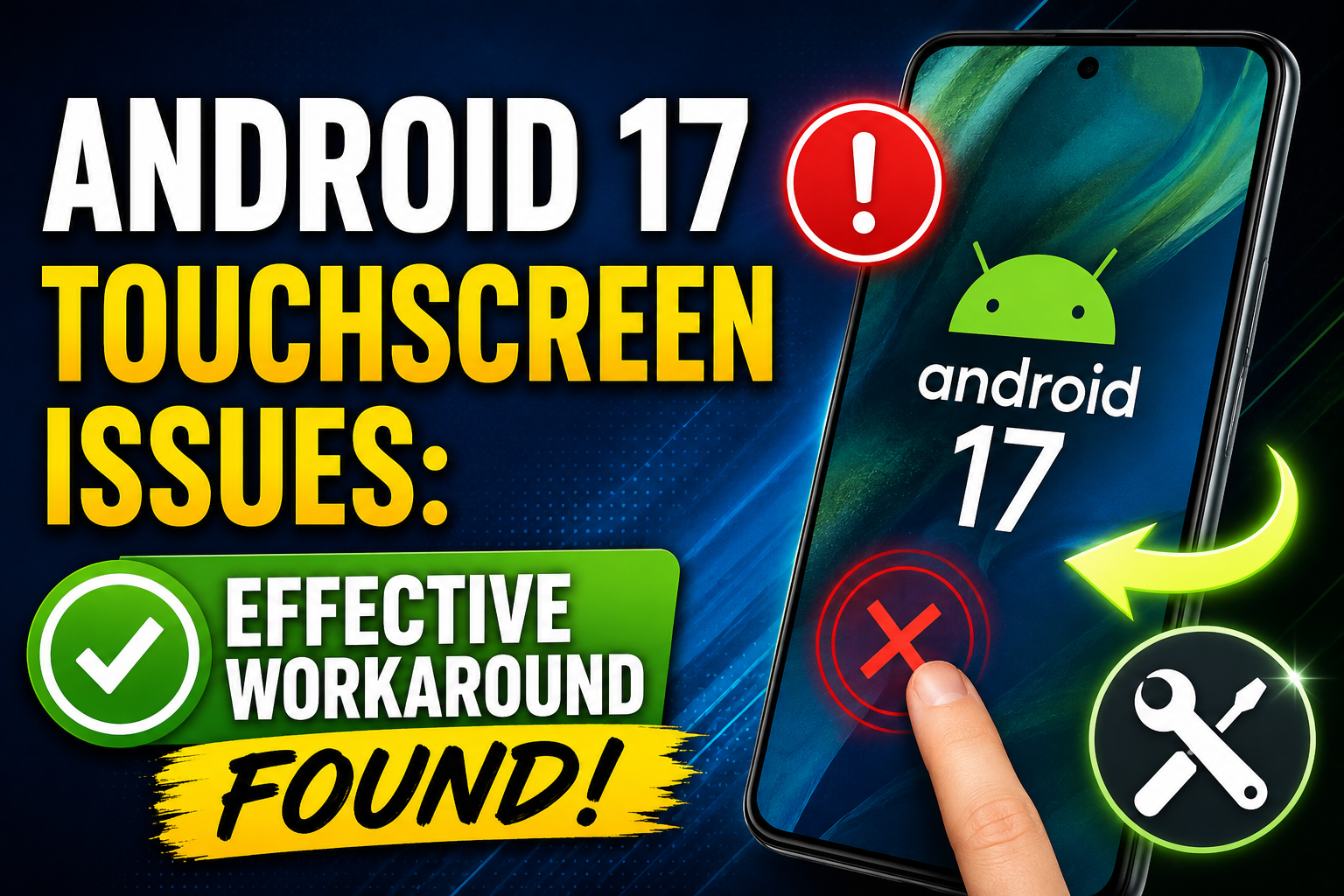
The much-anticipated release of Android 17 has brought a wave of excitement to the smartphone world, promising groundbreaking features, enhanced performance, and a more intuitive user experience. Pixel owners, in particular, looked forward to seeing how Google’s latest software innovations would seamlessly integrate with their bespoke hardware. However, for a significant number of Pixel users, the upgrade has been marred by an unexpected and deeply frustrating problem: Android 17 touchscreen issues, manifesting as persistent and often debilitating unresponsiveness.
Table of Contents
- The Android 17 Update: A Double-Edged Sword
- Unpacking the Android 17 Touchscreen Issues
- Why Pixel Devices?
- Impact on Daily Usage
- The Search for a Solution: Official vs. Community
- The Potential Workaround: A Deep Dive
- Preventative Measures and Best Practices (While You Wait)
- Looking Ahead: Google’s Role and Future Updates
- Conclusion
Reports have been flooding community forums, Reddit threads, and support channels, detailing issues ranging from intermittent lags and missed touches to complete dead zones on their screens. While Google has yet to issue an official universal fix, the community has been hard at work trying to diagnose the problem and, crucially, discover a temporary workaround. This article dives deep into the nature of these Android 17 touchscreen issues, explores the potential causes, and provides a detailed guide to a promising workaround that has brought relief to many affected Pixel owners.
The Android 17 Update: A Double-Edged Sword
Android 17, codenamed “Quantum,” was heralded as a monumental leap forward in mobile operating systems. Its flagship features included a revamped “Neural Touch Engine” designed to offer ultra-low latency touch response through AI prediction, a more aggressive “Dynamic Display Refresh” for superior battery life without sacrificing smoothness, and “Contextual Haptics” providing nuanced tactile feedback across the UI. For Pixel devices, these features were expected to be even more profound, leveraging the Tensor chip’s machine learning capabilities to create an unparalleled user experience.
The initial rollout was met with enthusiasm, as users praised the snappier animations, smarter notifications, and the generally polished feel of the new OS. However, within days, a discordant note began to emerge. A growing chorus of Pixel owners started reporting an alarming degradation in touchscreen performance immediately following the Android 17 update. What began as isolated complaints quickly escalated into a widespread concern, casting a shadow over what was otherwise a highly anticipated release, specifically highlighting the prevalence of Android 17 touchscreen issues.
Unpacking the Android 17 Touchscreen Issues
The nature of the Android 17 touchscreen issues reported by Pixel owners is varied, but a few common patterns have emerged, painting a picture of a deeply disruptive bug.
Symptoms of the Issue
Users describe a range of symptoms, often appearing inconsistently, which makes the problem particularly frustrating to diagnose and address, all stemming from the underlying Android 17 touchscreen issues:
- Intermittent Unresponsiveness: The most common complaint involves the screen simply failing to register touches. Taps, swipes, and gestures might work perfectly one moment and then be completely ignored the next. This can manifest as a delay in response or a complete lack of registration, requiring multiple attempts to perform a simple action, a key symptom of Android 17 touchscreen issues.
- Ghost Touches/Phantom Inputs: Some users have reported the opposite problem, where the screen registers touches that weren’t made. This can lead to apps opening randomly, text being typed erroneously, or unintended actions being performed, creating a chaotic and unpredictable user experience, contributing to the broader Android 17 touchscreen issues.
- Lag and Stuttering: Even when touches are registered, there’s often a noticeable delay between the input and the on-screen reaction. Scrolling might feel less fluid, typing might be sluggish, and general navigation can feel unresponsive and frustratingly slow, another manifestation of Android 17 touchscreen issues.
- Dead Zones: Specific areas of the screen, particularly along the edges or in certain quadrants, have been reported to become completely unresponsive. This can render certain UI elements or keyboard keys unusable, severely impacting the device’s functionality, a severe aspect of these Android 17 touchscreen issues.
- Reduced Sensitivity: For some, the screen requires significantly more pressure or a longer press to register an input, making precise interactions difficult and fatiguing, further highlighting the Android 17 touchscreen issues.
- Issues with Gestural Navigation: The popular gestural navigation system, which relies heavily on precise swipes from the edges, becomes particularly problematic, leading to frequent misfires or non-registrations, directly linked to Android 17 touchscreen issues.
Affected Devices
While the issue isn’t universal across all Pixel devices, reports indicate a higher prevalence among specific models experiencing Android 17 touchscreen issues. For a comprehensive look at top models, check out our guide to the Best Pixel Phones 2026. The problem appears most frequently on:
- Pixel 8 and Pixel 8 Pro: These are the latest flagship devices, and their advanced display technology and tight integration with the Tensor G3 chip might be particularly susceptible to the bug, leading to significant Android 17 touchscreen issues.
- Pixel 7 and Pixel 7 Pro: Owners of the previous generation Pixel devices, running the Tensor G2, have also reported significant Android 17 touchscreen issues.
- Pixel Fold: The unique folding display mechanism of the Pixel Fold seems to exacerbate the problem for some users, with both the inner and outer screens exhibiting Android 17 touchscreen issues.
- Pixel 6 and Pixel 6 Pro: While less frequent than on newer models, some users with these devices have also experienced a degradation in touch performance post-Android 17, contributing to the overall Android 17 touchscreen issues landscape.
It’s important to note that not every owner of these devices is affected, suggesting that the bug might be triggered by specific software configurations, app combinations, or even subtle hardware variations.
User Reports and Community Buzz
The sheer volume of user reports across various platforms underscores the severity and widespread nature of the problem, specifically the Android 17 touchscreen issues. On Reddit, subreddits like r/GooglePixel and r/Android have seen dozens of threads dedicated to the issue, with users sharing their experiences, troubleshooting steps, and growing frustration regarding these Android 17 touchscreen issues. Furthermore, tech news outlets have highlighted numerous reports detailing these problems, confirming the widespread nature of the bug. Google’s official support forums are similarly inundated with complaints, often accompanied by videos demonstrating the erratic touch behavior.
These community discussions have been vital in collating symptoms, identifying affected models, and, crucially, in the collaborative effort to find a temporary solution. The collective frustration is palpable, as many users rely on their Pixel devices for critical daily tasks, and a malfunctioning touchscreen renders their premium smartphone nearly unusable.
Initial Theories on the Cause
Without official confirmation from Google, the community has put forward several theories regarding the root cause of the Android 17 touchscreen issues bug:
- Neural Touch Engine Conflict: The most prominent theory points to Android 17’s new “Neural Touch Engine.” This AI-powered system, designed to predict and optimize touch inputs for ultra-low latency, might be conflicting with existing display drivers or hardware components on certain Pixel models. An overzealous or buggy prediction algorithm could be misinterpreting inputs, leading to ghost touches, or failing to register legitimate ones, thus causing the Android 17 touchscreen issues.
- Dynamic Display Refresh Bug: Android 17’s more aggressive “Dynamic Display Refresh” might be at fault. If the system is struggling to rapidly switch refresh rates (e.g., between 120Hz and 1Hz) in response to touch input, it could lead to momentary unresponsiveness or lag, exacerbating the Android 17 touchscreen issues. This would be particularly noticeable during scrolling or rapid interactions.
- GPU Driver Issues: The update might have introduced new GPU drivers or changes to the graphics rendering pipeline that are not fully compatible with the display hardware on older or specific Pixel models. This could cause rendering delays or conflicts that manifest as Android 17 touchscreen issues.
- Power Management Conflicts: Aggressive new power-saving features in Android 17 could be inadvertently throttling the display or touch controller, leading to intermittent unresponsiveness, especially when the device is under load or trying to conserve battery, contributing to the Android 17 touchscreen issues.
- Kernel-Level Bug: A deeper, kernel-level bug affecting how the OS communicates with the touch controller hardware could be the culprit behind these persistent Android 17 touchscreen issues. Such issues are notoriously difficult to diagnose and fix without a system-level patch.
- Accessibility Service Conflicts: Less likely, but possible, is a conflict with certain accessibility services or third-party apps that interact with the touch layer, which might have been broken or altered by the Android 17 update, potentially contributing to the Android 17 touchscreen issues.
Why Pixel Devices?
The question naturally arises: why are Pixel devices seemingly more affected than other Android phones by these Android 17 touchscreen issues? The answer likely lies in Google’s unique approach to hardware and software integration.
Pixel phones are designed with a “full stack” philosophy, where Google controls both the hardware (including the Tensor chip, custom display controllers, and other components) and the software. While this typically leads to a highly optimized and seamless experience, it also means that deep-seated bugs in new OS features can have a more profound and specific impact on Pixel hardware.
The “Neural Touch Engine” and “Dynamic Display Refresh” features of Android 17 are likely optimized for the Tensor chips and Pixel display panels. If there’s a slight mismatch or an unforeseen edge case in the interaction between these new software components and the specific firmware or calibration of certain Pixel display units, it could manifest as the observed Android 17 touchscreen issues. Third-party Android devices, with their more diverse hardware and often less aggressive software-hardware integration, might not trigger the bug in the same way, or their manufacturers might have implemented different drivers that mitigate the issue.
Impact on Daily Usage
The impact of a malfunctioning touchscreen on daily usage, particularly due to the Android 17 touchscreen issues, cannot be overstated. For many, a smartphone is an indispensable tool for work, communication, navigation, and entertainment.
- Communication Breakdown: Typing messages, answering calls, or navigating contacts becomes a frustrating ordeal when facing Android 17 touchscreen issues. Missed touches lead to typos, delayed responses, and a general breakdown in communication efficiency.
- Productivity Halts: For professionals who rely on their phones for email, document editing, or managing schedules, the unresponsiveness caused by Android 17 touchscreen issues can bring work to a standstill. Precision tasks, like selecting text or interacting with small UI elements, become nearly impossible.
- Navigation Nightmares: Using mapping applications for directions becomes hazardous if the screen fails to register taps on navigation buttons or zoom gestures due to Android 17 touchscreen issues.
- Gaming and Entertainment Ruined: Mobile gaming, which often demands precise and rapid touch inputs, becomes unplayable when plagued by Android 17 touchscreen issues. Even simple tasks like pausing a video or scrolling through social media feeds are marred by the erratic touch behavior.
- Safety Concerns: In emergency situations, a non-responsive touchscreen could prevent users from dialing emergency services or accessing critical information, posing a serious safety risk exacerbated by Android 17 touchscreen issues.
The constant battle with a device that doesn’t respond as expected leads to significant user frustration, stress, and a feeling of having a premium device rendered useless by a software update.
The Search for a Solution: Official vs. Community
Upon the initial reports, Google’s official stance has been typical for a widespread bug: acknowledgment of the Android 17 touchscreen issues and a statement that they are “investigating and working on a fix.” While this provides some reassurance, the timeline for an official patch remains unclear, and users are left in limbo with malfunctioning devices.
In the interim, the vibrant Android community has stepped up. Users have been diligently experimenting with various settings, performing diagnostic tests, and sharing their findings. This collaborative effort has been crucial in identifying patterns, ruling out common culprits (like screen protectors or specific apps), and ultimately, in discovering a potential workaround for the Android 17 touchscreen issues that has offered significant relief to many.
The Potential Workaround: A Deep Dive
After extensive community testing and experimentation, a promising workaround has emerged for the Android 17 touchscreen issues. This solution involves adjusting specific settings related to Android 17’s new “Adaptive Touch Optimization” (ATO) system and display refresh rate, which are believed to be at the heart of the conflict.
Disclaimer: This workaround is a community-discovered solution, not an official fix from Google. It may not work for all users or all Pixel models, and its long-term implications are not fully understood. Proceed with caution and understand that results may vary. Always back up your device before making significant system changes.
The Core Idea Behind the Workaround
The prevailing theory is that Android 17’s new “Adaptive Touch Optimization” (ATO) feature, designed to use AI to predict touch inputs and dynamically adjust display responsiveness, is buggy on certain Pixel hardware. This system, intended to enhance fluidity and reduce latency, might be over-optimizing or misinterpreting touch events, leading to the reported issues. The workaround aims to disable or mitigate the effects of this new, potentially problematic system, thereby addressing the Android 17 touchscreen issues.
Step-by-Step Guide to the Workaround
This workaround involves accessing Developer Options, which are hidden by default.
Part 1: Enabling Developer Options
- Open Settings: Swipe down from the top of your screen twice to open Quick Settings, then tap the gear icon (⚙️) or find the “Settings” app in your app drawer.
- Navigate to About Phone: Scroll down and tap on “About phone.”
- Find Build Number: Scroll down within “About phone” until you see “Build number.”
- Tap Build Number Repeatedly: Tap on “Build number” seven times in quick succession. As you tap, you’ll see a toast message counting down (“You are now X steps away from being a developer.”).
- Enter PIN/Pattern: After the seventh tap, you’ll be prompted to enter your device’s PIN, pattern, or password. Once entered, you’ll see a message saying, “You are now a developer!”
Part 2: Disabling Adaptive Touch Optimization (ATO)
- Go Back to Settings: Return to the main “Settings” menu.
- Access System Settings: Scroll down and tap on “System.”
- Open Developer Options: Tap on “Developer options.” (This new menu item will appear above “Reset options” or similar).
- Locate ATO Setting: Scroll through the extensive list of Developer Options. Look for a setting related to “Touch Optimization,” “Adaptive Touch,” “Neural Touch Engine,” or “Enhanced Touch Responsiveness.” The exact name might vary slightly based on your Pixel model and Android 17 build.
- Common names to look for:
- “Adaptive Touch Optimization”
- “Neural Touch Prediction”
- “Enhanced Touch Responsiveness”
- “AI Touch Acceleration”
- If you cannot find an exact match, look for anything related to “Touch,” “Input,” or “Display” that sounds like an optimization feature.
- Common names to look for:
- Disable the Setting: Once you locate the suspicious setting (e.g., “Adaptive Touch Optimization”), toggle it OFF. This step is crucial for mitigating the Android 17 touchscreen issues.
- Optional: Adjust Display Refresh Rate (If ATO is not found or doesn’t fully resolve):
- If disabling the ATO setting doesn’t fully resolve the issue, or if you can’t find a clear ATO setting, navigate back to the main “Settings” menu.
- Tap on “Display.”
- Tap on “Smooth Display” or “Screen refresh rate.”
- Change the setting from “Adaptive” or “Automatic” to a fixed refresh rate, such as 60 Hz or 90 Hz (if available). While this might make scrolling slightly less fluid, it can sometimes stabilize touch input if the dynamic refresh rate is conflicting with the touch controller, further helping with Android 17 touchscreen issues.
- Reboot Your Device: After making these changes, it is crucial to restart your Pixel device. Hold down the power button, then tap “Restart.”
What to Expect After Applying the Workaround
- Improved Responsiveness: Many users report an immediate and significant improvement in touchscreen responsiveness, directly addressing the Android 17 touchscreen issues. Missed touches, ghost touches, and general lag tend to be drastically reduced or eliminated.
- Potential Trade-offs:
- Slightly Less “Smooth” Feel: If you disabled a touch optimization feature, you might notice that the screen feels marginally less “buttery smooth” than it did before the bug, especially during very fast scrolling. This is because the AI prediction is no longer active. However, the trade-off for a functional touchscreen, free from Android 17 touchscreen issues, is generally considered well worth it.
- Battery Life (Minor Impact): If you fixed the refresh rate to a higher value (e.g., 90Hz from 60Hz adaptive), there might be a negligible impact on battery life. Conversely, if you fixed it to 60Hz from 120Hz adaptive, you might see a slight improvement in battery life.
- Consistency: The primary benefit is the return of consistent and predictable touch behavior, allowing you to use your phone without constant frustration from Android 17 touchscreen issues.
Troubleshooting the Workaround
If the workaround doesn’t immediately resolve your Android 17 touchscreen issues, consider these additional steps:
- Double-Check Settings: Ensure you correctly disabled the “Adaptive Touch Optimization” (or similar) setting and rebooted.
- Clear System UI Cache:
- Go to
Settings > Apps > See all apps. - Tap the three dots in the top right and select
Show system. - Find and tap on
System UI. - Tap
Storage & cache, thenClear cache. - Reboot your device.
- Go to
- Test in Safe Mode: Boot your device into Safe Mode to see if a third-party app is causing a conflict. If touch works perfectly in Safe Mode, an app is likely the culprit, and you’ll need to identify and uninstall it.
- Press and hold the power button.
- On the screen, touch and hold “Power off.”
- You’ll see a dialog asking if you want to reboot to Safe Mode. Tap “OK.”
- Factory Reset (Last Resort): If all else fails, a factory reset might be necessary to fully address persistent Android 17 touchscreen issues. WARNING: This will erase all data on your device. Ensure you have a complete backup before proceeding.
- Go to
Settings > System > Reset options > Erase all data (factory reset).
- Go to
- Report to Google: Even if the workaround helps, continue to report your experience to Google through the “Send feedback” option in your device settings or via official support channels. The more data they receive, the better they can pinpoint and fix the underlying bug causing the Android 17 touchscreen issues.
Preventative Measures and Best Practices (While You Wait)
While we await an official patch, there are several best practices Pixel owners can adopt to minimize potential issues and ensure their device is ready for a permanent fix for the Android 17 touchscreen issues:
- Regular Backups: Always maintain up-to-date backups of your device data. This is crucial for any potential factory resets or if a future update goes awry.
- Keep Apps Updated: Ensure all your apps are updated to their latest versions. App developers often release updates to ensure compatibility with new Android versions.
- Monitor Official Channels: Keep an eye on Google’s official Pixel support pages, Twitter accounts, and community forums for announcements regarding a fix for the Android 17 touchscreen issues.
- Report Bugs: If you experience the touchscreen issue, use the “Send feedback” option in your phone’s settings to report it directly to Google. Provide as much detail as possible, including when it started, what you were doing, and your device model.
- Consider Deferring Updates (Future): For future major Android updates, consider waiting a few weeks after the initial release before updating, especially if you rely heavily on your device. This allows early adopters to uncover and report critical bugs, giving Google time to issue initial patches.
Looking Ahead: Google’s Role and Future Updates
The current touchscreen debacle is a significant setback for Google and the Pixel brand. While software bugs are an inevitable part of complex operating systems, a fundamental issue like touchscreen unresponsiveness on flagship devices demands a swift and decisive response to the Android 17 touchscreen issues.
Users expect Google to:
- Expedite a Fix: Prioritize the development and release of an official patch (likely in a maintenance release or a dedicated hotfix) that permanently resolves the Android 17 touchscreen issues without requiring users to disable core Android 17 features.
- Transparent Communication: Provide clearer and more frequent updates on the status of the investigation and the expected timeline for a fix for these Android 17 touchscreen issues.
- Thorough Testing: Re-evaluate their testing protocols for major Android releases, especially concerning the interaction between new software features and existing Pixel hardware configurations to prevent future Android 17 touchscreen issues.
Rebuilding user trust will be paramount. A quick and effective resolution will demonstrate Google’s commitment to its users and the quality of its Pixel devices.
Conclusion
The Android 17 update, while bringing many exciting new features, has unfortunately introduced a frustrating and widespread Android 17 touchscreen issue for a segment of Pixel owners. From intermittent unresponsiveness to ghost touches, the problem has severely impacted the daily usability of these premium devices.
While Google works on an official solution, the community has rallied to discover a promising workaround for these Android 17 touchscreen issues. By disabling the “Adaptive Touch Optimization” (or similar) setting in Developer Options and potentially adjusting the display refresh rate, many users have found significant relief, restoring much-needed functionality to their Pixel phones.
This workaround serves as a temporary bridge, allowing users to regain control of their devices while eagerly awaiting a permanent, official patch from Google. If you’re a Pixel owner grappling with these Android 17 touchscreen issues, we encourage you to try the detailed steps outlined above. Remember to proceed with caution, back up your data, and continue to report your experiences to Google to help them pinpoint and fix the underlying bug.