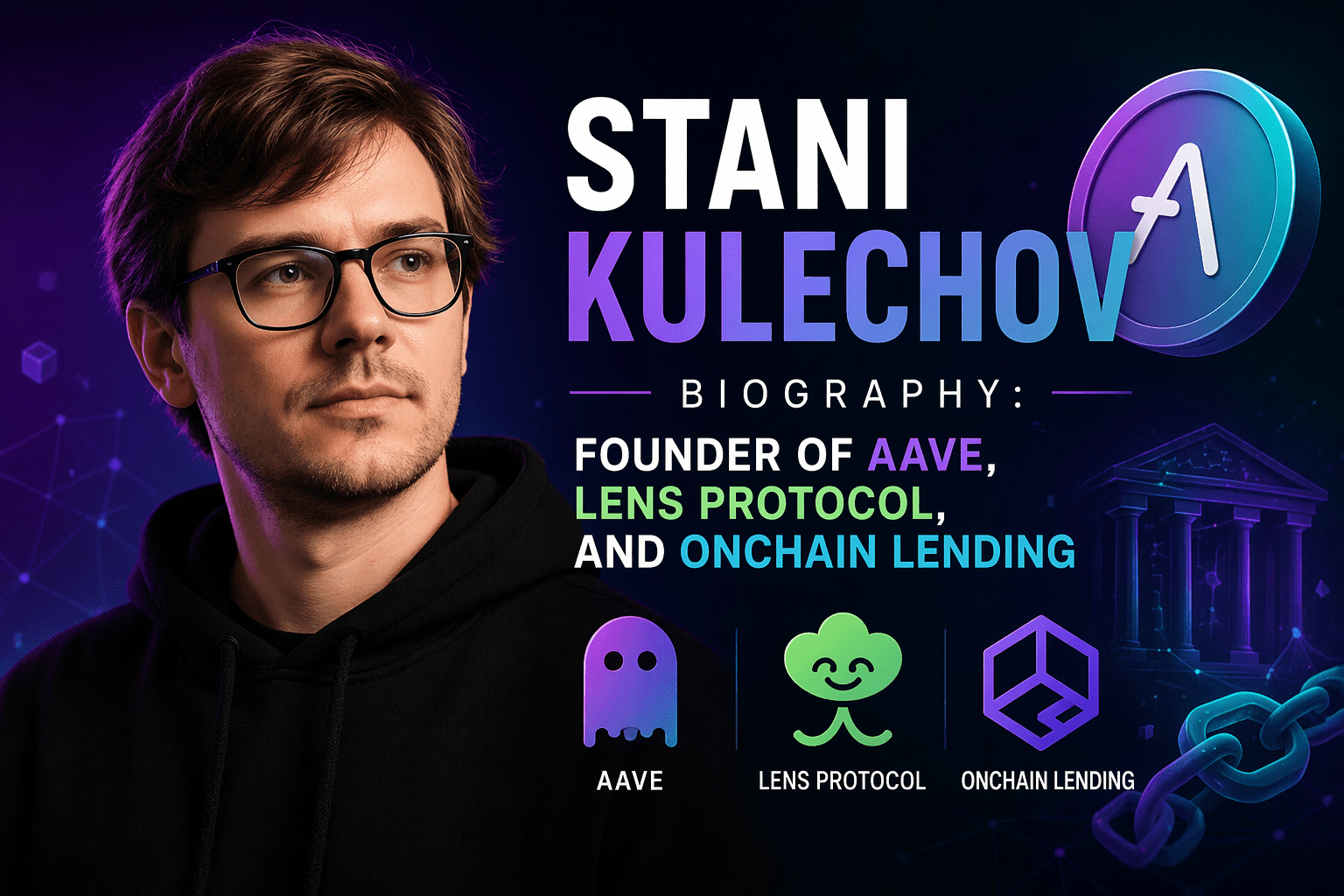
Stani Kulechov Biography: Creator of Aave, Lens Protocol & the Future of Onchain Lending
In the rapidly evolving landscape of decentralized finance (DeFi) and Web3, few figures loom as large as Stani Kulechov. As the founder of Aave and Lens Protocol, Kulechov has not only built some of the most utilized tools in the blockchain space but has also fundamentally reshaped how we think about liquidity, credit, and digital ownership.
His journey from a law student in Helsinki to a titan of the crypto industry is a testament to the power of “code as law” and the vision of a permissionless financial system. This biography explores his early life, the evolution of Aave, the birth of Lens Protocol, and his enduring influence on the future of the onchain world.
Early Life and the Intersection of Law and Code
Born and raised in Finland, Stani Kulechov’s path to becoming a blockchain pioneer was unconventional. Unlike many of his peers in the space who came from pure computer science backgrounds, Kulechov’s academic foundation was in law. While studying at the University of Helsinki, he became fascinated by the intersection of legal frameworks and technology.
It was during his time in law school (circa 2016-2017) that Kulechov discovered Ethereum. To a law student, Ethereum wasn’t just a cryptocurrency; it was a platform for “smart contracts”—self-executing agreements where the terms are written directly into code. Kulechov saw the potential for these contracts to replace the slow, bureaucratic, and often exclusionary processes of traditional legal and financial institutions.
He realized that if code could automate a contract, it could also automate a bank. This realization led him to experiment with the first iterations of decentralized lending, a move that would eventually give birth to the DeFi movement.
Hayden Adams Biography: The Uniswap Founder Revolutionizing Decentralized Trading
Samsung Galaxy A37 Review: The Ultimate Mid-Range Smartphone for 2025
Vitalik Buterin Biography: Ethereum Founder’s Life, Achievements & Future Plans
The Genesis of ETHLend: The P2P Experiment
In 2017, during the height of the Initial Coin Offering (ICO) boom, Kulechov launched ETHLend. At the time, the concept of borrowing and lending on a blockchain was almost entirely theoretical. ETHLend was one of the first platforms to attempt to bridge this gap.
The Peer-to-Peer Model
The original ETHLend model was a peer-to-peer (P2P) marketplace. If a user wanted to borrow funds, they had to post a request, and a specific lender had to manually agree to those terms. While revolutionary, the model faced significant hurdles:
- Low Liquidity: Borrowers often had to wait days for a lender to match their request.
- Inflexibility: Terms were fixed, making it difficult to adjust to the volatile crypto market.
- Scalability Issues: The manual nature of the matching process prevented the platform from scaling to meet global demand.
Despite these challenges, ETHLend successfully raised $16.2 million in its ICO. However, Kulechov was quick to realize that for decentralized lending to truly compete with traditional finance, it needed to be faster, more liquid, and more automated.
The Pivot to Aave: From P2P to Liquidity Pools
In 2018, Kulechov made a strategic decision that would change the course of DeFi history. He rebranded ETHLend to Aave, a Finnish word meaning “ghost.” The name reflected the brand’s shift toward becoming an invisible, seamless infrastructure for the future of finance.
The Innovation of Pool-to-Peer Lending
The most significant change in the transition to Aave was the move from a peer-to-peer model to a pool-to-peer model. Instead of waiting for a specific lender, users could now deposit their assets into “liquidity pools.” Borrowers could then draw from these pools instantaneously, provided they posted enough collateral.
This model introduced several key concepts to the crypto world:
- Over-collateralization: To ensure the safety of the protocol, borrowers had to deposit more value than they were taking out.
- Algorithmic Interest Rates: Interest rates were no longer negotiated; they were determined by supply and demand within the pool.
- aTokens: When users deposited funds, they received “aTokens” (like aDAI or aETH) that represented their share of the pool and accrued interest in real-time.
Aave V1 launched on the Ethereum mainnet in early 2020, just months before the “DeFi Summer” that would see billions of dollars flow into the ecosystem.
Flash Loans: Aave’s “Zero-to-One” Moment
Perhaps Stani Kulechov’s most famous contribution to the technical architecture of DeFi is the Flash Loan. Introduced with Aave V1, Flash Loans allowed users to borrow millions of dollars worth of assets with zero collateral, provided the loan was returned within the same blockchain transaction.
How Flash Loans Work
In a single transaction block, a user can:
- Borrow a massive amount of capital.
- Use that capital to execute an arbitrage trade or refinance a position.
- Pay back the loan plus a small fee.
If the borrower cannot pay back the loan by the end of the transaction, the entire sequence is reverted as if it never happened. This ensures the protocol never loses money.
Flash Loans democratized high-level financial strategies. Previously, only “whales” or institutional desks with massive capital could perform large-scale arbitrage. With Aave, anyone with the coding skills to write a smart contract could access the same level of liquidity. This invention solidified Kulechov’s reputation as a visionary who understood the unique capabilities of programmable money.
The Growth of the Aave Ecosystem (V2 and V3)
Under Kulechov’s leadership, Aave did not rest on its initial success. The protocol underwent several major upgrades, each pushing the boundaries of what was possible in onchain lending.
Aave V2: Efficiency and Flexibility
Launched in late 2020, V2 introduced features like Collateral Swap (allowing users to change their collateral without closing their loan) and Native Credit Delegation. It optimized gas costs and made the user experience significantly smoother, helping Aave become the dominant lending protocol by Total Value Locked (TVL).
Aave V3: The Multichain Era
As Ethereum faced high gas fees, Kulechov recognized the need for a multichain future. Aave V3 was designed with “Portals,” allowing assets to move seamlessly between different Layer 2 networks like Polygon, Arbitrum, and Optimism.
V3 also introduced High Efficiency Mode (eMode), which allows for much higher Loan-to-Value (LTV) ratios when users borrow assets correlated in price (e.g., borrowing one stablecoin against another), and Isolation Mode, which allows the protocol to list newer, riskier assets without endangering the entire liquidity pool.
Beyond Finance: The Launch of Lens Protocol
While Aave was conquering the world of finance, Stani Kulechov began looking at another centralized pillar of the internet: social media. He observed that users on platforms like Twitter and Facebook do not own their data, their followers, or their content. If a platform decides to de-platform a user, that user loses their entire digital identity.
In early 2022, Kulechov and his team at Aave Companies (now Avara) introduced Lens Protocol.
What is Lens Protocol?
Lens is a decentralized social graph built on the Polygon blockchain. Unlike traditional social media, Lens is “composable” and “user-owned.”
- The Profile NFT: When you create a profile on Lens, you own a non-fungible token (NFT) that contains your entire history, followers, and content.
- Portability: Because the data lives on the blockchain, any developer can build a “frontend” (an app) on top of Lens. If you don’t like the algorithm of one app, you can move your entire profile and following to another app instantly.
- Monetization: Lens allows creators to monetize their content directly through “collect” modules, where followers can pay to own a piece of content.
Kulechov’s move into social media was a signal that his vision extended beyond “DeFi” and into “Web3”—a total reimagining of the internet where ownership is the default.
The Philosophy of “Everything Onchain”
Stani Kulechov is a vocal advocate for the “onchain” movement. His philosophy is rooted in the belief that transparency and decentralization are the only ways to build a resilient global society.
Transparency as a Feature
In traditional finance, the “books” of a bank are opaque. In Aave, every single transaction, liquidation, and interest rate change is visible on the public ledger. Kulechov argues that this transparency prevents the kind of systemic collapses seen in the 2008 financial crisis or the 2022 failures of centralized crypto firms like Celsius and FTX.
The GHO Stablecoin
In 2023, Aave launched GHO, its native over-collateralized stablecoin. For Kulechov, GHO is the final piece of the puzzle for the Aave ecosystem. It allows the protocol to facilitate lending not just with external assets like USDC or USDT, but with a currency that is natively governed by the Aave DAO (Decentralized Autonomous Organization).
Real World Assets (RWAs)
Kulechov has also been a pioneer in bringing Real World Assets onchain. Through partnerships with firms like Centrifuge, Aave has experimented with using real-world invoices, real estate, and trade receivables as collateral for loans. This bridges the gap between the trillions of dollars in traditional markets and the efficiency of DeFi.
Leadership Style and the Aave DAO
One of the most remarkable aspects of Kulechov’s career is his commitment to decentralization. While he is the face of Aave, he has worked tirelessly to hand over control of the protocol to the Aave DAO.
The AAVE token is not just a speculative asset; it is a governance tool. Token holders vote on everything from which new assets to list to the risk parameters of the protocol. Kulechov often describes himself as a “contributor” rather than a CEO, emphasizing that the community is the ultimate owner of the technology.
His leadership style is characterized by:
- Open Source Ethos: All of Aave’s code is open-source, encouraging others to build on top of it.
- Resilience: He has led the protocol through multiple market cycles, including the “crypto winters” of 2018 and 2022, always focusing on security and risk management.
- Innovation over Extraction: Kulechov has consistently prioritized long-term ecosystem health over short-term profits.
Challenges and Controversies
No journey in the crypto space is without its hurdles. Kulechov has faced his share of challenges, including:
- Regulatory Scrutiny: As DeFi grows, regulators in the US and Europe have increased their focus on lending protocols. Kulechov’s legal background has been an asset here, as he often engages in constructive dialogue about how to balance innovation with consumer protection.
- Security Risks: While Aave has a stellar security record, the DeFi space is rife with exploits. Kulechov has been a vocal proponent of rigorous audits and bug bounties.
- The Twitter Ban: In a famous incident in 2022, Kulechov was briefly banned from Twitter after jokingly tweeting that he was joining the platform as “interim CEO.” This event served as a catalyst for his push for Lens Protocol, highlighting the fragility of centralized social media.
The Future: Avara and the Unified Web3 Experience
In late 2023, Aave Companies rebranded to Avara. This move signaled a broadening of the mission. Under the Avara umbrella, Kulechov is working to integrate finance (Aave), social (Lens), and stablecoins (GHO) into a single, cohesive user experience.
The goal is to create a world where a user can:
- Earn a living through decentralized social media (Lens).
- Receive payments in a decentralized stablecoin (GHO).
- Save and borrow against those earnings in a decentralized bank (Aave).
- Do all of this without ever needing a traditional bank account or a centralized tech company.
Legacy and Impact
Stani Kulechov’s impact on the blockchain industry is difficult to overstate. He took the abstract concept of a “smart contract” and turned it into a multi-billion dollar financial engine. He saw the flaws in the first generation of DeFi and had the humility to pivot and innovate.
Key Contributions at a Glance:
- Pioneered Liquidity Pools: Shifted the industry from slow P2P matching to instant pool-based lending.
- Invented Flash Loans: Created a new category of financial primitive that exists only in the blockchain world.
- Championed User-Owned Social: Built the foundation for a future where digital identity cannot be censored or taken away.
- Institutionalized DeFi: Through Aave Arc, he created a path for regulated institutions to participate in onchain finance.
Conclusion
Stani Kulechov is more than just a developer or an entrepreneur; he is an architect of the new digital economy. By combining a deep understanding of the law with a visionary approach to code, he has built tools that empower individuals and challenge the status quo of global finance and social media.
As we move toward a future where more of our lives are lived onchain, Kulechov’s work with Aave and Lens Protocol will likely be remembered as the bedrock upon which the decentralized internet was built. His story is a reminder that in the world of Web3, the only limit is the imagination of the person writing the code. Whether through the “ghost” of Aave or the “lens” of social ownership, Kulechov continues to lead the charge toward a more transparent, equitable, and permissionless world.