
Table of Contents
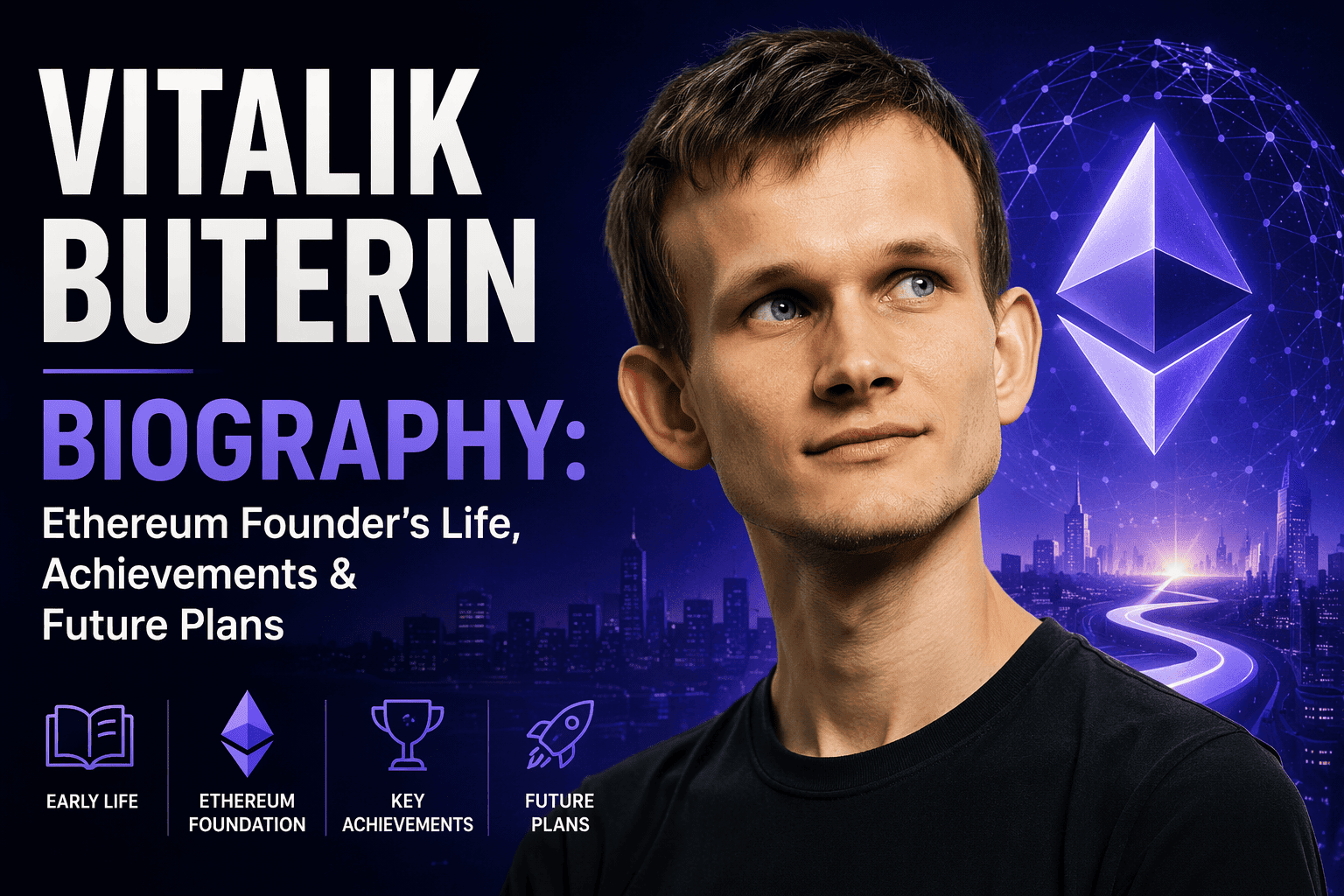
Vitalik Buterin Biography: Who Is Founder of Ethereum? Life, Achievements & Future Plans
In the rapidly evolving landscape of blockchain technology, few names resonate with the same weight and influence as Vitalik Buterin. A prodigious programmer, visionary thinker, and the co-founder of Ethereum, Buterin has not merely contributed to the digital revolution; he has fundamentally reshaped its trajectory. His creation, Ethereum, transcended the initial concept of a digital currency to become a global, decentralized computing platform, giving birth to smart contracts, decentralized applications (dApps), decentralized finance (DeFi), non-fungible tokens (NFTs), and the broader vision of Web3.
This article delves into the remarkable life of Vitalik Buterin, tracing his journey from a childhood prodigy to one of the most impactful figures in modern technology. We will explore the formative experiences that shaped his intellect, the pivotal moments that led to the genesis of Ethereum, the monumental achievements of his brainchild, the challenges he and the Ethereum community have faced, and his ongoing vision for a decentralized future. Understanding Vitalik Buterin is not just about understanding a person; it’s about grasping the very essence of the decentralized revolution he helped ignite.
Early Life and Prodigy Years
Vitalik Buterin was born on January 31, 1994, in Kolomna, Russia, a small city southeast of Moscow. His parents, Dmitry Buterin, a computer scientist, and Natalia Ameline, a business analyst, quickly recognized their son’s exceptional intellectual capabilities. The family immigrated to Canada when Vitalik was six years old, seeking better educational and economic opportunities. This move to Toronto would provide the fertile ground for his burgeoning intellect.
From a very young age, Vitalik displayed an extraordinary aptitude for mathematics, programming, and economics. His mind processed information at an accelerated pace, often finding traditional schooling methods too slow or unstimulating. He was placed in a program for gifted children, where his unique talents truly began to flourish. While other children were playing, Vitalik was immersed in complex spreadsheets, designing intricate game mechanics, and grappling with advanced mathematical concepts. He famously recalls being fascinated by the game World of Warcraft, not just for its gameplay but for its underlying economic systems and community dynamics, which he later cited as an early influence on his thinking about decentralized systems.
His father, Dmitry, played a crucial role in nurturing Vitalik’s curiosity, introducing him to computers and programming at an early age. This early exposure laid the groundwork for his future endeavors, instilling in him a deep understanding of logical structures and computational thinking. Vitalik’s childhood was characterized by an intense focus on intellectual pursuits, a trait that would define his later career. He was a quiet, introspective child, more comfortable with algorithms and data than with social interactions, a disposition that allowed him to delve deeply into complex subjects without distraction.
The Bitcoin Revelation
Vitalik Buterin’s journey into the world of cryptocurrency began in 2011, when he was just 17 years old. Initially skeptical when his father first mentioned Bitcoin, he soon found himself drawn into its revolutionary potential. What started as a casual interest quickly evolved into an obsession. He spent countless hours researching Bitcoin, delving into its whitepaper, its underlying cryptography, and its philosophical implications.
He was captivated by the idea of a decentralized, censorship-resistant digital currency that operated outside the control of governments and financial institutions. This concept resonated deeply with his innate understanding of systems and his nascent libertarian leanings. However, he also quickly identified Bitcoin’s limitations. While groundbreaking as a peer-to-peer electronic cash system, its scripting language was intentionally limited, designed primarily for financial transactions. It lacked the flexibility to build more complex applications directly on its blockchain.
To further his understanding and engage with the nascent crypto community, Vitalik began writing for Bitcoin Magazine in 2011. He co-founded the publication with Mihai Alisie, becoming its lead writer and contributing extensively to its early content. Through his articles, he explored various aspects of Bitcoin, from its technical intricacies to its economic and social implications. This role provided him with a platform to articulate his thoughts, learn from other pioneers, and solidify his understanding of the blockchain paradigm.
His work with Bitcoin Magazine also allowed him to travel the world, attending conferences and meeting key figures in the cryptocurrency space. He encountered developers, entrepreneurs, and enthusiasts who shared his vision for a decentralized future. These interactions were instrumental in shaping his ideas and confirming his belief that blockchain technology had a far greater potential than simply enabling digital cash. It was during this period of intense learning and engagement that the seeds of Ethereum began to germinate in his mind.
The Genesis of Ethereum
The limitations Vitalik observed in Bitcoin’s design became the catalyst for his most significant invention. He envisioned a more generalized blockchain platform, one that could host not just a currency but any kind of decentralized application. He wanted a blockchain that was “Turing complete,” meaning it could execute any arbitrary computational logic, effectively becoming a global, decentralized computer.
In late 2013, Vitalik Buterin published the initial whitepaper for Ethereum, titled “A Next-Generation Smart Contract and Decentralized Application Platform.” In this seminal document, he outlined his vision for a new blockchain that would allow developers to build and deploy smart contracts and decentralized applications without the need for intermediaries. He proposed a platform where code could run exactly as programmed, without any possibility of censorship, downtime, fraud, or third-party interference.
The core innovation was the Ethereum Virtual Machine (EVM), a runtime environment for smart contracts. The EVM would enable developers to write programs in various languages (most notably Solidity) that would then be executed by the decentralized network of computers running the Ethereum protocol. This marked a significant departure from Bitcoin’s more restricted scripting capabilities.
Gathering a team of brilliant minds was the next crucial step. Vitalik attracted a diverse group of co-founders and early contributors who shared his vision, including Gavin Wood, Charles Hoskinson, Anthony Di Iorio, Mihai Alisie, Joseph Lubin, and Jeffrey Wilcke. Each brought unique skills and perspectives to the nascent project, from technical development to business strategy.
To fund the ambitious project, the Ethereum team launched a public crowdsale (Initial Coin Offering or ICO) of its native cryptocurrency, Ether (ETH), in July 2014. The ICO raised over $18 million in Bitcoin, making it one of the largest crowdfunding campaigns at the time. This capital was essential for developing the protocol, building the core infrastructure, and attracting a global community of developers.
The development phase was intense and challenging, involving complex cryptographic engineering, network design, and community building. After nearly two years of dedicated work, the Ethereum network officially went live on July 30, 2015, with the release of its “Frontier” network. This marked the birth of a new era for blockchain technology, one that extended far beyond simple digital currencies and laid the foundation for the decentralized internet we know today.
Ethereum’s Impact and Achievements
Ethereum’s launch was a watershed moment, unleashing a torrent of innovation that fundamentally reshaped the digital landscape. Its impact can be seen across numerous sectors, giving rise to entirely new industries and paradigms.
Smart Contracts: The Foundation of Trustless Execution
At the heart of Ethereum’s revolution are smart contracts – self-executing contracts with the terms of the agreement directly written into code. These contracts automatically execute when predetermined conditions are met, eliminating the need for intermediaries and ensuring transparency and immutability. Smart contracts have revolutionized how agreements are made, from simple escrow services to complex financial derivatives, providing a trustless and efficient way to conduct transactions and enforce rules.
Decentralized Applications (dApps): A New Internet Paradigm
Ethereum enabled the creation of decentralized applications (dApps), which run on the blockchain and are not controlled by any single entity. This opened the floodgates for developers to build a vast array of applications, including:
- Gaming: CryptoKitties, Axie Infinity, and other blockchain-based games introduced digital ownership and play-to-earn models.
- Social Media: Platforms like Peepeth (though no longer active) explored censorship-resistant social networking.
- Identity Management: Projects aiming to give users control over their digital identities.
Decentralized Autonomous Organizations (DAOs): Governance of the Future
DAOs are organizations represented by rules encoded as a transparent computer program, controlled by the organization’s members, and not influenced by a central government. Ethereum provided the perfect infrastructure for DAOs, allowing communities to collectively manage funds, vote on proposals, and govern projects in a transparent and democratic manner. The concept of DAOs has since expanded to govern everything from investment funds to art collectives.
Decentralized Finance (DeFi): Reshaping Financial Services
Perhaps one of Ethereum’s most profound impacts has been the emergence of Decentralized Finance (DeFi). DeFi leverages smart contracts to recreate traditional financial services – lending, borrowing, trading, insurance – in a decentralized, permissionless, and transparent way. Key examples include:
- Decentralized Exchanges (DEXs): Uniswap, SushiSwap, and Curve allow users to trade cryptocurrencies directly from their wallets without intermediaries.
- Lending Protocols: Aave and Compound enable users to lend and borrow crypto assets, earning interest or accessing liquidity.
- Stablecoins: USDC, DAI, and USDT, often built on Ethereum, provide price stability in the volatile crypto market.
DeFi has grown into a multi-billion dollar industry, challenging traditional financial institutions and offering greater accessibility to financial services globally.
Non-Fungible Tokens (NFTs): Digital Ownership and Art
NFTs, unique digital assets whose ownership is recorded on a blockchain, gained massive mainstream attention, largely thanks to Ethereum. ERC-721 and ERC-1155 token standards on Ethereum enabled the creation and verifiable ownership of digital art, collectibles, music, and virtual real estate. Projects like CryptoPunks, Bored Ape Yacht Club, and countless digital artists have leveraged NFTs to establish new paradigms of digital ownership and monetization, empowering creators and collectors alike.
Web3: The Vision of a Decentralized Internet
Ethereum is a foundational pillar of the Web3 vision – a decentralized internet where users have more control over their data and digital interactions, rather than relying on centralized corporations. It’s about shifting power from platforms to individuals, fostering open protocols, and creating a more equitable digital ecosystem.
Philanthropy and Public Goods
Beyond its technological achievements, Vitalik Buterin has also emerged as a significant philanthropist. He has consistently advocated for using blockchain technology for social good and has made substantial donations to various causes. Notable contributions include:
- COVID-19 Relief: A massive donation of Shiba Inu (SHIB) tokens, valued at over $1 billion at the time, to the India Crypto Covid Relief Fund.
- Longevity Research: Significant funding for research into life extension and combating aging.
- AI Safety: Donations to organizations focused on ensuring the safe and ethical development of artificial intelligence.
- Public Goods Funding: Active support for Gitcoin and other initiatives aimed at funding open-source development and public goods within the crypto ecosystem.
Vitalik’s commitment to open-source development, academic rigor, and using technology to improve the human condition underscores his broader vision for Ethereum’s role in the world.
Challenges and Controversies
Despite its groundbreaking success, Ethereum’s journey has not been without significant challenges and controversies.
The DAO Hack (2016)
One of the most critical moments in Ethereum’s early history was the DAO hack in June 2016. The DAO (Decentralized Autonomous Organization) was an early, ambitious project built on Ethereum, designed as a venture capital fund governed by its token holders. A vulnerability in its smart contract code allowed an attacker to drain approximately one-third of its funds (worth around $50 million at the time).
This event sparked an intense debate within the Ethereum community: should the community intervene to reverse the hack, thereby violating the blockchain’s immutability, or should they let the hack stand, upholding the principle that “code is law”? Ultimately, after much discussion, the community voted to perform a hard fork, creating a new version of the Ethereum blockchain that reversed the stolen funds. This led to a split, with the original, unforked chain continuing as Ethereum Classic (ETC) and the new, forked chain becoming the dominant Ethereum (ETH) we know today. The DAO hack was a painful but formative experience, highlighting the complexities of decentralized governance and the nascent nature of smart contract security.
Scalability Issues and High Gas Fees
As Ethereum’s popularity soared, its underlying architecture, particularly its Proof-of-Work (PoW) consensus mechanism, struggled to keep up with demand. The network could only process a limited number of transactions per second, leading to congestion and soaring “gas fees” (transaction costs). During peak demand, gas fees could make using the network prohibitively expensive for many users, hindering adoption and frustrating developers. This scalability bottleneck became one of the most pressing issues for the Ethereum community.
Regulatory Scrutiny
The rapid growth of the crypto industry, fueled by Ethereum’s ecosystem, inevitably attracted the attention of regulators worldwide. Governments grappled with how to classify and regulate cryptocurrencies, ICOs, DeFi, and NFTs. This created uncertainty for developers and businesses building on Ethereum, with ongoing debates about security classifications, consumer protection, and anti-money laundering (AML) compliance.
Competition from “Ethereum Killers”
Ethereum’s success also spawned a wave of competitors, often dubbed “Ethereum killers.” These alternative Layer 1 blockchains (e.g., Solana, Avalanche, Cardano, Polkadot) aimed to address Ethereum’s scalability issues with different architectural choices, often promising higher transaction throughput and lower fees. While none have fully dethroned Ethereum, they represent significant competition and push Ethereum to continuously innovate and improve.
These challenges have driven the Ethereum community to embark on a multi-year, ambitious upgrade path, fundamentally redesigning the network’s core architecture.
The Road to Ethereum 2.0 (The Merge and Beyond)
Recognizing the limitations of its initial design, the Ethereum community, under Vitalik’s leadership, embarked on a multi-year, multi-phase upgrade known as Ethereum 2.0, or more accurately, a series of upgrades leading to “Serenity.” The primary goals were to enhance scalability, security, and sustainability.
Proof-of-Stake (PoS): The Merge
The most significant and anticipated upgrade was the transition from a Proof-of-Work (PoW) consensus mechanism to Proof-of-Stake (PoS). PoW, which relies on energy-intensive mining, was criticized for its environmental impact and scalability limitations. PoS, on the other hand, involves validators “staking” their ETH to secure the network, consuming significantly less energy and paving the way for future scalability improvements.
The culmination of this transition was “The Merge,” which occurred on September 15, 2022. The Merge saw Ethereum’s original execution layer (the “Eth1” chain) merge with the Beacon Chain, a PoS consensus layer that had been running in parallel since December 2020. This was a monumental technical achievement, akin to changing the engine of a spaceship mid-flight, without any downtime. The Merge successfully transitioned Ethereum to a PoS network, reducing its energy consumption by over 99.9% and setting the stage for further upgrades.
Sharding: Enhancing Scalability
While The Merge addressed the consensus mechanism and energy consumption, the next major phase of upgrades focuses on scalability through “sharding.” Sharding involves dividing the Ethereum blockchain into multiple smaller, parallel chains called “shards.” Each shard can process transactions and smart contracts independently, significantly increasing the network’s overall transaction throughput. This will allow Ethereum to handle a much larger volume of activity, reducing congestion and gas fees. Sharding is expected to be rolled out in phases following The Merge.
The “Surge,” “Verge,” “Purge,” and “Splurge”
Vitalik Buterin has outlined a long-term roadmap for Ethereum, often summarized by the “Surge,” “Verge,” “Purge,” and “Splurge” phases:
- The Surge: Focuses on sharding to improve scalability.
- The Verge: Introduces Verkle trees, a more efficient way to store and verify state, further improving node efficiency.
- The Purge: Aims to reduce the amount of historical data that nodes need to store, simplifying the protocol and reducing storage requirements.
- The Splurge: Encompasses miscellaneous smaller upgrades and optimizations to ensure the network’s long-term health and efficiency.
Vitalik remains at the forefront of this technical evolution, actively contributing to research, design, and community discussions. His continued leadership is crucial in navigating the complexities of these upgrades and guiding Ethereum towards a more scalable, secure, and sustainable future.
React & Tailwind CSS: Create Custom Buttons UI
Galaxy S26 Deal: Get $200 Off at Samsung Today
Agentic AI: Transforming Industries and Solving Interoperability Challenges
Vitalik Buterin: The Public Figure
Vitalik Buterin’s unique personality and intellectual prowess have made him a distinctive public figure in the tech world. Often seen in his signature t-shirts and with an earnest, thoughtful demeanor, he stands apart from the typical Silicon Valley entrepreneur.
His public image is characterized by:
- Intellectual Curiosity: He is relentlessly curious, delving into diverse fields from economics and philosophy to artificial intelligence and longevity research. This broad intellectual scope informs his vision for Ethereum and its potential societal impact.
- Philosophical Leanings: Vitalik is deeply interested in the philosophical underpinnings of decentralization, governance, and the future of human coordination. He frequently writes and speaks about topics like quadratic funding, effective altruism, and the ethical implications of technology.
- Thought Leadership: Beyond technical contributions, Vitalik serves as a key thought leader for the entire blockchain space. His blog posts, speeches, and interviews often provide profound insights into the future of crypto, its challenges, and its potential to solve real-world problems.
- Commitment to Open Source and Public Goods: He is a staunch advocate for open-source development, believing that foundational technologies should be freely accessible and collectively owned. His philanthropic efforts consistently emphasize funding public goods that benefit society as a whole.
- Evolving Views: Vitalik is not afraid to critically examine the crypto space, including Ethereum itself. He has openly discussed the challenges of decentralization, the risks of over-financialization, and the need for the community to focus on real-world utility and ethical considerations.
While maintaining a relatively private personal life, Vitalik’s public persona is one of a brilliant, somewhat eccentric, but deeply committed visionary. He continues to be a driving force behind Ethereum’s development, not just as a coder, but as a philosopher guiding the direction of a global movement.
Future Plans and Vision
Vitalik Buterin’s future plans and vision extend far beyond the immediate technical upgrades of Ethereum. He sees Ethereum not just as a technological platform but as a fundamental building block for a more open, fair, and decentralized world.
His primary focus remains on:
- Continued Ethereum Protocol Development: Ensuring the successful implementation of sharding, Verkle trees, and other future upgrades to make Ethereum maximally scalable, secure, and resilient. He envisions a future where Ethereum can support billions of users and a vast array of complex applications without prohibitive costs or congestion.
- Enhancing Decentralization and Censorship Resistance: Vitalik is deeply committed to ensuring Ethereum remains truly decentralized and resistant to censorship. This involves ongoing research into client diversity, node operation, and governance mechanisms that prevent single points of failure or control.
- Sustainability: Beyond the energy efficiency of PoS, he is interested in the long-term economic and social sustainability of the Ethereum ecosystem, ensuring it can thrive and adapt for decades to come.
- Broader Societal Impact of Blockchain: He believes blockchain technology has immense potential to address global challenges, from identity management for stateless people to transparent supply chains and new models of democratic governance. He actively explores how crypto can contribute to public goods and solve real-world problems beyond speculation.
- Interests Beyond Ethereum: Vitalik’s intellectual curiosity leads him to explore other critical areas. He is a vocal proponent of AI safety, advocating for responsible development and ethical considerations in artificial intelligence. He also continues to support longevity research, believing in the potential for scientific advancements to extend healthy human lifespans. His commitment to effective altruism guides his philanthropic decisions, aiming to maximize positive impact with his resources.
Vitalik’s long-term vision is for a decentralized internet that empowers individuals, fosters global cooperation, and is resistant to authoritarian control. He sees Ethereum as a critical piece of infrastructure for this future, a “world computer” that can host a new generation of applications and organizations built on principles of transparency, fairness, and trustlessness. He is not just building technology; he is building a paradigm for a different kind of society.
Conclusion
Vitalik Buterin, a name synonymous with innovation and decentralization, has irrevocably altered the course of digital history. From his early days as a prodigious programmer to his pivotal role in conceiving and launching Ethereum, his journey is a testament to the power of visionary thinking and relentless execution. Ethereum, his brainchild, has transcended its initial purpose to become a foundational layer for a new internet, giving rise to smart contracts, DeFi, NFTs, and the expansive Web3 movement.
Despite facing significant technical challenges and controversies, Vitalik’s unwavering commitment to decentralization, open-source principles, and the betterment of society has guided Ethereum through its most difficult periods. His ongoing leadership in the transition to Ethereum 2.0 (The Merge and beyond) underscores his dedication to building a scalable, secure, and sustainable platform for global innovation.
Beyond his technical genius, Vitalik Buterin stands out as a unique public figure – a philosopher, philanthropist, and thought leader who constantly pushes the boundaries of what’s possible and challenges the status quo. His vision for a more open, fair, and censorship-resistant world continues to inspire millions, cementing his legacy as one of the most influential figures of the 21st century. The story of Vitalik Buterin is not just the story of a blockchain; it’s the narrative of a future being built, block by decentralized block.
Have any thoughts?
Share your reaction or leave a quick response — we’d love to hear what you think!
-
 1
1
-
 0
0
-
 0
0
-
 0
0
-
 0
0
-
 0
0
