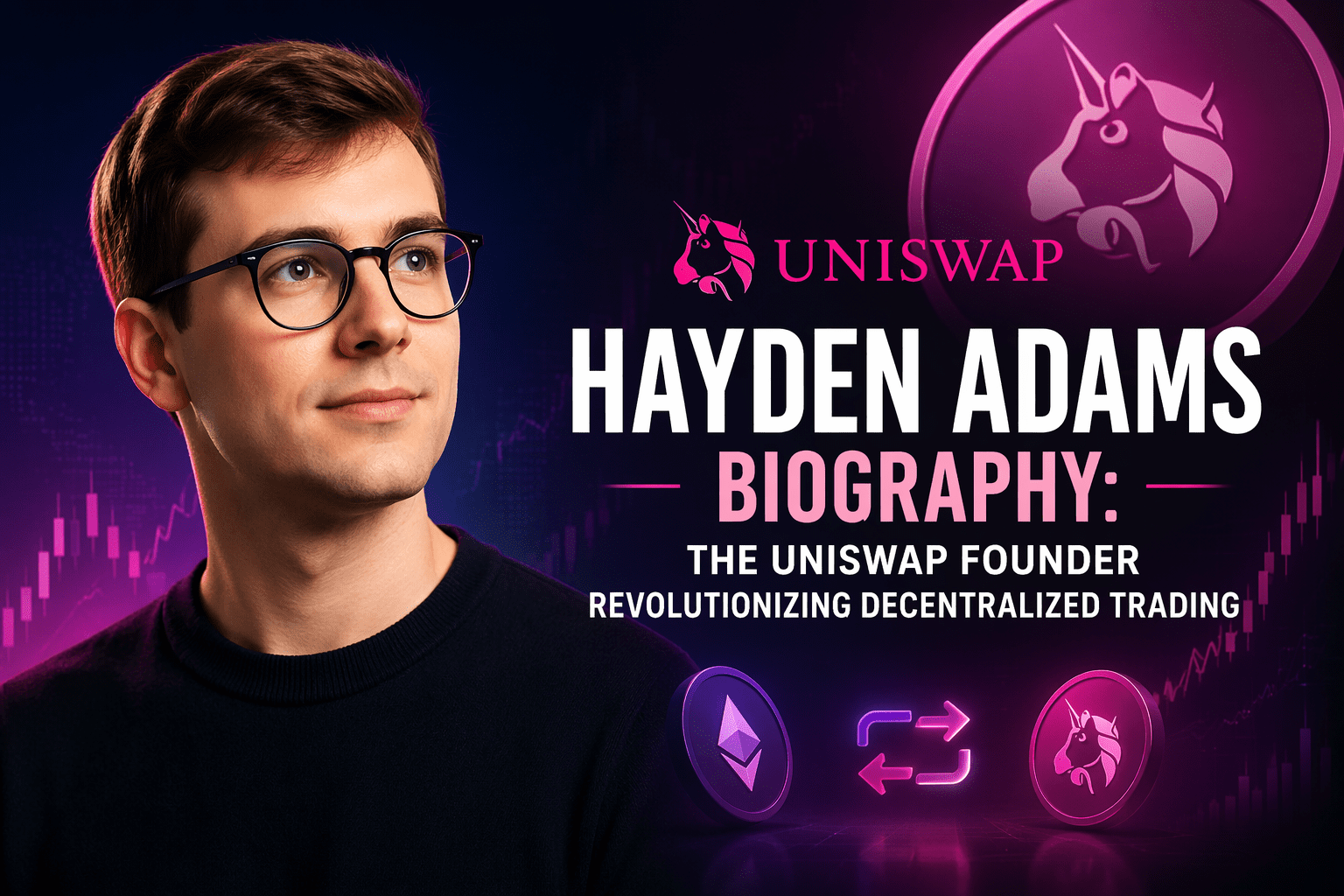
Hayden Adams Biography: The Man Who Built Uniswap, Unichain & Revolutionized Decentralized Trading
In the annals of financial history, few stories are as unlikely or as impactful as that of Hayden Adams. In 2017, Adams was a young mechanical engineer who had just lost his job at Siemens. He knew nothing about blockchain, smart contracts, or the burgeoning world of decentralized finance (DeFi). Less than a year later, he would write the code for Uniswap, a protocol that would eventually process trillions of dollars in volume and fundamentally change how the world thinks about liquidity, trading, and market-making.
This is the biography of Hayden Adams—the man who turned a layoff into a revolution, survived the “Vampire Attacks” of the DeFi Summer, and continues to push the boundaries of Ethereum with the creation of Unichain.
The Early Years: From Mechanical Engineering to the Unemployment Line
Hayden Adams grew up in a suburb of New York. Unlike many of the “crypto-natives” who were mining Bitcoin in their dorm rooms in 2011, Adams followed a traditional academic path. He attended Stony Brook University, where he studied Mechanical Engineering.
After graduating in 2016, he landed what many would consider a stable, prestigious job as a mechanical engineer at Siemens. His work involved performing stress and fatigue analysis for gas turbine components. However, the corporate world proved to be volatile. In July 2017, after only a year on the job, Adams was laid off.
At the time, the layoff felt like a catastrophe. In hindsight, it was the catalyst for the birth of DeFi.
The Karl Floersch Connection
Shortly after losing his job, Adams reached out to his friend Karl Floersch, who was then working as a researcher at the Ethereum Foundation. When Adams expressed his uncertainty about his next career move, Floersch gave him a piece of advice that would change his life: “Mechanical engineering is a dying field. Smart contracts are the future. You should learn Solidity.”
Floersch pointed Adams toward a post on Reddit written by Vitalik Buterin, the co-founder of Ethereum. The post detailed the concept of an “On-Chain Automated Market Maker” (AMM). While the math was elegant, no one had yet built a functional, user-friendly version of it. Floersch challenged Adams to build it as a way to learn how to code on Ethereum.
Samsung Galaxy A37 Review: The Ultimate Mid-Range Smartphone for 2025
Microsoft Increases Surface Laptop Prices: MacBook Air Is Now Cheaper
Huawei’s Wide Foldable Beats Samsung and Apple, but Is It Necessary?
The Birth of Uniswap: Learning to Code by Building a Revolution
Adams spent the next several months in a state of deep immersion. He didn’t just learn Solidity; he learned the philosophy of Ethereum. He spent his days in libraries and cafes, teaching himself the intricacies of the Ethereum Virtual Machine (EVM).
The Proof of Concept
By late 2017, Adams had built a functional proof of concept. It was a simple smart contract that allowed users to swap ETH for an ERC-20 token using a mathematical formula rather than a traditional order book.
In traditional finance, if you want to buy an asset, there must be a seller on the other side of the trade at that specific price. This is an “order book” model. Adams’s project utilized a “Liquidity Pool” model. In this system, users (Liquidity Providers) deposit pairs of tokens into a pool, and traders trade against the pool.
The “Constant Product” Formula
The core of Uniswap was the formula $x times y = k$.
- x is the amount of one token in the pool.
- y is the amount of the other token.
- k is a constant value.
This simple equation ensured that the pool always had liquidity, regardless of the trade size, by adjusting the price of the tokens based on the ratio of the assets in the pool.
From “Project” to “Uniswap”
Initially, Adams called the project “Internal Dynamics.” It was Vitalik Buterin who suggested the name “Uniswap.” In early 2018, Adams received a grant from the Ethereum Foundation to continue his work. He flew to Seoul and later to Prague for Devcon 4, where Uniswap V1 was officially launched on the Ethereum mainnet on November 2, 2018.
Uniswap V1 and V2: The DeFi Explosion
When Uniswap V1 launched, it was a minimalist masterpiece. It had no token, no listing fees, and no gatekeepers. Anyone could list any Ethereum-based token by simply providing liquidity.
The Rise of Permissionless Trading
Before Uniswap, if a new project wanted to get their token traded, they had to pay massive listing fees to centralized exchanges like Binance or Coinbase. Uniswap democratized this process. This led to an explosion of new tokens and experimental projects, fueling the “DeFi Summer” of 2020.
Uniswap V2: The Turning Point
In May 2020, Uniswap V2 was released. It introduced several critical features:
- ERC-20 to ERC-20 Pairs: V1 required every pair to include ETH. V2 allowed direct swaps between any two tokens (e.g., DAI to USDC).
- Price Oracles: It provided a highly secure way for other DeFi protocols to track token prices.
- Flash Swaps: This allowed users to borrow assets from the pool, perform a transaction, and return them in a single block—enabling complex arbitrage.
By mid-2020, Uniswap’s trading volume began to rival that of major centralized exchanges. Hayden Adams had successfully moved the needle from “crypto as a speculative asset” to “crypto as a functional financial system.”
The “Vampire Attack” and the UNI Token
As Uniswap grew, it faced its first major existential threat: Sushiswap. In August 2020, an anonymous developer known as “Chef Nomi” forked Uniswap’s open-source code to create Sushiswap.
The Battle for Liquidity
Sushiswap launched a “Vampire Attack,” offering massive rewards in the form of SUSHI tokens to anyone who moved their liquidity from Uniswap to Sushiswap. Within days, over $1 billion in liquidity migrated away from Adams’s platform.
The industry watched to see how Adams would respond. For years, he had resisted launching a token, wanting Uniswap to remain a pure utility. However, the competitive landscape had changed.
The UNI Airdrop
On September 16, 2020, Uniswap announced the launch of the UNI governance token. In one of the most famous moves in crypto history, Adams orchestrated a “retrospective airdrop.” Every single wallet that had ever used Uniswap—even once—was given 400 UNI tokens. At the time, those tokens were worth roughly $1,200; at the token’s peak, they were worth over $17,000.
This move didn’t just win back the liquidity; it solidified Uniswap as a community-owned protocol and set the standard for how decentralized projects should reward their users.
Uniswap V3: Concentrated Liquidity
While V2 made Uniswap famous, V3 (released in May 2021) made it efficient. Adams and his team recognized that the $x times y = k$ formula, while simple, was capital inefficient. Most trading happens within a narrow price range, yet liquidity was spread out across all prices from zero to infinity.
The Innovation of V3
Uniswap V3 introduced Concentrated Liquidity. This allowed Liquidity Providers (LPs) to choose a specific price range in which to provide their capital.
- Example: If you provide liquidity for a stablecoin pair like USDC/USDT, you know the price will almost always be $1.00. In V3, you can concentrate your capital between $0.99 and $1.01, earning significantly higher fees with less capital.
This innovation made Uniswap the most capital-efficient decentralized exchange in the world, often surpassing the liquidity depth of centralized giants like Binance for major pairs like ETH/USDC.
Unichain: The Next Frontier
For years, Uniswap operated as a series of smart contracts on the Ethereum mainnet. However, as Ethereum grew, gas fees became a barrier for smaller traders. While Uniswap expanded to Layer 2 networks like Arbitrum, Optimism, and Base, Hayden Adams envisioned a more integrated future.
In late 2024, Uniswap Labs announced Unichain, a dedicated Layer 2 network built on the OP Stack.
Why Unichain Matters
Unichain represents a massive shift in Adams’s strategy. By building a dedicated blockchain, Uniswap can:
- Reduce Transaction Costs: Making swaps nearly free for users.
- Improve Speed: Achieving sub-second block times.
- Capture MEV (Maximal Extractable Value): Historically, bots have “front-run” trades on Uniswap, costing users money. Unichain is designed to capture this value and return it to the users and the protocol.
- Interoperability: Unichain aims to be a hub for “cross-chain” swaps, allowing users to trade assets across different blockchains seamlessly.
With Unichain, Hayden Adams is moving from building an application to building the infrastructure that powers the entire decentralized economy.
Challenges and Controversies
Hayden Adams’s journey has not been without friction. As the face of DeFi, he has often been in the crosshairs of regulators.
The SEC and the Wells Notice
In April 2024, the U.S. Securities and Exchange Commission (SEC) issued a Wells Notice to Uniswap Labs, signaling their intent to pursue an enforcement action. The SEC’s argument generally centers on whether decentralized exchanges should be regulated as traditional broker-dealers and whether certain tokens are unregistered securities.
Adams’s response was defiant and principled. He stated: “I am frustrated that the SEC seems to be more concerned with protecting opaque systems than protecting consumers. We have to fight this for the future of our industry.”
This legal battle is seen as a landmark case that will determine the future of decentralized software in the United States. Adams has become an accidental statesman for the crypto industry, defending the right to write and deploy open-source code.
The Philosophy of Hayden Adams
What sets Hayden Adams apart from many other founders in the space is his commitment to the “Ethereum Ethos.” While other DEXs have come and gone, Uniswap has remained a constant.
Open Source and Transparency
Adams has consistently kept Uniswap’s code open-source. While this allows competitors to “fork” his work (as seen with Sushiswap or PancakeSwap), it also ensures that the protocol is transparent and auditable. He views Uniswap as a “public good”—a piece of financial infrastructure that belongs to the internet rather than a single corporation.
Minimalist Design
Adams is a proponent of “minimalism” in software. Uniswap’s interface has remained remarkably simple over the years, even as the underlying math became incredibly complex. This focus on user experience (UX) is a large part of why Uniswap remains the most used application in the Ethereum ecosystem.
The Impact on Global Finance
To understand Hayden Adams’s legacy, one must look at the numbers. Uniswap has:
- Processed over $2 trillion in lifetime trading volume.
- Supported millions of individual users.
- Enabled thousands of new projects to bootstrap liquidity without a middleman.
But beyond the numbers, Adams has proven that a “trustless” financial system is possible. He showed that you don’t need a bank, a clearinghouse, or a centralized exchange to facilitate the global trade of assets. You only need math and code.
Examples of the “Uniswap Effect”
- The 2020 Crash: During the market volatility of March 2020, many centralized exchanges went offline due to high traffic. Uniswap remained functional throughout, processing trades every single block.
- Yield Farming: The concept of “Liquidity Mining,” which powered the growth of the entire DeFi sector, was built on top of Uniswap’s LP token model.
- Tokenization of Everything: From carbon credits to real estate, Uniswap provides the venue for these niche assets to find a market.
Conclusion: The Architect of the New Economy
Hayden Adams’s story is a testament to the power of the “permissionless” internet. In a span of seven years, he went from an unemployed engineer to the architect of a new financial system. He didn’t ask for permission to build Uniswap; he simply downloaded the Ethereum whitepaper and started typing.
Through the development of Uniswap V1-V4 and the launch of Unichain, Adams has consistently prioritized decentralization, security, and innovation. He has navigated “Vampire Attacks,” regulatory scrutiny, and the extreme volatility of the crypto markets, emerging as one of the most respected figures in the industry.
As Uniswap transitions into its next phase with Unichain, the goal remains the same: to create a financial system that is open, fair, and accessible to everyone on the planet. Hayden Adams didn’t just build a decentralized exchange; he built the foundation for the future of value exchange. In the world of decentralized finance, there is a “before Uniswap” and an “after Uniswap,” and the man behind that divide has forever changed the trajectory of global finance.