Samsung Galaxy S26 Ultra vs. Google Pixel 10 Pro XL: Which Flagship Phone is Best?
The smartphone landscape of 2026 has reached a fever pitch. With the release of the Samsung Galaxy S26 Ultra and the Google Pixel 10 Pro XL, the industry has moved beyond incremental updates into an era defined by custom silicon, generative AI integration, and professional-grade optics. Both devices represent the pinnacle of their respective ecosystems, but they cater to fundamentally different philosophies of what a smartphone should be.
Samsung continues its “everything and the kitchen sink” approach, refining the Ultra into a productivity powerhouse that blurs the line between mobile and desktop. Meanwhile, Google has reached a historic milestone with the Pixel 10 series, finally moving to a fully custom, TSMC-manufactured Tensor G5 chip that promises to close the performance gap with its rivals.
If you are looking to invest in a flagship that will last you the next seven years, the choice between these two is more complex than ever. In this comprehensive comparison, we break down every facet of these titans to help you decide which belongs in your pocket.
Design and Build Quality: Industrial Elegance vs. Organic Minimalism
Samsung Galaxy S26 Ultra: The Titanium Monolith
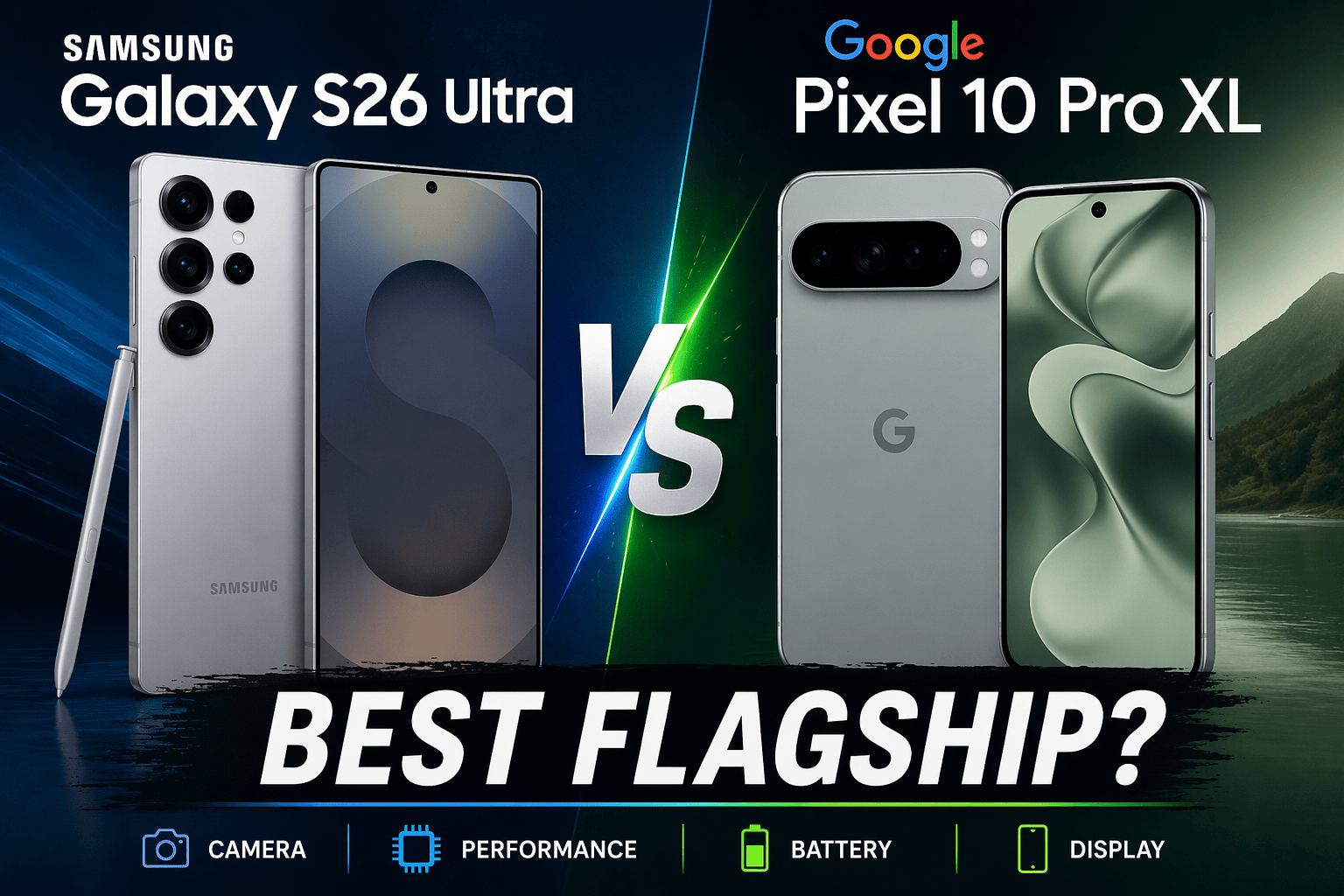
The Galaxy S26 Ultra carries forward the design language established by its predecessors but with significant refinements in ergonomics. Samsung has moved toward a “Grade 5 Titanium” frame that is both lighter and more scratch-resistant than previous iterations. The most notable change is the subtle rounding of the sharp corners that plagued the S24 and S25 Ultra, making the device much more comfortable to hold without a case.
The S26 Ultra remains a massive device, housing the integrated S Pen. The back glass features a new “Satin Armor” finish that is virtually immune to fingerprints. Samsung’s commitment to durability is evident with the introduction of Gorilla Glass Armor 3, which reduces reflections by up to 80% and offers industry-leading drop protection.
Google Pixel 10 Pro XL: The 10th Anniversary Evolution
For the 10th anniversary, Google has overhauled the Pixel’s aesthetic. The Pixel 10 Pro XL features a refined “floating” camera bar that no longer stretches from edge to edge but sits as a pill-shaped island of polished aluminum. The frame is crafted from 100% recycled aerospace-grade aluminum with a soft-touch matte glass back.
The Pixel 10 Pro XL is slightly narrower and more rounded than the S26 Ultra, making it the preferred choice for users who find Samsung’s “boxy” design too cumbersome. It feels more like a lifestyle accessory than a piece of industrial equipment, offering a friendly, approachable aesthetic in a variety of “Obsidian,” “Porcelain,” and new “Tensor Gold” colorways.
The Verdict on Design:
- Choose Samsung if you want a rugged, professional tool with an integrated stylus.
- Choose Google if you prefer a more ergonomic, stylish, and comfortable handheld experience.
Display Technology: The Battle of Nits and Clarity
Both Samsung and Google have sourced the best OLED panels available, but their tuning priorities differ.
Samsung’s Dynamic AMOLED 2X
The S26 Ultra features a 6.9-inch Dynamic AMOLED 2X display with a 144Hz refresh rate—a first for the Ultra line. Samsung has pushed the peak brightness to a staggering 3,200 nits, ensuring perfect visibility even under direct mid-day sun. The real star, however, is the anti-reflective coating. Following the success of the S24 Ultra, the S26 Ultra uses an even more advanced layer that makes the screen look like printed paper, significantly reducing eye strain.
Google’s Super Actua Display
The Pixel 10 Pro XL sports a 6.8-inch Super Actua Display. While it tops out at 3,000 nits (slightly lower than Samsung), Google focuses on color accuracy and “Natural Tone” rendering. The Pixel’s LTPO technology allows the screen to drop to 0.1Hz to save battery, whereas Samsung typically bottoms out at 1Hz. Google also introduces “Ultra HDR 2.0,” which makes photos and videos pop with a level of dynamic range that feels almost three-dimensional.
Key Display Comparison:
- Samsung: 144Hz refresh rate, superior anti-reflection, S Pen support.
- Google: Better color calibration for photography, more efficient low-frequency scaling.
Performance: The Tensor G5 Revolution vs. Snapdragon 8 Gen 5
For years, the performance debate was lopsided. Samsung’s use of Qualcomm’s Snapdragon chips consistently outperformed Google’s Samsung-manufactured Tensor chips. In 2026, the playing field has leveled.
Google’s Custom Leap (Tensor G5)
The Pixel 10 Pro XL marks the debut of the Tensor G5, Google’s first chip designed entirely in-house and manufactured by TSMC on a 3nm (or potentially 2nm) process. This move has eliminated the thermal throttling and efficiency issues of previous Pixels. The Tensor G5 isn’t just about raw speed; it features a dedicated “Gemini TPU” (Tensor Processing Unit) that allows the phone to run massive AI models locally without needing an internet connection.
Samsung’s Raw Power (Snapdragon 8 Gen 5)
The Galaxy S26 Ultra utilizes the Snapdragon 8 Gen 5 “For Galaxy.” This chip remains the king of synthetic benchmarks and gaming. With an overclocked GPU and a massive vapor chamber cooling system, the S26 Ultra is the ultimate mobile gaming machine. It handles Ray Tracing at 60fps in AAA mobile titles like Genshin Impact or Resident Evil with ease.
Performance Summary:
- Samsung is for the power user, the gamer, and the multi-tasker who uses DeX mode to turn their phone into a PC.
- Google is for the AI enthusiast, offering the smoothest UI animations and the most intelligent background processing seen on Android.
Camera Systems: Computational Magic vs. Hardware Dominance
The “Camera King” title is the most contested part of this comparison.
Samsung Galaxy S26 Ultra: The Zoom Specialist
Samsung has doubled down on its “Space Zoom” legacy. The S26 Ultra features:
- 200MP Main Sensor: Improved low-light performance through 16-in-1 pixel binning.
- 50MP 5x Periscope: Now featuring a “Liquid Lens” that allows for seamless variable optical zoom between 5x and 10x.
- 12MP Ultra-wide: With macro capabilities.
- 10MP 3x Telephoto: For classic portraits.
The S26 Ultra excels in versatility. Whether you are at a concert zooming in on a performer from the back row or taking a 100x shot of the moon, Samsung’s hardware is unmatched.
Google Pixel 10 Pro XL: The King of HDR
Google doesn’t play the megapixel game as aggressively, opting for a triple 50MP setup (Main, Ultra-wide, 5x Telephoto). However, the Pixel 10 Pro XL’s “Pro Image Engine” is revolutionary.
- Video Boost 2.0: Google now processes 4K video in the cloud (or locally via Tensor G5) to provide night-time video that looks like it was shot on a DSLR.
- Real Tone & Face Unblur: Google remains the leader in representing diverse skin tones accurately and ensuring that fast-moving subjects (like kids or pets) are never blurry.
- Add Me & Magic Editor: The AI tools on the Pixel allow you to insert yourself into group photos or move objects in a photo with perfect lighting reconstruction.
Example Scenario:
If you are taking a photo of a sunset behind a person, the Pixel will perfectly balance the shadows on the face and the highlights of the sky. The Samsung will provide a sharper, more detailed image that you can crop into significantly without losing quality.
Best eSIMs 2026: Top Plans for Travel, Business, and Home Use
Best Touchscreen Laptops 2026: Top Models Expertly Tested and Reviewed
Samsung Warns of Fake SSDs in Europe Amid Major CPU Sales Slump
AI Integration: Galaxy AI vs. Google Gemini
In 2026, these aren’t just phones; they are AI companions.
Galaxy AI 3.0
Samsung’s AI suite is focused on productivity.
- Note Assist: Can summarize a 30-minute meeting recorded via the voice recorder into a formatted bulleted list in seconds.
- Live Translate: Now works across third-party apps like WhatsApp and Zoom, providing real-time voice and text translation.
- S Pen AI: You can scribble a rough sketch of an idea, and the AI will transform it into a professional vector illustration.
Google Gemini Nano (2nd Gen)
Google’s AI is more deeply integrated into the OS.
- Gemini Live: A conversational assistant that feels human. You can interrupt it, ask it to look at your screen, and have it explain complex topics.
- Call Notes: Automatically summarizes phone calls and adds action items to your calendar.
- Universal Search: Circle to Search has evolved into “Contextual Awareness,” where the phone understands what you are doing and offers help before you even ask.
Software and Longevity: Seven Years of Support
Both manufacturers have committed to seven years of OS and security updates, meaning these phones will be supported until 2033.
- Samsung One UI 8: Samsung’s skin is feature-rich. It offers “DeX” (Desktop Experience), which allows you to plug your phone into a monitor for a PC-like interface. It is highly customizable but can feel “bloated” to some users due to the sheer number of settings.
- Pixel UI (Android 16): Google’s software is clean, fast, and exclusive. Features like “Call Screen” (which answers spam calls for you) and “Hold for Me” make the Pixel the most “intelligent” phone to use daily.
Battery Life and Charging
The S26 Ultra packs a 5,500mAh battery, a slight increase from previous years, thanks to new stacked battery technology. It supports 45W wired charging and 15W wireless charging. While 45W is decent, it lags behind Chinese competitors, taking about an hour for a full charge.
The Pixel 10 Pro XL features a 5,100mAh battery. Thanks to the efficiency of the TSMC-made Tensor G5, the Pixel finally matches Samsung in “screen-on time,” easily lasting a full day of heavy use. Google has also upgraded its charging to 37W, closing the gap with Samsung.
The Ecosystem Factor
The Samsung Advantage
If you own a Galaxy Watch, Galaxy Tab, or a Samsung Galaxy Book, the integration is seamless. You can copy text on your phone and paste it on your tablet, or use your phone as a secondary webcam for your laptop. The S Pen remains a unique selling point for digital artists and note-takers.
The Google Advantage
The Pixel ecosystem is catching up. The Pixel Watch 4 and Pixel Buds Pro 3 integrate perfectly with the Pixel 10 Pro XL. Google’s advantage lies in its software services—Google Photos, Drive, and Workspace are more deeply integrated into the Pixel than any other Android device.
Price and Value
- Samsung Galaxy S26 Ultra: Expected to start at $1,299.
- Google Pixel 10 Pro XL: Expected to start at $1,099.
Samsung justifies its $200 premium with the inclusion of the S Pen, a more complex camera hardware array (four lenses vs. three), and the higher licensing costs of the Snapdragon chip. Google offers a “smarter” experience and arguably better photography for a slightly lower price point.
Comparison Table: At a Glance
| Feature | Samsung Galaxy S26 Ultra | Google Pixel 10 Pro XL |
|---|---|---|
| Display | 6.9″ 144Hz AMOLED (3200 nits) | 6.8″ 120Hz LTPO (3000 nits) |
| Processor | Snapdragon 8 Gen 5 | Tensor G5 (TSMC 3nm) |
| RAM | 12GB / 16GB | 16GB |
| Storage | 256GB to 1TB | 128GB to 1TB |
| Main Camera | 200MP + 50MP + 10MP + 12MP | 50MP + 50MP + 50MP |
| Battery | 5,500mAh (45W Charging) | 5,100mAh (37W Charging) |
| Stylus | Integrated S Pen | None |
| Software | One UI 8 (Android 16) | Pixel UI (Android 16) |
| Support | 7 Years of Updates | 7 Years of Updates |
Conclusion: Which Flagship Should You Buy?
Choosing between the Samsung Galaxy S26 Ultra and the Google Pixel 10 Pro XL comes down to your personal priorities as a user.
Buy the Samsung Galaxy S26 Ultra if:
- You are a power user: You need the S Pen for signing documents, taking notes, or remote-controlling your camera.
- You are a gamer: You want the highest possible frame rates and the best thermal management.
- You want the best zoom: You frequently take photos of distant objects or attend large-scale events.
- You want a desktop replacement: Samsung DeX is a game-changer for mobile productivity.
Buy the Google Pixel 10 Pro XL if:
- You want the smartest AI: You want a phone that anticipates your needs, screens your calls, and edits your photos with magical ease.
- You value photography over specs: You want the most consistent, “point-and-shoot” camera that handles skin tones and motion better than any other.
- You prefer clean software: You want the “Apple version of Android”—smooth, cohesive, and free of redundant apps.
- You want better value: You get a world-class flagship experience for $200 less than the Ultra.
In 2026, the gap between these two has never been smaller. With Google finally fixing its hardware efficiency issues through the Tensor G5 and Samsung refining its Ultra design to be more ergonomic, there is no wrong choice. However, the Samsung Galaxy S26 Ultra remains the king of hardware versatility, while the Google Pixel 10 Pro XL is the undisputed champion of the helpful, AI-driven smartphone experience.