
Table of Contents
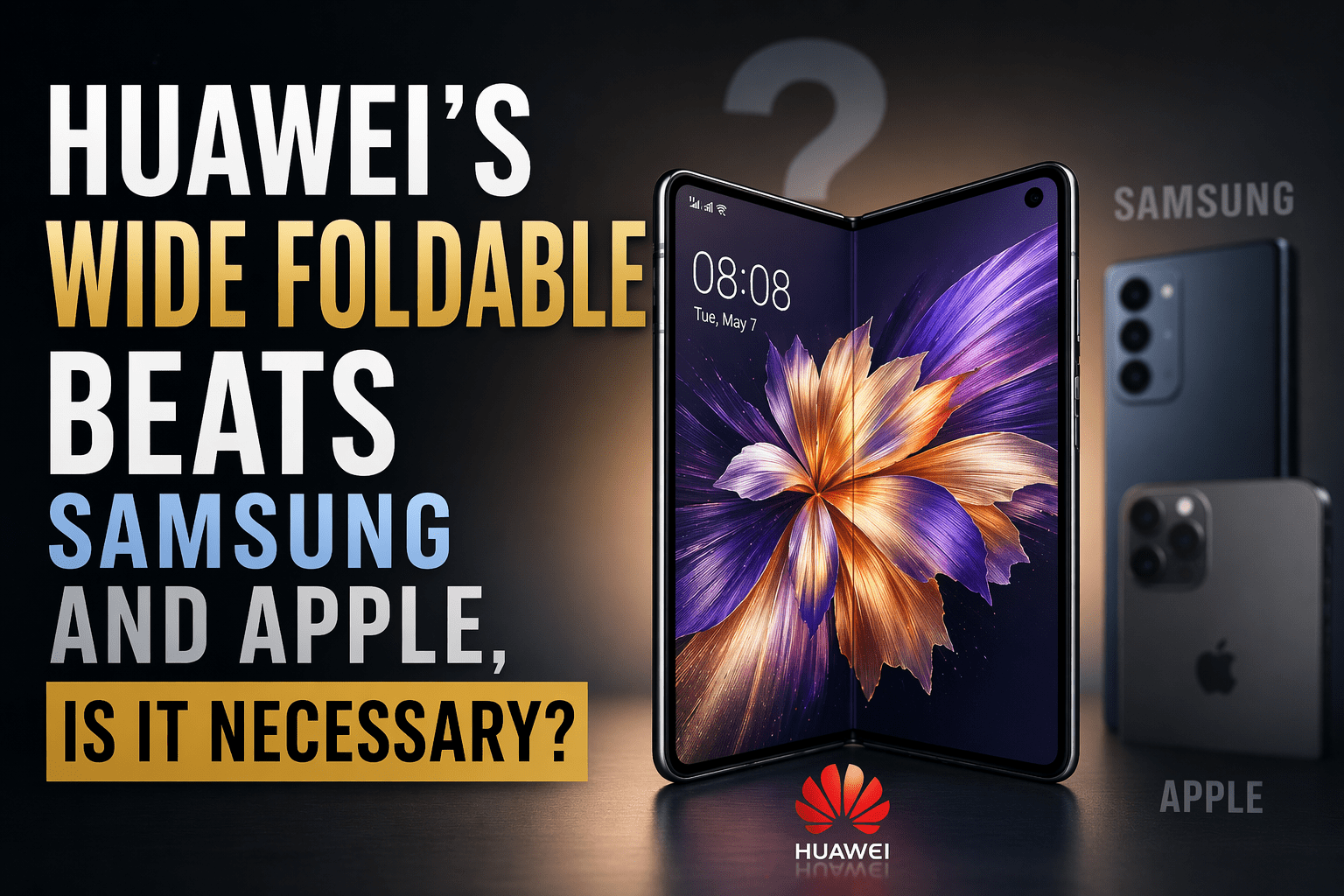
Huawei’s Wide Foldable Beat Samsung and Apple – But I Don’t See the Point
The smartphone industry has long been a game of incrementalism. For the better part of a decade, the “innovation” we received annually consisted of slightly faster processors, marginally better cameras, and perhaps a new shade of titanium or glass. Then came the foldables. When Samsung launched the original Galaxy Fold, it felt like the future had finally arrived, albeit in a fragile, first-generation package.
Fast forward to today, and the foldable market has matured. Or so we thought. While Samsung has settled into a rhythm of iterative refinements with the Z Fold 6, and Apple remains conspicuously absent from the category altogether, Huawei decided to shatter the status quo. The Huawei Mate XT Ultimate Design—the world’s first triple-folding smartphone—is a masterclass in engineering. It is a 10.2-inch tablet that folds into a standard-sized smartphone.
On paper, Huawei has won. They have out-engineered the South Korean giant and out-innovated the Cupertino titan. They have achieved the “holy grail” of mobile hardware. But as the dust settles on the initial hype, a glaring question remains: What is the actual point?
The Engineering Triumph: How Huawei Took the Lead
To understand why the Mate XT is such a significant milestone, we have to look at the technical hurdles Huawei overcome. Creating a dual-hinge system that folds in both directions (an “inner” fold and an “outer” fold) is a mechanical nightmare.
The Z-Fold Mechanism
Unlike the book-style foldables we are used to (like the Pixel Fold or Galaxy Z Fold), the Mate XT uses a “Z” shape. This means one hinge folds inward, protecting the screen, while the other folds outward, leaving a portion of the flexible display exposed as the phone’s primary cover screen.
Huawei managed to make this device incredibly thin. When fully unfolded, it measures just 3.6mm in thickness. Even when folded shut, it remains comparable to some of the bulkier traditional foldables on the market. This is a feat of miniaturization that Samsung, despite its years of experience, has yet to match.
Display Technology
The 10.2-inch OLED panel is a marvel. It’s not just about size; it’s about the versatility of aspect ratios. You can use it as a 6.4-inch traditional phone, a 7.9-inch “square” foldable, or the full 10.2-inch canvas. Huawei has effectively created a 3-in-1 device.
By beating Samsung to the punch, Huawei has reclaimed its title as the hardware innovator of the mobile world—a title it held briefly before US sanctions hampered its global trajectory. They have proven that they can innovate without the help of Western supply chains in ways their competitors seemingly cannot.
The “Apple Way” vs. The “Huawei Way”
The contrast between Huawei and Apple has never been more stark. Apple is famously conservative. They wait for a technology to be “perfect” (or at least commercially viable at scale) before entering a category. We saw this with high-refresh-rate screens, widgets, and even 5G.
Huawei, conversely, is throwing everything at the wall. The Mate XT is a “halo product.” It exists to prove that it can exist. While Apple is busy refining the curve of a bezel, Huawei is reimagining the geometry of the handheld computer.
However, Apple’s absence from the foldable market might not be due to a lack of capability, but rather a calculated assessment of the “point.” Apple focuses on the “User Experience” (UX). If a device is awkward to hold, difficult to protect, or lacks software that justifies its form factor, Apple generally stays away. Huawei has won the hardware race, but they may have ignored the finish line of actual utility.
The Practicality Gap: Why More Isn’t Always Better
Despite the “wow” factor, the Mate XT introduces a litany of practical problems that suggest we may have reached the point of diminishing returns in smartphone design.
1. The Durability Nightmare
Foldable screens are, by nature, made of plastic polymers or ultra-thin glass (UTG) that can bend. They are significantly softer than the Gorilla Glass found on standard iPhones or S24 Ultras.
In a traditional foldable, the main screen is protected when the device is closed. In Huawei’s tri-fold design, because one fold is an “outer” fold, a third of that soft, expensive, 10.2-inch screen is always exposed to the world. It’s in your pocket with lint; it’s on the table with crumbs. One accidental scratch from a fingernail or a set of keys, and a $2,800 device is permanently marred.
2. The Weight and Bulk Factor
While 3.6mm is thin for a single panel, you have to multiply that by three, plus the thickness of the hinges and the casing. The Mate XT is a heavy device. Carrying it in a pair of jeans is less like carrying a phone and more like carrying a stack of three phones.
The ergonomics of holding a 10.2-inch screen that is only 3.6mm thick are also questionable. There is no “grip” or bezel to hold onto without triggering accidental touches on the screen. It is a device that almost requires two-handed use 100% of the time, defeating the purpose of a “mobile” phone.
3. The Software Scaling Issue
This is where the “point” of the device truly begins to crumble. Android (and Huawei’s HarmonyOS) has struggled for years to get developers to optimize apps for the 7.6-inch “square-ish” screens of the Galaxy Z Fold.
Now, Huawei has introduced a third aspect ratio.
- Phone Mode: Standard 19.5:9 or similar.
- Dual-Screen Mode: Nearly square.
- Triple-Screen Mode: A wide 16:11 ratio.
Most apps will simply “stretch” to fit these screens, leading to wasted space, awkward UI elements, and “letterboxing” in videos. A 10.2-inch screen sounds great for movies, but because most content is filmed in 16:9 or 21:9, you end up with massive black bars at the top and bottom. The actual viewable area of a movie on the Mate XT isn’t significantly larger than it would be on a much cheaper, much more durable iPad Mini or even a large Pro Max phone.
The Price of Innovation
We cannot discuss the Mate XT without discussing the price. Launching at approximately $2,800 USD (and retailing for much more on the secondary market due to limited supply), it is the most expensive mass-produced smartphone ever made.
For $2,800, a consumer could buy:
- An iPhone 16 Pro Max ($1,199)
- An iPad Pro M4 ($999)
- A MacBook Air ($800)
You could own the entire Apple ecosystem for the price of one Huawei tri-fold. When you buy the “three-in-one” device, you aren’t just getting the benefits of three devices; you are also getting the compromises of three devices. You get a phone that is too thick, a tablet that is too fragile, and a workstation that lacks a keyboard and a desktop-class OS.
Samsung’s “Boring” Strategy is Starting to Look Smart
For the last two years, tech journalists (myself included) have criticized Samsung for being “lazy” with the Z Fold 5 and Z Fold 6. The changes have been minimal—a slightly better hinge, a slightly wider cover screen, a faster chip.
However, looking at the Mate XT, Samsung’s strategy starts to look like maturity rather than laziness. Samsung realized that the “book-style” foldable is the sweet spot for most people. It provides a “big enough” screen for multitasking while remaining (mostly) pocketable and durable enough for daily use.
Samsung has focused on:
- IP48 Water and Dust Resistance: Something Huawei’s complex tri-fold hinges likely cannot achieve.
- S-Pen Integration: Making the large screen actually useful for productivity.
- Software Refinement: OneUI is arguably the best software for multitasking on a foldable.
Huawei has beaten Samsung in a “spec war,” but Samsung is winning the “usability war.” Most people don’t need a 10-inch screen in their pocket; they need a 7-inch screen that doesn’t break when it rains.
Who is This For?
If the Mate XT isn’t practical, isn’t durable, and is prohibitively expensive, who is the target audience?
The Status Symbol Seekers
In China, Huawei has become a symbol of national pride and technological defiance. Owning the “Ultimate Design” Mate XT is the ultimate flex. It’s the digital equivalent of a Ferrari. You don’t buy a Ferrari because it’s the most practical way to get to the grocery store; you buy it because of what it says about your bank account and your appreciation for engineering.
The “Early Adopters”
There is a segment of the tech community that will always want the “first” of anything. These are the people who bought the original Galaxy Fold despite the screen peeling issues. For them, the “point” is the novelty itself. Being able to unfold a phone twice in a coffee shop and watch people’s jaws drop is worth the $2,800.
The Niche Power User
There is a very small sliver of the population—perhaps high-level executives or field researchers—who truly need a large-format tablet that can fit in a pocket. For someone who spends their life reviewing complex spreadsheets or architectural blueprints on the go, the Mate XT might actually be a productivity tool. But this is a tiny fraction of the market.
Juan Benet Biography: The Visionary Behind Protocol Labs, IPFS, and Filecoin
Best Xiaomi Phones: Top Xiaomi & Poco Mobiles Reviewed
Vitalik Buterin Biography: Ethereum Founder’s Life, Achievements & Future Plans
The Future of the Form Factor
While I struggle to see the point of the tri-fold today, I recognize that it is a necessary step in the evolution of hardware.
The first mobile phones were “bricks” that were barely portable. The first laptops were “luggables” that weighed 20 pounds. Innovation often starts with an impractical, expensive, and fragile proof-of-concept.
Huawei’s tri-fold might be the “Motorola DynaTAC” of the foldable world. In five to ten years, when screen technology evolves to be as scratch-resistant as glass, and when hinges become so thin that a tri-fold is no thicker than a modern iPhone, the “point” will become clear. We will have a single device that truly replaces the phone, the tablet, and the laptop.
But we aren’t there yet. We are currently in the “awkward teenage years” of foldable tech.
The Apple Factor: The Silent Spectator
Apple’s strategy of waiting is often mocked, but in the case of the tri-fold, it is entirely justified. Imagine if Apple released a “tri-fold iPhone” tomorrow.
- If the screen scratched easily, it would be “Fold-gate.”
- If the software didn’t perfectly transition between three different sizes, it would be panned as “un-Apple-like.”
- If it cost $3,000, the media would have a field day.
Apple is likely watching Huawei very closely. They are letting Huawei do the expensive R&D and make the public mistakes. Apple will wait until the supply chain can produce a tri-fold screen that is durable and a hinge that is seamless. When (or if) they finally release a foldable, it won’t be because they want to be “first”; it will be because they found a way to make the form factor make sense for a billion people, not just a few thousand enthusiasts.
The Hidden Costs of Being “First”
Beyond the retail price, there are hidden costs to owning a device like the Mate XT.
Repairability
If you crack the screen on an iPhone, it’s an expensive but straightforward fix. If you damage the triple-folding display of the Mate XT, you are essentially looking at a total loss. The complexity of the internal ribbon cables and the tension required for the dual hinges make third-party repairs impossible and manufacturer repairs likely cost as much as a new flagship phone.
Battery Life
Driving a 10.2-inch high-resolution OLED panel requires an immense amount of power. While Huawei has used cutting-edge Silicon-Carbon battery technology to keep the device thin, the laws of physics still apply. Using the device in its fully unfolded state will likely drain the battery at an alarming rate. You are essentially carrying a tablet-sized screen with a phone-sized battery.
Ecosystem Lock-in
For global users, the lack of Google Mobile Services (GMS) remains a dealbreaker. No matter how impressive the hardware is, a $2,800 phone that can’t natively run the YouTube app, Google Maps, or the Play Store is a non-starter for the vast majority of the Western world. Huawei is winning the hardware race in a vacuum.
Conclusion: A Masterpiece Without a Gallery
Huawei’s Mate XT is, without a doubt, the most impressive piece of mobile hardware I have seen in a decade. It is a triumph of human ingenuity and a bold statement to the rest of the industry. Huawei has effectively told Samsung and Apple: “We can do things you wouldn’t even dare to try.”
But being the most impressive doesn’t make it the most useful.
The tri-fold form factor, in its current state, feels like a solution in search of a problem. It solves the “problem” of wanting a 10-inch screen in your pocket, but it creates a dozen new problems regarding durability, weight, software optimization, and price.
For now, the “wide foldable” is a fascinating experiment—a glimpse into a future where our devices are fluid and shape-shifting. But until the technology catches up with the vision, I’ll stick to my “boring” slab phone or my “simple” single-fold device. Huawei has won the race, but they’ve arrived at a destination where nobody else is quite ready to live yet.
The Mate XT is a masterpiece of engineering, but for the average consumer, it remains a masterpiece without a gallery—a beautiful, expensive, and fragile curiosity that proves we can fold a screen twice, but fails to explain why we should.
Have any thoughts?
Share your reaction or leave a quick response — we’d love to hear what you think!
-
 0
0
-
 0
0
-
 0
0
-
 0
0
-
 0
0
-
 0
0
