WhyEthereum Layer-2 Networks Are Dominating Web3 Growth
Web3 promises decentralized finance, digital ownership, and programmable trust, but its real‑world adoption hinges on one practical problem: scalability. Ethereum’s mainnet can process roughly 15–30 transactions per second (TPS), with fees that swing from a few cents to dozens of dollars depending on network congestion. For everyday use — micropayments, gaming, social tokens, or high‑frequency trading — these constraints are prohibitive.
Enter Layer‑2 (L2) networks: auxiliary protocols that offload work from Ethereum’s base layer while inheriting its security guarantees. Over the past 18 months, L2 solutions have moved from experimental side‑chains to the primary growth engines of the Web3 ecosystem. This article unpacks the technical, economic, and cultural forces driving that dominance, illustrated with concrete examples and data points.
The Scaling Challenge on Ethereum
Transaction Costs and Throughput- Base‑layer limits: Ethereum’s consensus mechanism (Proof‑of‑Stake as of “The Merge”) secures the network but does not increase throughput. Each block can contain only ~15 M gas units, translating to a hard ceiling on TPS.
- Fee volatility: During spikes — e.g., NFT mints or DeFi rallies — gas prices can exceed 200 gwei, making simple transfers cost $30–$50. Such price spikes deter casual users and small‑scale developers.
User Experience Constraints- Latency: Finality on Ethereum mainnet takes ~15 seconds (plus potential re‑orgs). For applications requiring instant feedback — like gaming or real‑time payments — this latency is unacceptable.
- Complexity: Users must manage gas fees, approve transactions, and sometimes wait for multiple confirmations, creating friction that clashes with Web2 expectations of “click‑and‑go” interactions.
These constraints have forced the community to look beyond the base layer for scalable, cost‑effective solutions.
Bitcoin Adoption in Developing Countries: The Future Outlook
Top Web3 Business Ideas for Entrepreneurs to Launch in 2026
Elizabeth Stark Net Worth 2026: Bitcoin Lightning Network Fortune.
What Are Layer‑2 Solutions?
Layer‑2 refers to any protocol that processes transactions off the Ethereum mainnet while leveraging its security through cryptographic commitments or fraud proofs. L2s can be categorized into three broad families:
| Category | Core Mechanism | Typical Throughput | Finality |
|---|---|---|---|
| Optimistic Rollups | Assume transactions are valid; challenge period for fraud proofs | 1,000–4,000 TPS | ~10 minutes (challenge window) |
| Zero‑Knowledge Rollups (ZK‑Rollups) | Validity proofs generated off‑chain; instantly posted to mainnet | 2,000–10,000 TPS | ~1–2 minutes |
| Sidechains & State Channels | Independent consensus or off‑chain settlement | 5,000–10,000+ TPS | Near‑instant (seconds) |
Each family trades off speed vs. security guarantees vs. complexity, but all share a common goal: reduce fees and latency while preserving the trust model of Ethereum.
Drivers of Dominance
1. Dramatically Lower Transaction Fees
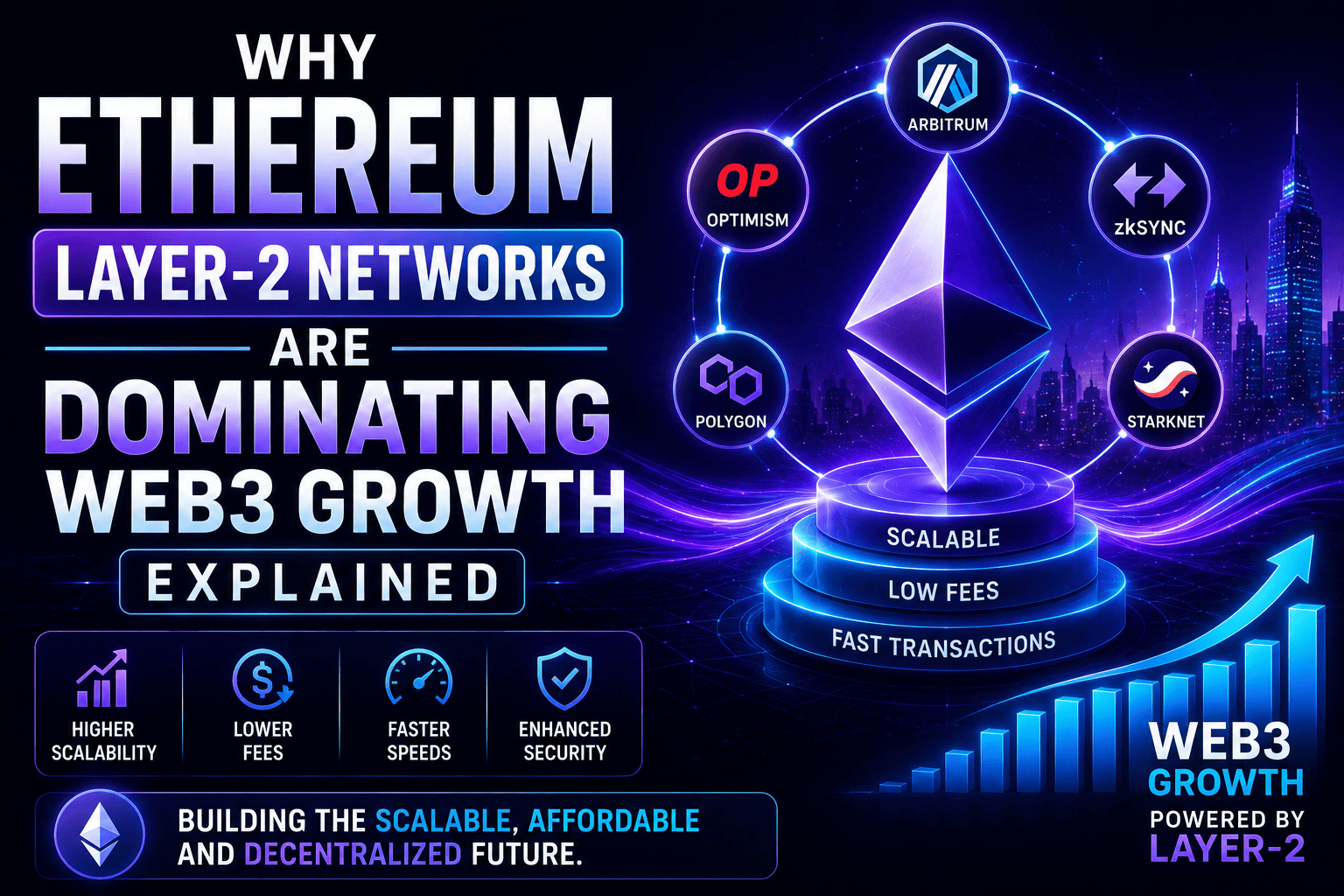
- Optimistic Rollups like Arbitrum and Optimism typically charge $0.001–$0.05 per transaction, a 100‑x reduction versus mainnet fees.
- ZK‑Rollups such as zkSync and StarkNet push fees even lower, often under $0.001, enabling micro‑transactions at scale.
2. Faster Finality and Improved UX
- ZK‑Rollups finalize blocks in under 2 minutes, compared to 15 seconds on mainnet plus potential re‑orgs.
- Users can interact with dApps without waiting for multiple confirmations, mirroring the responsiveness of centralized services.
3. Ecosystem Momentum
- Developer adoption: Over 70% of top‑10 DeFi projects now deploy on at least one L2. The total number of active L2 contracts surpasses 15,000.
- Funding inflows: In 2023, L2‑focused projects raised >$3 billion in venture capital, dwarfing mainnet‑only projects.
- User migration: Daily active addresses on Arbitrum and Optimism collectively exceed 1 million, a figure that would be impossible on Ethereum mainnet under current fee regimes.
4. Interoperability and Bridging- L2s are increasingly interconnected via cross‑rollup bridges (e.g., Hop Protocol, Connext) that enable seamless asset movement.
- This bridges the “siloed L2” perception, creating a unified scalability layer that feels like a single network to end users.
5. Regulatory and Security Perception
- Because L2s inherit Ethereum’s security model (via fraud proofs or validity proofs), regulators view them as compliant extensions rather than separate, unregulated chains.
- This perception encourages enterprises to experiment with L2‑based solutions without fearing a security downgrade.
Real‑World Examples of Leading L2s
Optimistic Rollups#### Arbitrum One
- Throughput: ~4,000 TPS
- Fees: Median $0.02 per transaction
- Ecosystem: Over 150 dApps, including Uniswap v3, Aave, and Curve.
- Key Innovation: “AnyTrust” data availability model reduces cost by posting only summaries on‑chain.
Optimism
- Throughput: ~2,000 TPS- Fees: $0.01–$0.03 per transaction
- Ecosystem: Hosts the Optimism Collective, a governance framework funded by a portion of protocol fees.
- Unique Feature: “Retroactive Public Goods Funding” incentivizes developers with on‑chain rewards.
Zero‑Knowledge Rollups
zkSync 2.0 (zkSync Era)
- Throughput: Up to 7,000 TPS
- Fees: Sub‑$0.001 for simple transfers- EVM Compatibility: Full EVM equivalence, enabling seamless porting of existing contracts.
- Notable Projects: Gitcoin Grants, dYdX (layer‑2 perpetuals), and Circle’s USDC bridge.
StarkNet
- Throughput: 10,000+ TPS (theoretical)
- Fees: Typically <$0.001
- Proof System: Recursive SNARKs (STARK) offering transparent verification.
- Key Users: dYdX (now on StarkNet), Immutable X (NFT marketplace), and DeversiFi.
Sidechains & Hybrid Solutions
Polygon zkEVM
- Combines ZK‑rollup security with Polygon’s ecosystem reach.
- Offers EVM‑compatible execution while leveraging zk‑proofs for data availability.
Base (Coinbase)
- An Optimistic Rollup built by Coinbase, targeting mainstream adoption.
- Emphasizes user‑friendly onboarding (e.g., gas‑less transactions for end users).
These examples illustrate how L2s are no longer niche experiments; they are production‑grade platforms hosting billions of dollars in value and millions of active users.
The Business Case for L2s
Revenue Models
| L2 Type | Primary Revenue Stream |
|---|---|
| Optimistic Rollups | Transaction fee share, sequencer fees, token incentives |
| ZK‑Rollups | Gas‑less or low‑gas fee structures, premium API access |
| Sidechains | Native token economics, staking rewards, ecosystem grants |
Many L2s monetize through sequencer fees — a small cut of each transaction that funds network operators and developers. Some projects allocate a portion of fees to public‑goods pools, creating a virtuous cycle of reinvestment into the ecosystem.
Tokenomics and Incentives
- Governance tokens (e.g., OP, ARB, STARK) empower users to vote on protocol upgrades and fee parameters.
- Staking mechanisms secure the rollup and reward participants, aligning economic incentives with network health.
- Liquidity mining programs attract liquidity providers, deepening DEX reserves and reducing slippage.
These token‑driven models not only fund growth but also embed community ownership, a hallmark of decentralized ecosystems.
Future Outlook and Remaining Challenges
1. Security Scrutiny
- While fraud proofs and validity proofs provide strong security guarantees, bridge exploits (e.g., the $600 M Wormhole hack) highlight the risks of cross‑chain transfers.
- Ongoing research into universal bridges and formal verification aims to mitigate these vulnerabilities.
2. Fragmentation and User Onboarding
- The proliferation of L2s can confuse end users, who must manage multiple wallets, bridges, and fee tokens.
- Account abstraction and universal accounts (e.g., ERC‑4337) are emerging solutions to present a unified interface.
3. Data Availability and Decentralization
- Some L2s rely on centralized data availability layers, which could become a bottleneck or single point of failure.
- Projects are experimenting with distributed data availability (e.g., Celestia) to ensure truly decentralized security.
4. Regulatory Clarity
- As L2s handle increasing volumes of value, regulators will scrutinize KYC/AML compliance, especially for on‑ramps and off‑ramps.
- Proactive engagement with policymakers and the implementation of privacy‑preserving proofs could shape the regulatory landscape.
5. Performance Scaling
- While current L2s achieve 2,000–10,000 TPS, the long‑term vision is 100,000+ TPS to support global payment networks.
- Advances in recursive SNARKs, sharding, and hardware acceleration are expected to push these limits further.
Conclusion
Ethereum Layer‑2 networks have transitioned from a technical curiosity to the primary engine of Web3 growth. By slashing fees, reducing latency, and preserving the security guarantees of the Ethereum mainnet, L2s unlock use cases that were previously impossible — micropayments, real‑time gaming, mass‑adoption of NFTs, and more. The dominance is evident in the surge of active addresses, the billions of dollars locked in L2‑based protocols, and the unprecedented venture capital flowing into rollup projects.
The momentum is self‑reinforcing: lower costs attract developers, which in turn draws users, generating more fees that fund further innovation. Yet the ecosystem must navigate challenges around security, user experience, and regulatory compliance. If those hurdles are addressed, L2s will not only dominate Web3 growth — they will redefine the economic architecture of the internet, making decentralized applications as seamless and ubiquitous as their centralized counterparts.
In short, the rise of Ethereum Layer‑2 networks is not a temporary scaling hack; it is the foundational layer upon which the next generation of decentralized finance, media, and identity will be built. The future of Web3 is being written on rollups, and the world is watching.