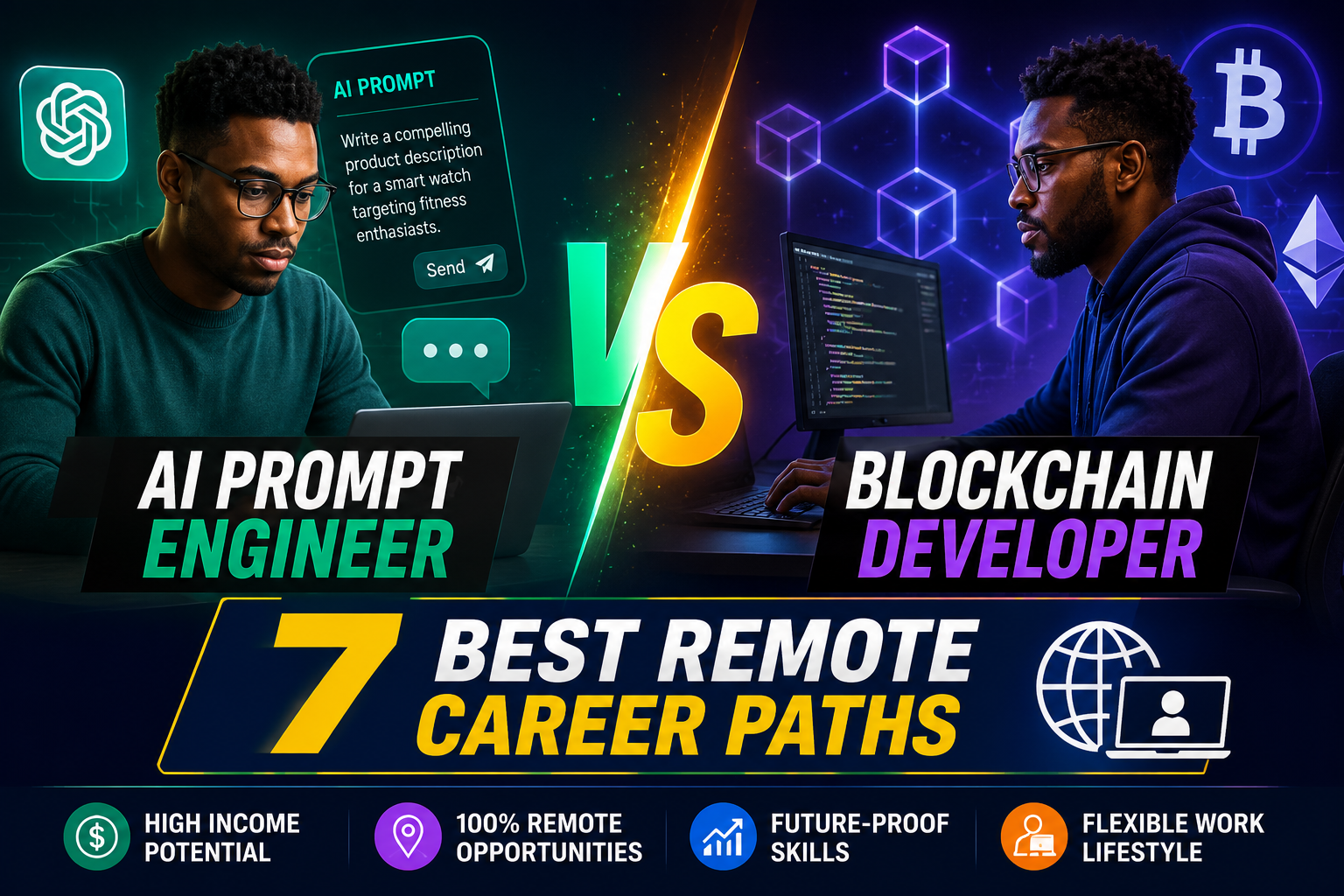
The digital landscape is shifting at an unprecedented pace, making the choice between an AI Prompt Engineer vs Blockchain Developer career path a major decision for remote workers in 2026. As these fields mature, they are not only reshaping industries but also creating entirely new career paths. For those looking to thrive in the remote work environment, understanding the burgeoning roles within these sectors is crucial. Two prominent positions that have emerged are the AI Prompt Engineer and the Blockchain Developer.
Table of Contents
Understanding the AI Prompt Engineer
At its core, an AI Prompt Engineer is an individual who specializes in crafting effective prompts for artificial intelligence models, particularly large language models (LLMs) like GPT-4, Claude 3.5, and specialized coding assistants. Think of it as being a translator between human intent and machine understanding, but with a highly sophisticated and nuanced language. For more details on specific roles, check out our guide on the best remote AI jobs.
The Evolution of Prompt Engineering in 2026
By 2026, prompt engineering has moved beyond simply “talking to a chatbot.” It now involves complex techniques like Chain-of-Thought (CoT) prompting, where the engineer guides the AI through logical steps, and Tree-of-Thoughts (ToT) frameworks for solving multi-layered problems. Prompt engineers are now essential for fine-tuning how enterprises use proprietary data without leaking sensitive information.
The primary responsibility of a prompt engineer is to design, refine, and optimize the instructions (prompts) given to AI systems to elicit desired outputs. This isn’t as simple as asking a question; it involves a deep understanding of how the AI model processes information and what kind of input will yield the most accurate, relevant, creative, or specific results.
Essential Skills for an AI Prompt Engineer
While the field is still evolving, certain skills are becoming indispensable for prompt engineers:
- Excellent Communication Skills: The ability to articulate complex ideas clearly and precisely, both in writing and verbally.
- Analytical and Critical Thinking: The capacity to break down problems, understand cause-and-effect relationships, and evaluate the quality of AI-generated output.
- Linguistic Proficiency: A strong grasp of language, grammar, syntax, and semantics. Understanding nuances in language is key.
- Creativity and Problem-Solving: The ability to think outside the box and devise novel ways to interact with AI.
- Iterative Refinement: Testing prompts, analyzing the AI’s output, and iteratively adjusting the prompt based on the results.
Understanding the Blockchain Developer
Blockchain technology, the decentralized ledger system underpinning cryptocurrencies like Bitcoin and Ethereum, has expanded far beyond its financial origins. It’s now being applied to supply chain management, digital identity, voting systems, and much more. A Blockchain Developer is an individual who designs, develops, and maintains blockchain-based applications and systems. Developers often start by exploring the official Ethereum developer documentation to understand the foundations of decentralized apps.
The State of Web3 Development in 2026
In 2026, the focus has shifted from simple token creation to building scalable Layer 2 solutions and Zero-Knowledge (ZK) proof applications. Blockchain developers are now tasked with creating “interoperable” ecosystems where different blockchains can communicate seamlessly. This requires a deeper understanding of cross-chain protocols and advanced security measures to prevent smart contract vulnerabilities.
Essential Skills for a Blockchain Developer
The skillset for a blockchain developer is more technical and often requires a strong foundation in computer science and programming.
- Strong Programming Skills: Proficiency in languages like Solidity (for Ethereum), Rust (for Solana and Polkadot), and Go is essential.
- Understanding of Cryptography: A solid grasp of cryptographic principles, hashing, digital signatures, and encryption.
- Data Structures and Algorithms: A deep understanding of computer science fundamentals, specifically how Merkle trees and linked lists function in a distributed environment.
- Smart Contract Development: Expertise in developing and auditing smart contracts to ensure they are gas-efficient and secure.
- Security Mindset: A keen awareness of potential vulnerabilities like reentrancy attacks and front-running.
AI Prompt Engineer vs Blockchain Developer: A Comparative Analysis
When comparing the AI Prompt Engineer vs Blockchain Developer roles, we must look at the nature of the work. One is linguistic and logic-based, while the other is structural and code-heavy.
1. Nature of Work and Skill Set
- AI Prompt Engineer: This role leans more towards linguistics, creativity, and analytical reasoning. It requires understanding human language and how to manipulate it to guide an AI. The technical barrier to entry can be lower, though deep expertise requires continuous learning.
- Blockchain Developer: This role is fundamentally technical and code-centric. It demands a strong foundation in computer science, programming, and cryptography. The learning curve is steeper, requiring significant investment in technical education.
2. Demand and Market Growth
The demand for prompt engineers is exploding as AI becomes a standard business tool. Conversely, the demand for blockchain developers remains high but more specialized, focusing on infrastructure and high-security financial applications. Both roles offer incredible remote flexibility, as the work is entirely digital.
Salary and Compensation Trends
In 2026, the compensation for both roles is among the highest in the tech industry. AI Prompt Engineers can expect salaries ranging from $120,000 to $250,000, depending on their ability to integrate AI into specific business domains like legal or medical tech. Blockchain Developers, particularly those skilled in Rust or advanced Solidity, often see salaries exceeding $200,000, with additional incentives in the form of token grants.
Building a Winning Portfolio
To succeed in either field, a portfolio is non-negotiable. For an AI Prompt Engineer, this means a GitHub repository or a personal site showcasing “Prompt Chains”—complex sequences of prompts that solve a specific business problem. You should demonstrate how you reduced hallucination rates or improved output accuracy.
For a Blockchain Developer, a portfolio should include deployed smart contracts on testnets (like Sepolia) or mainnets. Contributing to open-source Web3 projects is also a highly valued signal to remote recruiters. Showing that you can write clean, audited code is the key to landing high-paying roles.
The Verdict: Which Career Is the Future?
This is not a simple either/or question, as both AI Prompt Engineering and Blockchain Development represent significant and promising futures for remote work. The “better” choice depends heavily on an individual’s aptitude, interests, and career goals.
AI Prompt Engineering is arguably poised for a more immediate and widespread impact on the everyday remote worker. It is about optimizing human-AI collaboration in the existing digital framework. If you enjoy the intersection of psychology, language, and technology, this is your path.
Blockchain Development represents a more fundamental shift, building the decentralized infrastructure that could redefine how remote work, value exchange, and digital ownership function. If you are a builder who loves deep technical challenges and the philosophy of decentralization, blockchain is the way to go.
Ultimately, the most successful professionals in 2026 might be those who can bridge the gap—using AI to audit smart contracts or using blockchain to verify the training data used by AI models. Both careers offer exciting opportunities for those seeking fulfilling and flexible remote work.