
Table of Contents
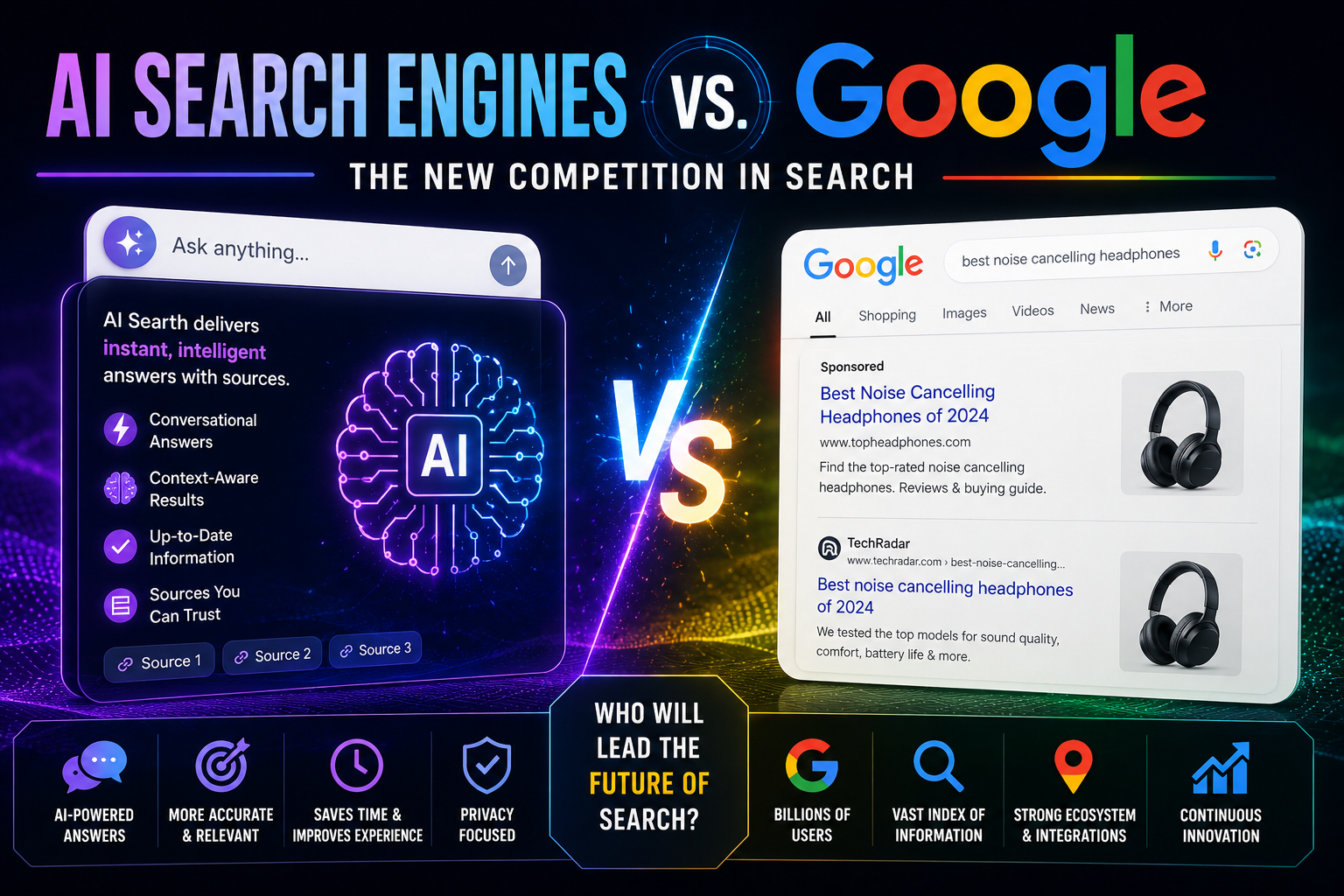
How AI-Powered Search Engines Are Competing With Traditional Google Search
For over two decades, Google has been synonymous with internet search. Its iconic homepage, a simple search bar, and a list of blue links have defined how billions of people access information online. Google’s dominance has been so absolute that “to Google” became a verb, a testament to its unparalleled efficiency and comprehensive index of the world wide web. However, the landscape of information retrieval is undergoing a seismic shift, driven by the rapid advancements in artificial intelligence, particularly large language models (LLMs).
A new generation of AI-powered search engines, or traditional engines integrating AI, are emerging, promising a fundamentally different and often more intuitive way to find answers. These challengers aren’t just indexing web pages; they’re understanding context, generating summaries, engaging in conversational dialogue, and even performing tasks. This evolution is sparking an intense competition, forcing Google to rapidly innovate and adapt, and reshaping user expectations for what a search engine can truly be.
The Reign of Traditional Google Search
Before delving into the AI revolution, it’s crucial to understand the bedrock upon which traditional search, epitomized by Google, was built and why it achieved such monumental success.
How Google Works: The Pillars of Traditional Search
At its core, Google’s traditional search engine operates on a sophisticated three-step process:
- Crawling: Google’s automated programs, known as “spiders” or “crawlers,” continuously explore the internet, following links from page to page. They discover new web pages and updates to existing ones.
- Indexing: The information gathered by crawlers is then processed and stored in Google’s massive index. This index is like a colossal library catalog, containing information about billions of web pages, including keywords, content, and metadata.
- Ranking: When a user enters a query, Google’s complex algorithms (like PageRank, Hummingbird, RankBrain, and countless others) spring into action. They analyze hundreds of factors to determine which pages from the index are most relevant and authoritative for that specific query. These factors include keyword matching, link popularity, content quality, mobile-friendliness, user experience signals, and more.
The result is a Search Engine Results Page (SERP) primarily composed of a list of blue links, each leading to a different website, often accompanied by snippets of text.
Strengths of Traditional Google Search
Google’s traditional model boasts several undeniable strengths that have cemented its position:
- Vast Index and Comprehensive Coverage: Google has indexed an unparalleled amount of the internet, making it the go-to source for finding almost any piece of information.
- Speed and Reliability: For decades, Google has delivered search results with incredible speed and consistency, a testament to its robust infrastructure.
- User Familiarity and Habit: Billions of users have grown up with Google, making it an ingrained habit. The interface is simple, predictable, and universally understood.
- Established SEO Ecosystem: A massive industry has grown around optimizing websites for Google’s algorithms, ensuring a steady stream of high-quality, relevant content (at least in theory).
Limitations of Traditional Google Search
Despite its strengths, the traditional keyword-centric model has inherent limitations that AI-powered search aims to address:
- Keyword-Centricity: Users often have to guess the right keywords to find what they’re looking for. A slight variation in phrasing can lead to vastly different results.
- Information Overload: Even with good ranking, users are still presented with a list of links, requiring them to click through multiple pages to synthesize information or find a direct answer. This “sifting” process can be time-consuming.
- Lack of Contextual Understanding: Traditional search struggles with nuanced queries, follow-up questions, or understanding the broader intent behind a series of searches. It treats each query largely in isolation.
- Vulnerability to SEO Manipulation: While Google constantly battles it, bad actors can sometimes manipulate algorithms to push low-quality or irrelevant content higher in rankings.
- Limited Conversational Ability: The interaction is one-way: query in, links out. There’s no natural dialogue or clarification.
The Rise of AI-Powered Search Engines
The advent of sophisticated AI, particularly large language models (LLMs) like OpenAI’s GPT series, Google’s Gemini, and others, has fundamentally changed what’s possible in search. These models are trained on vast datasets of text and code, enabling them to understand, generate, and process human language with unprecedented fluency.
What Defines “AI-Powered” Search?
AI-powered search engines go beyond simple keyword matching. They leverage:
- Natural Language Understanding (NLU): To comprehend the intent, context, and nuances of a user’s query, even if it’s phrased in complex, conversational language.
- Generative AI: To synthesize information from multiple sources and generate direct, coherent, and often conversational answers, summaries, or even new content.
- Machine Learning (ML): To continuously learn from user interactions, personalize results, and improve accuracy over time.
- Contextual Awareness: To maintain a memory of previous queries within a session, allowing for natural follow-up questions and a more interactive experience.
Key Players and Their Approaches
Several players are at the forefront of this AI search revolution:
- Microsoft Bing Chat (now Copilot): Perhaps the most prominent challenger, Microsoft integrated OpenAI’s GPT-4 into its Bing search engine, rebranding it as Copilot. It offers conversational search, generative answers, and the ability to ask follow-up questions directly within the search interface.
- Google Search Generative Experience (SGE): Google’s response to the challenge, SGE integrates generative AI directly into its traditional search. It provides AI-powered overviews and summaries at the top of the SERP for complex queries, alongside the familiar blue links. It also allows for conversational follow-up questions.
- Perplexity AI: Positioned as an “answer engine,” Perplexity focuses on providing direct, sourced answers to complex questions, citing its sources clearly. It emphasizes academic rigor and factual accuracy.
- You.com / YouChat: This search engine offers a customizable search experience, allowing users to prioritize sources. Its YouChat feature provides AI-generated answers and conversational capabilities.
- Neeva (now Arc Search): Originally a subscription-based ad-free search engine, Neeva was acquired by The Browser Company (creators of Arc browser). Arc Search now integrates AI to summarize pages and answer questions directly within the browser experience, often bypassing traditional search results entirely.
How AI-Powered Search Engines Are Competing
The competition isn’t just about who has the best algorithm; it’s about fundamentally rethinking the user experience and the very definition of “search.”
1. Natural Language Understanding & Conversational Search
Traditional search often feels like talking to a database. AI search aims to make it feel like talking to a knowledgeable assistant.
- Beyond Keywords: Instead of typing “best Italian restaurants NYC midtown,” a user can ask, “I’m looking for a cozy Italian restaurant in Midtown Manhattan for a special occasion tonight, preferably with vegetarian options. Can you suggest a few?” AI search engines can parse this complex sentence, understand the intent, and extract multiple criteria.
- Follow-up Questions: If the AI suggests a restaurant, a user can then ask, “What’s their average price range?” or “Do they have outdoor seating?” The AI maintains context, understanding that “they” refers to the previously mentioned restaurant. This iterative dialogue significantly reduces the need for multiple, disjointed searches.
- Example: Bing Copilot excels here, allowing users to refine queries, ask for comparisons, or delve deeper into a topic without starting a new search from scratch. Google SGE also offers a “follow-up” section with suggested questions, guiding users to explore topics more deeply.
2. Generative Answers & Summarization
This is perhaps the most visible and impactful difference. Instead of a list of links, AI search can provide a direct, synthesized answer.
- Direct Answers: For factual questions like “What are the symptoms of vitamin D deficiency?” an AI search engine can generate a concise, well-structured answer, drawing information from multiple authoritative sources, rather than linking to several medical websites.
- Information Synthesis: For complex topics, an AI can summarize key points from several articles, saving the user the effort of reading through each one. For example, asking “Compare the pros and cons of solar vs. wind energy” might yield a bulleted list directly in the search results.
- Time-Saving: This capability dramatically reduces the “click fatigue” associated with traditional search, where users spend time opening multiple tabs, scanning pages, and piecing together information themselves.
- Example: Perplexity AI is built around this concept, providing a comprehensive answer followed by clear citations. Google SGE’s “AI overviews” do the same, offering a summary at the top of the SERP before the traditional links.
3. Personalization & Contextual Relevance
AI can learn from user behavior, preferences, and even real-time context to deliver more relevant results.
- Learning User Preferences: Over time, an AI search engine could learn that a user prefers vegan restaurants, travel blogs over corporate sites, or academic papers over general news articles. This implicit learning can subtly influence future results.
- Real-time Context: If a user is searching for “weather” on their phone, the AI can infer their location and provide local weather without explicit input. If they’ve recently searched for “hiking trails,” a subsequent search for “water bottles” might prioritize options suitable for outdoor activities.
- Adaptive Search: The AI can adapt its output based on the perceived complexity of the user’s query or their expressed knowledge level. A beginner might get simpler explanations, while an expert might receive more detailed, technical information.
- Example: While still in early stages, the potential for deeply personalized search is a major differentiator. Platforms like You.com allow explicit customization of sources, hinting at this future.
4. Multimodal Search
The world isn’t just text. AI search is expanding to understand and generate content across different modalities.
- Image and Video Understanding: Users can upload an image (e.g., a plant, a piece of furniture) and ask, “What is this?” or “Where can I buy this?” AI can analyze the image and provide relevant information. Similarly, AI can summarize video content or answer questions about specific moments in a video.
- Voice Search Evolution: While voice search exists in traditional engines, AI enhances its capabilities by better understanding natural speech patterns, accents, and complex spoken queries, making the interaction more seamless.
- Generating Multimodal Output: In the future, an AI might not just provide text answers but also generate relevant images, short video clips, or interactive maps as part of the search result.
- Example: Google Lens (integrated into Google Search) is a precursor to this, allowing visual search. AI-powered search engines are integrating these capabilities more deeply into the core search experience.
5. Proactive Information Delivery & Task Completion
AI search isn’t just about answering questions; it’s about anticipating needs and helping users complete tasks.
- Beyond Information Retrieval: Instead of just finding information about booking a flight, an AI search engine could potentially help book the flight, draft an email based on search results, or create a travel itinerary.
- Idea Generation: A user could ask, “Give me ideas for a 3-day trip to Rome for a family with young children,” and the AI could generate a structured itinerary with suggestions for activities, restaurants, and accommodation types.
- Content Creation Assistance: For content creators, AI search can help brainstorm topics, outline articles, or even generate snippets of text based on research.
- Example: Bing Copilot’s ability to draft emails or generate code snippets directly within the chat interface showcases this potential. Arc Search’s “Browse for Me” feature summarizes entire pages, effectively completing the “reading” task for the user.
6. Combating Information Overload
In an age of overwhelming digital content, AI search offers a powerful antidote to information overload.
- Filtering Noise: By understanding context and intent, AI can more effectively filter out irrelevant or low-quality content, presenting only the most pertinent and authoritative information.
- Curated Views: Instead of presenting a broad spectrum of results, AI can curate a focused summary or a selection of highly relevant sources, reducing the mental burden on the user.
- Example: When researching a complex medical condition, an AI could synthesize information from peer-reviewed journals, reputable health organizations, and patient forums, providing a balanced overview without requiring the user to navigate dozens of disparate sites.
7. Real-time Information & Trend Analysis
AI models, especially when connected to live web data, can offer insights into rapidly evolving situations and trends.
- Breaking News Summaries: For unfolding events, AI can quickly synthesize information from various news outlets and social media, providing real-time updates and summaries.
- Market Trends and Analysis: AI can analyze vast amounts of data to identify emerging trends in finance, consumer behavior, or technology, offering insights that would be laborious for a human to compile.
- Dynamic Content Generation: As information changes, the AI’s generated answers can be dynamically updated, ensuring the user always receives the most current understanding.
- Example: Asking an AI search engine about the latest developments in a specific conflict or a rapidly changing stock market could yield a current summary, continuously updated as new information emerges.
Challenges and Considerations for AI Search
- AI Replace Software Developers: 5 Crucial Insights for 2024
- Emerging Technologies 2026: 10 Incredible Investment Opportunities
- Galaxy Z Fold 8: Incredible Thinness & The Looming iPhone Fold Threat
While the potential of AI-powered search is immense, it also introduces significant challenges and ethical considerations.
1. Accuracy and Hallucinations
LLMs, despite their sophistication, can sometimes “hallucinate” – generate factually incorrect, nonsensical, or fabricated information with high confidence.
- Risk of Misinformation: If an AI search engine confidently presents false information as fact, it can lead to serious consequences, especially in critical areas like health, finance, or legal advice.
- Difficulty in Verification: Users may find it harder to verify AI-generated answers compared to traditional links, where they can click through to the original source.
- Example: Early versions of Bing Chat were known to occasionally provide incorrect dates, facts, or even make up quotes. While models are improving, this remains a fundamental challenge.
2. Bias in Training Data
AI models learn from the vast datasets they are trained on, which inevitably reflect the biases present in human-generated text.
- Reinforcing Stereotypes: If the training data contains societal biases (e.g., gender, race, political leanings), the AI may inadvertently perpetuate these biases in its responses or search results.
- Unfair Representation: Certain perspectives or demographics might be underrepresented or misrepresented in the AI’s generated content.
- Example: An AI might disproportionately suggest certain professions for men or women based on historical data, even if those biases are no longer reflective of reality or desired.
3. Transparency and Explainability
Understanding how an AI arrived at an answer is crucial for trust and accountability.
- Black Box Problem: LLMs are often “black boxes,” making it difficult to trace the exact reasoning or sources behind a generated answer.
- Source Attribution: While some AI search engines cite sources, the way they synthesize and present information can obscure the original context or nuance of the source material.
- Example: If an AI provides a summary of a complex scientific topic, it’s important for users to know which studies or experts contributed to that summary, and to what extent.
4. Cost of Operation
Running and scaling large language models is significantly more computationally intensive and expensive than traditional keyword-based search.
- Infrastructure Demands: The processing power required for real-time AI generation is immense, leading to higher operational costs for search providers.
- Business Models: This cost could influence how AI search engines are monetized, potentially leading to more subscription models, different advertising formats, or a hybrid approach.
5. SEO Implications and Content Creation
The shift to generative answers has profound implications for content creators and the SEO industry.
- Reduced Click-Throughs: If users get direct answers, they may be less likely to click on individual website links, potentially reducing organic traffic for publishers.
- New Optimization Strategies: SEO will need to evolve beyond keywords and backlinks to focus on clear, concise, authoritative content that AI models can easily understand and summarize.
- Value of Original Content: There’s a concern that AI could diminish the perceived value of original human-created content if it’s constantly being summarized and re-presented.
6. User Trust and Adoption
Overcoming decades of ingrained habit and building trust in a new paradigm of search will be a significant hurdle.
- Skepticism: Users may initially be skeptical of AI-generated answers, especially if they’ve encountered inaccuracies.
- Learning Curve: While designed to be intuitive, the conversational nature of AI search might require users to adapt their querying habits.
Google’s Response and Future Outlook
Google, acutely aware of the competitive threat, has not stood idly by. Its response, primarily through the Search Generative Experience (SGE) and the integration of its Gemini models, demonstrates its commitment to evolving its core product.
Google’s strategy appears to be a hybrid one: augmenting its traditional link-based search with AI-powered summaries and conversational capabilities, rather than replacing it entirely. This approach aims to leverage its vast index and established user base while incorporating the benefits of generative AI. The “AI Search War” is less about one technology completely obliterating the other, and more about a rapid evolution where AI becomes an indispensable layer within the search experience.
The future of search will likely involve a dynamic interplay between AI-generated insights and traditional web links. Users might start with a conversational query, receive a synthesized answer, and then delve into specific sources via links if they need more detail or want to verify information.
The User Experience Transformed
Ultimately, the competition driven by AI is transforming the user experience in several key ways:
- Efficiency Gains: Users can find answers and synthesize information much faster, reducing the time spent sifting through results.
- Deeper Understanding: Conversational capabilities allow users to explore topics more thoroughly, ask clarifying questions, and gain a more nuanced understanding without feeling lost.
- New Ways of Interacting: Search is becoming less of a static query-and-response and more of an interactive, dynamic dialogue.
- Empowerment: Users are empowered to ask more complex questions, receive more tailored answers, and potentially even complete tasks directly within the search interface.
Conclusion
The era of AI-powered search engines marks a pivotal moment in the history of information retrieval. While traditional Google search has served us incredibly well for decades, its keyword-centric model is being challenged by AI’s ability to understand natural language, generate direct answers, and engage in conversational dialogue.
This competition is driving rapid innovation, pushing both established giants like Google and nimble newcomers to redefine what a search engine can do. The future of search is likely not a complete replacement of the familiar blue links, but rather a powerful augmentation, where AI acts as an intelligent co-pilot, guiding users to information more efficiently, comprehensively, and intuitively than ever before. As AI models continue to advance and overcome current challenges, the way we find, consume, and interact with information online will be fundamentally and irrevocably transformed.
Have any thoughts?
Share your reaction or leave a quick response — we’d love to hear what you think!
-
 0
0
-
 0
0
-
 0
0
-
 0
0
-
 0
0
-
 0
0
