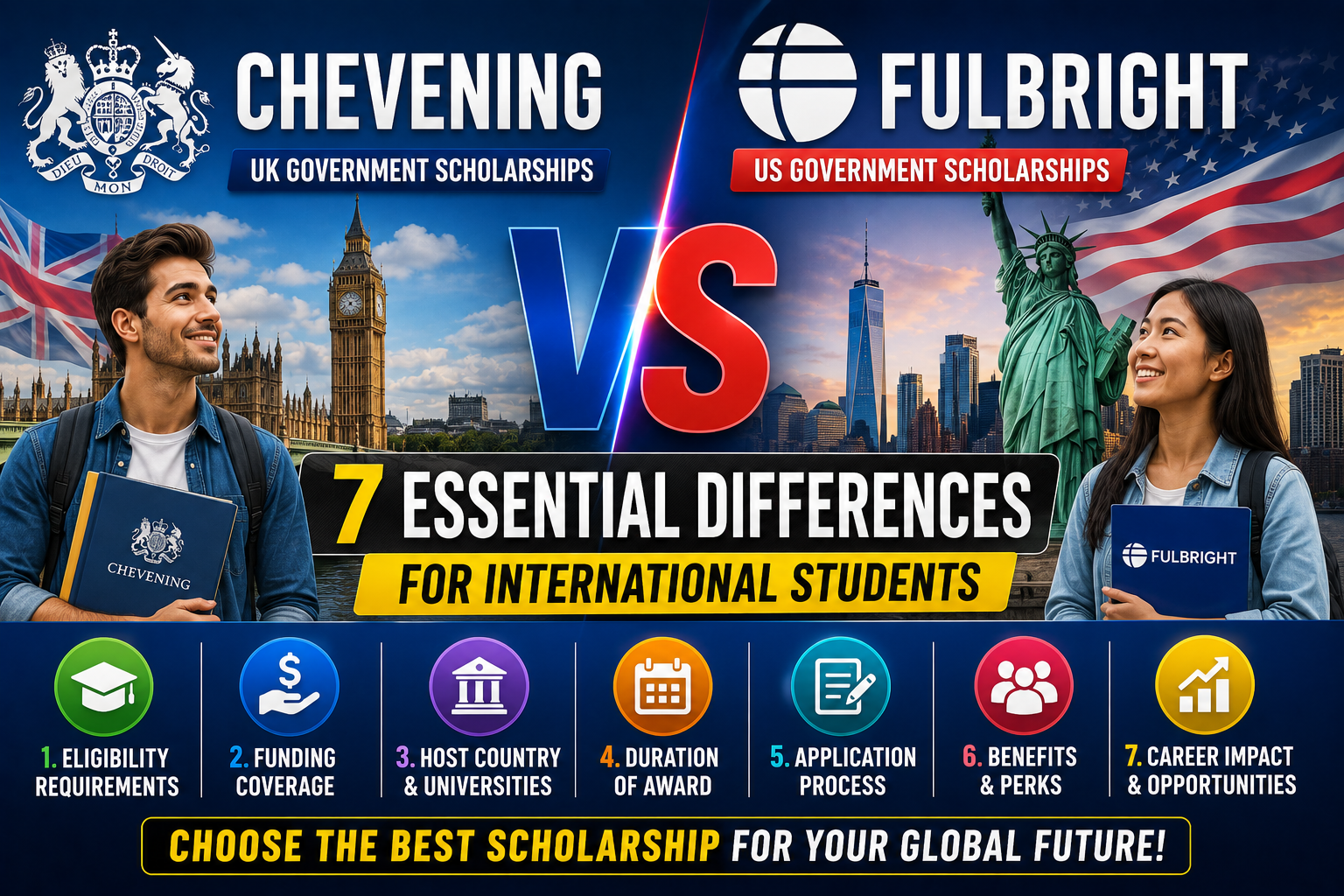
For ambitious international students dreaming of pursuing higher education abroad, comparing the Chevening vs Fulbright programs is essential. Both the Chevening Scholarship and the Fulbright Program stand out as two of the most prestigious and highly sought-after opportunities. Both scholarships offer life-changing experiences, fully funding academic pursuits in world-renowned institutions and fostering global leadership. However, despite their shared goal of empowering future leaders, they differ significantly in their geographic focus, program structure, underlying philosophies, and eligibility criteria.
Navigating the nuances of each program can be a daunting task. This comprehensive guide aims to dissect the Chevening Scholarship and the Fulbright Program, providing a detailed comparison to help international students determine which opportunity best aligns with their academic aspirations, career goals, and personal values. By understanding their unique offerings, you can make an informed decision that propels your journey toward global impact.
Understanding the Chevening Scholarship
The Chevening Scholarship is the UK government’s international awards program aimed at developing global leaders. Funded by the Foreign, Commonwealth and Development Office (FCDO) and partner organizations, Chevening offers a unique opportunity for future leaders, influencers, and decision-makers from around the world to study a one-year master’s degree in any subject at any UK university. Learn more about the official program on the Chevening website.
What is Chevening?
Established in 1983, Chevening has built a reputation for identifying and nurturing individuals with leadership potential. The scholarship is more than just a financial award; it’s an investment in an individual’s potential to contribute positively to their home country and the global community upon their return. The program emphasizes networking, cultural exchange, and the development of strong leadership skills within the context of a world-class UK education.
Who is Chevening For?
Chevening targets mid-career professionals and emerging leaders who have demonstrated a strong commitment to making a difference in their communities or fields. Applicants are typically individuals with at least two years of work experience who possess clear leadership potential, strong academic backgrounds, and a vision for how a UK master’s degree will help them achieve their professional goals and contribute to their home country’s development.
What Does Chevening Cover?
The Chevening Scholarship is a fully funded award, designed to cover all essential costs associated with studying in the UK. This typically includes:
- University tuition fees (capped at a certain amount, with the FCDO covering any excess).
- A monthly stipend to cover living expenses.
- Economy class return airfare to the UK.
- An arrival allowance.
- A departure allowance.
- The cost of one visa application.
- A travel grant to attend Chevening events in the UK.
It’s important to note that Chevening scholarships are generally for the applicant only and do not typically provide financial support for dependents.
Key Features and Philosophy
The core philosophy of Chevening revolves around developing future leaders who will return to their home countries equipped with new knowledge, skills, and networks to drive positive change. Key features include:
- Leadership Development: A strong emphasis on identifying and nurturing leadership potential.
- Networking: Extensive opportunities to connect with fellow scholars, UK government officials, academics, and business leaders through exclusive events and activities.
- Global Community: Becoming part of a prestigious global alumni network of over 55,000 individuals.
- Flexibility: The ability to choose almost any one-year master’s course at any UK university, provided it aligns with the applicant’s career goals and Chevening’s objectives.
- UK Experience: Immersion in British culture and academic excellence.
Eligibility Criteria
While specific requirements can vary slightly by country, general Chevening eligibility criteria include:
- Be a citizen of a Chevening-eligible country or territory.
- Return to your country of citizenship for a minimum of two years after your award has ended.
- Have completed all components of an undergraduate degree that will enable you to gain admission to a postgraduate programme at a UK university by the time you submit your application. This is typically equivalent to an upper second-class (2:1) honours degree in the UK.
- Have at least two years’ work experience (equivalent to 2,800 hours). This can be full-time, part-time, voluntary, or paid internships.
- Apply to three different eligible UK university master’s courses and receive an unconditional offer from one of these choices by a specified deadline.
- Meet the English language requirement (though this is often met by the university offer itself).
- Not hold dual British citizenship.
- Not have previously studied in the UK with UK government funding.
Application Process
The Chevening application process is highly competitive and typically involves several stages:
- Online Application: Submission of a detailed online application form, including essays on leadership, networking, studying in the UK, and career plans.
- Shortlisting: Applications are reviewed, and a shortlist is created.
- Interviews: Shortlisted candidates are invited for an interview with British Embassy or High Commission staff in their home country. This is a crucial stage where candidates articulate their motivations, leadership potential, and post-study plans.
- University Application: Simultaneously, applicants must apply to three eligible UK master’s courses and secure an unconditional offer from at least one.
- Final Selection: Successful candidates are notified and begin preparations for their studies.
Post-Scholarship Requirements
A fundamental condition of the Chevening Scholarship is the “two-year rule.” Scholars are required to return to their home country for a minimum of two years upon completion of their studies. This ensures that the investment in their education directly benefits their home communities and aligns with Chevening’s mission of building global capacity.
Understanding the Fulbright Program
The Fulbright Program, the flagship international educational exchange program sponsored by the U.S. government, aims to foster mutual understanding between the people of the United States and other countries. Established in 1946 by Senator J. William Fulbright, the program operates in over 160 countries worldwide, offering grants for students, scholars, teachers, and professionals to undertake a wide range of academic and professional pursuits.
What is Fulbright?
Fulbright is renowned for its emphasis on cultural exchange and diplomacy, alongside academic excellence. It provides opportunities for U.S. citizens to study, teach, and conduct research abroad, and for non-U.S. citizens to do the same in the United States. The program’s core mission is to promote international goodwill through the exchange of students and scholars in all fields of endeavor.
Who is Fulbright For?
Fulbright is open to a broader range of applicants than Chevening, encompassing graduate students, young professionals, artists, and even faculty members. For international students, the primary opportunity is typically the Foreign Student Program, which supports master’s or PhD studies, or non-degree research programs in the U.S. Applicants are expected to demonstrate academic excellence, leadership potential, and a genuine interest in promoting mutual understanding between their home country and the United States.
What Does Fulbright Cover?
The scope of Fulbright funding can vary significantly by country and specific program, as it is often co-sponsored by binational commissions, U.S. Embassies, and partner institutions. Generally, a Fulbright grant for international students may cover:
- Tuition and fees for the academic program.
- A living stipend for the duration of the grant.
- Round-trip airfare to the U.S.
- Health benefits.
- Book and supply allowances.
- Sometimes, limited funding for dependents (though this is less common and highly country-dependent).
The exact benefits package is determined by the Fulbright Commission or U.S. Embassy in the applicant’s home country.
Key Features and Philosophy
Fulbright’s philosophy is deeply rooted in international diplomacy and cultural exchange. Key features include:
- Mutual Understanding: A central tenet is building bridges between cultures and fostering global peace through education.
- Academic and Professional Diversity: Supports a wide array of fields, from arts and humanities to STEM and social sciences, and various program types (Master’s, PhD, research, teaching).
- Decentralized Structure: Operates through binational Fulbright Commissions and U.S. Embassies, allowing for country-specific program design and selection processes.
- Global Network: Becoming part of an extensive and influential alumni network that includes Nobel laureates, heads of state, and leaders in various fields.
- Cultural Immersion: Encourages scholars to engage deeply with American culture and share their own cultural heritage with host communities.
Eligibility Criteria
Fulbright eligibility criteria are highly country-specific, as each binational commission or U.S. Embassy sets its own requirements based on local needs and priorities. However, common general requirements for international students include:
- Be a citizen of a participating country.
- Hold a bachelor’s degree (or equivalent).
- Demonstrate academic excellence and leadership potential.
- Meet the English language proficiency requirements (e.g., TOEFL or IELTS).
- Be in good health.
- Not hold dual U.S. citizenship or permanent residency.
- Meet specific age or experience requirements set by their home country’s program.
- Have limited or no prior experience studying or living in the U.S. (some programs have strict rules on this).
Application Process
The Fulbright application process for international students is decentralized and typically involves:
- Application through Home Country: Applicants apply through the Fulbright Commission or U.S. Embassy in their home country. This is a critical distinction from Chevening.
- National Selection: Each country’s commission or embassy conducts its own selection process, which usually includes an application form, essays (statement of purpose, personal statement), academic transcripts, letters of recommendation, and interviews.
- U.S. Placement: Nominated candidates’ applications are then forwarded to the Institute of International Education (IIE) in the U.S. for academic placement at American universities. This involves matching candidates with suitable programs and securing admission.
- Final Grant Offer: Once university admission is secured and all requirements are met, a final grant offer is extended.
Post-Scholarship Requirements
Fulbright scholars coming to the U.S. on a J-1 visa are subject to the “two-year home-country physical presence requirement” (212(e) rule). This means they must return to their home country for a cumulative total of two years after completing their program before being eligible for certain U.S. visas (like H-1B, L-1, or permanent residency). This rule reinforces the program’s goal of ensuring scholars contribute their newly acquired skills and knowledge to their home communities.
Key Differences and Similarities: Chevening vs Fulbright
While both scholarships are prestigious and life-changing, understanding their core differences and subtle similarities is crucial for making an informed choice.
Geographic Focus
- Chevening: Exclusively focused on the United Kingdom. Scholars study at any eligible UK university.
- Fulbright: Primarily focused on the United States for international students coming to the U.S. However, Fulbright also supports U.S. citizens going to over 160 countries, and some countries have reciprocal programs. For an international student, the destination is almost always the U.S.
Funding Model and Administration
- Chevening: Fully funded by the UK government (FCDO) and partner organizations. The application and selection process is largely centralized through the Chevening Secretariat in the UK, with interviews conducted by British Embassies/High Commissions.
- Fulbright: Sponsored by the U.S. government (Department of State) and partner governments/institutions worldwide. The program is highly decentralized, with binational Fulbright Commissions or U.S. Embassies in each participating country managing their own application and selection processes.
Program Structure and Scope
- Chevening: Primarily supports one-year master’s degrees. There are very few exceptions for other program types. The focus is on intensive, postgraduate study.
- Fulbright: Offers a much broader range of program types for international students, including:
- Master’s degrees
- PhD studies (often for a portion of the degree)
- Non-degree research programs
- English Teaching Assistant (ETA) programs (though less common for inbound international students, more for outbound U.S. citizens).
This flexibility allows students pursuing longer-term academic goals or specific research projects to find a suitable path.
Emphasis and Philosophy
- Chevening: Emphasizes leadership development, networking, and the UK’s global influence. It seeks individuals who will return home and make a significant impact, leveraging their UK education and connections. The narrative often centers on how the UK experience will enhance their capacity for leadership and positive change.
- Fulbright: Strongly rooted in cultural exchange, mutual understanding, and public diplomacy. While academic excellence and leadership are important, the core mission is to build bridges between nations. Applicants are expected to be cultural ambassadors, sharing their heritage while immersing themselves in American culture. The narrative focuses on how the exchange will foster international goodwill and shared knowledge.
Eligibility Nuances
- Work Experience: Chevening explicitly requires a minimum of two years of work experience. This is a non-negotiable criterion, making it suitable for mid-career professionals.
- Academic Excellence: Fulbright places a very strong emphasis on academic excellence and research potential. While work experience is valuable, it’s not a strict minimum requirement in the same way as Chevening. Some programs may be open to recent graduates.
- Prior Study in Host Country: Both programs generally prefer candidates with limited or no prior extensive study or residency in the host country, but the strictness can vary. Chevening has a clear rule against previous UK government-funded study. Fulbright often has similar preferences to ensure a genuine exchange experience.
Application Process
- Chevening: A more centralized application process. All applicants apply through the Chevening online application system, regardless of their home country. The interview is conducted by British diplomatic missions.
- Fulbright: A highly decentralized application process. Applicants apply directly to the Fulbright Commission or U.S. Embassy in their home country, each of which has its own specific deadlines, requirements, and selection procedures. This means the application experience can differ significantly from one country to another.
Post-Scholarship Obligations
- Both: Require scholars to return to their home country for a period after completing their studies.
- Chevening: The “two-year rule” requires scholars to return to their country of citizenship for a minimum of two years.
- Fulbright: Scholars on a J-1 visa are subject to the “two-year home-country physical presence requirement” (212(e) rule), which has specific implications for future U.S. visa categories.
Similarities
Despite their differences, Chevening and Fulbright share several fundamental similarities:
- Prestige: Both are globally recognized as highly prestigious scholarships.
- Fully Funded: Both aim to be fully funded, covering tuition, living expenses, and travel.
- Leadership Development: Both seek to identify and nurture future leaders.
- Alumni Networks: Both boast extensive, influential global alumni networks.
- Competitive: Both are extremely competitive, requiring strong applications and compelling personal narratives.
- Global Impact: Both aim to create a positive global impact through their scholars.
Factors to Consider When Choosing
Deciding between Chevening and Fulbright requires a careful evaluation of your personal circumstances, academic goals, and career aspirations. Here are key factors to consider:
1. Academic Goals and Program Type
- One-Year Master’s: If your goal is specifically a one-year master’s degree, Chevening is a perfect fit. It’s designed for this.
- Longer Master’s, PhD, or Research: If you’re aiming for a two-year master’s, a PhD, or a non-degree research program, Fulbright offers more flexibility and is likely the better option. Chevening does not typically support programs longer than one year.
2. Country Preference and Cultural Experience
- United Kingdom: If you are drawn to the UK’s academic system, culture, and specific universities, Chevening is your path. The UK offers a distinct European experience.
- United States: If you prefer the U.S. higher education system, its diverse geography, and American culture, Fulbright is the way to go. The U.S. offers a vast array of institutions and research opportunities.
3. Career Aspirations and Leadership Philosophy
- Leadership and Networking Focus: If your career path emphasizes direct leadership roles, policy-making, and building a strong professional network with a UK-centric or global outlook, Chevening’s emphasis on leadership development and its robust alumni network might be more aligned.
- Cultural Diplomacy and Academic Contribution: If your career involves international relations, academia, research, or promoting cross-cultural understanding, and you value the experience of being a cultural ambassador, Fulbright’s philosophy might resonate more deeply.
4. Work Experience
- Minimum Two Years Work Experience: If you have at least two years of relevant work experience, you meet a core Chevening eligibility criterion.
- Recent Graduate or Less Experience: If you are a recent graduate with limited work experience, Fulbright might be more accessible, as its work experience requirements are often less stringent or program-specific.
5. Application Process and Support
- Centralized vs. Decentralized: Consider whether you prefer a single, centralized application system (Chevening) or a country-specific process with local support (Fulbright Commissions/U.S. Embassies). The local support from Fulbright Commissions can be invaluable during the application and placement process.
- University Placement: Chevening requires you to secure your own university offers. Fulbright, through IIE, often assists with university placement for nominated candidates, which can be a significant advantage.
6. Dependent Support
- No Dependent Support (Chevening): If you plan to travel with family, be aware that Chevening does not typically provide financial support for dependents.
- Limited/Country-Specific Dependent Support (Fulbright): While not guaranteed, some Fulbright programs, depending on the country and funding, may offer limited dependent support or allow dependents to accompany scholars on a J-2 visa. This is a crucial point to verify with your local Fulbright Commission.
7. Post-Scholarship Obligations
- Return to Home Country: Both scholarships require you to return home. Understand the specific “two-year rule” for each (Chevening’s general rule vs. Fulbright’s J-1 visa 212(e) rule) and how it might impact your long-term plans for international work or further study.
Application Strategies for Both Scholarships
Regardless of which scholarship you choose, a strong application is paramount. Here are general and specific strategies to maximize your chances:
General Application Tips
- Start Early: Both applications are lengthy and require significant time for essay writing, securing recommendations, and gathering documents. For more detailed guidance on securing scholarships, explore our Ultimate Guide: Apply for STEM Scholarships Worldwide.
- Research Thoroughly: Understand the specific requirements, deadlines, and philosophies of the scholarship and the universities you’re applying to.
- Craft Compelling Essays: Your essays are your voice. They should be personal, articulate your motivations clearly, demonstrate your potential, and directly address the scholarship’s values.
- Secure Strong Recommendation Letters: Choose recommenders who know you well academically and professionally and can speak to your strengths, potential, and character. Provide them with all necessary information and ample time.
- Proofread Meticulously: Errors in grammar or spelling can detract from your application.
- Prepare for Interviews: If shortlisted, practice articulating your motivations, goals, and how you embody the scholarship’s values. Be ready to discuss current affairs and your field of interest.
Chevening Specific Strategies
- Emphasize Leadership and Networking: In your essays, provide concrete examples of your leadership experiences, even if they are informal. Explain how you’ve influenced others, initiated projects, or solved problems. Clearly articulate how you plan to leverage the Chevening network.
- Connect to UK Values: Demonstrate an understanding of the UK’s global role and how your chosen field of study in the UK aligns with your country’s development needs and Chevening’s objectives.
- Show Impact: Focus on the “what next.” How will a UK master’s degree and the Chevening experience enable you to make a significant positive impact in your home country upon your return?
- Choose Relevant Courses: Select one-year master’s courses that directly align with your career goals and demonstrate how they will enhance your leadership capabilities.
Fulbright Specific Strategies
- Highlight Mutual Understanding and Cultural Exchange: Your essays should clearly express your desire to be a cultural ambassador. Discuss how you plan to engage with American culture and share your own culture with your host community.
- Demonstrate Academic Rigor and Research Potential: For academic grants, emphasize your academic achievements, research interests, and how studying in the U.S. will advance your scholarly or professional goals.
- Articulate Community Engagement: Show your commitment to community service and how you might contribute to your host university or local community in the U.S.
- Address Host Country Relevance: Explain why studying in the U.S. is essential for your particular field or research, and how it will benefit your home country.
- Connect with Your Local Commission: Engage with your home country’s Fulbright Commission or U.S. Embassy early. They are your primary point of contact and can offer invaluable guidance specific to your country’s program.
Success Stories and Alumni Networks
Both Chevening and Fulbright boast incredibly influential alumni networks, a testament to their long-standing commitment to developing global leaders.
Chevening Alumni: With over 55,000 alumni worldwide, the Chevening network includes heads of state, prominent politicians, Nobel laureates, leading academics, and successful entrepreneurs. The network offers lifelong connections, professional development opportunities, and a platform for continued collaboration and impact. Alumni events and initiatives are regularly organized globally, fostering a strong sense of community.
Fulbright Alumni: The Fulbright Program has produced over 400,000 alumni globally, including 62 Nobel laureates, 89 Pulitzer Prize winners, 40 heads of state or government, and countless leaders in business, academia, and the arts. The Fulbright Association and various country-specific alumni associations provide platforms for networking, advocacy, and continued engagement in the program’s mission of mutual understanding.
Becoming a part of either network means joining an elite group of individuals dedicated to making a difference, offering unparalleled opportunities for mentorship, collaboration, and global influence throughout your career.
Conclusion
The Chevening Scholarship and the Fulbright Program are both exceptional opportunities for international students seeking to pursue higher education abroad. Both offer full funding, prestigious academic experiences, and access to powerful global networks. However, they cater to slightly different profiles and aspirations.
Choose Chevening if:
- You are specifically aiming for a one-year master’s degree in the UK.
- You have at least two years of work experience and are an emerging leader.
- You prioritize developing leadership skills, building a strong professional network, and contributing to your home country with a UK-centric global perspective.
- You are prepared to secure your own university offers.
Choose Fulbright if:
- You are interested in a broader range of programs, including longer master’s degrees, PhD studies, or non-degree research in the U.S.
- You are a recent graduate or have less than two years of work experience, but demonstrate strong academic excellence and research potential.
- You prioritize cultural exchange, mutual understanding, and acting as a cultural ambassador between your home country and the U.S.
- You value assistance with university placement through the IIE.
Ultimately, the “better” scholarship depends entirely on your individual profile, academic goals, career aspirations, and desired cultural experience. By carefully evaluating the key differences and similarities outlined in this guide, you can make an informed decision that propels you towards a truly transformative educational journey and global impact.