Freelancing vs. Full-Time Remote Tech Jobs: Which Is Better for Beginners?
The tech industry is a vibrant, ever-evolving landscape, and the shift towards remote work has opened up unprecedented opportunities for aspiring professionals worldwide. For those just starting their journey, the path ahead can seem daunting, with two primary avenues often presenting themselves: the structured stability of a full-time remote tech job or the flexible autonomy of a freelance career. Both offer unique advantages and disadvantages, especially for beginners who are still finding their footing, building skills, and establishing a professional identity.
Navigating this choice requires a deep understanding of what each path entails, an honest assessment of personal preferences, financial situations, and long-term career aspirations. This article will delve into the intricacies of full-time remote tech jobs and freelancing, comparing them across critical dimensions relevant to beginners, and ultimately help you determine which might be the better fit for your entry into the exciting world of tech.
Understanding Full-Time Remote Tech Jobs
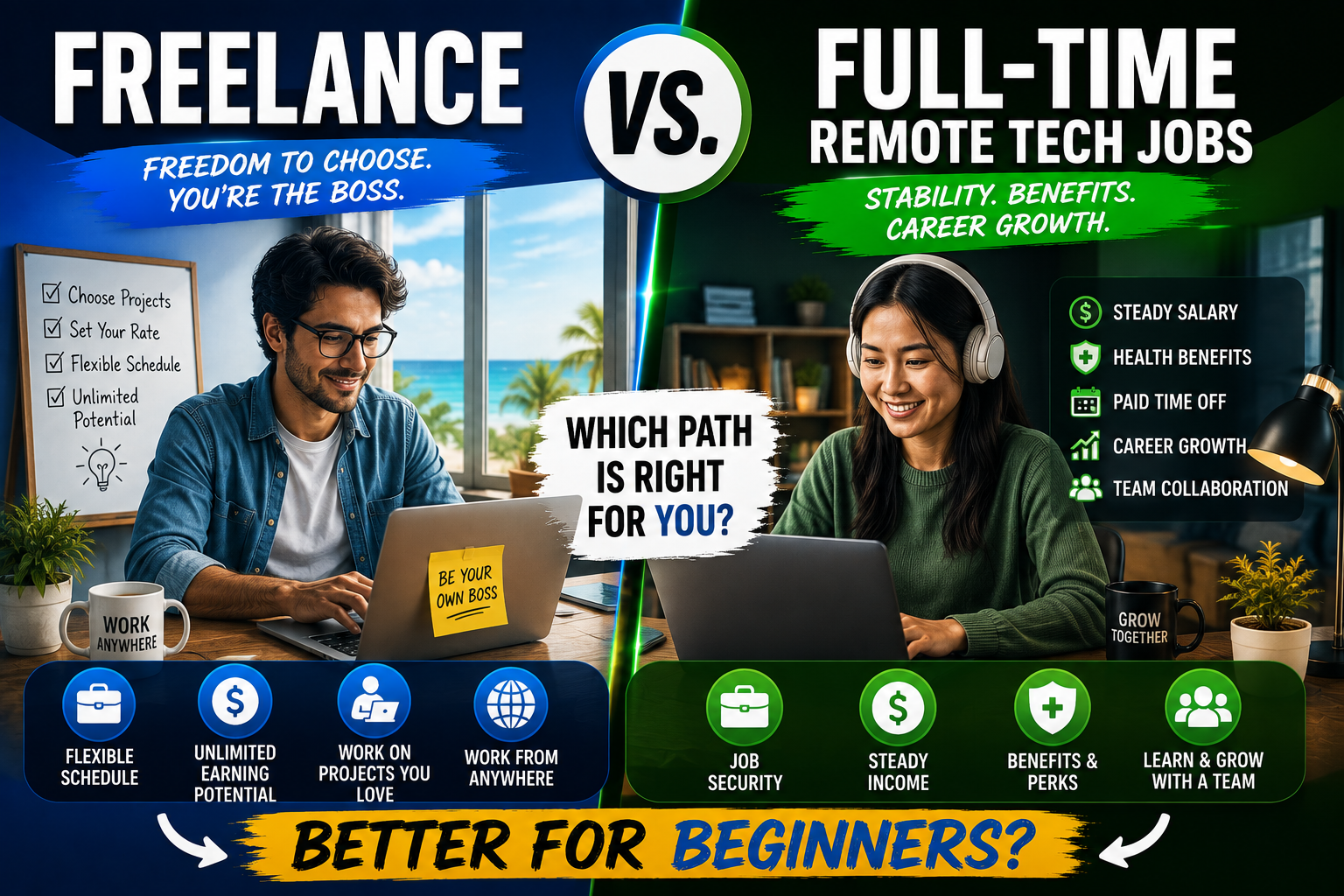
A full-time remote tech job means you are an employee of a company, working from a location of your choice (usually your home) rather than commuting to a physical office. You are integrated into the company’s structure, culture, and team, performing duties similar to your in-office counterparts but with the added flexibility of remote work.
What Defines a Full-Time Remote Role?
- Employee Status: You are an official employee, not an independent contractor. This comes with legal protections and responsibilities from both sides.
- Fixed Salary: You receive a regular, predictable salary, typically paid bi-weekly or monthly, regardless of the number of projects completed in a given period.
- Benefits Package: Full-time employees usually receive a comprehensive benefits package, including health insurance, dental, vision, retirement plans (like 401k), paid time off (PTO), sick leave, and sometimes even stock options or profit-sharing.
- Company Culture & Team: You are part of a specific company’s culture, working within established teams, collaborating with colleagues, and reporting to a manager.
- Dedicated Tools & Resources: Companies typically provide the necessary hardware, software licenses, and access to internal knowledge bases and training resources.
- Set Hours (Often Flexible): While remote, there are usually core hours of availability expected, often aligned with a specific time zone, though many companies offer flexibility within those bounds.
The Allure for Beginners: Stability and Structure
For someone new to the tech industry, a full-time remote role offers a compelling package of benefits that can significantly ease the entry process:
- Consistent Income: The most immediate and significant advantage is a stable, predictable income. This financial security allows beginners to focus on learning and developing skills without the constant pressure of finding the next client or project.
- Structured Learning & Mentorship: Companies often have structured onboarding processes, internal training programs, and experienced colleagues or dedicated mentors. This environment is invaluable for beginners to learn best practices, understand complex systems, and receive direct feedback. You’re not just learning what to do, but how to do it within a professional context.
- Clear Career Path: Full-time roles typically come with defined career ladders. You can see a progression from junior to mid-level to senior roles, with clear expectations for skill development and responsibilities at each stage. This provides a roadmap for growth and advancement.
- Comprehensive Benefits: Access to health insurance, retirement plans, and paid time off is a massive advantage, especially for those who might not have the financial means or knowledge to secure these independently. PTO allows for vacations and personal time without income loss.
- Team Collaboration & Networking: Working within a team provides immediate opportunities for collaboration, learning from peers, and building an internal professional network. This can be crucial for understanding team dynamics, version control, project management methodologies, and communication skills.
- Focus on Specialization: Full-time roles often allow beginners to deep-dive into a specific technology, framework, or domain. This focused learning can lead to becoming an expert in a particular area, which is highly valued in the tech industry.
- Less Administrative Burden: As an employee, you don’t have to worry about invoicing, taxes (beyond standard payroll deductions), marketing yourself, or chasing payments. The company handles these administrative tasks, freeing you to focus on your technical work.
Potential Downsides for Beginners
While attractive, full-time remote roles also have their drawbacks:
- Less Flexibility (Compared to Freelancing): While remote work offers location flexibility, you are still bound by company hours, meeting schedules, and project deadlines. There’s less autonomy over when you work.
- Slower Skill Diversification: You might be working on a specific tech stack or type of project for an extended period, which can limit exposure to other technologies or industries. This can be a pro or con depending on your goals.
- Company Politics & Bureaucracy: Like any large organization, companies can have internal politics, bureaucratic processes, and decision-making hierarchies that might be frustrating or slow.
- Potential for Micromanagement: Some remote companies, especially those new to remote work, might struggle with trust and implement excessive monitoring or check-ins, which can feel stifling.
- Geographic Limitations: While remote, some companies still have geographic restrictions for hiring due to legal, tax, or time zone reasons, limiting the pool of available jobs.
- Limited Earning Ceiling (Initially): While stable, your initial salary might be lower than what an experienced freelancer could command per hour, and significant raises typically come with promotions or annual reviews.
Ideal Candidates for Full-Time Remote
Full-time remote tech jobs are often ideal for beginners who:
- Value financial stability and a predictable income.
- Thrive in structured environments with clear guidance and mentorship.
- Prefer working as part of a team and contributing to a larger vision.
- Are looking for comprehensive benefits like health insurance and retirement plans.
- Want a clear path for career progression and professional development.
- Are comfortable with defined work hours and responsibilities.
Understanding Freelancing in Tech
Freelancing, in contrast, means you operate as an independent contractor or a self-employed individual. You offer your technical skills and services to multiple clients on a project-by-project or hourly basis. You are essentially running your own small business.
What Defines Freelancing?
- Independent Contractor Status: You are not an employee. You contract with clients for specific projects or tasks. This means you are responsible for your own taxes, benefits, and legal compliance.
- Project-Based or Hourly Work: Income is generated by completing projects or billing for hours worked. There’s no fixed salary; earnings directly correlate with the work you secure and complete.
- Self-Employment: You are your own boss, responsible for all aspects of your business, including marketing, sales, client management, invoicing, and financial planning.
- Multiple Clients: Typically, freelancers work with several clients concurrently or sequentially, diversifying their income streams and project experiences.
- Autonomy & Flexibility: You have significant control over your work schedule, location, the projects you take on, and your rates.
The Freedom and Flexibility for Beginners
Freelancing offers a unique appeal, particularly for those who prioritize autonomy and a diverse work experience:
- Choose Your Projects & Clients: You have the power to select projects that align with your interests, skill set, and values. This can lead to more engaging work and faster skill development in areas you genuinely care about.
- Set Your Own Hours & Location: True flexibility means you can often decide when and where you work, as long as you meet deadlines. This is ideal for those with other commitments, different peak productivity hours, or a desire for location independence.
- Rapid Skill Diversification: By working on various projects for different clients, you’ll be exposed to a wider range of technologies, industries, and problem-solving approaches. This can lead to a more versatile skill set much faster than a single full-time role.
- Build a Diverse Portfolio Quickly: Each completed project for a new client adds a valuable entry to your portfolio, showcasing your adaptability and breadth of experience. This is crucial for beginners trying to prove their capabilities.
- Higher Earning Potential (Per Hour/Project): While income is unstable, experienced freelancers often command higher hourly rates than their full-time counterparts, as clients pay for specialized skills and don’t bear the cost of benefits. For beginners, this might not be immediately true, but the potential is there.
- Direct Impact & Ownership: You often have more direct ownership over your work and its impact on the client’s business, which can be highly motivating.
- Learn Business Skills: Beyond technical skills, freelancing forces you to learn marketing, sales, negotiation, financial management, and client communication – invaluable life and business skills.
The Challenges for Beginners
The freedom of freelancing comes with significant responsibilities and challenges, especially for those new to the tech world:
- Income Instability: The most significant challenge is the unpredictable nature of income. There can be feast-or-famine cycles, making financial planning difficult, especially without an emergency fund.
- No Benefits: You are solely responsible for securing and paying for your own health insurance, retirement savings, paid time off, and sick leave. This can be a substantial financial burden.
- Self-Discipline & Motivation Required: Without a manager or team structure, you need immense self-discipline, time management skills, and internal motivation to stay productive and meet deadlines. Procrastination can be a career killer.
- Client Acquisition & Marketing: Finding clients is a constant job in itself. Beginners must actively market themselves, network, write proposals, and often compete with more experienced freelancers. This can be time-consuming and discouraging initially.
- Financial & Tax Management: You are responsible for tracking all income and expenses, setting aside money for taxes, and understanding self-employment tax laws. This administrative burden can be complex and time-consuming.
- Isolation: Working alone can lead to feelings of isolation and a lack of social interaction that a team environment provides. This can impact mental well-being.
- Lack of Mentorship: While online communities exist, direct, consistent mentorship from experienced professionals is often harder to come by in freelancing, which can slow down a beginner’s learning curve in certain areas.
- Imposter Syndrome: Beginners may struggle with confidence in pricing their services, negotiating with clients, or even believing they are “good enough” to be a freelancer.
Ideal Candidates for Freelancing
Freelancing in tech is often ideal for beginners who:
- Are highly self-motivated, disciplined, and proactive.
- Thrive on variety and enjoy working on diverse projects.
- Are comfortable with financial uncertainty and have a safety net.
- Want to be their own boss and have full autonomy over their work.
- Are eager to learn business skills alongside technical ones.
- Are good at networking and self-promotion.
- Have a clear niche or specialized skill they can offer.
Key Comparison Points for Beginners
Let’s break down the critical factors beginners should consider when weighing freelancing against full-time remote roles.
Income Stability & Financial Security
- Full-Time Remote: Offers unparalleled stability with a fixed salary, making budgeting and financial planning much easier. The inclusion of benefits significantly reduces out-of-pocket expenses for healthcare and retirement.
- Freelancing: Highly variable income. Beginners often start with lower rates and fewer clients, leading to unpredictable earnings. You are responsible for all your benefits, adding to your financial burden.
- Beginner Perspective: For most beginners, especially those without significant savings or dependents, the financial security of a full-time role is a major draw. It provides a stable foundation to build skills without financial stress.
Learning & Skill Development
- Full-Time Remote: Provides a structured learning environment. You’ll often have access to company-sponsored training, senior mentors, and a team to learn from. This allows for deep dives into specific technologies and best practices within a controlled setting.
- Freelancing: Learning is self-directed and often project-driven. You’ll gain broad exposure to different tech stacks and problem types, learning on the fly. However, consistent mentorship might be lacking, and you’ll need to proactively seek out learning resources.
- Beginner Perspective: If you thrive with structured guidance and direct mentorship, a full-time role might accelerate your foundational learning. If you’re a self-starter who learns best by doing and enjoys diverse challenges, freelancing can be a rapid skill accelerator.
Work-Life Balance & Flexibility
- Full-Time Remote: Offers location flexibility but usually adheres to set working hours (e.g., 9-5, often with some flexibility) and company holidays. Paid time off is a significant benefit for maintaining work-life balance.
- Freelancing: Offers maximum flexibility in terms of when you work and where. However, beginners often find themselves working more hours, especially initially, to acquire clients, build a portfolio, and meet tight deadlines. The line between work and personal life can easily blur.
- Beginner Perspective: While freelancing promises flexibility, beginners often sacrifice work-life balance in the pursuit of establishing their business. Full-time remote, with its defined hours and PTO, can paradoxically offer a more predictable and balanced schedule for a beginner.
Networking & Community
- Full-Time Remote: You’re immediately part of a professional team and company culture. This provides an instant network of colleagues, managers, and potentially clients through company connections.
- Freelancing: Requires proactive networking. You’ll build a network through clients, online communities, and self-promotion. This can be more diverse but also more challenging to establish from scratch.
- Beginner Perspective: A full-time role provides an immediate, built-in professional community and network, which can be less intimidating for a beginner. Freelancing demands more effort in building connections.
Career Progression & Growth
- Full-Time Remote: Offers clear career paths with defined roles (e.g., Junior Developer, Mid-Level, Senior, Lead, Architect). Promotions come with increased responsibilities and salary.
- Freelancing: Career progression is less linear. Growth involves building a strong reputation, increasing your rates, specializing in high-demand niches, or potentially scaling into an agency model.
- Beginner Perspective: For those who prefer a clear roadmap and traditional advancement, full-time is more straightforward. Freelancing offers a different kind of growth – entrepreneurial and self-directed.
Benefits & Perks
- Full-Time Remote: Comprehensive benefits package including health, dental, vision, retirement plans (401k), paid time off, sick leave, and sometimes even professional development stipends or equipment allowances.
- Freelancing: You are responsible for all your own benefits. This means paying out-of-pocket for health insurance, setting up your own retirement accounts, and taking unpaid time off.
- Beginner Perspective: The cost and complexity of self-funding benefits can be a significant hurdle for beginners in freelancing. Full-time benefits provide immense peace of mind and financial relief.
Portfolio Building & Experience
- Full-Time Remote: You’ll gain deep experience on one or a few major projects, often within a specific industry or tech stack. Your portfolio will showcase depth and long-term commitment.
- Freelancing: You can build a diverse portfolio quickly by working on numerous smaller projects for different clients across various industries. This showcases versatility and adaptability.
- Beginner Perspective: Freelancing can be a faster way to build a varied portfolio, which is excellent for demonstrating a broad range of skills. However, full-time experience often carries more weight for future full-time roles due to its depth and context.
Which Path is Better for a Beginner? Factors to Consider
There’s no universal “better” path; the ideal choice depends heavily on your individual circumstances, personality, and goals.
- Chevening vs Fulbright: 7 Essential Differences for International Students
- DAAD vs Erasmus Mundus: Comparing European Scholarship Benefits
- Ethical Hacker vs Cloud Engineer: 2 Incredibly Valuable Remote Tech Skills
Your Personality & Risk Tolerance
- Full-Time: Suits those who prefer structure, clear expectations, and a lower risk profile. If you’re uncomfortable with financial uncertainty or prefer being told what to do rather than figuring it out entirely on your own, full-time is a safer bet.
- Freelance: Ideal for self-starters, highly disciplined individuals who thrive on autonomy and are comfortable with a higher degree of risk and uncertainty. If you enjoy problem-solving independently and managing multiple aspects of a “business,” freelancing might appeal.
Financial Situation & Safety Net
- Full-Time: If you have limited savings, dependents, or immediate financial obligations, the stability of a full-time salary and benefits is likely paramount.
- Freelance: Requires a robust emergency fund (at least 3-6 months of living expenses) to weather dry spells and cover initial business expenses. If you don’t have this, freelancing can be incredibly stressful and unsustainable.
Learning Style & Mentorship Needs
- Full-Time: If you learn best through structured training, direct mentorship, and collaborative problem-solving within a team, a full-time role offers a superior environment for foundational learning.
- Freelance: If you’re a proactive, self-directed learner who enjoys figuring things out independently and learning by doing across diverse projects, freelancing can be a rapid growth engine.
Long-Term Career Goals
- Full-Time: If your goal is to become a specialist, climb the corporate ladder, lead teams within an organization, or work on large-scale, complex projects, a full-time role provides the most direct path.
- Freelance: If you aspire to be an entrepreneur, run your own business, have complete control over your work, or become a highly specialized consultant, freelancing aligns more closely with these ambitions.
Skill Level & Niche
- Full-Time: Many entry-level full-time roles are designed for beginners, offering training and support.
- Freelance: While some beginners find success, it’s generally easier to freelance if you have at least one marketable skill that clients are willing to pay for immediately. Niches like basic web development (front-end), content writing for tech, social media management for tech companies, or simple QA testing can be entry points. More complex roles (e.g., senior backend development, DevOps) are harder to break into as a beginner freelancer.
Hybrid Approaches and Transition Strategies
It’s important to remember that the choice between freelancing and full-time isn’t always permanent. Many professionals successfully transition between the two throughout their careers.
Starting Full-Time, Transitioning to Freelance
This is a common and often recommended path for beginners.
- Gain Experience: You get paid to learn and gain real-world experience in a structured environment.
- Build Network: You build a professional network within the company and industry.
- Save Money: You can build up an emergency fund to support your transition to freelancing.
- Learn Best Practices: You learn industry standards, project management, and team collaboration skills.
- Identify Niche: You can discover what you enjoy and what skills are in demand before going solo.
Starting Freelance, Seeking Full-Time
Some beginners jump straight into freelancing, often out of necessity or a strong desire for autonomy.
- Build Portfolio Quickly: Freelancing allows you to rapidly accumulate diverse project experience.
- Prove Capabilities: Successful freelance projects demonstrate your ability to deliver results.
- Develop Business Acumen: You learn valuable self-management and client relation skills.
If freelancing proves too unstable or you crave structure, this experience can be leveraged to secure a full-time role.
“Side Hustle” Freelancing While Full-Time
This is an excellent way for beginners to test the waters of freelancing with minimal risk.
- Test the Market: See if there’s demand for your skills and if you enjoy the freelance lifestyle.
- Earn Extra Income: Supplement your full-time salary.
- Build Portfolio: Work on projects outside your main job to diversify your experience.
- Learn Business Skills: Practice client acquisition, negotiation, and time management without relying on it for your primary income.
This approach allows you to gain confidence and experience before making a full leap.