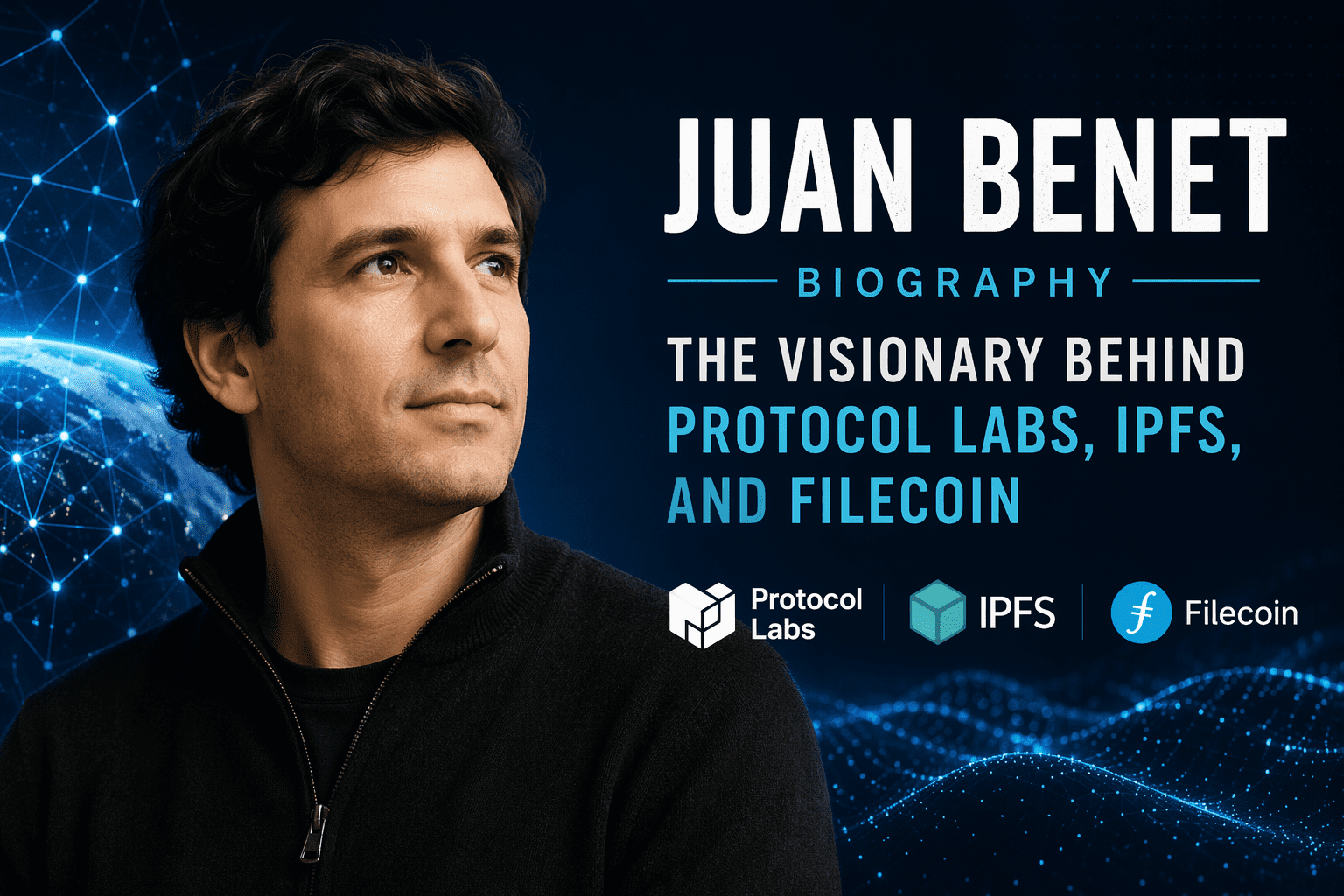
Juan Benet Biography: Protocol Labs CEO, Filecoin & Inventor of IPFS
In the history of the internet, there are rare moments when the underlying architecture of how we share information is fundamentally challenged. For decades, the Hypertext Transfer Protocol (HTTP) has been the bedrock of the web. However, as the digital world transitioned from static pages to a massive, data-heavy global infrastructure, the limitations of centralized, location-based addressing became apparent. Enter Juan Benet, a computer scientist and entrepreneur whose work has aimed to rewrite the rules of the internet.
As the founder and CEO of Protocol Labs and the inventor of the InterPlanetary File System (IPFS) and Filecoin, Benet has become one of the most influential figures in the Web3 movement. His vision is nothing less than creating a “permanent web”—a decentralized infrastructure that makes the internet faster, safer, and more resilient to censorship and data loss.
Early Life and Academic Foundations
Juan Benet’s journey into the heart of distributed systems began with a deep-seated curiosity about how information is structured and preserved. While biographical details about his early childhood remain relatively private, his academic trajectory provides a clear map of his intellectual development.
Benet attended Stanford University, an institution synonymous with Silicon Valley innovation. At Stanford, he immersed himself in Computer Science, eventually earning both his Bachelor’s and Master’s degrees. It was during this time that Benet began to see the cracks in the current internet architecture. He was particularly interested in distributed systems, peer-to-peer (P2P) networking, and the way data is routed across the globe.
His time at Stanford coincided with a period of massive growth for centralized platforms like Facebook and Google. While these platforms offered immense utility, Benet recognized the inherent risks of centralization: single points of failure, the ease of censorship, and the “link rot” that causes millions of web pages to disappear every year. These observations would eventually form the philosophical and technical basis for his future projects.
The Birth of IPFS: A New Way to Address the Web
In 2014, Juan Benet introduced the InterPlanetary File System (IPFS). To understand the significance of IPFS, one must first understand how the traditional web works.
The Problem: Location-Based Addressing
When you type a URL into your browser, you are using location-based addressing. You are telling the computer where to find a file (e.g., on a specific server owned by Amazon or Google). If that server goes down, or if the file is moved, the link breaks, resulting in the infamous “404 Not Found” error. Furthermore, if a government wants to block content, they simply need to block access to that specific location.
The Solution: Content-Based Addressing
Benet’s IPFS flipped this model on its head by using content-based addressing. Instead of asking “where” a file is, IPFS asks “what” the file is. Every piece of data on IPFS is assigned a unique cryptographic hash (a Content Identifier or CID). If you want to access a specific document, your computer searches the network for the hash of that document.
This approach offers several transformative benefits:
- Resilience: Since files are distributed across many nodes, there is no single point of failure.
- Efficiency: If a neighbor has the file you are looking for, you can download it from them rather than fetching it from a server halfway across the world.
- Immutability: Because the address is derived from the content itself, the data cannot be changed without changing the address. This creates a permanent, verifiable record.
The name “InterPlanetary” was not hyperbole. Benet envisioned a system that could function even across the vast distances of space, where the high latency of traditional server-client models would make the standard web unusable.
Founding Protocol Labs
To bring IPFS to life and continue researching the future of the web, Benet founded Protocol Labs in May 2014. The organization was accepted into the Summer 2014 cohort of Y Combinator, the prestigious startup accelerator.
Protocol Labs was never intended to be a traditional software company. Benet structured it as a research, development, and deployment laboratory for network protocols. His goal was to create a “lab-to-market” pipeline where complex theoretical computer science could be turned into functional, open-source tools.
Under Benet’s leadership, Protocol Labs adopted a unique organizational culture. It operates as a remote-first, highly collaborative network of engineers and researchers. The lab’s mission is to “drive breakthroughs in computing to push humanity forward,” a goal that reflects Benet’s belief that the internet is the most important piece of infrastructure in human history.
Filecoin: The Incentive Layer for the Decentralized Web
While IPFS provided the architecture for a decentralized web, it lacked a built-in mechanism to ensure that data remained stored over the long term. In the early days of IPFS, users had to “pin” their own data or rely on the altruism of others to keep files available.
To solve this, Benet conceived Filecoin, a decentralized storage network that turns cloud storage into an algorithmic market.
How Filecoin Works
Filecoin acts as the incentive layer for IPFS. It allows users to rent out their excess hard drive space to others. In exchange for storing data and providing “proofs” that the data is safe, storage providers earn Filecoin (FIL) tokens.
Benet introduced two groundbreaking cryptographic proofs to make this possible:
- Proof-of-Replication (PoRep): Proves that a storage provider has created a unique copy of the data.
- Proof-of-Spacetime (PoSt): Proves that the data is being stored continuously over a period of time.
The 2017 ICO and Launch
In 2017, Filecoin held an Initial Coin Offering (ICO) that made headlines across the financial world. It raised over $257 million, which at the time was one of the largest token sales in history. This funding provided Protocol Labs with the resources to build out the complex infrastructure required for a global, decentralized storage market.
After years of rigorous research and testing, the Filecoin Mainnet officially launched in October 2020. Since then, it has grown into the world’s largest decentralized storage network, with exabytes of capacity contributed by thousands of storage providers globally.
Expanding the Ecosystem: libp2p, IPLD, and Multiformats
Juan Benet’s influence extends far beyond IPFS and Filecoin. He realized early on that building a decentralized web required a modular stack of tools that others could use to build their own applications. This led to the creation of several foundational projects under the Protocol Labs umbrella:
libp2p
Originally the networking layer of IPFS, libp2p was spun off as its own project. It is a modular network stack that allows developers to build P2P applications without worrying about the complexities of NAT traversal, transport protocols, or security. Today, libp2p is a critical component of many major blockchain projects, including Ethereum 2.0, Polkadot, and Kusama.
IPLD (InterPlanetary Linked Data)
IPLD is the data model for the content-addressable web. It provides a way to link data structures together across different protocols. For example, IPLD allows a file on IPFS to point to a transaction on the Bitcoin or Ethereum blockchain, creating a unified, interoperable web of data.
Multiformats
To ensure that the protocols built today remain future-proof, Benet introduced Multiformats. This is a collection of protocols that allow systems to self-describe their values. For instance, instead of assuming a specific hash function is being used, a Multihash header tells the system exactly which algorithm was used to generate the hash. This allows the network to upgrade to new cryptographic standards without breaking existing infrastructure.
Philosophy and Vision: The “Verifiable Web”
At the heart of Juan Benet’s work is a profound philosophical commitment to the “Verifiable Web.” In the current era of “fake news,” deepfakes, and data manipulation, Benet argues that the internet must move toward a model where truth is mathematically provable.
Long-Termism
Benet is a proponent of long-term thinking. He often speaks about the “Long Now” and the responsibility of engineers to build systems that can last for centuries. He views the loss of digital data as a modern-day equivalent to the burning of the Library of Alexandria. By creating a permanent web, he aims to preserve the collective knowledge of humanity against the ravages of time, political shifts, and corporate failures.
Computing as a Human Right
Benet views access to secure, private, and uncensored computing as a fundamental human right. He has often criticized the “feudal” nature of the modern web, where users are “serfs” on platforms owned by “lords” (large tech corporations). His work is an attempt to democratize the web, giving individuals true ownership over their data and digital identities.
The Protocol Labs Network (PLN)
In recent years, Juan Benet has transitioned Protocol Labs from a single company into a sprawling network of independent organizations, known as the Protocol Labs Network (PLN). This evolution reflects his belief in decentralization not just as a technical goal, but as an organizational one.
The PLN includes:
- Network Goods: Focused on public goods and open-source funding.
- Filecoin Foundation: An independent organization dedicated to the governance and growth of the Filecoin ecosystem.
- Bedrock: A venture capital arm that invests in startups building on the PL stack.
- Various Research Labs: Dedicated to cryptography, consensus mechanisms, and human-computer interaction.
By decentralizing the development of the protocols themselves, Benet ensures that the mission can continue regardless of the fate of any single entity.
Best Xiaomi Phones: Top Xiaomi & Poco Mobiles Reviewed
Genshin Impact on Galaxy S26 Ultra: Unbelievable Mobile Gaming Performance
React & Tailwind CSS: Create Custom Buttons UI
Challenges, Criticisms, and the Road Ahead
Despite his massive success, Juan Benet’s journey has not been without challenges. The road to a fully decentralized web is fraught with technical and economic hurdles.
Technical Complexity
The protocols Benet has championed are notoriously complex. IPFS and Filecoin require a high level of technical expertise to navigate, and the user experience (UX) of decentralized applications (dApps) still lags behind their centralized counterparts. Benet has acknowledged this, and much of Protocol Labs’ current focus is on improving the developer experience and building “gateways” that make these technologies accessible to everyday users.
Market Volatility
As the leader of a major crypto-economic project, Benet has had to navigate the extreme volatility of the cryptocurrency markets. The price of Filecoin (FIL) has seen dramatic highs and lows, which can impact the incentives for storage providers. However, Benet has consistently maintained a focus on the “utility” of the network rather than the speculative price of the token, urging the community to build real-world use cases.
Competition
The decentralized storage space is increasingly crowded, with projects like Arweave, Sia, and Storj offering alternative visions. Furthermore, centralized giants like Amazon (AWS) and Google Cloud are not standing still, offering high-performance storage at competitive prices. Benet’s challenge is to prove that the benefits of decentralization—security, permanence, and censorship resistance—outweigh the convenience of centralized providers.
The Legacy of Juan Benet
Juan Benet belongs to a lineage of internet pioneers that includes Vint Cerf, Tim Berners-Lee, and Satoshi Nakamoto. Like them, he recognized that the existing systems were insufficient for the future and had the technical brilliance to propose a viable alternative.
His legacy is already visible in the way we think about data. The concept of “content-addressing” is no longer a niche academic idea; it is a fundamental pillar of the Web3 movement. Thousands of developers are building on IPFS, and the Filecoin network stores everything from historical archives and scientific datasets to the world’s most famous NFTs.
Beyond the code, Benet has fostered a global community of thinkers and builders dedicated to the idea that the internet should be a public good, owned by no one and accessible to everyone.
Conclusion
Juan Benet is more than just the CEO of Protocol Labs; he is an architect of the next era of human connectivity. Through IPFS, Filecoin, and the broader Protocol Labs ecosystem, he has provided the tools to transition from a fragile, centralized web to a resilient, decentralized, and permanent one.
While the full realization of his “InterPlanetary” vision may take decades, the foundation has been laid. In a world where data is the most valuable resource, Benet’s work ensures that this resource remains secure, verifiable, and available to all, fulfilling his mission to drive human progress through the power of better protocols. As the digital and physical worlds continue to merge, the “Verifiable Web” envisioned by Juan Benet may well become the most important infrastructure of the 21st century.