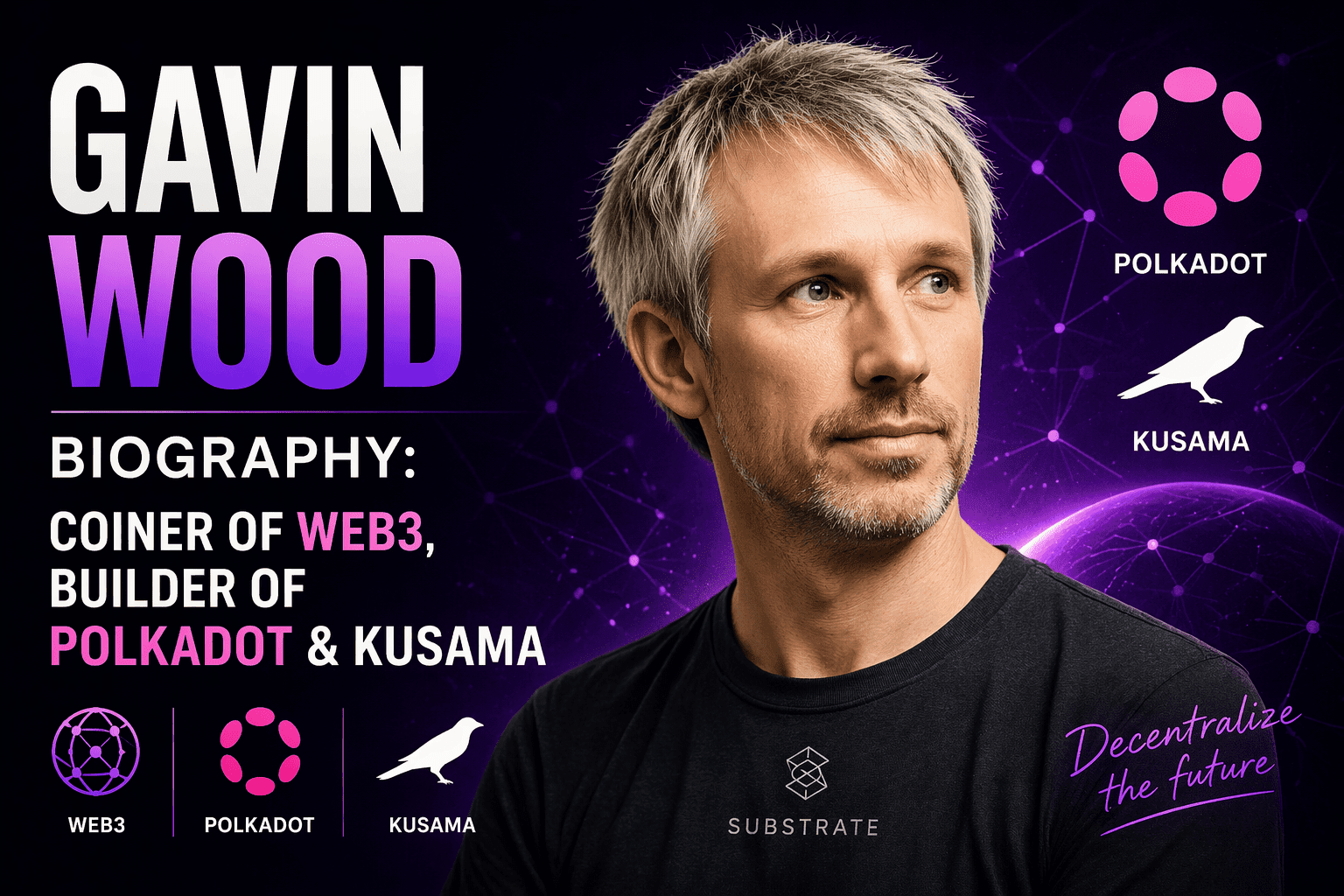
Gavin Wood Biography: The British Genius Who Coined Web3 and Built Polkadot & Kusama
In the rapidly evolving landscape of blockchain technology and decentralized systems, few individuals have left as indelible a mark as Gavin Wood. A British computer scientist and programmer, Wood is a name synonymous with foundational innovation, having played a pivotal role in the creation of Ethereum, the coining of the term “Web3,” and the architecture of the ambitious Polkadot and Kusama networks. His journey is a testament to a relentless pursuit of decentralization, a profound understanding of complex systems, and an unwavering commitment to building the next generation of the internet.
From his early academic pursuits to his current role as a visionary architect of the decentralized web, Wood’s career is characterized by a consistent drive to push the boundaries of what’s possible. He is not merely an engineer but a philosopher of technology, deeply concerned with the implications of centralized power and the potential for open, trustless systems to reshape human interaction and digital economies. This article delves into the life and achievements of Gavin Wood, exploring the intellect and ambition that have propelled him to the forefront of the blockchain revolution.
Early Life and Academic Foundations
Gavin Wood’s intellectual journey began in the United Kingdom, where his innate curiosity for technology and complex systems blossomed from a young age. While specific details of his early childhood are not widely publicized, it is clear that his formative years were spent cultivating a deep interest in computing, a passion that would ultimately define his career path.
His academic pursuits led him to Lancaster University, a prestigious institution known for its strong computer science programs. Here, Wood immersed himself in the intricacies of software engineering and distributed systems, laying the groundwork for his future innovations. He pursued a Master of Engineering (MEng) degree in Computer Systems and Software Engineering, graduating in 2002. His studies at Lancaster provided him with a robust theoretical understanding of computer science principles, coupled with practical experience in developing sophisticated software solutions. This period was crucial in honing his analytical skills and fostering a systems-level thinking approach that would later prove invaluable in designing complex blockchain architectures.
Following his MEng, Wood continued his academic journey, undertaking a Ph.D. in computer science. His doctoral research focused on the application of formal methods to software design, a highly specialized area concerned with mathematically proving the correctness and reliability of software systems. This deep dive into formal verification reflects Wood’s meticulous nature and his commitment to building robust, secure, and provably correct systems – a philosophy that would become a hallmark of his work in the blockchain space. While he did not complete his Ph.D., the rigorous training and intellectual discipline gained during this period undoubtedly shaped his approach to engineering and his ability to tackle some of the most challenging problems in distributed computing.
Vitalik Buterin Biography: Ethereum Founder’s Life, Achievements & Future Plans
Galaxy S26 Deal: Get $200 Off at Samsung Today
React & Tailwind CSS: Create Custom Buttons UI
The Formative Years: A Mind for Innovation
Before his meteoric rise in the blockchain world, Gavin Wood spent several years honing his skills and exploring various facets of software development. These formative years were crucial in developing his unique problem-solving approach and expanding his technical repertoire.
His early career involved working on a diverse range of projects, from developing user interfaces and compilers to designing complex gaming systems. He gained experience in various programming languages and paradigms, developing a versatile skill set that would later enable him to contribute across multiple layers of the blockchain stack. For instance, he worked on projects involving artificial intelligence, computer graphics, and even music visualization software. This breadth of experience provided him with a holistic understanding of software development, from low-level systems programming to high-level application design.
Wood’s early work was characterized by a deep interest in open-source software and a collaborative approach to development. He was an active participant in various online communities, contributing to projects and engaging in discussions that pushed the boundaries of conventional computing. This period allowed him to experiment with novel ideas, refine his coding style, and develop a keen eye for architectural elegance and efficiency. It was during these years that Wood cultivated the intellectual independence and innovative spirit that would later define his contributions to the decentralized web. He was not content with merely using existing tools; he sought to understand their underlying mechanisms and, if necessary, build better ones from scratch.
The Ethereum Revolution: A Founding Visionary
Gavin Wood’s entry into the world of blockchain technology marked a turning point, not only for his career but for the entire industry. His collaboration with Vitalik Buterin and other co-founders led to the creation of Ethereum, a platform that fundamentally reshaped the landscape of decentralized applications.
Meeting Vitalik Buterin and the Genesis of Ethereum
The story of Ethereum often begins with Vitalik Buterin’s whitepaper, outlining a vision for a programmable blockchain. However, it was the coming together of a diverse group of talented individuals, including Gavin Wood, that brought this vision to life. Wood met Buterin in late 2013/early 2014, and quickly recognized the profound potential of a generalized blockchain capable of executing arbitrary code. His deep understanding of formal systems and software architecture made him an ideal candidate to translate Buterin’s conceptual framework into a tangible, working protocol.
Wood’s initial role was instrumental in crystallizing the technical specifications of Ethereum. He was one of the original eight co-founders and quickly assumed the critical position of Chief Technology Officer (CTO). His responsibilities were vast, encompassing the technical design, implementation, and overall architectural integrity of the Ethereum protocol.
Crafting the Ethereum Yellow Paper
One of Wood’s most significant contributions to Ethereum was the authorship of the Ethereum Yellow Paper. While Buterin’s whitepaper provided the high-level vision, the Yellow Paper served as the formal specification of the Ethereum Virtual Machine (EVM). Published in April 2015, this document meticulously detailed the protocol’s inner workings, including:
- State Transition Function: How the Ethereum state changes from one block to the next.
- Transaction Processing: The lifecycle of a transaction, from creation to inclusion in a block.
- Gas Mechanism: The system for metering computational resources and preventing denial-of-service attacks.
- EVM Instruction Set: The low-level operations that the EVM can execute.
The Yellow Paper was written with the precision of a formal specification, using mathematical notation and rigorous definitions. This level of detail was crucial for ensuring that different implementations of Ethereum (e.g., in various programming languages) could achieve interoperability and maintain a consistent state. It became the definitive technical guide for developers and researchers, solidifying Ethereum’s foundational architecture.
Developing Solidity
Beyond the Yellow Paper, Wood also played a key role in the development of Solidity, Ethereum’s primary smart contract programming language. Recognizing the need for a high-level language that could compile down to EVM bytecode, Wood initiated the design and implementation of Solidity. He envisioned a language that was object-oriented, Turing-complete, and familiar enough to traditional developers while being specifically tailored for the unique constraints and security requirements of blockchain environments.
Solidity’s creation was a monumental step, making it significantly easier for developers to write and deploy decentralized applications (dApps) on Ethereum. Its influence cannot be overstated; it became the de facto standard for smart contract development and remains widely used today, powering countless dApps, DeFi protocols, and NFTs.
Departing from Ethereum
Despite his foundational contributions, Gavin Wood eventually transitioned away from his direct involvement with the Ethereum project. The reasons for his departure were multifaceted, but primarily stemmed from a desire to focus on more fundamental architectural challenges and a different approach to scaling and interoperability. While Ethereum was pioneering smart contracts, Wood began to envision a more generalized, interoperable framework for decentralized systems. He felt that the core architectural decisions of Ethereum, while innovative, might not be sufficient to address the long-term scalability and governance needs of a truly decentralized web. This divergence in vision ultimately led him to explore new avenues for innovation, setting the stage for his next groundbreaking endeavor.
Coining Web3: A Vision for a Decentralized Future
Even before his full departure from Ethereum, Gavin Wood was already articulating a grander vision for the internet’s future. In 2014, he coined the term “Web3” in a blog post, laying out a conceptual framework for a decentralized web that would fundamentally shift power away from centralized entities and back to individual users.
The Context: Disillusionment with Centralized Web
Wood’s vision for Web3 emerged from a growing disillusionment with the trajectory of Web2, the current iteration of the internet dominated by large tech corporations like Google, Facebook, and Amazon. While Web2 offered unprecedented connectivity and user-generated content, it also led to:
- Data Silos: Users’ data was controlled and monetized by platforms.
- Censorship and Control: Centralized entities had the power to censor content and deplatform users.
- Lack of Transparency: Algorithms and data practices were often opaque.
- Single Points of Failure: Reliance on centralized servers made systems vulnerable to outages and attacks.
Wood recognized that while blockchain technology offered a solution to some of these problems, a broader conceptual shift was needed to guide the development of truly decentralized applications and infrastructure.
Defining Web3: A New Paradigm
Web3, as envisioned by Wood, is not merely an upgrade to Web2 but a paradigm shift. Its core tenets include:
- Decentralization: Applications and data are distributed across a network of peer-to-peer nodes, rather than residing on centralized servers. This eliminates single points of failure and reduces reliance on intermediaries.
- User Ownership and Control: Individuals regain ownership of their data and digital identities. They can control who accesses their information and how it’s used.
- Trustlessness: Interactions can occur directly between parties without the need for trusted third-party intermediaries, thanks to cryptographic proofs and blockchain consensus mechanisms.
- Censorship Resistance: Because there’s no central authority to control content, Web3 applications are inherently more resistant to censorship and arbitrary shutdowns.
- Interoperability: Different decentralized applications and blockchains can communicate and share data seamlessly, fostering a more integrated and dynamic digital ecosystem.
Wood articulated that Web3 would be built on cryptographic primitives, peer-to-peer networking, and decentralized consensus mechanisms. It would enable new forms of digital identity, secure data exchange, and truly autonomous organizations.
The Web3 Foundation: Fostering the Ecosystem
To champion and realize this vision, Gavin Wood founded the Web3 Foundation in 2017. Based in Zug, Switzerland, the foundation’s mission is to nurture and steward the technologies and applications in the decentralized web software stack. It acts as a grant-giving body, funding research and development projects that contribute to the Web3 ecosystem, with a particular focus on Polkadot and its related technologies.
The Web3 Foundation’s work extends beyond funding; it also plays a crucial role in:
- Research and Development: Supporting fundamental research into cryptography, distributed systems, and economic models for decentralized networks.
- Community Building: Fostering a global community of developers, researchers, and enthusiasts dedicated to building the decentralized web.
- Education and Advocacy: Promoting understanding and adoption of Web3 technologies through educational initiatives and outreach.
Through the Web3 Foundation, Wood has provided a vital institutional framework for advancing his vision, ensuring that the principles of decentralization and user empowerment remain at the core of future internet development.
The Birth of Polkadot: Interoperability and Scalability
While the concept of Web3 provided the philosophical blueprint, Gavin Wood recognized that existing blockchain technologies, including Ethereum, faced significant limitations in achieving its full potential. Specifically, issues of interoperability and scalability presented major hurdles. This realization led him to conceive Polkadot, an ambitious next-generation blockchain protocol designed to address these challenges head-on.
The Problem Polkadot Aims to Solve
In the early days of blockchain, each network operated in isolation, forming “walled gardens” of data and functionality. This created several critical problems:
- Blockchain Silos: Different blockchains (e.g., Bitcoin, Ethereum) could not communicate directly, hindering the development of truly interconnected decentralized applications.
- Scalability Limitations: Most early blockchains struggled with transaction throughput, making them unsuitable for widespread adoption.
- Lack of Specialization: A single blockchain had to be general-purpose, leading to compromises in efficiency and security for specific use cases.
- Upgradeability Challenges: Hard forks were often required for protocol upgrades, leading to community divisions and potential network instability.
Wood envisioned a “blockchain of blockchains” – a heterogeneous multi-chain framework that could overcome these limitations.
Core Concepts: Relay Chain, Parachains, and Bridges
Polkadot’s architecture is a testament to Wood’s deep understanding of distributed systems and his commitment to elegant, scalable solutions. Its core components include:
- Relay Chain: The central chain of Polkadot, responsible for the network’s shared security, consensus, and interoperability. It coordinates the entire system, ensuring that all connected blockchains (Parachains) operate under the same security umbrella. The Relay Chain does not support smart contracts directly but focuses on coordinating the system.
- Parachains: These are independent, application-specific blockchains that connect to the Relay Chain. Each Parachain can have its own specialized functionality, governance model, and token. They benefit from the Relay Chain’s shared security and can communicate with other Parachains via the Relay Chain. Examples could include a Parachain optimized for DeFi, another for gaming, and another for supply chain management.
- Bridges: These allow Polkadot and its Parachains to connect and communicate with external blockchains that are not part of the Polkadot ecosystem, such as Bitcoin or Ethereum. Bridges enable true cross-chain interoperability, extending Polkadot’s reach across the entire blockchain landscape.
This architecture allows for massive scalability by distributing transaction processing across multiple specialized Parachains, while maintaining a unified security model provided by the Relay Chain.
Technical Design Philosophy
Polkadot’s design reflects several key technical philosophies championed by Wood:
- Shared Security: All Parachains connected to the Relay Chain inherit its security, meaning that even small or new Parachains are as secure as the entire Polkadot network. This significantly lowers the barrier to entry for new blockchain projects.
- Heterogeneous Sharding: Unlike traditional sharding that divides a single blockchain into smaller pieces, Polkadot allows for diverse, specialized blockchains (Parachains) to coexist and interact.
- Forkless Upgrades: Polkadot incorporates an on-chain governance system that allows the network to upgrade itself without the need for hard forks, ensuring smoother evolution and greater stability.
- Substrate Framework: Polkadot is built using Substrate, a modular framework developed by Parity Technologies (also founded by Wood). Substrate allows developers to quickly and easily build custom blockchains that can be connected to Polkadot as Parachains or operate as standalone chains.
The vision for Polkadot is not just about building a single blockchain but creating an entire ecosystem where diverse blockchains can thrive, communicate, and collectively form the backbone of the decentralized web. It represents a significant leap forward in blockchain architecture, addressing many of the limitations that plagued earlier generations of decentralized networks.
Kusama: The Canary Network and Innovation Hub
As Polkadot began to take shape, Gavin Wood and his team recognized the need for an environment where new features, upgrades, and experimental applications could be tested in a real-world, yet less critical, setting. This led to the creation of Kusama, often referred to as Polkadot’s “canary network.”
What is Kusama?
Kusama is an independent, experimental blockchain network that shares almost the exact same codebase as Polkadot. It functions as an early, unrefined, and faster-moving version of Polkadot. The name “canary network” is apt, referencing the historical practice of using canaries in coal mines to detect dangerous gases – Kusama serves as an early warning system for Polkadot.
Key characteristics of Kusama include:
- Real-World Environment: It’s a live, operational blockchain with real economic incentives, not a testnet. This means that assets on Kusama have real value, and participants have genuine stakes.
- Faster Iteration: Kusama has faster governance parameters, allowing for quicker upgrades and more rapid experimentation. Proposals can be voted on and enacted in days, rather than weeks or months as might be the case on Polkadot.
- Lower Stakes: While it has real value, the stakes on Kusama are generally lower than on Polkadot, making it a more forgiving environment for innovation and risk-taking.
Its Purpose and Relationship to Polkadot
Kusama serves several crucial purposes within the broader Polkadot ecosystem:
- Testing Ground for Polkadot Upgrades: Before major protocol upgrades or new features are deployed on Polkadot, they are often first launched and tested on Kusama. This allows developers to identify and fix bugs, assess performance, and gather community feedback in a live environment, minimizing risks for Polkadot.
- Proving Ground for Parachains: Projects aiming to launch a Parachain on Polkadot often first deploy on Kusama. This allows them to test their application-specific blockchain, optimize its performance, and build a user base before making the significant investment required for a Polkadot Parachain slot.
- Innovation Hub: Kusama attracts projects that prioritize speed, agility, and experimentation. It’s a network for bold ideas and early-stage deployments, fostering a vibrant ecosystem of cutting-edge decentralized applications.
- Independent Network: While closely related to Polkadot, Kusama is an independent network with its own community, governance, and token (KSM). It is designed to be self-sufficient and can evolve on its own trajectory.
The relationship between Polkadot and Kusama is symbiotic. Kusama acts as a dynamic testing ground and an incubator for innovation, providing valuable insights and battle-testing technologies before their deployment on the more stable and economically significant Polkadot network. It embodies Wood’s philosophy of iterative development and robust testing in a live environment.
Parity Technologies: The Engineering Powerhouse
The ambitious vision of Polkadot and Kusama required a dedicated and highly skilled engineering team. To bring these networks to fruition, Gavin Wood co-founded Parity Technologies in 2015, initially known as Ethcore.
Founding Parity
After his foundational work on Ethereum, Wood recognized the need for a company that could focus on building robust, high-performance blockchain infrastructure. Parity Technologies was established with the mission to develop core blockchain technology and tools that would power the decentralized web. The company quickly assembled a team of world-class engineers, cryptographers, and researchers, all aligned with Wood’s vision for a more decentralized and interoperable internet.
Parity’s early work included developing the Parity Ethereum client (now known as OpenEthereum), an alternative implementation of the Ethereum protocol written in Rust, known for its efficiency and stability. This experience in building a production-grade blockchain client proved invaluable for their subsequent work on Polkadot.
Its Role in Building Polkadot and Other Blockchain Infrastructure
Parity Technologies is the primary development team behind Polkadot and Kusama. Its contributions are extensive and encompass every layer of these networks:
- Core Protocol Development: Parity engineers are responsible for designing, implementing, and maintaining the Relay Chain for both Polkadot and Kusama, including their consensus mechanisms, governance systems, and networking layers.
- Substrate Framework: One of Parity’s most significant contributions is the development of Substrate, a modular framework for building custom blockchains. Substrate allows developers to create specialized blockchains (which can then become Parachains) with remarkable ease and flexibility. It provides a robust set of tools and pre-built modules for everything from networking and consensus to runtime logic and smart contract execution.
- Tooling and Ecosystem Support: Parity also develops a wide range of tools, libraries, and documentation to support developers building on Polkadot and Kusama, fostering a vibrant and accessible ecosystem. This includes wallets, explorers, and SDKs.
- Research and Innovation: The company invests heavily in research, exploring new cryptographic techniques, consensus algorithms, and scaling solutions to continually advance the state of blockchain technology.
Under Wood’s leadership, Parity Technologies has become a leading force in blockchain infrastructure development, known for its engineering excellence, commitment to open-source principles, and rigorous approach to security and performance.
Gavin Wood’s Philosophy and Impact
Gavin Wood’s contributions to the blockchain space are not merely technical; they are deeply rooted in a philosophical commitment to decentralization, open-source principles, and a vision for a more equitable digital future.
Commitment to Fundamental Research and Engineering
Wood is known for his methodical and rigorous approach to problem-solving. He doesn’t shy away from tackling fundamental challenges in computer science and distributed systems. His work on the Ethereum Yellow Paper, the design of Polkadot’s architecture, and the development of Substrate all exemplify a dedication to building robust, provably secure, and scalable systems from the ground up. He emphasizes the importance of formal specifications, well-tested code, and innovative cryptographic solutions. This deep engineering ethos contrasts with some projects that prioritize hype over substance, making his contributions particularly enduring.
Emphasis on Decentralization and Open Source
At the heart of Wood’s philosophy is an unwavering belief in decentralization. He views centralized control as a fundamental flaw of the current internet, leading to power imbalances, censorship, and vulnerability. His work on Web3, Polkadot, and Kusama is a direct effort to dismantle these centralized structures and empower individuals.
Equally important is his commitment to open source. All of Parity Technologies’ core work, including Polkadot, Kusama, and Substrate, is open source. This allows for transparency, community auditing, and collaborative development, aligning with the ethos of a truly decentralized and permissionless internet. He believes that the future of the web should be built by a global community, not by a select few corporations.
His Influence on the Broader Blockchain and Tech Landscape
Gavin Wood’s impact extends far beyond the projects he directly founded.
- Architectural Inspiration: Polkadot’s multi-chain architecture has inspired other projects to explore similar heterogeneous sharding models, influencing the broader discussion around blockchain scalability and interoperability.
- Web3 Movement: By coining and popularizing “Web3,” he provided a unifying vision and a clear narrative for the next generation of the internet, galvanizing countless developers and entrepreneurs to build decentralized applications.
- Developer Tooling: Substrate has become a powerful framework for blockchain development, enabling a new wave of innovation by abstracting away much of the complexity of building custom chains. This has lowered the barrier to entry for many projects.
- Thought Leadership: Wood is a respected voice in the blockchain community, frequently sharing his insights on the future of decentralized technology, governance, and the philosophical underpinnings of Web3.
His unique blend of theoretical depth, practical engineering prowess, and visionary thinking has positioned him as one of the most influential figures in the ongoing evolution of the internet.
Conclusion
Gavin Wood stands as a towering figure in the annals of modern computing, a true British genius whose intellectual curiosity and relentless drive have reshaped the digital landscape. From his foundational contributions to Ethereum, where he architected the very machine that powers smart contracts, to his prescient coining of “Web3” – a term that now defines a global movement – Wood has consistently been at the vanguard of innovation.
His magnum opus, Polkadot, along with its experimental counterpart Kusama, represents a profound leap forward in blockchain architecture. By tackling the critical challenges of interoperability and scalability, Wood has laid the groundwork for a truly interconnected and decentralized internet, where diverse blockchains can communicate seamlessly and users regain (Note: MAX_TOKENS) control over their digital lives. Through Parity Technologies and the Web3 Foundation, he continues to foster an ecosystem dedicated to building robust, open-source infrastructure for this future.
Gavin Wood’s