
Table of Contents
OpenAI Founders: Their Journey and AI Breakthroughs
The landscape of artificial intelligence has undergone a seismic shift in recent years, largely propelled by the groundbreaking work of OpenAI. From its ambitious inception as a non-profit dedicated to safe AI development to its current status as a global leader in generative AI, OpenAI has consistently pushed the boundaries of what machines can achieve. At the heart of this transformative journey are its visionary founders, a diverse group of entrepreneurs, researchers, and technologists united by a shared belief in the profound potential—and inherent risks—of artificial intelligence.
This article delves into the remarkable journey of OpenAI’s founders, exploring their motivations, the unique organizational structure they forged, and the pivotal AI breakthroughs that have redefined industries and captured the world’s imagination. We will trace their path from initial concerns about AI’s future to the creation of models like GPT-4 and DALL-E, examining how their collective vision has shaped the trajectory of AI development and its impact on humanity.
The Genesis of a Vision: Pre-OpenAI Landscape
Before OpenAI’s formal establishment, the world of artificial intelligence was already experiencing a renaissance. Deep learning, fueled by vast datasets and increasingly powerful computing, was demonstrating capabilities previously thought to be decades away. Yet, alongside this excitement grew a palpable sense of apprehension among certain thinkers and leaders regarding the long-term implications of advanced AI.
The AI Landscape Before OpenAI
By the mid-2010s, several trends were becoming clear:
- Rapid Advancements in Deep Learning: Techniques like convolutional neural networks (CNNs) and recurrent neural networks (RNNs) were achieving state-of-the-art results in areas like image recognition, natural language processing, and speech recognition.
- Concentration of Power: Much of the cutting-edge AI research and development was being conducted within a handful of large technology companies (e.g., Google, Facebook, Microsoft, Amazon). These companies had the resources—data, computing power, and talent—to dominate the field.
- Emerging Concerns about AI Safety: Prominent figures, including scientists, philosophers, and entrepreneurs, began vocalizing concerns about the potential existential risks posed by advanced artificial general intelligence (AGI). Questions arose about control, alignment with human values, and the ethical implications of creating systems potentially more intelligent than humans.
This backdrop set the stage for a new kind of AI organization, one explicitly designed to address these concerns and ensure that the benefits of AI were broadly distributed.
The Founders and Their Motivations
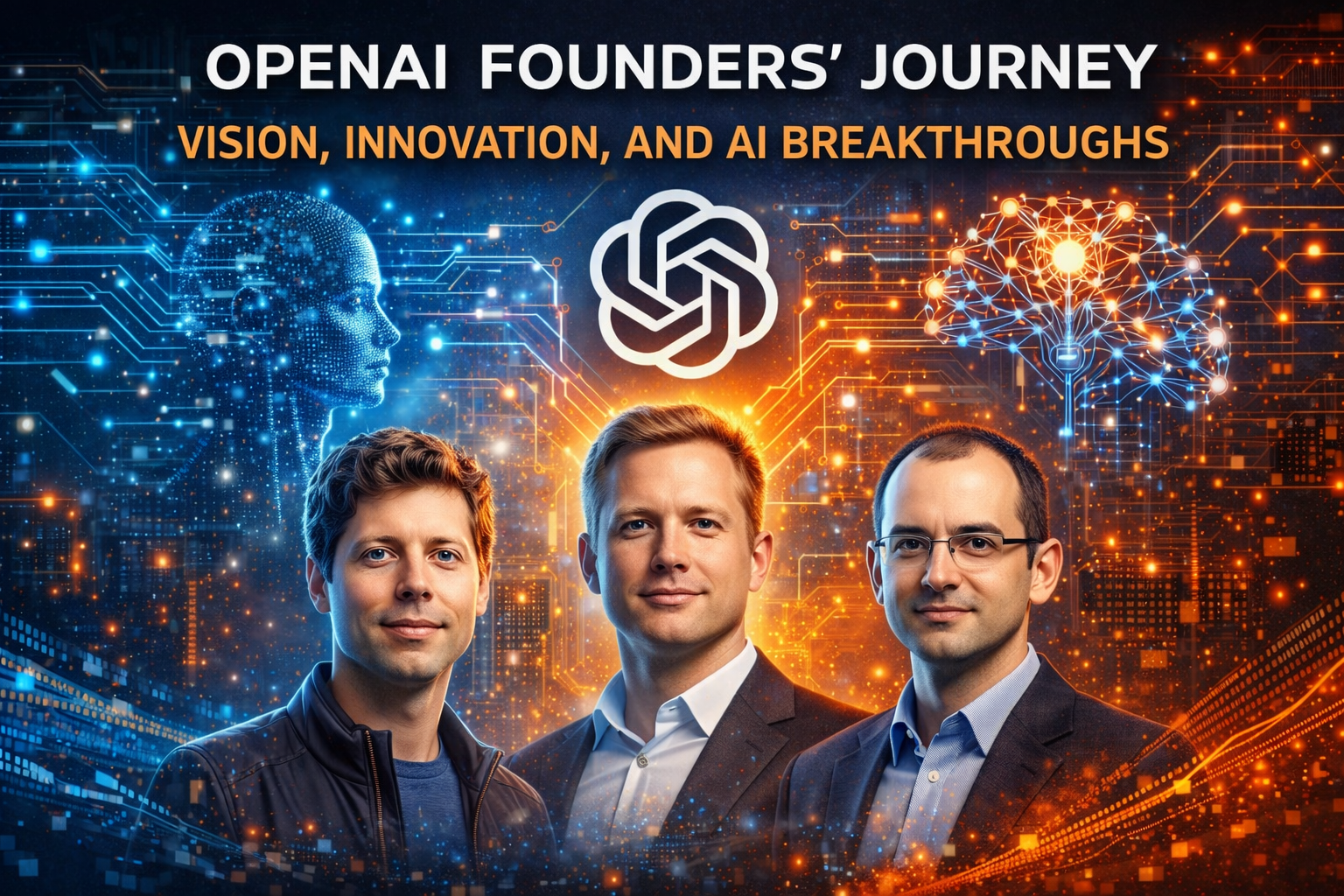
OpenAI was founded in December 2015 by a group of prominent figures, each bringing unique expertise and a shared commitment to shaping AI’s future responsibly.
Sam Altman: The Entrepreneurial Visionary
Sam Altman, known for his role as president of Y Combinator, a highly influential startup accelerator, brought a deep understanding of entrepreneurship, innovation, and scaling ambitious projects. Altman’s motivation stemmed from a belief that AI, particularly AGI, would be the most impactful technology in human history. He envisioned a future where AI’s benefits were widely accessible and not monopolized by a few corporations or governments. His entrepreneurial drive was crucial in assembling the initial team and securing early funding.
Elon Musk’s AI & Blockchain Influence: Lessons for Builders 2026
Connect AzuraCast with a Live Encoder: Setup Guide
Top Web3 Angel Investors: Howto Connect and Secure Funding
Elon Musk: The AI Safety Advocate
Elon Musk, the visionary behind Tesla and SpaceX, had been a vocal proponent of AI safety for years. His concerns about AI’s potential to become an uncontrollable force, even an existential threat, were well-documented. Musk’s involvement was driven by a desire to create a counterweight to the corporate pursuit of AI, ensuring that a significant portion of AI research was conducted openly and with safety as a paramount concern. He provided substantial initial funding and lent considerable public profile to the nascent organization.
Ilya Sutskever: The Deep Learning Pioneer
Ilya Sutskever, a leading expert in deep learning, was a critical technical architect of OpenAI. Having worked at Google Brain and contributed significantly to the development of neural networks (including co-inventing the sequence-to-sequence model), Sutskever brought unparalleled technical depth and a relentless pursuit of AGI. His motivation was rooted in the scientific challenge of building truly intelligent machines, coupled with a strong conviction that such powerful technology must be developed safely and for the benefit of all. He became OpenAI’s Chief Scientist, guiding its research agenda.
Greg Brockman: The Engineering and Operational Leader
Greg Brockman, formerly the CTO of Stripe, a successful financial technology company, brought invaluable experience in building and scaling complex engineering organizations. His ability to translate ambitious research goals into actionable engineering projects and to manage rapid growth was essential. Brockman’s motivation aligned with the others: to build a world-class research institution focused on AGI, with an emphasis on safety and broad distribution of benefits. He assumed the role of President, overseeing the operational aspects of the organization.
Other Key Backers
The initial founding also included significant financial backing from other prominent figures, including Reid Hoffman (co-founder of LinkedIn), Peter Thiel (co-founder of PayPal), Jessica Livingston (co-founder of Y Combinator), and Amazon Web Services (AWS), among others. These individuals and entities recognized the critical importance of OpenAI’s mission and provided the initial capital to kickstart its ambitious endeavors.
The collective motivation was clear: to create an organization that would advance AI in a way that benefited all of humanity, prioritizing safety and open collaboration over profit or proprietary control. They aimed to prevent a future where a single entity held disproportionate power over the most transformative technology ever created.
Founding OpenAI: A New Paradigm for AI Research
On December 11, 2015, OpenAI was officially announced, immediately capturing global attention due to its high-profile founders and audacious mission.
The Official Launch and Mission
OpenAI’s founding statement outlined its core mission: “to advance digital intelligence in the way that is most likely to benefit humanity as a whole, unconstrained by a need to generate financial return.” This mission was underpinned by several key principles:
- Non-Profit Structure: Initially, OpenAI was established as a non-profit organization, emphasizing its commitment to public good over profit. This structure was intended to align its incentives with the long-term benefit of humanity.
- Open-Source Research: A central tenet was the commitment to open-source research, sharing findings, code, and models with the broader scientific community. The idea was to accelerate collective progress and prevent the monopolization of critical AI advancements.
- Safety and Alignment: From day one, safety and alignment with human values were paramount. The founders recognized that powerful AI systems could have unintended consequences if not carefully developed and controlled.
The initial announcement highlighted a significant investment of $1 billion (though spread over time, not an immediate cash injection), signaling the serious intent behind the venture.
Initial Challenges and Early Research Directions
The early days of OpenAI were marked by both excitement and significant challenges:
- Attracting Top Talent: To compete with well-established tech giants, OpenAI needed to attract the world’s best AI researchers and engineers. The promise of working on fundamental AI problems with a clear mission, free from immediate commercial pressures, proved to be a powerful draw.
- Defining Research Focus: With a broad mission, the team had to strategically choose initial research directions. Early efforts focused on:
- Reinforcement Learning (RL): A branch of machine learning where agents learn to make decisions by performing actions in an environment and receiving rewards or penalties. This was seen as crucial for developing intelligent agents that could interact with complex real-world scenarios.
- Robotics: Research into dexterous manipulation and robot learning, aiming to create general-purpose robots capable of performing a wide range of tasks.
- Language Models: Exploring the potential of neural networks to understand and generate human language, laying the groundwork for future breakthroughs.
- Balancing Openness with Competition: While committed to open-source, the reality of the highly competitive AI landscape meant that completely open research could sometimes put OpenAI at a disadvantage against well-resourced competitors who could quickly commercialize shared findings. This tension would eventually lead to an evolution in its organizational structure.
The Evolution of OpenAI’s Structure: From Non-Profit to Capped-Profit
By 2019, it became evident that the scale of resources required to achieve OpenAI’s ambitious goals, particularly the development of AGI, far exceeded what a traditional non-profit structure could sustain. Training state-of-the-art AI models required astronomical amounts of computing power, vast datasets, and an ever-growing team of highly compensated experts.
The Rationale for the Shift
In March 2019, OpenAI announced a significant restructuring, creating a new “capped-profit” entity called OpenAI LP, which would operate under the non-profit parent, OpenAI Inc. The key reasons for this shift were:
- Massive Capital Requirements: Competing with tech giants like Google and Meta in the race for AGI demanded billions of dollars in investment, primarily for supercomputing infrastructure. The non-profit model struggled to attract capital at this scale.
- Talent Retention: While the mission was a strong draw, top AI talent commanded extremely high salaries in the private sector. The capped-profit model allowed OpenAI to offer competitive compensation, including equity-like incentives, to attract and retain the best researchers.
- Accelerated Research: With increased funding, OpenAI could accelerate its research efforts, acquire more powerful hardware, and scale up its training runs for larger and more complex models.
Implications of the New Structure
Under the new structure, investors in OpenAI LP could receive a capped return on their investment (e.g., 100x the invested capital), after which any further profits would flow back to the non-profit parent. The non-profit board of OpenAI Inc. retained control over the capped-profit entity, ensuring that the original mission of safe AGI for humanity remained paramount.
- Microsoft’s Investment: This new structure paved the way for a multi-billion dollar investment from Microsoft, which provided crucial financial backing and access to its Azure supercomputing infrastructure. This partnership proved instrumental in scaling OpenAI’s research and development.
- Increased Commercialization: The capped-profit model also allowed OpenAI to develop and commercialize its technologies, offering APIs and services to businesses. This generated revenue that could be reinvested into further research, creating a sustainable funding loop.
- Ongoing Debate: The shift sparked debate among the AI community and the public. Critics questioned whether a profit motive, even a capped one, could truly align with the original mission of benefiting all of humanity. OpenAI’s leadership, particularly Sam Altman, consistently maintained that the new structure was a necessary evil to achieve the mission faster and more effectively, with the non-profit’s oversight acting as a safeguard.
This structural evolution was a pivotal moment in OpenAI’s journey, enabling it to transition from an ambitious research lab to a powerhouse capable of delivering world-changing AI breakthroughs.
OpenAI’s AI Breakthroughs: A Timeline of Innovation
OpenAI’s journey is punctuated by a series of remarkable AI breakthroughs that have consistently pushed the boundaries of the field. These innovations, spanning reinforcement learning, robotics, and generative AI, have not only advanced scientific understanding but have also democratized access to powerful AI capabilities.
Early Milestones (2016-2018)
The initial years saw OpenAI laying foundational groundwork and demonstrating impressive capabilities in specific domains.
OpenAI Gym & Universe (2016)
To accelerate reinforcement learning research, OpenAI released Gym, a toolkit for developing and comparing RL algorithms, and Universe, a platform for training agents across a wide range of environments, including games and websites. These open-source tools became standard benchmarks for RL researchers globally.
Dota 2 Bots (OpenAI Five) (2017-2018)
One of OpenAI’s most celebrated early achievements was the development of OpenAI Five, a team of AI bots capable of playing the complex real-time strategy game Dota 2.
- Initial Feat (2017): A single bot defeated top professional players in 1v1 matches.
- Team Victory (2018): OpenAI Five, a team of five bots, defeated a team of professional players in a full 5v5 game. This was a monumental achievement, showcasing advanced multi-agent reinforcement learning, long-term planning, and cooperation in a highly dynamic and imperfect information environment. It required the AI to learn from hundreds of years of simulated gameplay daily.
Robotics: Dexterous Hand (2019)
OpenAI demonstrated a robotic hand capable of solving a Rubik’s Cube. What made this particularly significant was that the AI learned to manipulate the cube entirely through reinforcement learning, without explicit programming for each movement. This “learning from scratch” approach, combined with domain randomization (training in simulated environments with varying physics to improve real-world transfer), was a major step towards general-purpose robotic manipulation.
The Generative AI Revolution (2019-Present)
While early work was impressive, it was the advent of the Generative Pre-trained Transformer (GPT) series and related models that truly catapulted OpenAI into the global spotlight, igniting the generative AI revolution.
GPT Series (Generative Pre-trained Transformer)
The GPT models are large language models (LLMs) that use the transformer architecture to generate human-like text.
- GPT-1 (2018): The first iteration demonstrated the power of pre-training on a large corpus of text followed by fine-tuning for specific tasks. It showed promising results in tasks like natural language inference and question answering.
- GPT-2 (2019): This model, with 1.5 billion parameters, generated remarkably coherent and contextually relevant text. OpenAI initially withheld its full release due to concerns about potential misuse (e.g., generating fake news), sparking a global debate on responsible AI deployment. Its ability to perform various language tasks with “zero-shot” learning (without explicit fine-tuning) was a significant step.
- GPT-3 (2020): A monumental leap forward, GPT-3 boasted 175 billion parameters, making it by far the largest language model at the time. Its capabilities were astounding, performing a wide range of tasks with “few-shot” learning (given a few examples). It could write articles, generate code, translate languages, answer questions, and even compose poetry with unprecedented fluency and coherence. Its API made it accessible to developers, leading to a proliferation of AI-powered applications.
- GPT-3.5 / ChatGPT (2022): ChatGPT, a fine-tuned version of GPT-3.5 optimized for conversational interaction, was released to the public in November 2022. Its user-friendly interface and remarkable ability to engage in natural dialogue, answer complex questions, write code, and generate creative content captivated millions. It quickly became the fastest-growing consumer application in history, democratizing access to powerful generative AI and sparking a global surge of interest and investment in the field.
- GPT-4 (2023): Released in March 2023, GPT-4 represented another significant advancement. It demonstrated improved reasoning capabilities, higher accuracy, and the ability to handle more nuanced and complex prompts. Crucially, GPT-4 introduced multimodal capabilities, meaning it could process not only text but also images as input, allowing it to understand and respond to visual information. Its performance on professional and academic benchmarks (e.g., passing the bar exam with a high score) showcased its enhanced intelligence.
DALL-E Series
Alongside language models, OpenAI pioneered text-to-image generation.
- DALL-E (2021): The first DALL-E model demonstrated the ability to generate novel images from textual descriptions. It could combine unrelated concepts, render objects in different styles, and understand spatial relationships (e.g., “a teapot in the shape of an avocado”).
- DALL-E 2 (2022): A significant upgrade, DALL-E 2 produced higher-resolution, more realistic images with greater fidelity to prompts. It also introduced features like inpainting (modifying parts of an image), outpainting (extending an image beyond its original borders), and generating variations of existing images.
- DALL-E 3 (2023): Integrated directly into ChatGPT, DALL-E 3 further improved image quality and, critically, enhanced its understanding of complex and nuanced prompts, allowing users to generate highly specific and detailed images with greater ease.
CLIP (Contrastive Language-Image Pre-training) (2021)
CLIP is a neural network that efficiently learns visual concepts from natural language supervision. It can connect arbitrary text with arbitrary images, enabling zero-shot image classification and search. CLIP’s ability to bridge the gap between vision and language has been foundational for many multimodal AI systems, including DALL-E.
Whisper (2022)
OpenAI released Whisper, an open-source general-purpose speech recognition model. Trained on a massive dataset of diverse audio and text, Whisper is highly accurate, robust to various accents and background noise, and capable of transcribing and translating multiple languages. Its open-source nature made high-quality speech-to-text technology widely accessible.
Sora (2024)
The latest major breakthrough, Sora, is a text-to-video generation model. Announced in February 2024, Sora can generate realistic and imaginative videos up to a minute long from text prompts. It demonstrates a remarkable understanding of physics, object permanence, and camera movement, creating complex scenes with multiple characters, specific types of motion, and accurate details of the subject and background. Sora represents a significant leap towards AI understanding and simulating the physical world.
The Founders’ Evolving Roles and Impact
The journey of OpenAI has also seen the evolving roles of its founders, adapting to the organization’s growth and the dynamic AI landscape.
- Sam Altman: As CEO, Sam Altman has become the public face of OpenAI, navigating its strategic direction, partnerships (most notably with Microsoft), and the complex ethical and regulatory challenges of advanced AI. His focus is on accelerating AGI development while ensuring its safe and beneficial deployment. His leadership was tested during the November 2023 board crisis, which saw his brief ousting and subsequent return, underscoring the internal tensions and governance challenges inherent in an organization pursuing such a powerful technology.
- Ilya Sutskever: As Chief Scientist, Ilya Sutskever remains the technical visionary, driving the core research agenda towards AGI. His deep scientific expertise and relentless pursuit of breakthrough algorithms are central to OpenAI’s innovation engine. He also played a key role in the November 2023 board events, initially supporting Altman’s removal but later signing a letter calling for his return, highlighting the intense pressure and differing perspectives within the leadership regarding safety and deployment speed.
- Greg Brockman: As President, Greg Brockman has been instrumental in building OpenAI’s world-class engineering and operational infrastructure. His ability to scale the organization, manage complex projects, and ensure the efficient execution of research initiatives is critical. He too was significantly affected by the November 2023 events, resigning in solidarity with Altman before returning to the company.
- Elon Musk: Elon Musk stepped down from OpenAI’s board in 2018, citing potential conflicts of interest with Tesla’s own AI efforts. While his initial vision and substantial funding were crucial for OpenAI’s founding, he later became a vocal critic, expressing concerns about its shift to a capped-profit model and its partnership with Microsoft, arguing it deviated from the original open-source, non-profit mission.
The collective influence of these founders, even with their divergent paths, has profoundly shaped not only OpenAI but also the broader AI industry and public discourse about the future of artificial intelligence. Their initial concerns about AI safety and the concentration of power have become central themes in global conversations.
Have any thoughts?
Share your reaction or leave a quick response — we’d love to hear what you think!
-
 0
0
-
0
-
0
-
0
-
0
-
0


