
Table of Contents
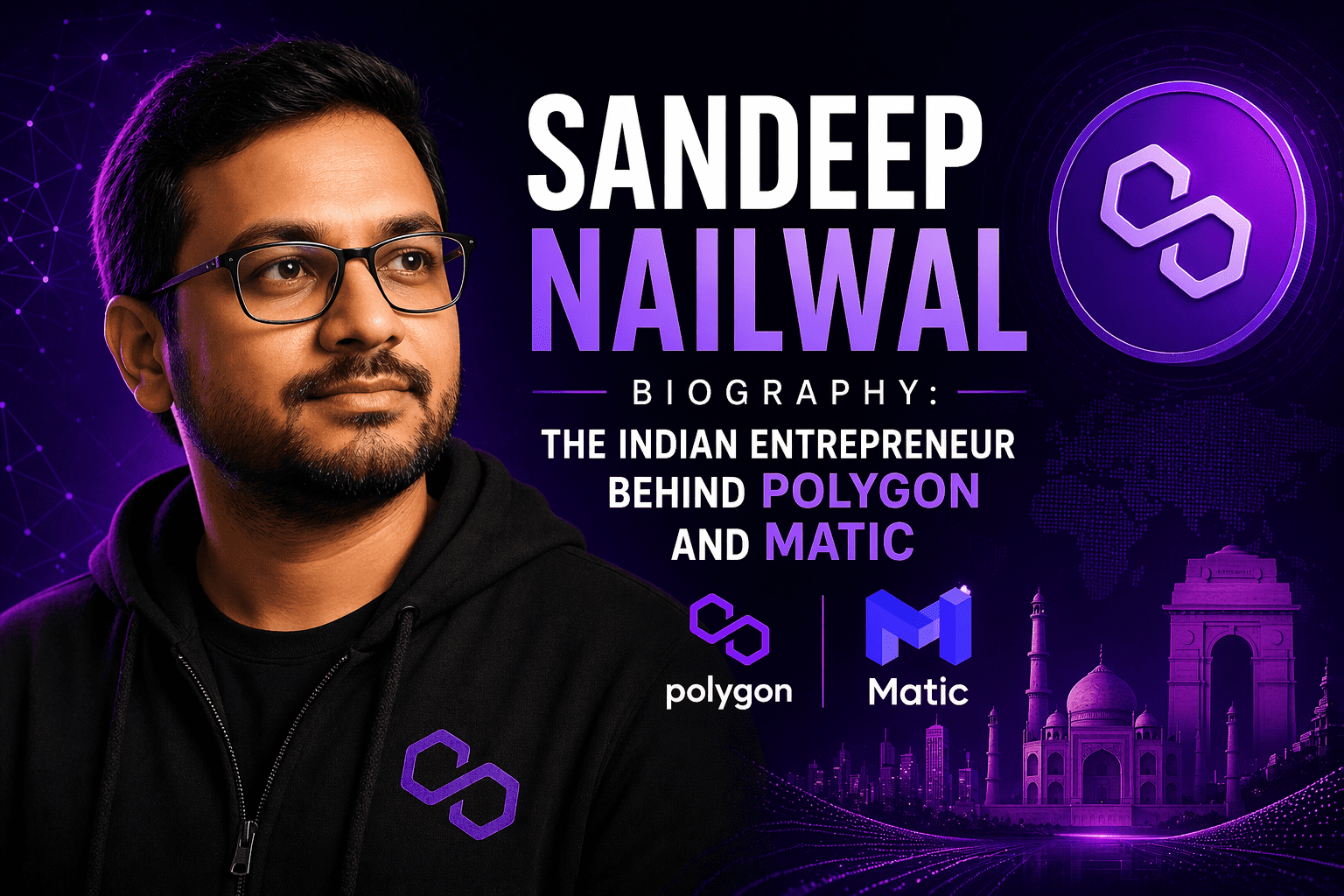
Sandeep Nailwal Biography: Indian Entrepreneur Who Built Polygon (Formerly Matic) and Leads Web3 Scaling
The story of the global blockchain revolution cannot be told without mentioning the dramatic rise of Polygon, a protocol that turned Ethereum from a congested digital highway into a scalable, multi-chain ecosystem. At the heart of this transformation is Sandeep Nailwal, a visionary entrepreneur who rose from a modest background in Delhi to become one of the most influential figures in decentralized finance (DeFi) and Web3.
Sandeep Nailwal’s journey is more than just a business success story; it is a testament to the power of “building from India for the world.” As a co-founder of Polygon (formerly Matic Network), Nailwal has played a pivotal role in solving the “trilemma” of blockchain—balancing security, scalability, and decentralization.
Early Life and Academic Background
Sandeep Nailwal was born in 1987 in a small village in the state of Uttarakhand, India, before his family moved to the outskirts of Delhi. Growing up in a middle-class household, Nailwal was no stranger to the struggles of limited resources. His father worked as a low-level employee in the local government, and the family’s financial situation often required Sandeep to be resourceful and resilient from a young age.
Despite the financial constraints, Nailwal excelled academically. He pursued a Bachelor’s degree in Computer Science and Engineering, where he first discovered his passion for technology and systems architecture. However, he realized that technical skills alone weren’t enough to create a global impact. To bridge the gap between engineering and business, he enrolled in the National Institute of Industrial Engineering (NITIE) in Mumbai (now known as IIM Mumbai), one of India’s premier institutes for supply chain and management.
During his time at NITIE, Nailwal honed his analytical skills and began to look at technology through the lens of scalability and market efficiency. This period was crucial in shaping his entrepreneurial mindset, as he began to see how broken systems could be fixed through innovative software solutions.
The Professional Prelude: From Deloitte to Entrepreneurship
Before diving into the world of blockchain, Sandeep Nailwal built a solid foundation in the traditional corporate world. After completing his MBA, he joined Deloitte as a consultant. At Deloitte, he worked on complex technology projects, gaining insights into how large-scale enterprises manage data and operations. This experience taught him the importance of institutional-grade infrastructure—a lesson that would later define the development of Polygon.
In 2014, he moved to Welspun Group, where he served as the Head of Technology for the E-commerce division. However, the “entrepreneurial itch” was too strong to ignore. In 2015, Nailwal decided to strike out on his own.
His first major venture was Scopeweaver.com, a marketplace for professional services. While the startup saw moderate success, it was during this period that Nailwal began exploring emerging technologies. In 2016, he fell down the “crypto rabbit hole.” He realized that while the internet had decentralized information, blockchain had the potential to decentralize value.
The Genesis of Matic Network
By 2017, the blockchain space was booming, but it was also hitting a wall. Ethereum, the world’s leading programmable blockchain, was suffering from extreme congestion. Transactions were slow, and “gas fees” (the cost of processing a transaction) were becoming prohibitively expensive for the average user.
Sandeep Nailwal saw this as the ultimate engineering challenge. He teamed up with Jaynti Kanani, a data scientist who had been contributing to Ethereum’s scaling research, and Anurag Arjun, a veteran in business research and product management. Together, they co-founded Matic Network in late 2017.
The Problem They Solved
At the time, the Ethereum community was debating various scaling solutions. The Matic team decided to focus on “Layer 2” scaling. Instead of trying to change Ethereum’s base layer (Layer 1), they built a “sidechain” that could process thousands of transactions per second (TPS) and then settle the final results back onto the Ethereum mainnet.
Example of Impact:
Imagine Ethereum as a crowded city highway. During peak hours, traffic moves at a crawl, and tolls are incredibly high. Matic Network acted like an express elevated metro line running above the highway. It moved people (data/transactions) much faster and cheaper, but it still used the highway’s security and destination points.
The Pivot to Polygon: Ethereum’s Internet of Blockchains
In February 2021, at the height of the DeFi summer, Matic Network underwent a massive rebranding to Polygon. This wasn’t just a change in name; it was a total expansion of the company’s vision.
Sandeep Nailwal and his team realized that the future of Web3 wouldn’t be dominated by a single scaling solution. Instead, different applications would need different types of infrastructure. Polygon evolved into a “Swiss Army Knife” for Ethereum scaling.
The Multi-Chain Vision
Under Nailwal’s leadership, Polygon expanded its suite of products to include:
- Polygon PoS: The flagship sidechain used by millions.
- Polygon zkEVM: A cutting-edge solution using Zero-Knowledge proofs to offer even higher security.
- Polygon Supernets: Allowing enterprises to build their own dedicated blockchains.
- Polygon Miden: A STARK-based scaling solution.
This strategic shift turned Polygon into “Ethereum’s Internet of Blockchains.” It allowed developers to choose the specific scaling tool that fit their needs, all while staying connected to the liquidity and security of the Ethereum ecosystem.
Global Partnerships and Mainstream Adoption
One of Sandeep Nailwal’s greatest strengths is his ability to bridge the gap between the “crypto-native” world and traditional global brands. While many blockchain founders focused solely on technical whitepapers, Nailwal focused on adoption.
Under his guidance, Polygon secured partnerships that were previously unheard of in the crypto space:
- Starbucks: Launched its “Odyssey” loyalty program on Polygon.
- Disney: Selected Polygon for its Accelerator program to explore AR, NFTs, and AI.
- Nike: Built its “Swoosh” digital platform on the network.
- Meta (Instagram/Facebook): Integrated Polygon to allow users to mint and share digital collectibles (NFTs).
- Reddit: Used Polygon for its highly successful “Collectible Avatars,” bringing millions of users into the Web3 space without them even realizing they were using blockchain.
These examples highlight Nailwal’s philosophy: for blockchain to succeed, it must be invisible to the end-user. It should just work—fast, cheap, and reliably.
The India Crypto Relief Fund: A Humanitarian Leader
Sandeep Nailwal’s influence extends far beyond code and capital. In April 2021, as India faced a devastating second wave of the COVID-19 pandemic, Nailwal took to Twitter to launch the India Crypto Relief Fund (CryptoRelief).
The initiative was a massive success, demonstrating the power of borderless finance for social good. The fund raised over $1 billion in various cryptocurrencies, including a massive donation of SHIB tokens from Ethereum co-founder Vitalik Buterin.
Nailwal managed the fund with transparency, navigating complex Indian regulations to ensure that the money reached grassroots organizations for oxygen cylinders, vaccinations, and healthcare infrastructure. This act of leadership solidified his status as a national hero in the Indian tech community and showed the world that crypto could be a force for immense positive change.
Investment and Mentorship: Symbolic Capital and Beacon
As Polygon grew into a multi-billion dollar entity, Sandeep Nailwal shifted some of his focus toward nurturing the next generation of founders. He co-founded Symbolic Capital, a venture capital firm dedicated to supporting Web3 startups, particularly those coming from emerging markets.
He also launched Beacon, a web3 accelerator program. Nailwal often speaks about the “brain drain” in India, where top talent leaves for Silicon Valley. Through his investments and mentorship, he actively works to provide Indian developers with the resources they need to build world-class companies from their home country.
Ryan Wyatt Biography: Cronos Labs CEO and Crypto Gaming Visionary
Stani Kulechov Biography: Founder of Aave, Lens Protocol, and Onchain Lending
Microsoft Increases Surface Laptop Prices: MacBook Air Is Now Cheaper
His Investment Philosophy
Nailwal looks for “cockroach startups”—those that are resilient, can survive “crypto winters,” and focus on building real utility rather than chasing hype. He frequently emphasizes that the next decade of the internet will be built on decentralized protocols, and he wants to ensure that founders from diverse backgrounds have a seat at the table.
Challenges and Controversies
No journey to the top is without its hurdles. Sandeep Nailwal has been a vocal critic of the regulatory uncertainty surrounding cryptocurrency in India. He has often expressed frustration with the lack of a clear framework, which led him to move his primary operations to Dubai, a global hub for crypto innovation.
Furthermore, the “Layer 2 wars” have intensified. With competitors like Arbitrum, Optimism, and ZK-Sync entering the fray, Nailwal has had to constantly innovate to keep Polygon at the forefront. The transition to Polygon 2.0—a vision for a unified layer of liquidity—is his current answer to these competitive pressures.
Leadership Style and Philosophy
Sandeep Nailwal is known for his “hustle” mentality. He is incredibly active on social media, often engaging directly with developers and critics alike. His leadership style is characterized by:
- Pragmatism: He prioritizes what works today while researching what will work tomorrow.
- Community-First: He views Polygon not as a company, but as a public utility owned by its community of validators and users.
- National Pride: He remains a staunch advocate for India’s potential to become a “global superpower” in the Web3 space.
In interviews, Nailwal often mentions that his motivation isn’t money—having achieved financial freedom early in Polygon’s journey—but rather the desire to see Ethereum reach a billion users.
The Future: Polygon 2.0 and Beyond
As of 2024, Sandeep Nailwal is focused on the evolution of the network into Polygon 2.0. This upgrade aims to create a “Value Layer” for the internet. The goal is to make the entire Polygon ecosystem feel like using a single blockchain, even though it consists of many interconnected chains.
By utilizing AggLayer (Aggregation Layer), Nailwal hopes to solve the problem of fragmented liquidity, allowing users to move assets across different chains instantly and safely. This is the next frontier in his mission to scale Web3 to the masses.
Conclusion
Sandeep Nailwal’s biography is a remarkable arc from the streets of Delhi to the pinnacle of global fintech. By co-founding Polygon, he didn’t just build a successful company; he built a fundamental piece of the modern internet’s infrastructure.
His contribution to the world is two-fold: technically, he provided the scaling solutions necessary for blockchain to host mainstream applications; socially, he proved that Indian entrepreneurs could lead the world in the most cutting-edge sectors of technology. As Web3 continues to evolve, Nailwal remains a central figure, driving the industry toward a more decentralized, scalable, and equitable future.
Key Takeaways from Sandeep Nailwal’s Journey:
- Identify the Bottleneck: Polygon succeeded because it addressed Ethereum’s most pressing issue—scalability.
- Adaptability is Key: The shift from Matic to Polygon showed the importance of evolving with the market.
- Think Globally: Nailwal built a product that was used by global giants like Starbucks and Nike, proving that geography is no barrier to innovation.
- Give Back: His work with the CryptoRelief fund highlighted the humanitarian potential of decentralized technology.
Have any thoughts?
Share your reaction or leave a quick response — we’d love to hear what you think!
-
 0
0
-
 0
0
-
 0
0
-
 0
0
-
 0
0
-
 0
0
