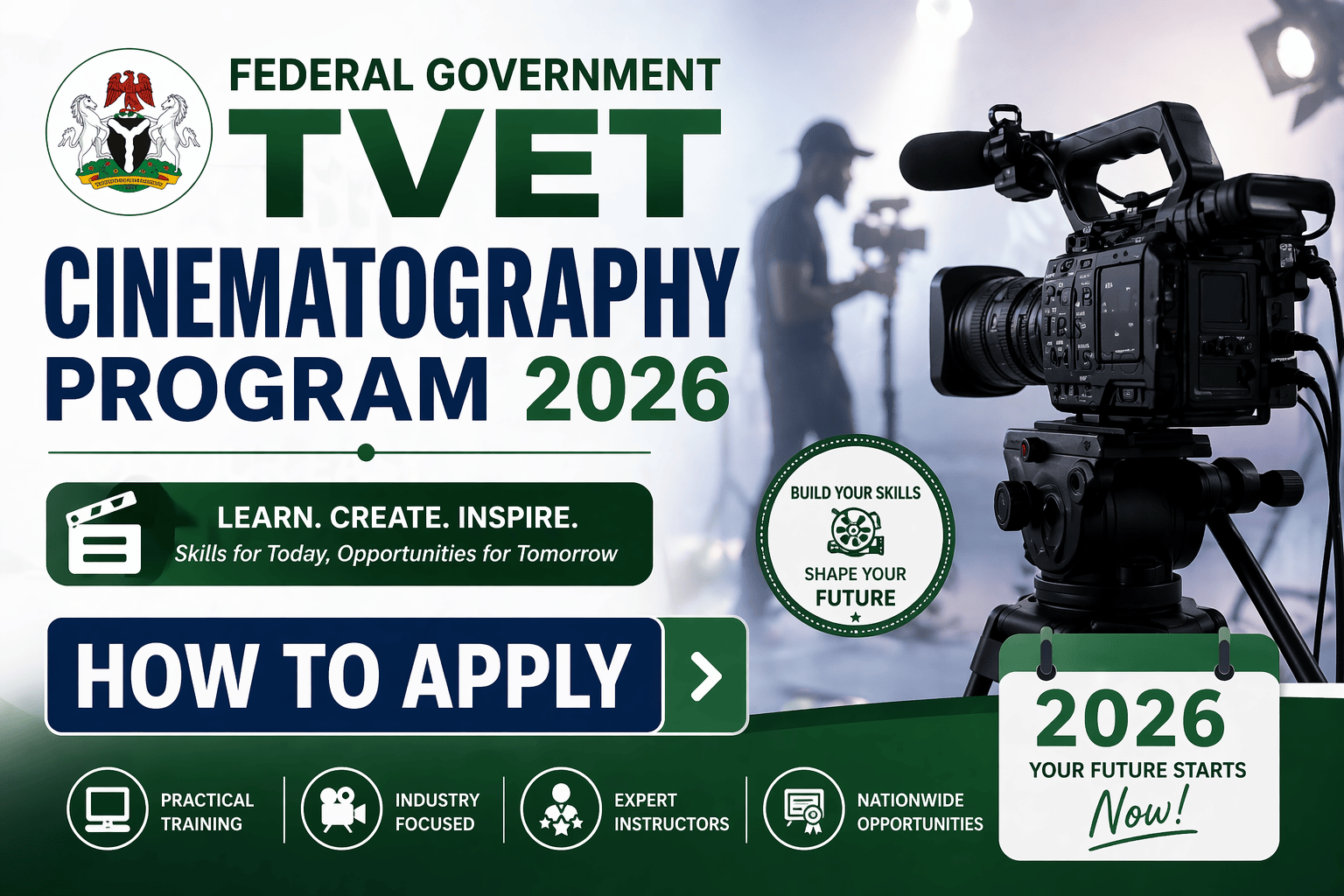
Federal Government TVET Cinematography Program 2026: Your Gateway to a Cinematic Career
The allure of filmmaking, the magic of storytelling through visuals, and the power of the moving image have captivated audiences for over a century. For aspiring storytellers and visual artists, a career in cinematography offers a dynamic and rewarding path. Recognizing this burgeoning interest and the critical need for skilled professionals in the creative industries, the Federal Government is proud to announce the Federal Government TVET Cinematography Program 2026. This comprehensive initiative is designed to equip individuals with the technical expertise, creative vision, and industry-relevant knowledge to excel in the field of cinematography.
This blog post will delve deep into the Federal Government TVET Cinematography Program 2026, outlining its objectives, curriculum, eligibility criteria, and most importantly, how to apply. Whether you dream of capturing breathtaking landscapes, crafting intimate character portraits, or directing the visual flow of a blockbuster film, this program could be your launchpad to a fulfilling career.
Understanding Technical and Vocational Education and Training (TVET)
Before we dive into the specifics of the cinematography program, it’s essential to understand the philosophy behind Technical and Vocational Education and Training (TVET). TVET is a form of education that focuses on providing learners with the knowledge, skills, and competencies required for specific occupations or trades. Unlike purely academic programs, TVET emphasizes practical application, hands-on experience, and direct relevance to the demands of the job market.
The Federal Government’s commitment to TVET stems from its recognition that a skilled workforce is the bedrock of a thriving economy. By investing in TVET programs, the government aims to:
- Bridge the skills gap: Ensure that graduates possess the in-demand skills that industries are seeking.
- Promote self-employment and entrepreneurship: Empower individuals with the skills to create their own opportunities.
- Enhance employability: Equip individuals with the practical abilities that make them attractive to employers.
- Boost economic growth: Contribute to a more productive and competitive national economy.
The Federal Government TVET Cinematography Program 2026 is a prime example of this commitment, directly addressing the growing demand for skilled cinematographers in film, television, advertising, and digital media production.
The Vision Behind the Federal Government TVET Cinematography Program 2026
The 2026 Cinematography Program is more than just a training course; it’s a strategic investment in the future of the nation’s creative industries. The program’s core vision is to:
- Cultivate a new generation of skilled cinematographers: Produce graduates who are not only technically proficient but also possess a strong artistic sensibility and a deep understanding of visual storytelling.
- Elevate the quality of local productions: By providing high-caliber training, the program aims to improve the overall aesthetic and technical quality of films, television shows, and other visual media produced within the country.
- Foster innovation in filmmaking: Encourage graduates to explore new techniques, technologies, and approaches to cinematography, pushing the boundaries of visual expression.
- Create viable career pathways: Offer a structured and recognized qualification that opens doors to employment and freelance opportunities within the burgeoning creative sector.
- Promote cultural storytelling: Empower individuals to tell their unique stories through the powerful medium of film, contributing to the richness and diversity of national culture.
What to Expect: The Curriculum of the TVET Cinematography Program
The Federal Government TVET Cinematography Program 2026 has been meticulously designed to provide a comprehensive and immersive learning experience. The curriculum will strike a balance between theoretical understanding and practical application, ensuring that graduates are well-rounded professionals. Key areas of study will include:
H3: Foundational Cinematography Principles
- Introduction to the Camera: Understanding different camera types, sensor sizes, lenses, and their impact on image quality.
- Exposure Control: Mastering aperture, shutter speed, ISO, and their interplay in achieving desired exposure and creative effects.
- Focus and Depth of Field: Techniques for achieving sharp focus, manipulating depth of field for artistic emphasis, and understanding the role of focus pullers.
- Composition and Framing: Principles of visual storytelling through shot selection, framing, rule of thirds, leading lines, and other compositional techniques.
- Lighting Fundamentals: Understanding the nature of light, its properties (intensity, direction, color temperature), and basic lighting setups (three-point lighting, etc.).
H3: Advanced Cinematographic Techniques
- Advanced Lighting Techniques: Exploring complex lighting scenarios, using different light modifiers, and understanding the psychological impact of light.
- Camera Movement and Stabilization: Mastering techniques like dolly, crane, Steadicam, gimbal operation, and understanding their narrative function.
- Color Theory and Grading: Understanding the principles of color, its emotional impact, and the basics of color correction and grading to achieve specific visual styles.
- Lens Choice and Usage: Selecting appropriate lenses for different shots and narratives, understanding focal lengths, and their impact on perspective.
- Aspect Ratios and Screen Formats: Understanding various screen formats and their implications for composition and storytelling.
H3: Storytelling and Visual Language
- Narrative Structure and Visuals: How cinematography supports and enhances the narrative.
- Developing a Visual Style: Exploring different aesthetic approaches and how to translate a director’s vision into compelling visuals.
- Working with Directors and Production Teams: Understanding collaboration, communication, and interpreting creative briefs.
- Shot Listing and Storyboarding: Practical skills in planning shots and visualizing scenes.
H3: Technical Skills and Equipment Proficiency
- Camera Operation and Maintenance: Hands-on experience with a range of professional cinema cameras and accessories.
- Grip and Electric Department Basics: Understanding the roles and equipment of the grip and electric departments, essential for cinematography.
- Introduction to Sound Recording: Basic principles of on-set sound recording and its relationship with cinematography.
- Digital Workflow and Data Management: Understanding file formats, codecs, and best practices for managing digital footage.
H3: Industry Practices and Professional Development
- Film Production Workflow: Understanding the stages of film production from pre-production to post-production.
- Health and Safety on Set: Essential knowledge for working safely in a film production environment.
- Portfolio Development: Guidance on creating a compelling showreel and portfolio to showcase skills.
- Industry Networking and Career Opportunities: Insights into the film and television industry, and strategies for building a career.
Program Structure and Duration
The Federal Government TVET Cinematography Program 2026 is designed to be intensive and practical. While specific details may vary slightly by institution, the program is generally structured as follows:
- Duration: Typically, the program will be a full-time course, likely spanning 12 to 18 months, depending on the depth and breadth of the curriculum.
- Delivery Method: A blend of theoretical lectures, practical workshops, studio sessions, and on-location shooting exercises.
- Assessment: A combination of practical assignments, technical tests, project work, portfolio development, and potentially a final graduation film project.
- Internship/On-the-Job Training: A crucial component will be a period of supervised internship or on-the-job training with established production houses or film studios, providing invaluable real-world experience.
Eligibility Criteria: Who Can Apply?
The Federal Government TVET Cinematography Program 2026 aims to be accessible to a wide range of aspiring individuals. While specific requirements will be detailed in the official application guidelines, general eligibility criteria are expected to include:
- Age: Applicants must typically be within a specified age range, usually 18 to 35 years old, to ensure they are of legal working age and can undertake the physical demands of the profession.
- Educational Qualification: A minimum educational qualification, such as a Senior Secondary Certificate Examination (SSCE) or its equivalent, will likely be required. Some programs might prefer candidates with a background in arts, media, or related fields, but this is not always mandatory.
- Passion and Aptitude: While not always formally tested, a demonstrable passion for filmmaking, visual arts, and storytelling will be a significant advantage. Applicants may be asked to submit a portfolio of creative work or undergo an aptitude test.
- Citizenship/Residency: Applicants must be citizens or legal residents of the country where the program is being offered.
- Physical Fitness: Cinematography can be physically demanding, involving long hours, carrying equipment, and working in various environments. Applicants should be in good general health.
- Language Proficiency: Proficiency in the national language of instruction will be essential.
Specific details regarding any required prior experience or specific academic subjects will be clearly outlined in the official program announcement.
How to Apply: Your Step-by-Step Guide
Applying for the Federal Government TVET Cinematography Program 2026 is a structured process designed to identify motivated and capable individuals. While the exact application portal and deadlines will be announced, here is a general step-by-step guide on how to apply:
Step 1: Stay Informed and Identify Application Channels
- Official Government Websites: The primary source of information will be the official websites of the Ministry of Education, Ministry of Information and Culture, or the relevant TVET authority. Keep an eye on these portals for announcements regarding the program launch and application period.
- News Outlets and Public Announcements: Official announcements will also be made through national newspapers, radio, and television.
- TVET Institutions: Reputable TVET institutions that are accredited to offer the program will also publish information on their websites and campuses.
Step 2: Review the Official Program Announcement and Guidelines
- Download the Prospectus/Brochure: Once the program is announced, a detailed prospectus or brochure will be made available. This document is crucial and will contain all the essential information, including:
- Specific program objectives
- Detailed curriculum breakdown
- Exact eligibility criteria
- Application deadlines
- Required supporting documents
- Application fees (if any)
- Selection process details
- List of participating institutions
- Read Carefully: Thoroughly read and understand all the guidelines before proceeding with the application.
Step 3: Gather Required Documents
Based on the program guidelines, you will likely need to prepare the following documents. It’s advisable to start gathering these early:
- Proof of Identity: National Identity Card or Passport.
- Educational Certificates: Copies of your SSCE certificate or equivalent, along with transcripts.
- Passport-Sized Photographs: Recent photographs meeting specific size and background requirements.
- Proof of Residence: A utility bill or similar document to verify your address.
- Birth Certificate: To confirm your age.
- Portfolio (if required): This could include photographs, short films, scripts, or any other creative work that demonstrates your visual aptitude and passion for storytelling.
- Letters of Recommendation (if required): From teachers, mentors, or employers who can attest to your character and potential.
- Application Fee Payment Slip (if applicable): Proof of payment for any application processing fees.
CAC Registration Process 2026: Your Easy Step-by-Step Guide
Get Your DUNS Number in Nigeria2026: Step-by-Step Registration Guide
Realme C81 Leak Reveals Memory, Storage, and Color Options
Step 4: Complete the Application Form
- Online Application Portal: Most government programs now utilize online application portals. You will need to create an account and fill out the application form accurately and completely.
- Offline Application: In some cases, a physical application form might be available for download or pick-up from designated centers.
- Accuracy is Key: Double-check all information entered on the form before submission. Incomplete or inaccurate information can lead to disqualification.
Step 5: Submit Your Application
- Online Submission: If applying online, follow the instructions to upload your supporting documents and submit the completed application form before the deadline.
- Physical Submission: If applying offline, ensure you submit the completed form and all required documents to the designated application submission center by the specified deadline. Keep a copy of your submitted application for your records.
Step 6: Await Selection and Entrance Examination/Interview
- Shortlisting: After the application period closes, applications will be reviewed, and eligible candidates will be shortlisted.
- Entrance Examination: Many TVET programs include an entrance examination to assess candidates’ aptitude, general knowledge, and basic understanding of relevant subjects.
- Interview: Shortlisted candidates may be invited for an interview to assess their motivation, communication skills, and suitability for the program. This is also an opportunity for you to ask questions.
- Portfolio Review: If a portfolio was submitted, it will likely be reviewed as part of the selection process.
Step 7: Admission and Enrollment
- Admission Notification: Successful candidates will be notified of their admission through official channels (email, SMS, or postal mail).
- Acceptance and Enrollment: You will need to formally accept the offer of admission and complete the enrollment process by paying tuition fees (if any) and submitting any remaining required documents by the given deadline.
- Orientation: Attend any mandatory orientation sessions to familiarize yourself with the institution, program structure, and fellow students.
Why Choose the Federal Government TVET Cinematography Program?
Investing your time and effort into this program offers several distinct advantages:
- Government Endorsement and Recognition: A program backed by the federal government carries significant weight and ensures a standardized, high-quality curriculum.
- Affordability: Government-sponsored TVET programs are often more affordable than private institutions, making quality education accessible to a wider population.
- Industry-Relevant Curriculum: The program is designed in consultation with industry experts, ensuring that the skills taught are directly applicable to the current demands of the film and television sector.
- Access to Resources: Participating institutions are likely to be equipped with modern cinematography equipment and facilities, providing hands-on experience with industry-standard tools.
- Networking Opportunities: The program fosters connections with instructors who are often industry professionals, as well as fellow students who will become your future collaborators.
- Clear Career Pathways: The structured curriculum and practical training are geared towards preparing graduates for immediate employment or freelance opportunities.
- Contribution to National Development: By becoming a skilled cinematographer, you contribute to the growth of the creative economy and the rich tapestry of national storytelling.
The Future of Cinematography and Your Role
The world of cinematography is constantly evolving, driven by technological advancements and innovative storytelling techniques. From the advent of digital cinema and advanced visual effects to the rise of streaming platforms and diverse content creation, the demand for skilled cinematographers is only set to grow.
The Federal Government TVET Cinematography Program 2026 is designed to equip you with the foundational knowledge and adaptability to thrive in this dynamic landscape. You will learn not only the traditional art of filmmaking but also the emerging technologies and workflows that define modern visual production.
As a graduate of this program, you could find yourself working as:
- Director of Photography (DP): Leading the visual aspect of a film or television production.
- Camera Operator: Operating the camera on set.
- First Assistant Camera (Focus Puller): Responsible for maintaining focus during shots.
- Second Assistant Camera (Clapper Loader): Managing camera equipment and logging shots.
- Gaffer: Chief lighting technician.
- Grip: Responsible for camera support and rigging.
- Steadicam Operator: Specializing in smooth, flowing camera movements.
- Freelance Cinematographer: Working on various projects for different clients.
- Visual Effects Cinematographer: Specializing in VFX integration.
Conclusion: Seize Your Cinematic Opportunity
The Federal Government TVET Cinematography Program 2026 represents a significant opportunity for individuals passionate about visual storytelling and filmmaking. It’s a chance to acquire in-demand skills, gain practical experience, and embark on a rewarding career in a vibrant and growing industry.
By understanding the program’s objectives, curriculum, and eligibility criteria, and by meticulously following the application process outlined above, you can position yourself to be a part of this exciting initiative. Remember to stay informed, gather your documents diligently, and submit your application with care.
Your journey into the captivating world of cinematography begins with a single step. Make sure that step is towards applying for the Federal Government TVET Cinematography Program 2026. Your cinematic dreams are within reach.