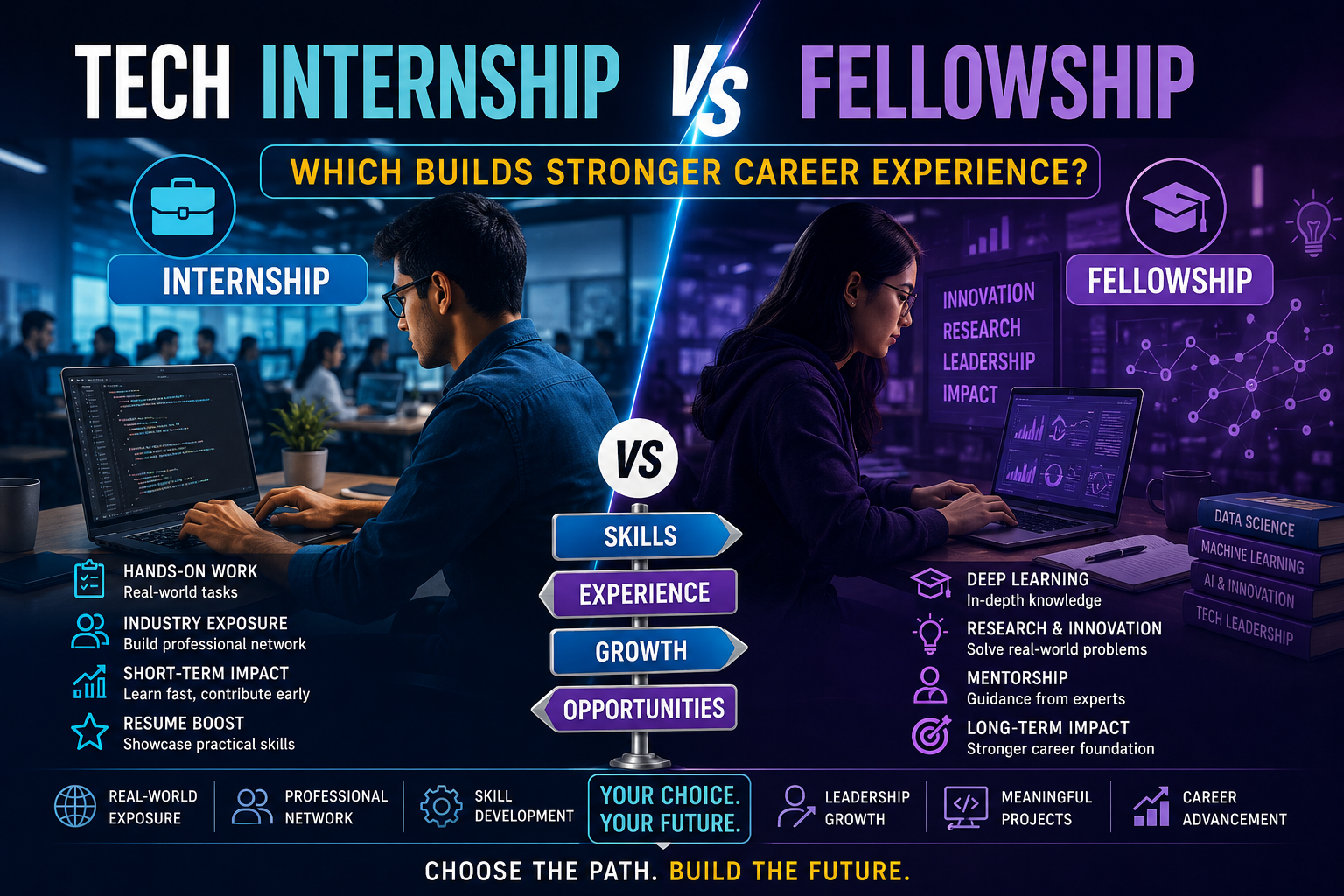
Tech Internship Programs vs Fellowship Opportunities: Which Helps Build Stronger Experience?
The path to a successful career in technology is no longer linear. A decade ago, the formula was straightforward: earn a computer science degree, secure a summer internship at a recognizable tech company, and transition into a full-time software engineering or product role.
Today, the early-career landscape is far more diverse—and competitive. While traditional tech internships remain a cornerstone of professional development, tech fellowships have emerged as a powerful alternative. Programs like the Major League Hacking (MLH) Fellowship, the Kleiner Perkins Fellowship, and various open-source or civic tech fellowships now compete directly for the industry’s top talent.
For students, self-taught developers, bootcamp graduates, and career switchers, this abundance of choice raises a critical question: Which pathway builds stronger, more marketable experience?
To answer this, we must look beyond the prestige of brand names and analyze how each model shapes your technical skills, professional network, portfolio, and long-term career trajectory.
1. Defining the Models: Internships vs. Fellowships
Before comparing their impact, we must establish clear definitions. While both pathways offer hands-on learning, their structural blueprints, funding models, and core philosophies differ significantly.
+------------------------+------------------------------------------+------------------------------------------+
| Feature                | Tech Internship Programs                 | Tech Fellowship Opportunities            |
+------------------------+------------------------------------------+------------------------------------------+
| Core Focus             | Integration into an existing company     | Project-based learning, research, or     |
|                        | workflow and corporate environment.      | open-source contribution.                |
+------------------------+------------------------------------------+------------------------------------------+
| Primary Deliverable    | Shipped features, bug fixes, or internal | Open-source code, research papers,       |
|                        | tools for a specific employer.           | prototypes, or community-driven products.|
+------------------------+------------------------------------------+------------------------------------------+
| Mentorship Structure   | 1:1 manager or "buddy" within a team.    | Cohort-based, with industry mentors,     |
|                        |                                          | advisors, and peer-to-peer learning.     |
+------------------------+------------------------------------------+------------------------------------------+
| Typical Duration       | 10 to 12 weeks (usually summer).         | Highly variable (8 weeks to 1 year).     |
+------------------------+------------------------------------------+------------------------------------------+
| Primary Outcome        | Direct return offer for full-time employment.| Broad industry network, portfolio piece, |
|                        |                                          | or entrepreneurial launchpad.            |
+------------------------+------------------------------------------+------------------------------------------+
What is a Tech Internship?
A tech internship is a temporary employment arrangement, typically lasting 10 to 12 weeks during the summer. Interns are embedded directly into an engineering, product, or design team within a single company.
The primary goal of an internship program is mutual evaluation: the company assesses the intern’s technical capabilities and cultural fit, while the intern evaluates the company’s work environment. The ultimate success metric for most internships is a return offer—either for another internship or a full-time position upon graduation.
What is a Tech Fellowship?
A tech fellowship is a competitive, cohort-based program that focuses on professional development, specialized project work, or research. Fellowships are often sponsored by venture capital firms, non-profit foundations, educational organizations, or consortiums of tech companies.
Rather than working as a standard employee, fellows often work on open-source software, build independent projects, conduct research, or rotate across multiple startups. The primary goal of a fellowship is talent incubation and leadership development, with a heavy emphasis on community, mentorship, and portfolio building.
2. Technical Skill Acquisition: Depth vs. Breadth
The strength of your technical experience is directly tied to the code you write, the systems you design, and the tools you master. Both internships and fellowships build technical competence, but they do so through different architectural lenses.
How Internships Build Technical Depth
Internships excel at teaching you how software is built at scale within a commercial environment. When you join an engineering team at a company like Stripe, Microsoft, or a mid-sized SaaS startup, you are introduced to:
- Legacy Codebases: You learn to navigate, debug, and extend codebases that have been written by hundreds of engineers over several years.
- Production Workflows: You gain hands-on experience with continuous integration and continuous deployment (CI/CD) pipelines, automated testing suites, and rigorous code review processes.
- Enterprise Tooling: You work with industry-standard monitoring, logging, and cloud infrastructure tools (e.g., Datadog, AWS, Kubernetes) that are rarely used in academic or personal projects.
The Trade-off: Interns are often assigned highly scoped, low-risk projects. You might spend ten weeks building a single internal dashboard or migrating a minor service. While you learn how a massive engineering organization operates, your creative agency and architectural ownership may be limited.
How Fellowships Build Technical Breadth and Autonomy
Fellowships, particularly those focused on open-source or rapid prototyping, prioritize “zero-to-one” development and deep technical autonomy. For example, in the MLH Fellowship, fellows contribute directly to major open-source projects like React, Jest, or Flask.
- Architectural Ownership: Fellows are often responsible for designing systems from scratch. You aren’t just fixing bugs; you are making high-level decisions about database schemas, API design, and state management.
- Diverse Tech Stacks: Because fellowships are project-centric rather than company-centric, you may work across multiple languages, frameworks, and paradigms over the course of a single program.
- Public-Facing Portfolios: The code you write during an open-source or project-based fellowship is public. You can link directly to your pull requests on GitHub, allowing future employers to see exactly how you write code, document your work, and interact with other contributors.
The Trade-off: Fellowships can sometimes lack the operational discipline of a corporate engineering team. If your fellowship does not emphasize strict testing, code reviews, or agile methodologies, you may develop self-taught habits that require correction when you enter a traditional corporate environment.
3. Mentorship and the Support Ecosystem
Technical growth does not happen in a vacuum. The quality of guidance you receive can accelerate your career by years.
         [Corporate Internship]                  [Cohort Fellowship]

          +------------------+                  +------------------+
          |  Hiring Manager  |                  | Industry Mentors |
          +--------+---------+                  +--------+---------+
                   |                                     |
         +---------v---------+                  +--------v---------+
         |  Direct Mentor /  |                  |  Global Cohort   |
         |   "Buddy" (1:1)   |                  |   Peer Network   |
         +---------+---------+                  +--------+---------+
                   |                                     |
         +---------v---------+                  +--------v---------+
         |   Internal Team   |                  | Specialized Tech |
         |   Siloed Focus    |                  | Ecosystem Access |
         +-------------------+                  +------------------+
The Internship Mentorship Model: Structured and Siloed
In an internship, you are typically assigned a direct mentor (often called an “intern buddy”) and a hiring manager.
- The Advantage: This mentorship is highly tactical. Your mentor helps you set up your local development environment, explains the nuances of the company’s proprietary systems, and provides feedback on your pull requests. This mirrors the exact relationship you will have as a junior engineer.
- The Disadvantage: Your mentorship is confined to the boundaries of your team and company. If your manager is busy or lacks strong coaching skills, your learning experience can suffer significantly. Furthermore, the advice you receive is often optimized for success within that specific company, rather than the industry at large.
The Fellowship Mentorship Model: Networked and Holistic
Fellowships leverage a cohort-based model, connecting you with a diverse web of mentors, industry leaders, and peers.
- The Advantage: A fellowship cohort acts as a professional accelerator. For instance, in the Kleiner Perkins Fellowship, you are mentored not just by engineers at your host startup, but also by venture capitalists, founders, and product executives across the entire KP portfolio. You receive career coaching, architectural advice, and leadership training that spans multiple industries.
- The Disadvantage: Mentorship in fellowships is often less hands-on when it comes to daily coding struggles. You are expected to be highly self-directed; mentors are there to guide your high-level strategy, not to help you debug a syntax error at 2:00 AM.
4. Career Trajectory: The “Return Offer” vs. “The Golden Ticket”
Ultimately, both experiences are investments in your future employability. However, they position you for the job market in fundamentally different ways.
Internships: The Direct Pipeline to Conversion
The primary business objective of a corporate internship program is recruitment. Companies invest heavily in interns because it is the most reliable way to source entry-level talent.
- The Conversion Rate: At major tech companies, conversion rates (the percentage of interns who receive full-time return offers) regularly exceed 60% to 70%.
- The De-risked Job Search: If you perform well during your summer internship, you can secure a full-time job offer by August of your senior year. This eliminates the stress of senior-year job hunting and technical interviewing.
- The Brand Equity: Having a brand-name internship (e.g., Google, Uber, Airbnb) on your resume acts as a permanent stamp of approval. It signals to all future recruiters that you have passed a highly competitive screening process and worked within a world-class engineering environment.
Fellowships: The Multi-Directional Launchpad
Fellowships rarely offer a direct, single-track path to a specific full-time role. Instead, they act as a “golden ticket” that opens doors across an entire ecosystem.
- Access to Elite Networks: Fellowships are highly prestigious and selective. Being named a Thiel Fellow, a Coding It Forward Fellow, or an MLH Fellow instantly distinguishes you from the sea of standard applicants.
- Entrepreneurial and Venture Opportunities: If your goal is to found a startup, join an early-stage team, or work in venture capital, a fellowship is vastly superior to a corporate internship. You are plugged directly into funding networks, pitch competitions, and founder communities.
- Flexibility Across Companies: Instead of being locked into a return offer with one company, fellowship alumni networks (like those of the Neo Fellowship or Pear VC Fellowship) actively help you secure interviews at dozens of top-tier startups and tech giants simultaneously.
5. Comparative Case Studies: When to Choose Which
To make this choice concrete, let’s analyze three common profiles of early-career tech professionals and evaluate which pathway offers the stronger experience for each.
Case Study A: The Traditional Computer Science Student
- Profile: A junior majoring in Computer Science at a state university. They have a solid GPA, know their data structures and algorithms, and want a stable, high-paying software engineering role at a mid-to-large-sized tech company upon graduation.
- The Verdict: Choose the Tech Internship.
- Why: For this profile, the structured pipeline of a corporate internship is unmatched. The primary goal is to secure a return offer and get a recognizable brand on their resume. The specialized, self-directed nature of a fellowship is an unnecessary risk when a standard software engineering internship at a company like Salesforce or Adobe provides a direct, well-paved road to a six-figure starting salary.
Case Study B: The Non-Traditional Developer or Career Switcher
- Profile: A self-taught developer or bootcamp graduate with a background in marketing. They have built several personal projects but struggle to get past automated resume screening tools because they lack a formal CS degree.
- The Verdict: Choose the Tech Fellowship.
- Why: Traditional corporate internship programs are notoriously difficult to access without a university affiliation; many explicitly require applicants to be enrolled in an active degree program. Fellowships (especially open-source programs like the MLH Fellowship or Outreachy) are far more inclusive. They evaluate applicants based on code portfolios and raw drive rather than university pedigree. Contributing to major open-source projects during a fellowship provides these candidates with public, verifiable, enterprise-grade code contributions that prove they can perform at a professional level.
Case Study C: The Aspiring Founder or R&D Specialist
- Profile: An undergraduate student working on novel machine learning models or dreaming of launching their own SaaS startup. They find corporate bureaucracy stifling and want to maximize their creative freedom and network.
- The Verdict: Choose the Tech Fellowship.
- Why: A traditional internship will likely relegate this student to maintaining existing enterprise code, which can stifle their entrepreneurial drive. A fellowship like the Kleiner Perkins, Neo, or Thiel Fellowship will surround them with venture capitalists, founders, and brilliant peers who can become co-founders, advisors, or early investors. The autonomy of a fellowship allows them to build, iterate, and ship novel technology rather than optimizing a legacy database query.
6. The Hybrid Approach: How to Combine Both for Maximum Impact
You do not necessarily have to choose one over the other. In fact, the most competitive candidates often leverage both pathways at different stages of their educational or early-career journeys.
Here is a highly effective, multi-year roadmap that combines the strengths of both models:
[Year 1-2: Exploration]  -->  [Year 2-3: Acceleration]  -->  [Year 3-4: Consolidation]

  MLH or Open-Source            Elite Fellowship              Big Tech Internship
     Fellowship                   (e.g., KP, Neo)             or High-Growth Startup
  (Builds public code,          (Builds elite network,        (Secures return offer,
   portfolio, & confidence)      broad industry exposure)      validates scale skills)
Phase 1: The Early-Stage Fellowship (Years 1 & 2)
In your freshman or sophomore year of college (or the first six months of your self-taught journey), securing a traditional corporate internship is incredibly difficult due to lack of experience.
- Strategy: Apply for open-source and project-based fellowships. These programs act as an on-ramp. They teach you Git workflows, collaborative coding, and system design in a supportive environment. The public contributions you make here will make your resume stand out dramatically when you apply for roles the following year.
Phase 2: The Prestigious Network Fellowship (Year 3)
As you gain technical confidence, target fellowships sponsored by venture capital firms or elite tech organizations.
- Strategy: Participate in a program that exposes you to high-growth startups, founders, and executive mentorship. This builds your industry context, refines your soft skills, and expands your professional network beyond your local region.
Phase 3: The Corporate or High-Growth Internship (Year 4 / Prior to Graduation)
With a robust public portfolio and an elite network already established, you are now a prime candidate for the most competitive internship programs in the world.
- Strategy: Secure a summer internship at a high-growth startup or tech giant. Use this period to master enterprise-scale engineering, understand corporate dynamics, and secure a high-paying full-time return offer. You enter the internship not as a novice, but as an experienced developer who has already shipped production-grade code and navigated complex technical ecosystems.
Conclusion: Which Builds Stronger Experience?
The question of whether a tech internship or a fellowship builds “stronger” experience ultimately depends on how you define strength in the context of your personal career goals.
- Choose a Tech Internship if your priority is structural stability, corporate validation, and a direct path to a full-time role. Internships build deep, specialized technical skills within established engineering ecosystems. They teach you how to be a highly effective cog in a massive, successful machine.
- Choose a Tech Fellowship if your priority is technical autonomy, public portfolio building, and access to an elite, multi-directional professional network. Fellowships build broad, versatile technical skills and foster an entrepreneurial mindset. They teach you how to build the machine itself.
By understanding the unique architectural blueprints of both pathways, you can strategically navigate your early career—building a resume that is not only technically formidable but perfectly aligned with the future you want to create.