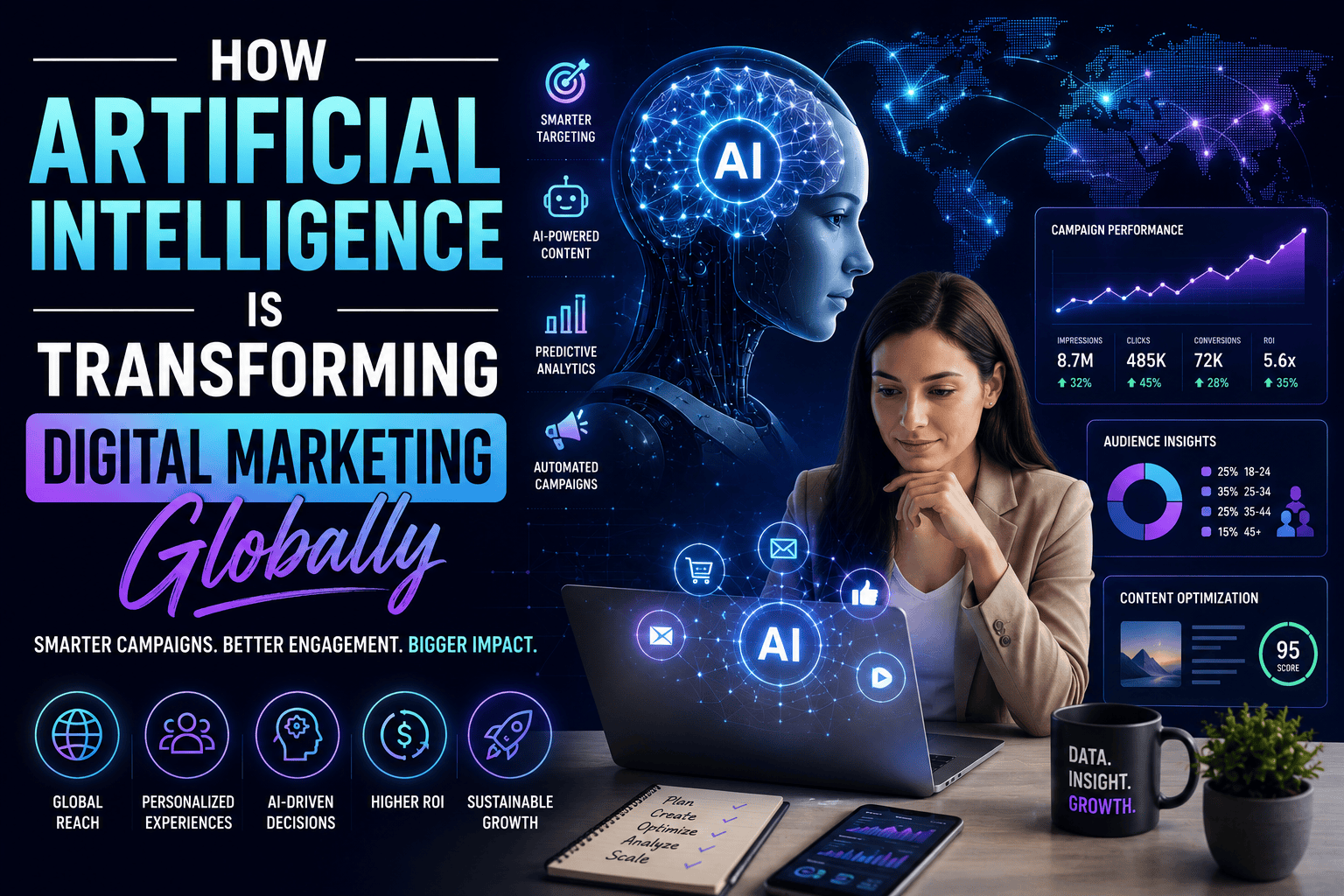
How Artificial Intelligence Is ReshapingDigital Marketing Worldwide
Introduction
Artificial intelligence (AI) has moved from a futuristic concept to a core driver of modern digital marketing. From hyper‑personalized recommendations to automated ad bidding, AI technologies are reshaping how brands attract, engage, and retain customers across every continent. This article explores the most impactful ways AI is transforming digital marketing, illustrates real‑world examples, and examines the challenges that accompany rapid adoption. By the end, readers will understand not only where AI is headed but also how marketers can harness its power responsibly and effectively.
The AI Landscape in Digital Marketing
The past five years have witnessed an explosion of AI‑enabled tools. Machine‑learning models can now process massive datasets in real time, natural‑language generation (NLG) can produce blog drafts, and computer vision can tag images at scale. According to a 2023 industry survey, 68 % of marketers worldwide report using AI for at least one core function, and 42 % claim AI has directly increased their ROI. These figures illustrate a shift from experimental pilots to enterprise‑wide integration.
Key drivers of this transformation include:
- Data abundance – The proliferation of digital touchpoints generates terabytes of structured and unstructured data daily.
- Computational advances – Cloud providers and specialized hardware (e.g., GPUs, TPUs) make training complex models affordable.
- Maturing frameworks – Open‑source libraries such as TensorFlow, PyTorch, and Hugging Face lower the barrier to entry for developers and marketers alike.
Together, these forces enable AI to move beyond simple automation into strategic decision‑making, reshaping the entire marketing funnel.
Key Areas of Transformation
Personalization at Scale
Personalization has evolved from simple “first name” email greetings to dynamic, context‑aware experiences that adapt to each user in real time. AI models analyze browsing history, purchase patterns, social signals, and even sentiment from reviews to generate individualized product recommendations.
- Example: A global fashion retailer uses a recommendation engine powered by collaborative filtering and deep learning to present outfit suggestions that change based on the visitor’s current weather, location, and trending styles. The system increased average order value by 18 % and reduced bounce rates by 12 %.
- Implementation tip: Start with rule‑based segmentation, then layer in AI‑driven predictive models to refine messaging as data matures.
Predictive Analytics and Customer Insights
Predictive analytics leverages historical data to forecast future behaviors, such as churn probability, lifetime value, or likelihood to convert after a campaign. AI‑enhanced predictive models outperform traditional statistical methods by capturing non‑linear relationships and high‑dimensional interactions.
- Case study: A telecommunications company built a churn‑prediction model using gradient‑boosted trees, achieving a 0.87 AUC score. By targeting at‑risk customers with personalized retention offers, the firm reduced churn by 9 % within six months, saving an estimated $4.2 million in recurring revenue.
- Best practice: Combine predictive scores with explainable AI techniques (e.g., SHAP values) to surface actionable insights for non‑technical stakeholders.
Automated Content Creation
Generating blog posts, social captions, and ad copy manually is time‑consuming. AI‑driven natural‑language generation (NLG) tools can produce drafts, suggest headlines, and even tailor tone based on brand voice.
- Illustration: A news outlet deployed an AI writer to produce earnings‑report summaries for thousands of publicly traded companies. The system reduced content production time from hours to seconds, enabling the outlet to publish breaking financial news faster than competitors.
- Guideline: Use AI for first‑draft generation, then apply human editors to inject nuance, brand personality, and factual verification.
Programmatic Advertising and Real‑Time Bidding
Programmatic advertising automates the buying, placement, and optimization of ad inventory through real‑time bidding (RTB) platforms. AI algorithms evaluate thousands of signals per impression to determine the optimal bid price, audience match, and creative variant.
- Metric: Brands that adopt AI‑optimized bidding strategies report a 25‑30 % lift in cost‑per‑acquisition (CPA) efficiency compared with manual bidding.
- Implementation: Integrate AI‑powered demand‑side platforms (DSPs) that support automated bidding rules, and continuously feed performance data back into the model for iterative improvement.
Chatbots and Conversational Marketing
Conversational AI, powered by large language models (LLMs), enables brands to engage customers 24/7 through chatbots, voice assistants, and messaging apps. These systems can answer FAQs, qualify leads, and even close sales without human intervention.
- Scenario: An e‑commerce site introduced a multilingual chatbot that handles order tracking, product recommendations, and returns. Within three months, the bot resolved 68 % of customer inquiries, freeing human agents to focus on high‑value interactions and reducing support costs by 35 %.
- Tip: Deploy hybrid models that combine rule‑based flows for predictable queries with LLM‑driven open‑ended conversations for complex interactions.
SEO and Voice Search Optimization
Search engines increasingly incorporate AI to understand user intent, context, and natural language queries. Voice assistants like Alexa and Google Assistant rely on conversational AI to deliver answers, making voice‑optimized content essential.
- Actionable step: Optimize for “question‑based” keywords, structure content with clear headings, and provide concise, factual answers that can be featured in rich snippets or voice responses.
- Result: Early adopters who aligned their SEO strategy with AI‑driven query patterns saw a 40 % increase in organic traffic from voice‑enabled devices within a year.
Global Impact and Regional Case Studies
- Humanoid Robots Drive the Future of Human-AI Collaboration
- Top AI Startups Transforming Healthcareand Medical Research
- NIPEX Oil and Gas: 5 Essential Ways it Transforms Nigeria’s Industry
North America
In the United States, AI adoption is driven by mature data ecosystems and heavy investment in cloud infrastructure. Large enterprises such as Amazon and Netflix have set industry benchmarks for recommendation engines and content personalization, influencing smaller firms to follow suit. – Benchmark: Amazon’s “Customers who bought this also bought” algorithm contributes to roughly 35 % of its total sales, illustrating the financial impact of AI‑driven personalization.
Europe
European marketers leverage AI to navigate strict data‑privacy regulations while still delivering personalized experiences. GDPR compliance has spurred the development of privacy‑preserving techniques such as federated learning and differential privacy.
- Illustration: A German automotive brand uses federated learning to train customer‑segmentation models across regional dealerships without moving raw data, achieving accurate segmentation while staying compliant with GDPR.
Asia‑Pacific
The Asia‑Pacific region showcases rapid AI adoption, particularly in China and India, where mobile‑first consumer behavior fuels innovative use cases.
- Example: A Chinese streaming platform employs AI‑generated short‑form video captions in multiple dialects, increasing user engagement by 22 % among non‑native speakers.
- Trend: In India, AI‑powered vernacular content creation tools enable brands to launch localized campaigns at scale, reducing translation costs by up to 70 %.
Emerging Markets
In Africa and Latin America, AI is being applied to overcome infrastructure constraints and language diversity.
- Case: A Kenyan fintech startup uses AI to detect fraudulent transactions in real time, processing millions of micro‑transactions daily with a false‑positive rate below 0.5 %.
- Opportunity: AI‑driven market‑entry analytics help multinational brands identify high‑potential micro‑markets based on socio‑economic indicators and digital adoption rates.
Challenges and Ethical Considerations
Data Privacy
AI systems require extensive personal data, raising concerns about consent, storage, and misuse. Marketers must implement robust data‑governance frameworks, conduct regular privacy impact assessments, and adopt privacy‑by‑design principles.
Bias and Transparency
Machine‑learning models can inherit biases from training data, leading to discriminatory outcomes in ad targeting or content recommendation. Transparent model documentation, bias audits, and diverse data sources are essential to mitigate these risks.
Workforce Implications
Automation may displace certain routine tasks, but it also creates new roles focused on AI oversight, data ethics, and creative strategy. Upskilling employees and fostering a culture of human‑AI collaboration are critical for sustainable growth.
Model Explainability
Stakeholders often demand insight into how AI makes decisions, especially when budget allocations or customer experiences are affected. Techniques such as LIME, SHAP, and counterfactual analysis help translate complex model outputs into understandable narratives.
Future Outlook
Emerging Technologies
- Generative AI: Next‑generation models (e.g., GPT‑4, Gemini) will enable fully automated campaign ideation, creative asset generation, and even end‑to‑end marketing strategy simulation.
- Edge AI: Processing data on devices (e.g., smartphones, IoT sensors) will reduce latency, enhance privacy, and support real‑time personalization without sending data to the cloud.
- AI‑Driven Creative Analytics: Advanced computer‑vision models will assess visual ad performance at pixel level, recommending design tweaks that maximize engagement.
Integration with AR/VR and IoT
AI will increasingly fuse with immersive technologies to deliver contextual experiences. For instance, an AR shopping app could use AI to recommend products based on a user’s gaze, while IoT‑enabled home devices could trigger personalized offers when appliances are used. ### Sustainable Marketing Practices
AI can optimize media spend to reduce waste, lower carbon footprints, and promote eco‑friendly messaging. Predictive modeling of audience fatigue helps brands avoid over‑exposure, contributing to more sustainable consumption patterns.
Conclusion
Artificial intelligence is fundamentally reshaping digital marketing on a global scale. From hyper‑personalized customer journeys to AI‑optimized ad buying, the technology offers unprecedented efficiency, insight, and creative potential. However, success hinges on responsible implementation — balancing innovation with privacy, fairness, and human oversight. Marketers who master this balance will not only achieve superior performance metrics but also build trust and lasting relationships with increasingly discerning audiences. As AI continues to evolve, staying informed, experimenting responsibly, and embedding ethical safeguards will be the keystones of sustainable digital‑marketing success worldwide.