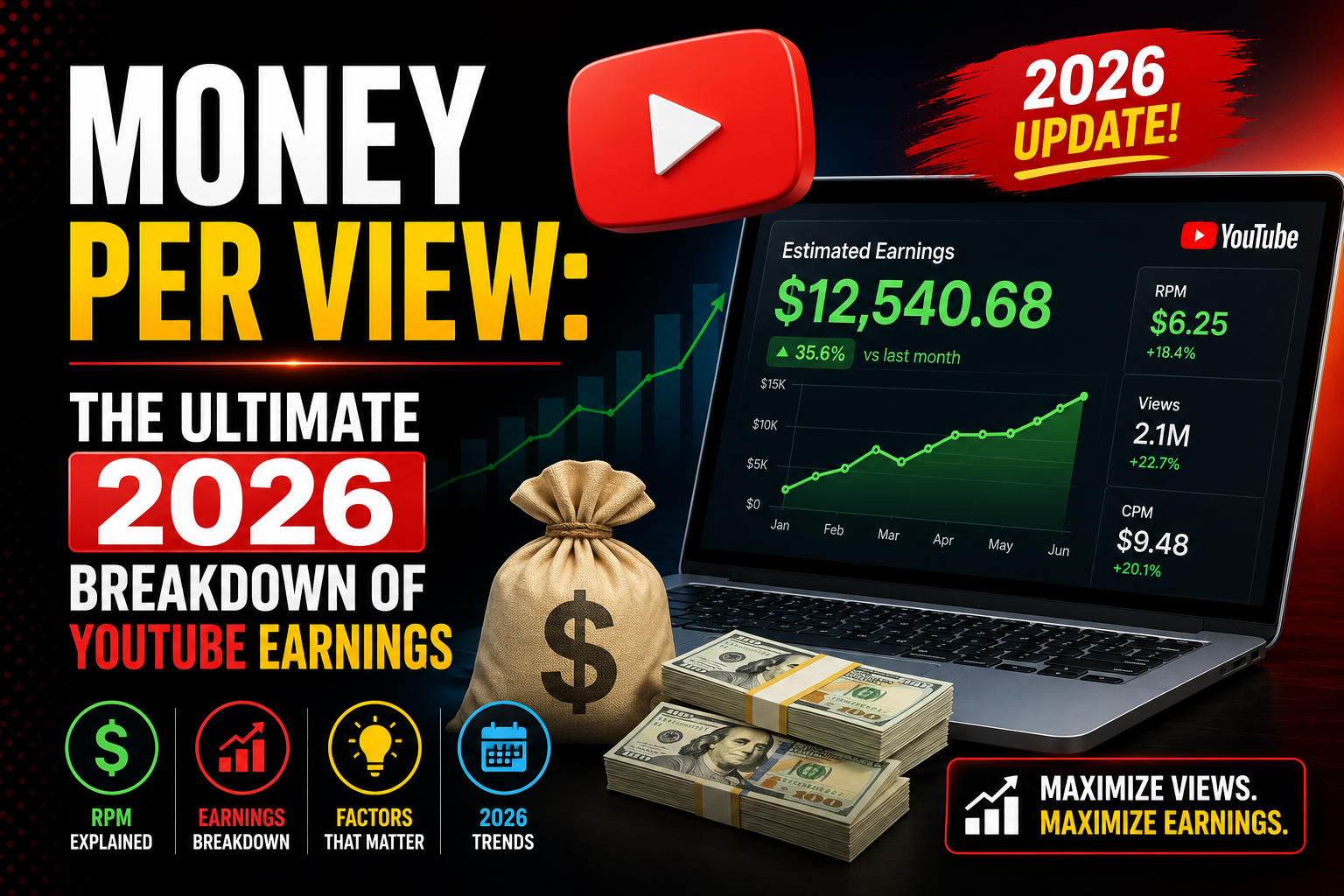
The dream of making money on YouTube is a powerful one, drawing millions of aspiring creators to the platform. Visions of viral videos and passive income often lead to a common, yet fundamentally flawed, question: how much money per view do you actually get on YouTube?
Table of Contents
While it’s tempting to think there’s a simple, fixed dollar amount tied to each view, the reality is far more complex. YouTube earnings are not a straightforward “per view” calculation. Instead, they are influenced by a dynamic interplay of factors, including audience demographics, content niche, ad formats, viewer engagement, and even the time of year.
Understanding these nuances is crucial for any creator looking to monetize their content effectively and build a sustainable income stream on YouTube. This comprehensive guide will demystify YouTube monetization, breaking down the key metrics, factors, and strategies that truly determine how much money you can earn.
The Myth of “Per View” Earnings
Let’s start by debunking the most common misconception: there is no universal “per view” rate on YouTube. If someone tells you they earn $X per 1,000 views, that figure is highly specific to their channel, their audience, and their content. It’s an average they’ve observed, not a fixed rate applied across the board.
The reason for this complexity lies in how YouTube’s advertising system works. YouTube uses a sophisticated auction-based model where advertisers bid to place their ads on videos. The price they’re willing to pay depends on who they want to reach, the type of ad, and the perceived value of the audience. This means that a view from a 45-year-old CEO in New York watching a financial advice video is far more valuable to an advertiser than a view from a 12-year-old watching a gaming compilation in a developing country.
Instead of a “per view” rate, YouTube creators need to understand two primary metrics: CPM and RPM.
Understanding Key YouTube Monetization Metrics
To truly grasp how YouTube earnings work, you must familiarize yourself with two core metrics: CPM and RPM. These are the closest you’ll get to a “per view” understanding, but they still represent averages over thousands of views, not individual ones.
CPM (Cost Per Mille/Thousand)
CPM stands for “Cost Per Mille,” where “Mille” is Latin for thousand. Essentially, CPM is the amount an advertiser pays for 1,000 ad impressions on YouTube.
- What it represents: CPM reflects the cost to advertisers. It’s the price tag for showing their ad 1,000 times on YouTube videos.
- Who pays it: Advertisers pay this to YouTube.
- What influences it: CPM varies significantly based on numerous factors, including:
- Niche/Content Category: Advertisers pay more for niches where viewers have higher purchasing power or are interested in high-value products/services (e.g., finance, real estate, tech reviews, B2B software).
- Audience Demographics: Viewers from affluent countries (e.g., USA, Canada, UK, Australia, Germany) command higher CPMs because advertisers are willing to pay more to reach them. Age, gender, and interests also play a role.
- Seasonality: Advertising budgets fluctuate throughout the year. Q4 (October-December) typically sees the highest CPMs due to holiday shopping, while Q1 (January-March) often has the lowest.
- Ad Format: Some ad formats (e.g., non-skippable in-stream ads) tend to have higher CPMs than others (e.g., display ads).
- Ad Placement: Ads placed strategically within longer videos (mid-roll ads) can sometimes fetch higher CPMs due to increased viewer engagement.
- Brand Safety: Advertisers are willing to pay more to place ads on content deemed “brand safe” and aligned with their values.
Example CPM Ranges:
- High CPM Niches (e.g., Finance, Business, Tech Reviews): $10 – $30+
- Medium CPM Niches (e.g., Lifestyle, Education, DIY): $5 – $15
- Lower CPM Niches (e.g., Gaming, Vlogs, Entertainment): $2 – $8
It’s important to remember that CPM is what advertisers pay, not what creators directly receive.
RPM (Revenue Per Mille/Thousand)
RPM stands for “Revenue Per Mille” or “Revenue Per Thousand Views.” This is the metric that truly matters to creators, as it represents the actual revenue you earn per 1,000 monetized views after YouTube takes its cut and other deductions.
- What it represents: RPM is your actual income per 1,000 views. It’s a more accurate reflection of your channel’s earning potential.
- Who receives it: The creator, after YouTube’s share.
- Why it’s lower than CPM: RPM is almost always lower than CPM for several reasons:
- YouTube’s Cut: YouTube takes a 45% share of the ad revenue generated from your videos. So, if an advertiser pays $10 CPM, YouTube keeps $4.50, and the creator gets $5.50 before other deductions.
- Non-Monetized Views: Not every view on your video will generate an ad impression. Viewers might use ad blockers, not all videos are eligible for ads, or ads simply might not be available for every viewer at every moment.
- Ad Blocker Usage: A significant portion of viewers use ad blockers, meaning ads are never shown, and no revenue is generated for those views.
- Skipped Ads: If an ad is skippable and a viewer skips it before a certain threshold, it might not count as a monetized impression.
- Viewers Not Logged In: Sometimes, ads aren’t served to viewers who aren’t logged into a Google account.
How RPM is calculated:
RPM = (Estimated Earnings / Monetized Playbacks) * 1000
Example RPM Ranges:
Given YouTube’s 45% cut and other factors, a realistic RPM for creators often falls into these ranges:
- High RPM Niches: $5 – $15+
- Medium RPM Niches: $2 – $8
- Lower RPM Niches: $0.50 – $4
Therefore, if your channel has an average RPM of $5, you would earn $5 for every 1,000 monetized views. If a video gets 100,000 monetized views, you’d earn approximately $500 from AdSense.
How YouTube Monetization Works (Beyond Views)
Understanding CPM and RPM is foundational, but it’s equally important to grasp the broader mechanics of how YouTube monetization functions.
YouTube Partner Program (YPP) Requirements
Before you can earn any ad revenue, you must be accepted into the YouTube Partner Program (YPP). The current requirements are:
- 1,000 Subscribers: A baseline audience for your channel.
- 4,000 Valid Public Watch Hours in the past 12 months (for long-form video) OR 10 Million Valid Public Shorts Views in the past 90 days (for YouTube Shorts).
- No Active Community Guideline Strikes: Your channel must be in good standing.
- AdSense Account: You need a linked and approved Google AdSense account to receive payments.
- Compliance with all YouTube Monetization Policies: This includes content guidelines, copyright policies, and advertiser-friendly content guidelines.
Ad Formats
The type of ads shown on your videos can impact your earnings. YouTube offers several formats:
- Skippable In-Stream Ads: Appear before, during (mid-roll), or after your video. Viewers can skip them after 5 seconds. These are common and generally have good CPMs.
- Non-Skippable In-Stream Ads: Appear before, during, or after your video and must be watched for a certain duration (usually 15-20 seconds) before the video can continue. These often have higher CPMs due to guaranteed viewership.
- Bumper Ads: Non-skippable ads up to 6 seconds long, appearing before your video.
- Overlay Ads: Semi-transparent ads that appear on the lower 20% portion of your video. Only available on desktop.
- Display Ads: Appear to the right of your video and above the suggestion list. Only available on desktop.
Ad Placement
Where ads appear within your video also matters:
- Pre-roll Ads: Play before your video starts.
- Mid-roll Ads: Play during your video. These are only available for videos 8 minutes or longer and are often the most lucrative because viewers are already engaged. Creators can manually place multiple mid-roll ads.
- Post-roll Ads: Play after your video ends.
Audience Engagement & Demographics
Advertisers pay for attention. The more engaged your audience is, the more valuable they are.
- Viewer Retention: How long viewers watch your videos. Higher retention means more opportunities for ads to be shown and watched.
- Click-Through Rates (CTR): For certain ad formats, if viewers click on an ad, it can increase its value.
- Geographic Location: As mentioned, viewers from countries with strong economies and high advertising spending (e.g., USA, Canada, UK, Australia, Germany, Nordic countries) generate significantly higher CPMs than viewers from developing nations.
- Age and Gender: Advertisers target specific age groups and genders. For instance, a luxury car brand might pay more to reach males aged 35-65, while a toy company targets parents of young children.
- Interests: YouTube’s algorithm understands viewer interests, allowing advertisers to target highly specific groups. If your audience is interested in topics with high advertising demand, your CPM/RPM will benefit.
Key Factors Influencing Your YouTube Money Per View Earnings
Let’s dive deeper into the specific elements that can swing your RPM from a few cents to several dollars per thousand views.
1. Niche/Content Category
This is arguably the most critical factor. Different content categories attract different types of advertisers with varying budgets.
- High-Value Niches:
- Finance & Investing: Personal finance, stock market, cryptocurrency, real estate. Advertisers include banks, investment firms, financial advisors, and trading platforms.
- Technology & Software: Tech reviews, software tutorials, B2B tech. Advertisers include electronics manufacturers, software companies, and SaaS providers.
- Business & Entrepreneurship: Marketing, startups, productivity. Advertisers target professionals and business owners.
- Health & Wellness (Specific Sub-Niches): Certain health products or services can attract high-paying advertisers.
- Medium-Value Niches:
- Education & DIY: Tutorials, skill-building, home improvement.
- Lifestyle & Beauty: Fashion, makeup, travel, vlogs (can vary widely).
- Lower-Value Niches:
- Gaming: While popular, gaming audiences often have lower purchasing power and high ad blocker usage.
- Kids’ Content: Heavily regulated, often lower CPMs due to COPPA (Children’s Online Privacy Protection Act) restrictions on data collection and targeted advertising.
- General Entertainment/Vlogs: Unless highly targeted, these can have broader, less valuable audiences for advertisers.
Impact: A channel in the finance niche might see RPMs of $10-$20, while a gaming channel with a similar number of views might only earn $2-$5.
2. Audience Demographics & Location
Where your viewers are from is paramount.
- Tier 1 Countries (Highest CPMs): United States, Canada, United Kingdom, Australia, Germany, Sweden, Norway, Switzerland, Netherlands. Advertisers pay top dollar to reach consumers in these affluent markets.
- Tier 2 Countries (Medium CPMs): Most of Western Europe, Japan, South Korea, New Zealand.
- Tier 3 Countries (Lower CPMs): India, Brazil, Mexico, Indonesia, and many developing nations. While these countries can bring high view counts, the ad revenue per view is significantly lower.
Impact: A channel with 80% US viewership will almost always have a higher RPM than a channel with 80% Indian viewership, even if the content niche is the same.
3. Seasonality
Advertising budgets are not constant throughout the year.
- Q4 (October, November, December): This is the peak season for advertisers due to holiday shopping (Black Friday, Cyber Monday, Christmas). CPMs are typically at their highest.
- Q1 (January, February, March): Often the lowest CPMs as advertisers reset budgets after the holiday spending spree.
- Q2 & Q3 (April-September): Generally stable, moderate CPMs, with some fluctuations around specific events or holidays.
Impact: Your earnings per 1,000 views can fluctuate by 20-50% or more between Q4 and Q1, even if your view count remains consistent.
4. Ad Blocker Usage
A significant portion of internet users employ ad blockers. If a viewer uses an ad blocker, no ad is displayed, and therefore no revenue is generated for that view.
Impact: While hard to quantify precisely, ad blockers can reduce potential ad revenue by 10-30% or more, depending on your audience’s tech savviness.
5. Video Length & Ad Density
Longer videos open up more monetization opportunities.
- Videos 8+ Minutes: These are eligible for mid-roll ads, which can be manually placed by the creator. Strategic placement of multiple mid-roll ads can significantly increase ad impressions and revenue.
- Shorter Videos: Only eligible for pre-roll and post-roll ads, limiting ad inventory.
Impact: A 15-minute video with 3-4 well-placed mid-roll ads will almost always earn more per view than a 5-minute video, assuming similar watch time percentages.
6. Viewer Engagement (Watch Time)
YouTube’s algorithm rewards videos that keep viewers engaged. Higher watch time means:
- More Ad Impressions: The longer someone watches, the more opportunities there are to show ads.
- Algorithm Boost: YouTube promotes videos with high watch time, leading to more views overall.
Impact: A video with a 50% average view duration will generate more ad revenue than a video with a 20% average view duration, even if they have the same initial click-through rate.
7. Channel Size & Authority
While not a direct CPM factor, larger, more established channels often attract premium advertisers who are willing to pay more for brand association and reach. They also tend to have more loyal, engaged audiences.
8. Content Quality & Brand Safety
Advertisers are increasingly conscious of where their ads appear. “Brand safe” content (non-controversial, family-friendly, positive) attracts more advertisers and higher bids. Content that is deemed inappropriate, hateful, or overly controversial may be demonetized or attract very low CPMs.
Beyond AdSense: Diversifying Your YouTube Income Streams
Relying solely on AdSense revenue (the money you get from ads) is often a mistake. For many creators, AdSense only accounts for a fraction of their total income. To build a sustainable and lucrative YouTube career, diversification is key.
1. Brand Deals & Sponsorships
This is often the most lucrative income stream for established creators. Brands pay creators directly to integrate their products or services into videos.
- How it works: Brands approach creators (or creators pitch to brands) for sponsored videos, dedicated reviews, product placements, or shout-outs.
- Earnings: Can range from a few hundred dollars for smaller channels to tens or hundreds of thousands for large channels, depending on audience size, engagement, and niche.
- Key: A highly engaged, niche audience is more valuable to brands than a massive, general audience.
2. Affiliate Marketing
Promoting products or services and earning a commission on sales made through your unique affiliate link.
- How it works: You recommend products you use and love, include an affiliate link in your video description, and earn a percentage of any sales generated through that link.
- Examples: Amazon Associates, specific software affiliate programs, online course platforms.
- Key: Authenticity is crucial. Only promote products you genuinely believe in.
3. Merchandise Sales
Selling branded products like t-shirts, hoodies, mugs, or custom items to your loyal fanbase.
- How it works: Use platforms like Teespring (now Spring), Shopify, or other e-commerce solutions.
- Key: Requires a strong brand identity and a highly engaged, loyal community willing to support you directly.
4. Channel Memberships
YouTube allows creators to offer monthly subscriptions to viewers for exclusive perks.
- How it works: Viewers pay a recurring fee (e.g., $4.99/month) for benefits like custom emojis, exclusive content, early access, or member-only live chats.
- Earnings: YouTube takes a cut (typically 30%), but the recurring nature can provide stable income.
5. Super Chat & Super Stickers
During live streams and Premieres, viewers can pay to have their comments highlighted (Super Chat) or send animated images (Super Stickers).
- How it works: Viewers pay varying amounts, and their message or sticker stands out in the chat.
- Key: Most effective for channels with active live stream audiences.
6. YouTube Premium Revenue
When YouTube Premium subscribers watch your content, you receive a portion of their subscription fee.
- How it works: This revenue is separate from ad revenue and is based on how much watch time Premium members contribute to your channel.
- Key: This is a bonus income stream that doesn’t require viewers to watch ads.
7. Digital Products/Services
Leveraging your expertise to create and sell your own digital products or services.
- Examples: Online courses, e-books, coaching, consulting, templates, presets.
- Key: This often has the highest profit margins as you control the product and pricing.
Estimating Your Potential YouTube Earnings (Examples)
Let’s look at some hypothetical scenarios to illustrate the wide range of potential earnings. Remember, these are estimates and actual results will vary.
Scenario 1: High CPM Niche (e.g., Financial Education Channel)
- Niche: Personal Finance, Investing
- Audience: Primarily US, Canada, UK (Tier 1 countries), 25-55 age range
- Content: 10-15 minute educational videos, well-optimized for mid-roll ads.
- Estimated RPM: $10 – $20
- **Earnings for 100,000 Monet