
Table of Contents
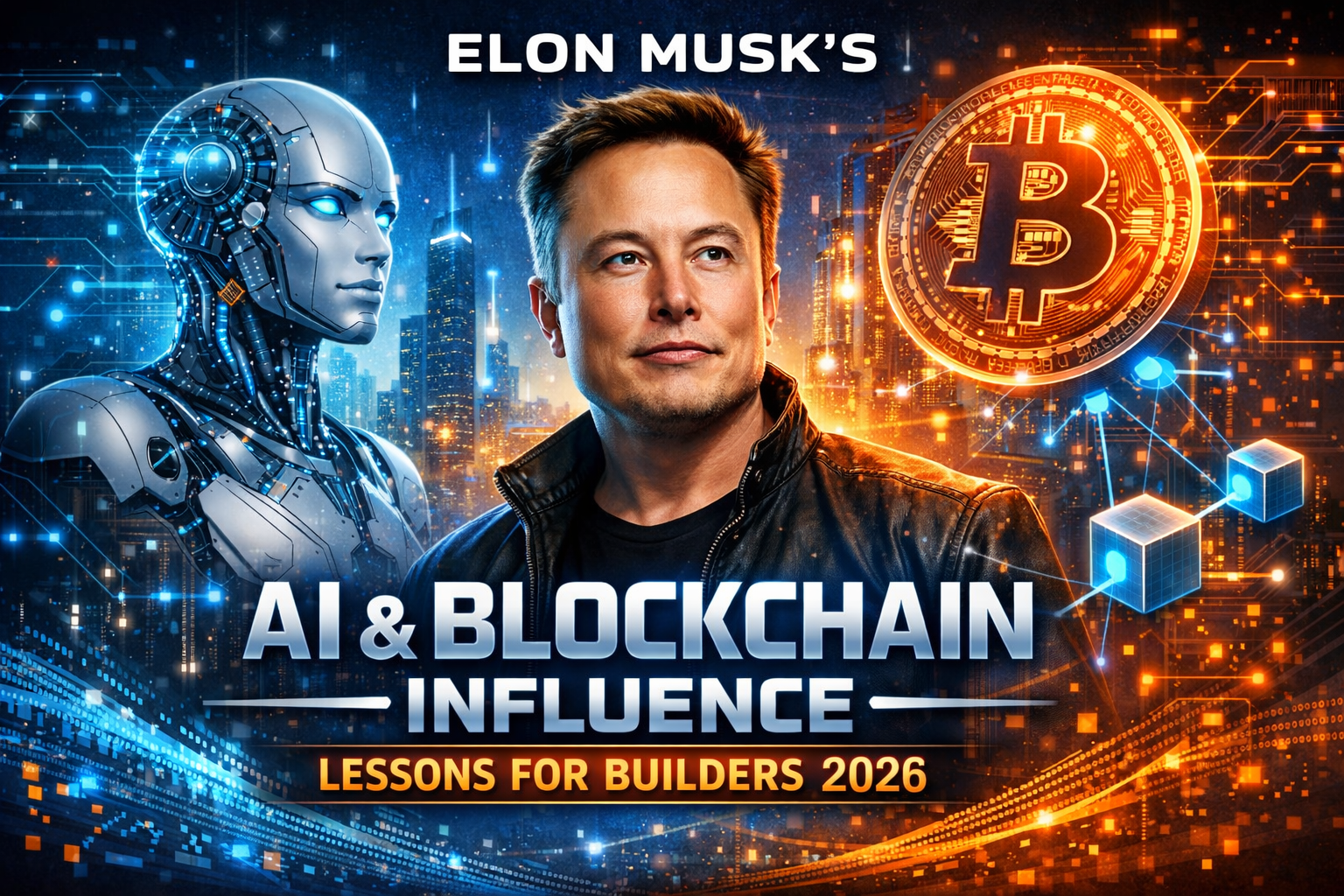
Elon Musk’s Influence on AI and Blockchain: Key Lessons for Builders in 2026
In the pantheon of modern disruptors, few figures loom as large or cast as long a shadow as Elon Musk. A name synonymous with audacious vision, relentless execution, and a penchant for challenging the status quo, Musk has indelibly stamped his mark across multiple industries, from electric vehicles and space exploration to neurotechnology and social media. His ventures are not merely businesses; they are grand experiments pushing the boundaries of what’s possible, often fueled by a blend of technological optimism and a profound concern for humanity’s future.
Among the most critical frontiers Musk has engaged with are Artificial Intelligence (AI) and Blockchain. These two transformative technologies, each with the potential to reshape society at its core, have seen their trajectories influenced, sometimes controversially, by Musk’s involvement, pronouncements, and the companies he leads. As we look ahead to 2026, a year where the foundational work of today will begin to manifest in tangible, widespread applications, understanding Musk’s impact and extracting actionable lessons becomes paramount for builders, innovators, and entrepreneurs navigating these complex landscapes.
This article will delve into Musk’s multifaceted influence on AI and Blockchain, examining his direct contributions, the philosophical underpinnings of his engagement, and the practical implications for those building the next generation of technological solutions. By dissecting his successes, failures, and evolving perspectives, we aim to distill key lessons that can guide builders in 2026 and beyond, equipping them to innovate responsibly, strategically, and with a keen awareness of the broader societal context.
Elon Musk’s AI Footprint: From Optimism to Caution
Elon Musk’s relationship with AI is perhaps the most complex and defining aspect of his technological philosophy. It began with a deep-seated concern about existential risk, evolved into direct involvement with groundbreaking initiatives, and continues to manifest in his latest ventures.
OpenAI: The Genesis of a Revolution
Musk was a co-founder of OpenAI in 2015, an organization initially conceived as a non-profit dedicated to ensuring that Artificial General Intelligence (AGI) benefits all of humanity, rather than being concentrated in the hands of a few corporations or governments. His motivation was clear: to democratize AI research and development, acting as a counterweight to the potential dangers of unchecked, proprietary AI. He envisioned an open-source approach, allowing the broader scientific community to scrutinize and contribute to AI safety.
However, Musk eventually departed from OpenAI’s board in 2018, citing potential conflicts of interest with Tesla’s AI development and a desire for the organization to remain truly independent. His departure preceded OpenAI’s controversial shift towards a “capped-profit” model, which many, including Musk himself, saw as a deviation from its original non-profit, open-source ethos. Despite this, OpenAI, under the leadership of Sam Altman, has since become a dominant force in the AI world, particularly with the launch of ChatGPT, which ignited the current generative AI boom.
Lesson 1 for Builders in 2026: The Power of Foundational Research & Openness (with caveats). OpenAI’s initial vision underscored the importance of investing in foundational AI research with a long-term, societal benefit in mind. While the “openness” aspect has evolved, the impact of its early commitment to pushing the boundaries of AI capabilities is undeniable. Builders should recognize the value of contributing to fundamental advancements, but also critically evaluate the long-term implications of their chosen operational models (open-source vs. proprietary, non-profit vs. for-profit) and how they align with their stated mission. The tension between rapid innovation and ethical deployment will only intensify.
Tesla’s AI-Driven Autonomy: Real-World Application and Iteration
While Musk was concerned about external AI, he was simultaneously building one of the most ambitious real-world AI systems within Tesla: Full Self-Driving (FSD). Tesla’s approach to autonomy is unique, relying heavily on a vision-only system powered by a vast fleet of customer vehicles collecting real-world data. This data-centric approach, combined with sophisticated neural networks and extensive simulation, represents a massive, continuous AI experiment.
Tesla’s FSD has faced significant challenges, including regulatory scrutiny, public skepticism, and repeated delays in achieving its promised capabilities. Yet, it also showcases Musk’s willingness to tackle “hard problems” head-on, iterate rapidly, and leverage a vertically integrated approach where Tesla designs its own AI chips (Dojo), collects its own data, and develops its own software. This end-to-end control allows for unparalleled optimization and rapid deployment of updates.
Lesson 2 for Builders in 2026: Embrace Iteration, Data-Centricity, and Vertical Integration. Tesla’s FSD saga teaches that building complex, real-world AI requires immense patience, continuous iteration, and a deep understanding of the data that fuels the system. For builders, this means:
- Data is King: Prioritize robust data collection, labeling, and management strategies. The quality and quantity of your data will directly impact your AI’s performance.
- Iterate Relentlessly: Expect failures and treat them as learning opportunities. Agile development and continuous deployment are crucial for complex AI systems.
- Consider Vertical Integration: Where feasible, controlling more layers of the tech stack (hardware, software, data pipelines) can provide a competitive edge, allowing for deeper optimization and faster innovation.
Neuralink: Merging Biology and AI
Neuralink, another Musk venture, pushes the boundaries of AI into the realm of biology. Its audacious goal is to develop ultra-high bandwidth brain-computer interfaces (BCIs) that can connect the human brain directly with computers. Initially focused on medical applications, such as restoring lost sensory and motor functions for individuals with neurological disorders, the long-term vision extends to enhancing human capabilities and, controversially, potentially merging human consciousness with AI to prevent humanity from becoming obsolete in an AGI-dominated future.
Neuralink represents the epitome of Musk’s “moonshot” approach, tackling a challenge that seems almost science fiction. The project involves intricate engineering, advanced robotics for surgical implantation, and sophisticated AI algorithms to interpret and generate neural signals. It also navigates immense ethical and regulatory hurdles, pushing the boundaries of what society considers acceptable in human augmentation.
Lesson 3 for Builders in 2026: Dare to Tackle Grand Challenges, but Prepare for Long Horizons and Ethical Scrutiny. Neuralink demonstrates that truly transformative innovation often requires tackling problems that seem insurmountable. Builders should:
- Think Big: Don’t shy away from problems with massive potential impact, even if they seem decades away from full realization.
- Anticipate Long Development Cycles: Groundbreaking research and development, especially in highly regulated fields like biotech, requires significant time and capital.
- Prioritize Ethics and Regulation: Proactively engage with ethical considerations, regulatory bodies, and public discourse. Ignoring these aspects can derail even the most promising innovations.
xAI: A New Chapter in the Quest for AGI
In 2023, Musk launched xAI, explicitly stating its goal to “understand the true nature of the universe” and, more practically, to develop an AI that can compete with OpenAI, Google, and other leading AI labs. xAI’s flagship product, Grok, is designed to be a “truth-seeking” AI, capable of real-time information access (leveraging data from X, formerly Twitter), and possessing a unique personality that includes humor and a willingness to answer questions others might reject.
xAI signifies Musk’s renewed, direct involvement in the AGI race, driven by his long-standing concerns about AI safety and his belief that a “curious and maximally truth-seeking AI” is the safest path forward. It also highlights his strategy of attracting top talent and leveraging existing data ecosystems (like X) to rapidly accelerate development.
Lesson 4 for Builders in 2026: Challenge the Status Quo, Seek Unique Angles, and Prioritize Foundational Understanding. xAI’s emergence provides several insights:
- Identify Market Gaps/Philosophical Differences: Even in a crowded field, there’s room for new players who offer a distinct approach or philosophical underpinning.
- Leverage Existing Assets: Integrating with existing data sources or platforms (like X) can provide a significant head start.
- Focus on Foundational Understanding: Musk’s emphasis on “understanding the universe” suggests that a deeper, more robust understanding of AI’s core mechanisms and capabilities, rather than just superficial performance, is crucial for long-term safety and utility.
Elon Musk’s Stance on Blockchain and Cryptocurrency: A Complex Relationship
Elon Musk’s involvement with blockchain and cryptocurrency has been less about direct development and more about influential commentary, market manipulation (intentional or not), and a philosophical wrestling match between decentralization and his own preference for centralized efficiency.
Bitcoin and Dogecoin: The Influence of a Tweet
Musk’s influence on the crypto markets is undeniable. His pronouncements, often delivered via Twitter (now X), have historically caused significant price swings for various cryptocurrencies. He initially embraced Bitcoin, with Tesla even announcing it would accept Bitcoin for vehicle purchases in early 2021. This move sent Bitcoin’s price soaring, legitimizing it in the eyes of many mainstream investors. However, just a few months later, Tesla reversed its decision, citing environmental concerns over Bitcoin’s energy consumption (due to its Proof-of-Work consensus mechanism). This reversal triggered a sharp market downturn, highlighting the immense power of his individual voice.
Even more famously, Musk became the self-proclaimed “Dogefather,” championing Dogecoin, a meme coin originally created as a joke. His frequent tweets, often featuring Dogecoin memes or direct endorsements, propelled the cryptocurrency to unprecedented valuations, attracting a new wave of retail investors. While some saw this as playful engagement, others criticized it as irresponsible market manipulation, especially given the volatility it introduced.
Lesson 5 for Builders in 2026: Understand Market Dynamics, Community Influence, and the Double-Edged Sword of Endorsement. Musk’s crypto escapades teach critical lessons:
- Influence is a Force Multiplier: For better or worse, influential figures can dramatically impact decentralized markets. Builders must understand how public perception and key endorsements can shape their project’s trajectory.
- Community is King (and Volatile): Dogecoin’s rise demonstrates the power of community and meme culture in crypto. Builders should learn to foster strong, engaged communities but also recognize their inherent volatility and susceptibility to external influence.
- Transparency and Responsibility: While Musk’s actions were his own, builders launching new blockchain projects must consider the ethical implications of their own endorsements and marketing strategies, especially concerning speculative assets.
Decentralization vs. Centralized Control: A Philosophical Tug-of-War
At the core of Musk’s approach to his companies is a drive for efficiency, speed, and often, centralized control. Tesla, SpaceX, Neuralink, and even X (formerly Twitter) operate under a highly centralized leadership structure, with Musk at the helm making key decisions. This philosophy inherently clashes with the foundational principles of blockchain: decentralization, immutability, and distributed governance.
Musk’s acquisition of Twitter and its rebranding to X further highlighted this tension. While he spoke of making X a “free speech absolutist” platform, the operational reality remained centralized. Speculation has long existed about potential blockchain integration within X – perhaps for payments, content monetization, or identity verification. However, any such integration would likely be a “permissioned” or hybrid blockchain, where X maintains significant control, rather than a fully decentralized public chain. This reflects a pragmatic approach to blockchain, where its utility is leveraged without fully embracing its ideological tenets.
Lesson 6 for Builders in 2026: Reconcile Ideals with Practicality, and Explore Hybrid Models. Builders in 2026 must navigate the ideological purity of decentralization with the practical demands of scalability, efficiency, and user experience.
- Identify Core Problems: Don’t use blockchain for blockchain’s sake. Identify specific problems where its unique properties (transparency, immutability, censorship resistance) offer a superior solution.
- Consider Hybrid Architectures: For many real-world applications, a hybrid approach combining centralized efficiency with decentralized elements (e.g., for data integrity, ownership verification) might be the most effective path forward.
- Understand Trade-offs: Be clear about the trade-offs between full decentralization and operational control, and communicate these clearly to users and stakeholders.
Energy Consumption and Environmental Concerns
Musk’s decision to halt Bitcoin payments for Tesla vehicles due to environmental concerns brought the issue of blockchain’s energy consumption to the forefront of mainstream discussion. Bitcoin’s Proof-of-Work (PoW) consensus mechanism, while secure, is notoriously energy-intensive. This move forced many in the crypto community to confront the sustainability challenge head-on, accelerating the shift towards more energy-efficient alternatives like Proof-of-Stake (PoS) and other consensus mechanisms.
While Musk’s concern was genuine, some criticized the timing, given that Bitcoin’s energy consumption was well-known long before Tesla’s initial adoption. Nevertheless, his public stance undeniably amplified the conversation around green blockchain solutions and pushed the industry towards greater environmental responsibility.
Lesson 7 for Builders in 2026: Prioritize Sustainability and Address Societal Concerns Proactively. The environmental impact of technology is a growing concern for consumers, investors, and regulators.
- Design for Sustainability: From the outset, consider the environmental footprint of your blockchain solution. Opt for energy-efficient consensus mechanisms or explore solutions that actively contribute to sustainability.
- Transparency is Key: Be transparent about your project’s energy consumption and carbon footprint, and actively work towards mitigating it.
- Anticipate Regulatory Pressure: Environmental regulations are likely to become stricter. Proactive measures will position your project favorably in the long run.
Connect AzuraCast with a Live Encoder: Setup Guide
Decentralized Startups: Future Ecosystems and VC Investment Strategies
2026 Blockchain Startup Mistakes: Avoid These Common Pitfalls
Overarching Lessons for Builders in 2026
Beyond the specific domains of AI and Blockchain, Elon Musk’s career offers several universal lessons for builders aiming to make a significant impact in 2026 and beyond.
Visionary Leadership and Audacious Goals
Musk consistently sets “impossible” goals – colonizing Mars, full self-driving cars, brain-computer interfaces. This visionary approach inspires teams, attracts top talent, and captures public imagination. Builders should not be afraid to think big and articulate a compelling future that transcends incremental improvements.
The Importance of First Principles Thinking
Musk is a vocal proponent of “first principles thinking,” which involves deconstructing problems to their fundamental truths rather than reasoning by analogy. This approach allows for novel solutions that might be overlooked if one only builds upon existing ideas. For builders, this means questioning assumptions and seeking the most efficient, fundamental solutions.
Embrace Risk and Failure as Learning Opportunities
Musk’s ventures are characterized by high risk and public failures (e.g., rocket explosions, FSD delays). Yet, he consistently frames these as learning opportunities, fostering a culture of rapid iteration and resilience. Builders must cultivate a similar mindset, understanding that innovation often involves a high degree of experimentation and that failure is an inevitable, valuable part of the process.
Vertical Integration and End-to-End Control
From designing chips to building factories and developing software, Musk’s companies often control the entire stack. This vertical integration allows for unparalleled optimization, faster iteration, and a deeper understanding of the entire system. While not always feasible for every startup, builders should consider where controlling key components of their value chain can provide a significant competitive advantage.
The Power of Narrative and Community Building
Musk is a master storyteller, capable of articulating a compelling vision that resonates with millions. His ability to rally communities around his projects, whether for Tesla, SpaceX, or Dogecoin, is a testament to the power of narrative. Builders must learn to communicate their vision clearly, passionately, and authentically to attract users, investors, and talent.
Ethical Considerations and Societal Impact
While Musk’s focus is often on technological advancement, his journey also highlights the increasing scrutiny on the ethical implications and societal impact of powerful technologies like AI and blockchain. Builders in 2026 must proactively engage with these concerns, designing solutions that are not only innovative but also responsible, equitable, and sustainable.
Conclusion: Navigating the Future with Musk’s Blueprint
Elon Musk’s influence on AI and Blockchain is a complex tapestry woven with threads of groundbreaking innovation, controversial pronouncements, and a relentless pursuit of ambitious goals. For builders in 2026, his journey offers a rich repository of lessons, not just in what to do, but also in the challenges and responsibilities that come with pushing the boundaries of technology.
From the foundational research spirit of OpenAI and the iterative, data-driven approach of Tesla FSD, to the audacious vision of Neuralink and the strategic re-entry with xAI, Musk’s AI ventures underscore the importance of big thinking, deep technical understanding, and a willingness to tackle hard problems over long horizons. Simultaneously, his engagement with blockchain, particularly Bitcoin and Dogecoin, serves as a potent reminder of market dynamics, the power of community, and the critical need for transparency and sustainability in decentralized ecosystems.
As we stand on the cusp of 2026, a year poised for significant maturation in both AI and blockchain, builders are tasked with not just creating new technologies, but shaping a future that is both innovative and responsible. By internalizing Musk’s blueprint – embracing audacious vision, first principles thinking, iterative development, vertical integration, and compelling narrative, all while navigating ethical complexities – the next generation of innovators can build solutions that truly make a positive, lasting impact on humanity. The future is being built now, and the lessons from one of its most prominent architects are invaluable guides for the journey ahead.
Have any thoughts?
Share your reaction or leave a quick response — we’d love to hear what you think!
-
 0
0
-
0
-
0
-
0
-
0
-
0


