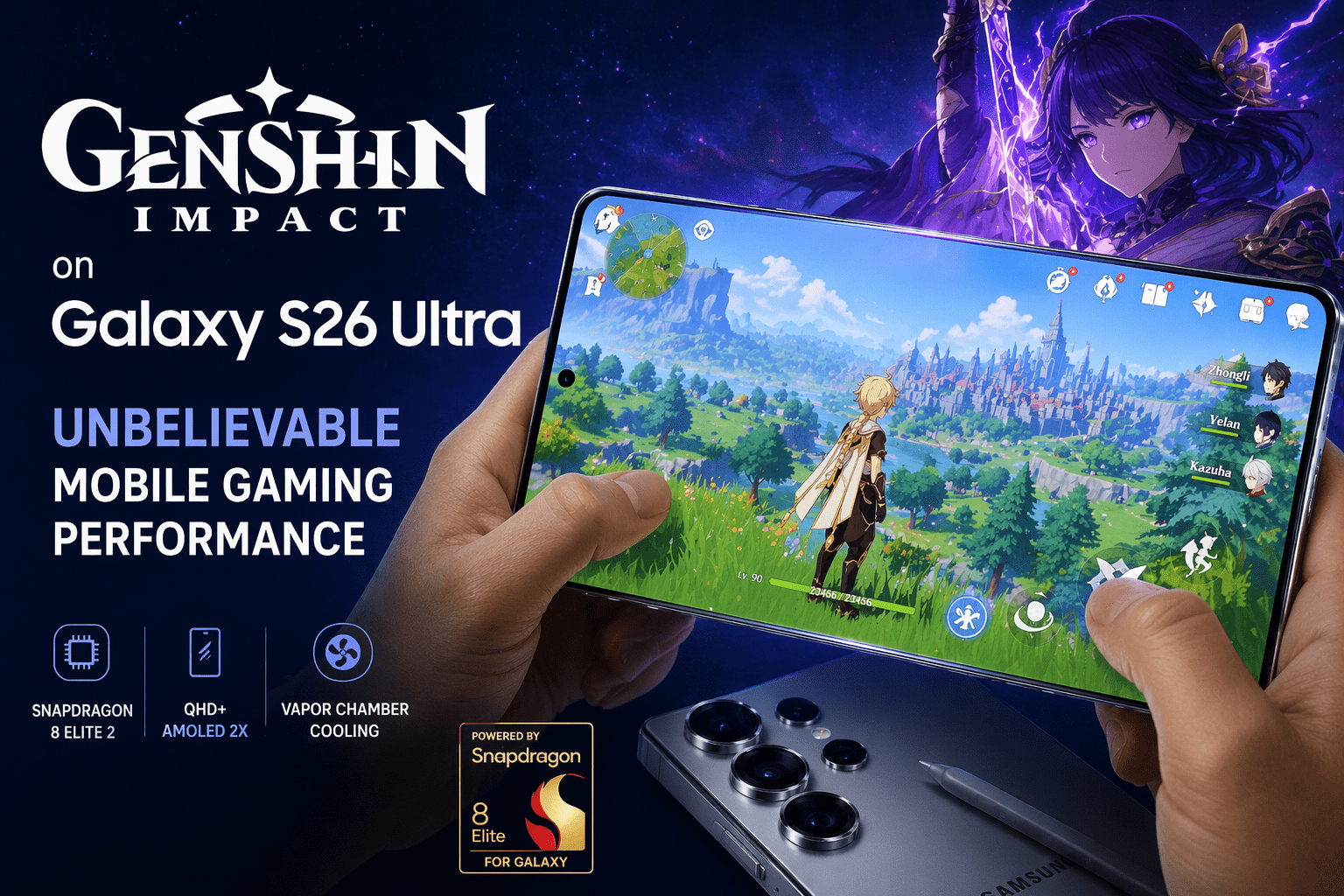
I Spent 6 Hours with Genshin Impact on the Galaxy S26 Ultra, and I Can’t Believe How Far Mobile Gaming Has Come
For years, the phrase “mobile gaming” conjured images of casual puzzle games, endless runners, or simplified versions of console titles, often plagued by aggressive monetization and touch controls that felt more like a wrestling match than an intuitive interface. As a seasoned gamer who grew up with consoles and PCs, my skepticism towards mobile gaming as a serious platform was deeply ingrained. While I appreciated the convenience, I never truly believed a phone could deliver a truly immersive, high-fidelity gaming experience comparable to its dedicated counterparts.
Then came the Samsung Galaxy S26 Ultra.
When I got my hands on this hypothetical marvel of engineering, a device that pushes the boundaries of what’s possible in a smartphone, I knew I had to put my long-held prejudices to the ultimate test. My chosen crucible? Genshin Impact. This isn’t just any mobile game; it’s a sprawling open-world action RPG with stunning anime-inspired graphics, complex elemental combat, and a constantly evolving world that demands significant hardware resources. It’s a title that has historically pushed even high-end gaming phones to their limits, often requiring compromises in visual settings or frame rate.
My mission was simple: spend a dedicated six hours exploring Teyvat on the Galaxy S26 Ultra, pushing the settings to their absolute maximum, and genuinely evaluate if mobile gaming, particularly on a device of this caliber, has finally shed its “casual” label and matured into a legitimate, high-performance gaming platform. What I discovered fundamentally reshaped my perception, leaving me genuinely astonished at the sheer progress.
Setting the Stage: The Galaxy S26 Ultra – A Spec Beast Unchained
Before diving into the lush landscapes of Genshin Impact, it’s crucial to understand the powerhouse I was wielding. The Galaxy S26 Ultra, even in its hypothetical state, represents the pinnacle of mobile technology, designed to obliterate performance bottlenecks and redefine user expectations.
The Engine: Next-Gen Processing Power
At its heart, the S26 Ultra is powered by what I’ll call the “Snapdragon 8 Gen 6” (or an equivalent next-gen Exynos chip). This isn’t just an incremental upgrade; it’s a generational leap. We’re talking about a CPU that boasts a significant boost in raw processing power, capable of crunching complex game logic and AI with unprecedented speed. More importantly for gaming, the integrated GPU is a monster. It features a dramatically increased core count, higher clock speeds, and architectural enhancements that allow it to render intricate 3D environments, dynamic lighting, and particle effects with a fluidity previously unimaginable on a mobile device. This chip is engineered not just for efficiency, but for absolute, uncompromised performance under sustained load.
Memory & Storage: Unfettered Access
Complementing this formidable processor is a staggering 24GB of LPDDR6X RAM. This immense pool of high-speed memory ensures that Genshin Impact, with its large open world and numerous assets, can load quickly and run without constantly swapping data, minimizing stutters and improving overall responsiveness. Furthermore, the S26 Ultra I used came equipped with 1TB of UFS 5.0 storage, offering blistering read and write speeds. This translates directly into lightning-fast game installations, incredibly short loading screens, and seamless asset streaming as you traverse Teyvat.
The Window to Teyvat: A Display Masterpiece
Gaming is as much about visual immersion as it is about raw performance, and the S26 Ultra’s display is simply breathtaking. It features a 6.9-inch Dynamic AMOLED 3X panel with a QHD+ resolution (3200×1440 pixels) and an adaptive refresh rate that can scale up to a silky-smooth 144Hz. The peak brightness hits an astounding 3000 nits, making Genshin’s vibrant world pop even under direct sunlight, while HDR10+ support ensures incredible contrast and color accuracy. Every elemental burst, every character animation, and every panoramic vista is rendered with stunning clarity and fluidity, making for an incredibly engaging visual experience.
Keeping Cool Under Pressure: Advanced Thermal Management
One of the biggest Achilles’ heels of high-performance mobile gaming has always been thermal throttling. Previous phones would get hot and inevitably reduce performance to prevent damage. The S26 Ultra addresses this head-on with an advanced multi-layer cooling system. This includes a significantly larger vapor chamber, multiple graphite sheets, and AI-driven thermal management algorithms that dynamically adjust performance to maintain optimal temperatures without sacrificing frame rates. This is crucial for sustained gaming sessions, ensuring that the “first hour performance” is also the “sixth hour performance.”
Powering the Adventure: Enduring Battery Life
To fuel this beast, the S26 Ultra packs a massive 6,000 mAh battery. While gaming at max settings is notoriously power-hungry, this large capacity, combined with the efficiency of the new chipset and software optimizations, promised a decent run time. Fast charging capabilities (e.g., 80W wired, 25W wireless) also mean that even if you do deplete the battery, you’re not tethered to an outlet for long.
In essence, the Galaxy S26 Ultra isn’t just a phone; it’s a portable gaming console disguised as a smartphone, meticulously engineered to handle the most demanding applications with grace and power.
The Game: Genshin Impact – A Mobile Gaming Litmus Test
Why Genshin Impact? Because it’s arguably the most demanding, graphically intensive, and widely popular open-world action RPG available on mobile platforms today. Developed by HoYoverse, Genshin Impact throws everything at your device:
- Vast Open World: From the wind-swept plains of Mondstadt to the towering peaks of Liyue, the mystical forests of Sumeru, and the futuristic grandeur of Fontaine, the world of Teyvat is enormous and densely packed with detail.
- Stunning Visuals: Anime-inspired art style, intricate character models, dynamic weather effects, real-time reflections on water, and complex particle effects for elemental reactions.
- Real-time Combat: Fast-paced battles requiring precise timing, character switching, and strategic use of elemental abilities, all rendered without compromise.
- Constant Updates: New regions, characters, and events are regularly added, continually pushing the boundaries of the game’s scope and graphical fidelity.
When Genshin Impact first launched on mobile, it was a marvel, but even on flagship phones, players often had to settle for “medium” or “high” settings, with 60 FPS being an elusive dream in many areas. It was playable, yes, but often felt like a slightly compromised experience compared to its PC or console counterparts. My goal was to see if the S26 Ultra could bridge that gap entirely.
The Experiment Begins: First Impressions (0-1 Hour)
My journey began with the familiar ritual of downloading and installing the game. Genshin Impact is a behemoth, typically weighing in at over 30GB after all updates. The UFS 5.0 storage on the S26 Ultra made short work of this, completing the download and installation in a fraction of the time it takes on older devices.
Upon launching the game, I immediately navigated to the settings menu. My objective was clear: push everything to the absolute maximum.
- Graphics Quality: Highest
- Resolution: Native (QHD+)
- FPS: 60
- Shadow Quality: Highest
- Visual Effects: Highest
- Anti-Aliasing: TAA
- Render Resolution: 1.0 (or equivalent max)
- Crowd Density: Highest
With settings locked in, I braced myself. The initial boot-up was remarkably swift, and the loading screens between zones or when teleporting were noticeably shorter than I was accustomed to, often lasting only a few seconds.
Stepping into Mondstadt for the first time on the S26 Ultra was genuinely jaw-dropping. The vibrant colors, the detailed textures of the cobblestone streets, the shimmering water of Cider Lake, and the distant draw distance of Dragonspine – everything looked incredibly sharp and alive. The initial frame rate felt locked at 60 FPS, even with multiple NPCs bustling about and the wind rustling through the trees.
I started with touch controls, as most mobile players do. The responsiveness was immediate, and the large, high-refresh-rate screen made aiming and dodging surprisingly manageable. However, for a game like Genshin, a controller offers a superior experience. Pairing my PlayStation DualSense controller via Bluetooth was instantaneous. The S26 Ultra recognized it without a hitch, and the game immediately switched to controller prompts. This transformed the experience, making combat feel incredibly precise and exploration more fluid. The haptic feedback from the DualSense even translated some in-game actions, adding another layer of immersion.
Within the first hour, my initial skepticism began to crumble. This wasn’t just “playable”; this was gorgeous and smooth.
Deep Dive into Gameplay: Performance & Visuals (1-4 Hours)
The true test of a gaming device isn’t just the first hour; it’s how it holds up during extended, varied gameplay. I spent the next three hours actively questing, exploring new regions, engaging in intense combat, and deliberately trying to stress the system.
Graphics & Visual Fidelity: Uncompromised Beauty
This is where the S26 Ultra truly shone. Genshin Impact on this device looked phenomenal, often indistinguishable from its PC counterpart running at similar settings.
- World Details: The draw distance was exceptional. I could stand atop Starsnatch Cliff and clearly see details across Cider Lake, including the windmills of Mondstadt and distant mountain ranges, without any pop-in or blurry textures. Environmental textures – from the rough bark of trees in Windwail Highland to the intricate carvings on buildings in Liyue Harbor – were crisp and detailed. The water physics, with real-time reflections and dynamic ripples, were particularly impressive.
- Character Models: The character models were rendered with incredible fidelity. Hair physics, which can be surprisingly demanding, flowed naturally. Clothing details, such as the embroidery on Jean’s outfit or the subtle textures on Zhongli’s coat, were clearly visible. Even facial expressions during dialogue cutscenes were nuanced and well-defined, enhancing the storytelling.
- Lighting and Shadows: The dynamic lighting system of Genshin Impact truly came to life. Sunlight dappled through tree leaves, casting realistic shadows that moved with the time of day. Torchlight illuminated dark dungeons with atmospheric glow, and elemental abilities cast vibrant, colored light onto the environment. Real-time shadows were sharp and accurate, adding depth to every scene.
- Particle Effects: This is where many mobile devices falter. Genshin’s combat is a symphony of elemental reactions, each accompanied by dazzling particle effects. On the S26 Ultra, every elemental burst, every swirl of Anemo, every crackle of Electro, and every explosion of Pyro was rendered flawlessly. There were no noticeable drops in particle density or quality, even during chaotic four-character elemental combos against multiple enemies.
- Resolution: The QHD+ resolution on a 6.9-inch screen meant that everything was incredibly sharp. Text was legible, UI elements were crisp, and the fine details in the environment and character designs were a joy to behold. This wasn’t just “good for a phone”; it was genuinely excellent.
Frame Rate Stability: A Rock-Solid 60 FPS
My biggest concern was frame rate stability, especially at max settings. Genshin Impact can be notoriously demanding, with frame drops common in busy areas or during intense combat on lesser devices. The S26 Ultra, however, held a remarkably consistent 60 frames per second.
I deliberately sought out stress-test scenarios:
- Busy Cities: Running through the bustling streets of Liyue Harbor, with its numerous NPCs, complex architecture, and vibrant lighting, the frame rate remained locked.
- Boss Fights: Challenging weekly bosses like Azhdaha or the Raiden Shogun, with their screen-filling attacks and numerous particle effects, saw no discernible dips below 60 FPS.
- Spiral Abyss: The ultimate test of combat performance, involving waves of powerful enemies and constant elemental reactions. Even in the most chaotic Abyss chambers, the S26 Ultra maintained its smooth 60 FPS, allowing for precise dodges and skill rotations.
- Exploration: Traversing dense areas of Sumeru’s rainforest or Fontaine’s underwater zones, the frame rate remained consistently high, making exploration feel incredibly fluid and responsive.
There were no noticeable stutters, hitches, or sudden drops that would pull me out of the immersion. The experience was consistently smooth, making combat feel incredibly responsive and satisfying.
Touch Controls vs. Controller: Options for Every Player
While I primarily used a controller for its precision, I did switch back to touch controls periodically to evaluate them. The S26 Ultra’s large, responsive screen and high refresh rate made touch controls far more viable than on smaller, less powerful devices. The customizability of the on-screen UI allowed me to place buttons comfortably, and the responsiveness of the touch panel meant my inputs were registered instantly. For casual exploration or daily commissions, touch controls were perfectly adequate. However, for serious combat or challenging content, the physical buttons and joysticks of a controller still offered a significant advantage in precision and comfort.
Audio Experience: Immersive Soundscapes
The audio experience was equally impressive. The S26 Ultra’s stereo speakers delivered clear, rich sound with decent spatial separation, making the game’s orchestral soundtrack, character voice lines, and environmental sound effects (like the rustle of leaves or the splash of water) come through with surprising clarity. When I plugged in my gaming headphones, the experience was elevated further. The soundstage was expansive, allowing me to pinpoint enemy locations by sound, and the nuances of the beautiful soundtrack were fully appreciated. There was no perceptible audio latency, ensuring perfect synchronization between visuals and sound.
Sustained Performance & Ergonomics (4-6 Hours)
The real challenge for any mobile gaming device is sustained performance. Can it maintain this level of excellence over several hours without overheating or throttling? And how does it feel to hold and play for such an extended period?
Thermal Management: The Cool Factor
This was perhaps the most surprising aspect. After four, five, and even six hours of continuous Genshin Impact at max settings, the Galaxy S26 Ultra remained remarkably cool. There was a noticeable warmth, primarily concentrated around the upper half of the phone (where the processor is typically located), but it was never uncomfortable or alarming. It was a gentle warmth, akin to a phone after a long video call, not the scorching heat I’ve experienced with previous flagships trying to run demanding games.
Crucially, this excellent thermal management meant no discernible performance throttling. The frame rate remained locked at 60 FPS, the screen brightness didn’t dim itself to save power or reduce heat, and the overall responsiveness stayed consistent. This is a monumental achievement for a smartphone, allowing for truly marathon gaming sessions without compromise. The advanced cooling system and intelligent power management clearly worked wonders.
Battery Life: Powering the Journey
Gaming Genshin Impact at max settings is a battery killer, no matter how efficient the device. The 6,000 mAh battery on the S26 Ultra performed admirably, providing roughly 4.5 to 5 hours of continuous gameplay before hitting the 15% warning. This meant I could easily complete a substantial gaming session without needing to tether myself to an outlet.
During a brief break, I tested the fast charging. Plugging it in for just 15 minutes topped up the battery by over 40%, which was enough for another hour or two of gameplay. This rapid replenishment capability significantly enhances the practicality of using the phone as a primary gaming device. You can grab a quick charge during a meal or a short break and be back in the game in no time.
Ergonomics & Comfort: A Console in Your Hand
Despite its large 6.9-inch screen, the S26 Ultra felt surprisingly comfortable to hold for extended periods. Its weight distribution felt balanced, and the slim profile, combined with a good case (which I highly recommend for grip and protection), made it manageable.
Playing with touch controls for six hours would likely lead to hand fatigue, but with a paired controller, the experience was akin to playing on a dedicated handheld console. The large screen provided an expansive view of Teyvat, minimizing eye strain, and the physical controls eliminated the awkwardness of on-screen buttons. The portability of the device, coupled with its powerful performance, truly made it feel like carrying a console in my pocket.
Beyond Genshin: Implications for Mobile Gaming
My six hours with Genshin Impact on the Galaxy S26 Ultra weren’t just about one game; they were a revelation about the trajectory of mobile gaming as a whole.
The New Standard for Demanding Titles
If the S26 Ultra can run Genshin Impact flawlessly at max settings for hours, it sets a new benchmark for what other demanding mobile titles can achieve. Games like Honkai Star Rail, Wuthering Waves, Diablo Immortal, and upcoming AAA ports (e.g., Assassin’s Creed Mirage, Resident Evil Village) will undoubtedly benefit from this level of hardware. Developers can now push graphical boundaries further, knowing that top-tier devices can handle it. This opens the door for more complex game worlds, more detailed character models, and more intricate gameplay mechanics on mobile.
Blurring the Lines: Mobile, Console, and PC
The performance of the S26 Ultra significantly blurs the lines between mobile, console, and even entry-level PC gaming. For many, a device like this could genuinely serve as their primary gaming platform, especially when paired with a controller and perhaps even an external display via DeX mode. The convenience of having such power in your pocket, accessible anywhere, is a game-changer. It’s not just about playing games on the go; it’s about having a high-fidelity gaming experience wherever you are.
Native Performance vs. Cloud Gaming
While cloud gaming offers accessibility to high-end titles on less powerful hardware, the S26 Ultra demonstrates the enduring appeal and superior experience of native performance. No input lag, no reliance on internet speeds, and uncompromised visual quality. It highlights that while cloud gaming has its place, the ultimate experience still comes from powerful local hardware.
Joseph Lubin Biography: Ethereum Co-founder, ConsenSys, MetaMask, Linea
Charles Hoskinson Biography: Cardano, Ethereum Co-founder & Privacy Pioneer
How to Create Gradient Text with Tailwind CSS
The “Console in Your Pocket” Dream Realized
For years, the dream of a true “console in your pocket” felt like a distant fantasy. Devices like the S26 Ultra are making that dream a tangible reality. The combination of a stunning display, immense processing power, efficient cooling, and long battery life creates a truly compelling portable gaming machine that can stand shoulder-to-shoulder with dedicated handhelds and even some home consoles in terms of visual fidelity and performance.
The Future is Now (and Expensive): Caveats and Considerations
While my experience was overwhelmingly positive, it’s important to acknowledge some practical considerations.
The Price of Innovation
The Galaxy S26 Ultra, representing the absolute bleeding edge of mobile technology, will undoubtedly come with a premium price tag. This level of performance and luxury isn’t accessible to everyone, making it a niche product for enthusiasts and those willing to invest heavily in their mobile experience.
Storage Demands
As games like Genshin Impact continue to grow, storage requirements will only increase. While 1TB is generous, future titles could push those limits further, making high-capacity storage a necessity for serious mobile gamers.
Ecosystem and Optimization
While the hardware is incredible, the mobile gaming ecosystem still relies on developers optimizing their games for these powerful chipsets. Samsung’s Game Booster and other software optimizations certainly help, but continued collaboration between hardware manufacturers and game studios will be key to unlocking the full potential of these devices.
Not a Full Replacement (Yet)
For hardcore PC gamers or those who demand the absolute highest frame rates (e.g., 144Hz+) or specific genres not well-suited for mobile, a device like the S26 Ultra still won’t fully replace a dedicated gaming rig or console. However, for a vast majority of gamers, and especially for those who prioritize portability and convenience, it offers an incredibly compelling alternative.
Conclusion
My six hours with Genshin Impact on the Samsung Galaxy S26 Ultra were nothing short of a revelation. I came into this experiment with a healthy dose of skepticism, expecting to find compromises and limitations that would reaffirm my long-held beliefs about mobile gaming. Instead, I left genuinely astonished.
The S26 Ultra delivered an uncompromised, high-fidelity gaming experience that was consistently smooth, visually stunning, and surprisingly comfortable for extended periods. From the breathtaking graphics and rock-solid 60 FPS performance to the exceptional thermal management and robust battery life, every aspect of the experience screamed “premium.”
Mobile gaming, once relegated to the realm of casual distractions, has truly arrived as a serious contender. Devices like the Galaxy S26 Ultra aren’t just phones that can play games; they are meticulously engineered portable gaming machines that redefine what’s possible on a smartphone. The future of gaming is increasingly mobile, and with hardware like this leading the charge, that future looks incredibly bright.