
Table of Contents
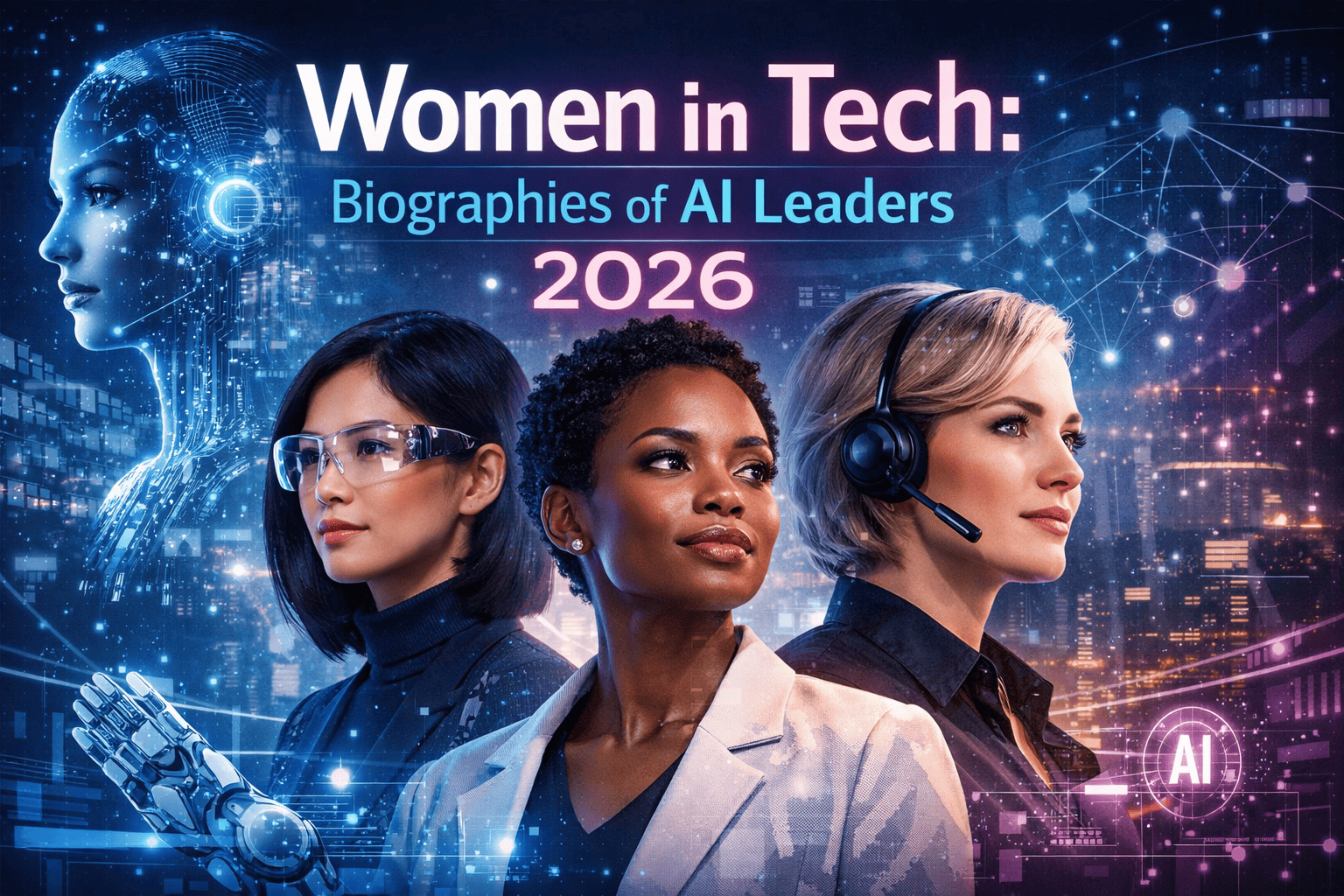
Women in Tech: Biographies of AI Revolution Leaders in 2026
The year is 2026. Artificial Intelligence, once a futuristic concept, has seamlessly woven itself into the fabric of our daily lives, transforming industries, economies, and societies at an unprecedented pace. From personalized healthcare and intelligent urban planning to hyper-realistic creative endeavors and sophisticated scientific discovery, AI’s influence is pervasive and profound. This revolution, however, is not a monolithic entity driven by a singular vision; it is a complex tapestry woven by diverse minds, perspectives, and leadership styles.
While the narrative of technological innovation has historically been dominated by male figures, the AI revolution of the mid-2020s tells a different, more inclusive story. Women are not merely participating; they are leading, innovating, and shaping the very trajectory of this transformative technology. They are at the helm of groundbreaking research, spearheading ethical frameworks, driving commercial applications, and ensuring that AI serves humanity’s best interests. Their contributions are indispensable, their visions inspiring, and their impact undeniable.
This article shines a spotlight on some of these extraordinary women—the AI revolution leaders of 2026. These are the engineers, scientists, entrepreneurs, and policymakers who, through their relentless dedication and visionary thinking, are defining the future of artificial intelligence and, by extension, the future of our world. Their stories are a testament to the power of diverse leadership and a beacon of inspiration for generations to come.
The AI Landscape in 2026: A Snapshot
By 2026, AI has moved beyond its nascent stages, maturing into a robust and multifaceted field. We witness:
- Ubiquitous Integration: AI-powered systems are embedded in everything from smart infrastructure and autonomous logistics to personalized education platforms and advanced medical diagnostics.
- Advanced Foundation Models: Large multimodal models (LMMs) have become the bedrock for many applications, capable of understanding, generating, and reasoning across text, images, audio, and video with remarkable fluency. These models are increasingly specialized for various domains.
- Ethical AI at the Forefront: Growing awareness of AI’s societal implications has led to a stronger emphasis on ethical AI development, fairness, transparency, and accountability. Regulatory frameworks are evolving globally, influencing design and deployment.
- Human-AI Collaboration: The focus has shifted from AI replacing humans to AI augmenting human capabilities, fostering new forms of collaboration in creative, scientific, and professional domains.
- Specialized AI for Grand Challenges: AI is being rigorously applied to address global issues such as climate change, sustainable development, disease eradication, and resource management, yielding tangible results.
- Edge AI Proliferation: AI processing capabilities are increasingly moving to the edge—on devices, sensors, and local networks—enabling real-time decision-making, enhanced privacy, and reduced latency.
Within this dynamic environment, the following women stand out as pivotal figures, each carving a unique path and leaving an indelible mark on the AI revolution.
Interesting Facts About CSS Image Styling: What You Need to Know
CSS Transitions and Animations: A Comprehensive Guide to Web Effects
Elon Musk’s AI & Blockchain Influence: Lessons for Builders 2026
Biographies of AI Revolution Leaders
Dr. Anya Sharma: The Architect of Ethical AI Governance
Title: CEO & Co-founder, EthosAI Labs; Chair, Global AI Ethics Council
Background & Early Career: Dr. Anya Sharma’s journey into AI began with a deep-seated interest in philosophy and computer science. After completing her Ph.D. in AI ethics from MIT, her early career at a leading tech giant exposed her to the immense power and potential pitfalls of unchecked AI development. Witnessing the subtle biases embedded in algorithms and the lack of robust governance, she became a vocal advocate for responsible AI. In 2021, she co-founded EthosAI Labs, a pioneering consultancy dedicated to auditing, developing, and implementing ethical AI frameworks for corporations and governments worldwide.
Key Contributions & Innovations in AI (2026 Context): By 2026, Dr. Sharma is widely recognized as the preeminent global authority on AI ethics and governance. Her firm, EthosAI Labs, has developed the industry-standard “EthosScore” – a comprehensive, auditable framework that assesses AI systems for fairness, transparency, privacy, and robustness. This framework is now mandated by several national governments and adopted by major multinational corporations as a prerequisite for AI deployment.
Her most significant contribution in 2026 is leading the Global AI Ethics Council, an independent body she helped establish, which advises the UN on international AI policy. Under her leadership, the Council has successfully pushed for the “AI Bill of Rights,” a set of universally recognized principles guiding the development and deployment of AI, focusing on human autonomy, non-discrimination, and data sovereignty. She has also pioneered “Explainable AI (XAI) as a Service,” making sophisticated tools for understanding complex AI decisions accessible to non-technical stakeholders, ensuring accountability across sectors.
Impact on the AI Landscape: Dr. Sharma has fundamentally shifted the conversation around AI from purely technological advancement to one deeply intertwined with societal values and human rights. Her work has instilled a culture of ethical responsibility within the AI community, preventing potential harms and fostering public trust. She is instrumental in shaping the regulatory landscape, ensuring that AI development is guided by foresight and a commitment to justice, rather than reactive damage control.
Vision for the Future: Dr. Sharma envisions a future where AI is not just intelligent but also wise, serving as a powerful tool for human flourishing, guided by robust ethical guardrails and democratic oversight. She believes in fostering global collaboration to prevent AI from exacerbating inequalities and to harness its power for collective good.
Professor Lena Petrova: Pioneering Multimodal AGI Research
Title: Lead Scientist, Cognito Dynamics; Professor of Computer Science, Stanford University
Background & Early Career: Professor Lena Petrova’s fascination with intelligence began in childhood, leading her to pursue theoretical physics and then computer science, specializing in neural networks. Her early research at CERN on complex data pattern recognition laid the groundwork for her later breakthroughs in AI. She joined Stanford’s AI Lab in the late 2010s, quickly establishing herself as a leading voice in deep learning and foundation models. Her seminal paper on “Emergent Properties in Large Language Models” in 2022 was a turning point, predicting the rapid ascent of multimodal AI.
Key Contributions & Innovations in AI (2026 Context): In 2026, Professor Petrova is at the forefront of the quest for Artificial General Intelligence (AGI). As Lead Scientist at Cognito Dynamics, a secretive but highly influential AI research lab, she heads the “Project Chimera” initiative. This project has achieved unprecedented success in developing multimodal foundation models capable of seamless reasoning and generation across diverse data types—text, images, video, audio, and even sensor data from robotic systems.
Her team’s “Chimera-7” model, released in a limited research capacity, has demonstrated advanced capabilities in complex problem-solving, scientific hypothesis generation, and even rudimentary forms of self-correction and adaptive learning across novel domains. Unlike previous models, Chimera-7 exhibits a more integrated understanding of causality and context, moving closer to human-like cognitive abilities. Her work has also focused on developing novel architectures that are significantly more energy-efficient, addressing a critical concern in large-scale AI deployment.
Impact on the AI Landscape: Professor Petrova’s research has accelerated the timeline for AGI development, pushing the boundaries of what was previously thought possible. Her work has inspired a new generation of AI researchers to tackle the grand challenges of intelligence, while also sparking crucial debates about the safety and control of increasingly powerful AI systems. Her contributions have laid the theoretical and practical groundwork for future AI systems that can learn, adapt, and innovate across a vast spectrum of tasks.
Vision for the Future: Professor Petrova envisions a future where AGI acts as a universal accelerator for human knowledge and progress, solving humanity’s most intractable problems. She champions a cautious, collaborative approach to AGI development, emphasizing safety, alignment, and transparent research to ensure that humanity remains in control of its most profound creation.
Dr. Vivian Chen: Revolutionizing Precision Medicine with AI
Title: Chief Medical AI Officer, BioGen Innovations; Head of AI Diagnostics, Global Health Alliance
Background & Early Career: Dr. Vivian Chen’s background is a unique blend of medical expertise and computational prowess. A board-certified oncologist, she became frustrated with the limitations of traditional diagnostics and treatment protocols. She pursued a second Ph.D. in bioinformatics and machine learning, recognizing AI’s potential to transform healthcare. Her early work focused on applying deep learning to analyze genomic data for cancer prognostics, leading to several high-impact publications and the establishment of BioGen Innovations in 2020.
Key Contributions & Innovations in AI (2026 Context): By 2026, Dr. Chen has spearheaded a revolution in precision medicine. BioGen Innovations, under her leadership, has launched “MediSense AI,” a platform that integrates patient genomic data, electronic health records, real-time physiological sensor data, and environmental factors to create highly personalized diagnostic and treatment pathways. MediSense AI can predict disease onset years in advance with remarkable accuracy, recommend optimal drug dosages tailored to individual metabolisms, and even design custom therapeutic molecules using generative AI.
Her most impactful work in 2026 is the deployment of “PathoScan,” an AI-powered diagnostic system that can identify over 500 diseases, including rare conditions and early-stage cancers, from a single blood sample with near-perfect accuracy, significantly reducing diagnostic delays and improving patient outcomes globally. As Head of AI Diagnostics for the Global Health Alliance, she is leading initiatives to deploy these technologies in underserved regions, making advanced healthcare accessible worldwide.
Impact on the AI Landscape: Dr. Chen has demonstrated the transformative power of AI in healthcare, moving beyond incremental improvements to fundamentally reshape how diseases are diagnosed, treated, and prevented. Her work has not only saved countless lives but has also inspired a new generation of “med-tech” innovators, bridging the gap between clinical practice and cutting-edge AI research. She has also been a strong advocate for patient data privacy and ethical AI deployment in sensitive medical contexts.
Vision for the Future: Dr. Chen dreams of a world where disease is largely preventable or highly manageable, and where personalized, proactive healthcare is a universal right. She believes AI will unlock new frontiers in human longevity and quality of life, making medicine truly predictive, preventive, personalized, and participatory.
Isabella Rossi: The Visionary Behind Creative AI’s New Renaissance
Title: Founder & Creative Director, Aetheria Studio; Professor of Generative Arts, Royal College of Art
Background & Early Career: Isabella Rossi began her career as a celebrated digital artist and animator, renowned for her evocative storytelling and innovative use of emerging technologies. Frustrated by the technical limitations of traditional creative tools, she started experimenting with early generative adversarial networks (GANs) in the late 2010s. Her groundbreaking interactive art installations, which allowed audiences to co-create evolving digital landscapes, caught the attention of both the art world and tech giants. In 2021, she founded Aetheria Studio, a multidisciplinary hub for creative AI.
Key Contributions & Innovations in AI (2026 Context): By 2026, Isabella Rossi is recognized as the leading figure in the Creative AI movement, pushing the boundaries of human-AI collaboration in art, design, and entertainment. Aetheria Studio’s “Muse Engine” is a sophisticated generative AI platform that allows artists, designers, and filmmakers to co-create hyper-realistic visuals, immersive soundscapes, and even entire narrative arcs with unprecedented speed and fidelity. Muse Engine can adapt to an artist’s unique style, learn their preferences, and generate endless variations, acting as a true creative partner.
Her studio has produced several critically acclaimed AI-generated feature films and interactive virtual reality experiences that blur the lines between human and machine creativity. She has also developed “SynthHarmony,” an AI that composes original musical scores in diverse genres, capable of adapting to emotional cues and narrative progressions. As a Professor at the Royal College of Art, she teaches “Algorithmic Aesthetics,” inspiring a new generation of artists to embrace AI as a powerful expressive medium.
Impact on the AI Landscape: Isabella Rossi has demystified creative AI, transforming it from a niche technical curiosity into a mainstream artistic tool. Her work has sparked a renaissance in digital art, challenging traditional notions of authorship and creativity. She has demonstrated that AI is not a threat to human creativity but rather an amplifier, opening up new avenues for artistic expression and collaboration, fostering a more inclusive and dynamic creative ecosystem.
Vision for the Future: Rossi envisions a future where AI empowers every individual to be a creator, democratizing artistic expression and fostering a global culture of collaborative innovation. She believes AI will unlock new forms of beauty and storytelling, allowing humanity to explore its collective imagination in ways previously unimaginable.
Dr. Kimiko Tanaka: Architecting Intelligent Embodied AI
Title: Head of Robotics & Autonomous Systems, Synapse Robotics; Fellow, Institute for Advanced Robotics
Background & Early Career: Dr. Kimiko Tanaka’s passion for robotics began with building intricate mechanical devices in her youth. She pursued degrees in mechanical engineering and AI, focusing on reinforcement learning for robotic control. Her early career at Boston Dynamics involved pioneering work on dynamic balancing and locomotion for humanoid robots. She joined Synapse Robotics in 2020, drawn by their vision for creating truly intelligent and adaptable embodied AI systems.
Key Contributions & Innovations in AI (2026 Context): In 2026, Dr. Tanaka is the driving force behind Synapse Robotics’ “Aura Series” of intelligent autonomous robots. These robots are not just sophisticated machines; they are embodied AI systems capable of complex reasoning, real-time adaptation to unpredictable environments, and intuitive human-robot interaction. The Aura Series includes:
- Aura-Industrial: Advanced collaborative robots that can learn new tasks on the factory floor through observation and demonstration, significantly boosting manufacturing efficiency and safety.
- Aura-Care: Humanoid robots designed for elder care and assistance, capable of empathetic interaction, monitoring vital signs, and providing personalized support in homes and healthcare facilities.
- Aura-Explorer: Autonomous drones and ground vehicles equipped with advanced AI for environmental monitoring, disaster response, and exploration in hazardous terrains, making critical decisions on the fly.
Her team has developed “CogniMotion,” a proprietary AI framework that allows these robots to understand human intent, predict actions, and engage in natural language communication, making human-robot collaboration seamless and intuitive.
Impact on the AI Landscape: Dr. Tanaka has bridged the gap between theoretical AI and practical, real-world robotic applications. Her work has moved robotics beyond repetitive tasks, creating intelligent machines that can learn, adapt, and interact meaningfully with humans. She has significantly advanced the field of embodied AI, paving the way for a future where intelligent robots seamlessly integrate into our daily lives, enhancing productivity and quality of life across various sectors.
Vision for the Future: Dr. Tanaka envisions a future where intelligent robots serve as reliable partners for humanity, augmenting our physical and cognitive capabilities, and freeing us to focus on higher-level creative and strategic pursuits. She emphasizes the importance of designing robots that are safe, ethical, and built to enhance human well-being.
Dr. Sofia Al-Farsi: Leveraging AI for Global Impact and Sustainability
Title: Director, Global AI for Impact Initiative, United Nations; Co-founder, EcoAI Solutions
Background & Early Career: Dr. Sofia Al-Farsi’s career began in environmental science and data analytics, with a focus on climate modeling. Witnessing the scale of global challenges, she quickly realized the potential of AI to accelerate solutions. She pursued a Ph.D. in computational sustainability, developing novel machine learning algorithms to predict deforestation patterns and optimize renewable energy grids. Her early work led to the co-founding of EcoAI Solutions, a startup focused on AI-driven environmental monitoring.
Key Contributions & Innovations in AI (2026 Context): In 2026, Dr. Al-Farsi is a leading voice in applying AI to address humanity’s most pressing global challenges. As Director of the UN’s Global AI for Impact Initiative, she oversees projects leveraging AI for climate action, sustainable agriculture, humanitarian aid, and equitable resource distribution.
Her team has deployed “ClimateNet,” an AI-powered global monitoring system that integrates satellite imagery, sensor data, and meteorological models to provide real-time, hyper-local predictions of climate events, resource scarcity, and disaster risks. ClimateNet has been instrumental in optimizing early warning systems for extreme weather, guiding humanitarian aid efforts, and informing sustainable land-use policies.
She has also championed “AgriSense AI,” an open-source platform that uses AI to optimize crop yields, predict pest outbreaks, and manage water resources for smallholder farmers in developing nations, significantly enhancing food security. Her work focuses on creating accessible, low-cost AI solutions that empower local communities and governments to tackle complex problems effectively.
Impact on the AI Landscape: Dr. Al-Farsi has demonstrated the profound potential of AI as a tool for social good, shifting the narrative from profit-driven applications to impact-driven solutions. Her leadership has galvanized international efforts to harness AI for sustainable development goals, proving that advanced technology can be a powerful equalizer and a force for positive global change. She has also been a fierce advocate for data equity and ensuring that AI benefits all populations, not just the privileged.
Vision for the Future: Dr. Al-Farsi envisions a future where AI is a collaborative partner in building a sustainable, equitable, and resilient world. She believes in democratizing access to AI tools and knowledge, empowering communities globally to solve their unique challenges and achieve a future of shared prosperity and environmental harmony.
The Broader Impact of Women in AI Leadership
The prominence of these and many other women in AI leadership roles in 2026 extends far beyond their individual achievements. Their collective presence is fundamentally reshaping the AI industry and its impact on society:
- Diversity in Thought and Problem-Solving: Women leaders bring diverse perspectives, experiences, and problem-solving approaches to the table. This cognitive diversity is crucial for developing robust, inclusive, and globally relevant AI solutions that cater to the needs of a heterogeneous world.
- Ethical Considerations and Bias Mitigation: With a greater representation of women, there’s a heightened focus on ethical considerations, fairness, and the mitigation of algorithmic bias. Leaders like Dr. Sharma are not anomalies but part of a broader movement ensuring AI systems are designed with empathy and societal well-being in mind.
- Mentorship and Inspiration for Future Generations: The visibility of these leaders serves as a powerful source of inspiration and mentorship for young women and girls considering careers in STEM and AI. Their success breaks down stereotypes and demonstrates that the highest echelons of tech are accessible to all.
- Shaping a More Inclusive AI Future: By being at the decision-making tables, women leaders are actively shaping the policies, products, and research directions of AI. This ensures that the future of AI is not just technologically advanced but also socially responsible, equitable, and reflective of humanity’s full potential.
Challenges and Continued Progress
While the progress highlighted in 2026 is significant, the journey towards full equity and representation in AI is ongoing. Challenges persist, including the need for continued efforts in STEM education for girls, combating unconscious biases in hiring and promotion, and ensuring equitable access to funding and resources. The leaders profiled here are not just celebrating their successes but are also actively working to dismantle these systemic barriers, paving the way for an even more inclusive AI landscape in the years to come.
Conclusion
The year 2026 stands as a testament to the transformative power of artificial intelligence, a revolution driven by innovation, vision, and, crucially, diverse leadership. The women profiled—Dr. Anya Sharma, Professor Lena Petrova, Dr. Vivian Chen, Isabella Rossi, Dr. Kimiko Tanaka, and Dr. Sofia Al-Farsi—are not just names; they are the architects of our AI future. Their groundbreaking work in ethical AI, AGI research, precision medicine, creative AI, embodied robotics, and global sustainability underscores the indispensable role women play in shaping a technological landscape that is intelligent, responsible, and profoundly impactful. Their stories are a powerful reminder that the true potential of AI can only be unlocked when all voices are heard, all talents are nurtured, and all leaders are celebrated, regardless of gender. As we look towards the next decade, these pioneers continue to inspire, innovate, and lead us toward an AI-powered future that is brighter, more equitable, and more human.
Have any thoughts?
Share your reaction or leave a quick response — we’d love to hear what you think!
-
 0
0
-
0
-
0
-
0
-
0
-
0


