The global technology landscape is undergoing a massive paradigm shift, driven by two monumental forces: Artificial Intelligence (AI) and Decentralized Ledger Technology (Blockchain). As these industries scale at unprecedented rates, the demand for highly specialized talent has skyrocketed. To capture this intellectual capital, academic institutions, corporate giants, and decentralized foundations are pouring billions of dollars into funding programs.
For researchers, developers, and graduate students, this funding boom presents a critical career crossroads. Should you pursue prestigious AI research scholarships, aligning yourself with institutional giants, deep learning breakthroughs, and corporate research labs? Or should you secure a blockchain fellowship, embedding yourself in the fast-paced, open-source world of Web3, cryptography, and decentralized finance (DeFi)?
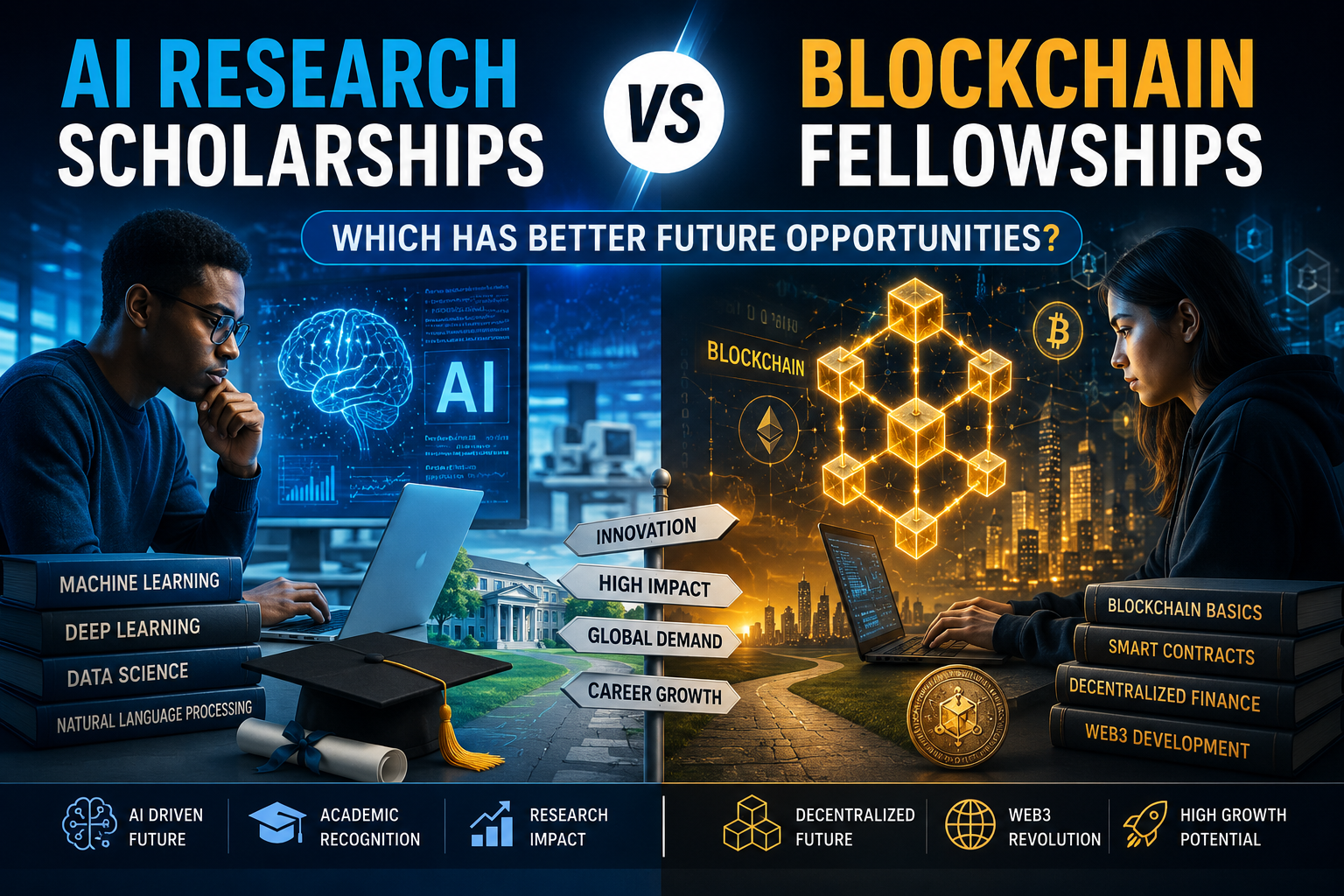
This comprehensive analysis compares AI research scholarships and blockchain fellowships across funding structures, career trajectories, intellectual freedom, and long-term market viability to help you determine which path offers the best future opportunities. In this guide, we will explore how AI research scholarships stack up against decentralized fellowships.
Table of Contents
- 1. Understanding AI Research Scholarships
- 2. Understanding Blockchain Fellowships
- 3. Head-to-Head Comparison
- 4. Deep Dive: Financial Structures and Compensation
- 5. Career Trajectories and Industry Placement
- 6. Intellectual Freedom and IP Ownership
- 7. Preparing Winning Applications
- 8. The Convergence: Where AI and Blockchain Meet
- 9. Which Path Has Better Future Opportunities?
1. Understanding AI Research Scholarships
Highly competitive AI research scholarships are structured funding opportunities designed to support academic inquiry, algorithmic development, and applied machine learning research. These programs are typically hosted by elite universities, government bodies, or the research arms of Big Tech conglomerates like Google, Meta, Microsoft, and NVIDIA.
Many academic institutions offer AI research scholarships to attract global talent. When evaluating AI research scholarships, it is important to look at the computing resources provided, as access to high-performance clusters is vital for training modern deep learning models.
Key Characteristics of AI Scholarships
- Academic Rigor: Most AI scholarships are tied to formal graduate programs (Master’s or Ph.D. tracks) and require a commitment to peer-reviewed publication at top-tier conferences like NeurIPS, ICML, or CVPR.
- Institutional Backing: These programs are deeply integrated with traditional academic infrastructure, offering access to massive supercomputing clusters, proprietary datasets, and world-renowned faculty advisors.
- Long-Term Horizon: AI research scholarships often fund multi-year research endeavors, focusing on fundamental questions in machine learning, natural language processing (NLP), computer vision, and AI alignment.
Prominent Examples of AI Research Scholarships
- The DeepMind Fellowship: Designed to support underrepresented groups in machine learning, providing full tuition, a living stipend, and mentorship from leading DeepMind researchers.
- The NVIDIA Graduate Fellowship Program: Awarding up to $50,000 per year to Ph.D. students working on GPU-accelerated computing, deep learning architectures, and graphics hardware.
- The Meta Ph.D. Fellowship: A highly competitive global program covering tuition and fees for two academic years, accompanied by a generous annual stipend and opportunities to intern at Meta AI (FAIR). For more details on securing these, check out our guide on Google, Microsoft, and Meta tech scholarships.
- Government Grants: Publicly funded fellowships, such as the National Science Foundation Graduate Research Fellowship Program in the United States, support graduate research in computational science by offering three years of financial support.
2. Understanding Blockchain Fellowships
Blockchain fellowships represent a newer, more agile paradigm of research and development funding. Emerging from the open-source ethos of Web3, these programs are funded by protocol foundations (such as the Ethereum Foundation or Solana Foundation), venture capital firms, and decentralized autonomous organizations (DAOs).
Unlike traditional academic scholarships, blockchain fellowships prioritize rapid deployment, open-source contribution, and practical implementation over theoretical publications. To explore more options, read our guide on Web3 fellowship programs.
Key Characteristics of Blockchain Fellowships
- Open-Source and Public Goods Ethos: Most blockchain fellowships require fellows to build open-source software, contribute to core protocol development, or write public-facing research papers.
- Decentralized and Remote-First: These programs are rarely tied to a physical campus. Fellows often work from anywhere in the world, collaborating asynchronously via GitHub, Discord, and governance forums.
- Rapid Commercialization: The gap between research and product launch in blockchain is incredibly narrow. A breakthrough in cryptography can be implemented into a live protocol within months, often accompanied by token launches or venture funding.
Prominent Examples of Blockchain Fellowships
- The Ethereum Foundation Fellowship Program: A program designed to support developers, researchers, and community leaders building public goods on the Ethereum network, with a strong focus on scaling, security, and cryptography.
- The Web3 Foundation Grants and Fellowships: Focused on supporting research and development in the Polkadot and Kusama ecosystems, particularly in areas like interoperability and consensus mechanisms.
- The Solana Foundation Fellowship: Aimed at developers and researchers looking to optimize high-throughput state machines, decentralized infrastructure, and parallel execution environments.
- The Chainlink Labs Research Fellowship: Supporting academic-grade research into decentralized oracle networks, smart contract security, and cross-chain communication protocols.
3. Head-to-Head Comparison
To understand which pathway offers better long-term opportunities, we must evaluate them across several critical dimensions. Before choosing, you must compare how AI research scholarships differ from Web3 opportunities in terms of financial compensation, career trajectories, intellectual property (IP) ownership, and technological longevity.
| Feature | AI Research Scholarships | Blockchain Fellowships |
|---|---|---|
| Primary Funding Source | Big Tech, Universities, Government Agencies | Protocol Foundations, DAOs, Web3 VCs |
| Average Duration | 1 to 5 years (often tied to degree completion) | 3 to 12 months (project-based or cohort-based) |
| Primary Output | Peer-reviewed papers, patents, proprietary code | Open-source code, EIPs, live protocol deployments |
| IP Ownership | Highly restricted (owned by university or sponsor) | Open-source (MIT, Apache 2.0, or Creative Commons) |
| Financial Structure | Fixed stipends, tuition coverage, health insurance | Token grants, stablecoin stipends, milestone payouts |
| Risk Profile | Low risk, stable, highly structured | High risk, highly volatile, entrepreneurial |
4. Deep Dive: Financial Structures and Compensation
The financial models of these two pathways reflect their underlying industry philosophies.
AI Research Scholarships: Stability and Institutional Security
AI Research Scholarships offer financial predictability. When you secure AI research scholarships from Meta or Google, you receive a guaranteed annual stipend (typically ranging from $40,000 to $60,000 USD), full tuition coverage, and comprehensive health benefits.
While this compensation is modest compared to industry salaries, AI research scholarships provide a secure, risk-free environment to focus entirely on research. Furthermore, these programs often serve as direct pipelines to highly lucrative corporate internships, where monthly compensation can exceed $10,000 USD, culminating in starting salaries of $200,000 to $500,000+ USD upon graduation.
Blockchain Fellowships: High Upside and Tokenomics
Blockchain fellowships operate on a different financial spectrum. While some offer standard fiat stipends, many distribute funding in cryptocurrency (stablecoins like USDC or native protocol tokens like ETH, SOL, or DOT).
The base compensation of a blockchain fellowship can vary wildly, from $5,000 for a short-term developer grant to $100,000+ for senior research fellowships. However, the true financial allure lies in the upside potential. Fellows who develop critical infrastructure or novel cryptographic primitives often spin their research out into independent startups.
By securing venture capital or launching a utility token, a blockchain fellow can transition from researcher to founder almost overnight, unlocking equity and token allocations that dwarf traditional academic compensation.
5. Career Trajectories and Industry Placement
Where do these pathways lead? The career destinations for AI scholars and blockchain fellows diverge significantly in culture, expectations, and daily operations.
[AI Research Scholarship] ──> Ph.D. / Postdoc ──> Big Tech Research (Google, Meta) OR Academia

[Blockchain Fellowship]   ──> Core Dev / Founder ──> Web3 Startups, VC Research, or DAO Governance
The AI Career Path: Corporate Labs and Academic Prestige
Securing AI research scholarships is often seen as the golden ticket to the upper echelons of corporate research and academia. Graduates who held AI research scholarships are highly coveted by top-tier corporate labs. The typical trajectory looks like this:
- The Corporate Research Scientist: Joining elite industrial labs like Google DeepMind, OpenAI, Anthropic, or Microsoft Research. Here, you will work on frontier models, utilizing massive compute budgets that are unavailable anywhere else.
- The Academic Tenure Track: Becoming a professor at a major research university. This path allows you to mentor the next generation of researchers, secure public grants, and maintain a high degree of intellectual independence.
- The AI Startup Founder: While some AI scholars launch startups, the capital-intensive nature of AI (requiring millions of dollars in compute infrastructure) means founders are heavily reliant on venture capital from day one.
The Blockchain Career Path: Decentralized Founders and Core Devs
A blockchain fellowship bypasses traditional institutional hierarchies. The typical trajectory includes:
- Core Protocol Developer: Becoming a maintainer of a major blockchain network. Your code will secure billions of dollars in TVL (Total Value Locked), and your decisions will shape the governance of global networks.
- Web3 Entrepreneur: Launching a decentralized application (dApp), Layer-2 scaling solution, or cryptographic service. Because Web3 projects are highly modular, small teams can achieve massive market caps with minimal overhead.
- Cryptographic Researcher in Industry: Working for specialized research firms like Paradigm, ConsenSys, or a16z Crypto, where you bridge the gap between academic cryptography and market-ready products.
6. Intellectual Freedom and IP Ownership
One of the most overlooked aspects of choosing a funding path is the ownership of the intellectual property you create.
AI: The Golden Cage of Proprietary IP
In the AI sector, intellectual property is fiercely guarded. Under most AI research scholarships, the sponsoring institution retains the intellectual property rights. If you are funded by a corporate AI scholarship, your research is often subject to strict non-disclosure agreements (NDAs) and patent filings. Even university-based scholarships are bound by university technology transfer offices, which claim ownership over any patents or commercial technologies developed on campus.
While you will receive academic credit through authorship, you may not have the freedom to take your models, datasets, or codebases with you if you decide to launch a competing venture. This “golden cage” restricts your ability to freely distribute your work or commercialize it on your own terms.
Blockchain: The Open-Source Revolution
In stark contrast, the blockchain ecosystem is built almost entirely on open-source software. Blockchain fellowships are designed to fund public goods.
When you write code or design a cryptographic scheme under a blockchain fellowship, your work is typically published under permissive open-source licenses (such as MIT or Apache 2.0). This means:
- Anyone in the world can view, fork, and build upon your work.
- You retain complete freedom to use your research to launch your own commercial projects.
- Your reputation is established publicly on GitHub, making your contributions verifiable by any potential employer or investor globally.
7. Preparing Winning Applications
Securing funding in either of these fields requires a strategic approach tailored to what selection committees value most.
How to Secure AI Research Scholarships
To win AI research scholarships, you need a compelling research proposal. Sponsoring committees look for candidates who demonstrate a deep understanding of algorithmic design, neural network optimization, or natural language processing. Furthermore, successful applicants for AI research scholarships usually have strong recommendation letters from established academics and a track record of publications, even if only at local workshops. If you want to maximize your chances, learn how to apply and win top AI research fellowships. If you are an international student, understanding how to secure a technology scholarship abroad can also give you a significant advantage.
How to Secure Blockchain Fellowships
For blockchain fellowships, the application process is highly practical. Instead of long academic proposals, selection committees want to see your GitHub contributions, smart contract deployments, or cryptographic proofs. Building a public portfolio of open-source contributions is the single most effective way to stand out. Be prepared to explain how your work benefits the broader decentralized ecosystem and how you plan to deploy your solutions in real-world environments.
8. The Convergence: Where AI and Blockchain Meet
While it is tempting to view these two fields as mutually exclusive, some of the most exciting future opportunities lie at their intersection. Researchers who can bridge the gap between AI and blockchain are becoming highly sought after. Some hybrid programs are now emerging that combine AI research scholarships with decentralized protocols.
                    ┌─────────────────────────┐
                    │      AI RESEARCH        │
                    │   - Machine Learning    │
                    │   - Neural Networks     │
                    └────────────┬────────────┘
                                 │
                                 ▼
                    ┌─────────────────────────┐
                    │      CONVERGENCE        │
                    │   - Decentralized AI    │
                    │   - ZK-Machine Learning │
                    │   - DePIN Compute       │
                    └────────────┬────────────┘
                                 │
                                 ▼
                    ┌─────────────────────────┐
                    │  BLOCKCHAIN FELLOWSHIP  │
                    │   - Cryptography        │
                    │   - Smart Contracts     │
                    └─────────────────────────┘
Zero-Knowledge Machine Learning (ZKML)
One of the hottest research areas today is ZKML. Machine learning models are traditionally black boxes, and running them requires trusting the host provider. By applying Zero-Knowledge Proofs (ZKPs)—a foundational blockchain technology—to machine learning, researchers can prove that an AI model ran a specific input and generated a specific output without revealing the underlying model weights or private user data.
Decentralized Physical Infrastructure Networks (DePIN)
AI requires astronomical amounts of compute power. Blockchain fellowships are currently funding projects that build decentralized compute marketplaces (e.g., Render Network, Akash, and Bittensor). These protocols allow individuals to lease out their idle GPU capacity to AI researchers, creating a decentralized alternative to AWS and Google Cloud.
AI Agents and Web3 Micro-payments
As autonomous AI agents become more sophisticated, they will need a native financial system to transact with other agents and services. Blockchains provide the perfect, trustless, API-friendly payment rails for AI agents to execute micro-transactions, secure API keys, and purchase decentralized storage.
9. Which Path Has Better Future Opportunities?
To determine which path is right for you, let us look at the specific profiles that excel in each domain.
Choose AI research scholarships if:
- You love deep academic research: You want to spend years deeply understanding neural network architectures, optimization theory, or cognitive science.
- You want access to massive scale: You want to train models with billions of parameters on state-of-the-art supercomputers.
- You value stability and prestige: You prefer a structured career path with guaranteed funding, clear milestones, and a highly respected title at a top-tier institution or tech giant.
- Your focus is long-term: Ultimately, AI research scholarships cater to those who want to solve foundational problems that may not see commercial application for a decade.
Choose a Blockchain Fellowship if:
- You are a builder and entrepreneur: You want to write code, deploy it to a live network, and see people use it immediately.
- You are passionate about cryptography and math: You love zero-knowledge proofs, consensus mechanisms, game theory, and mechanism design.
- You value freedom and open-source: You want to own your intellectual property, work remotely from anywhere in the world, and contribute to public goods.
- You have a high risk tolerance: You are comfortable with market volatility and want to capture the massive financial upside of launching new protocols.
Conclusion
Both AI research scholarships and blockchain fellowships offer extraordinary avenues for intellectual growth, financial reward, and global impact.
AI Research Scholarships remain the gold standard for those seeking institutional prestige, deep scientific inquiry, and access to the unprecedented computational resources of Big Tech. It is a highly stable, elite pathway that shapes the cognitive infrastructure of the future.
Blockchain fellowships, on the other hand, offer an unparalleled launchpad for builders, cryptographers, and self-starters who want to bypass traditional gatekeepers. It is a high-velocity, open-source ecosystem where research is rapidly transformed into economic reality.
Ultimately, the “better” opportunity depends on your personal risk profile, your preferred working style, and your vision for the future of technology. Whether you choose to build the minds of tomorrow through AI or the trustless systems of tomorrow through Blockchain, you will be positioning yourself at the absolute frontier of human innovation.