
Table of Contents
The rapid advancements in Artificial Intelligence (AI) have sparked both excitement and apprehension across various industries. From self-driving cars to sophisticated medical diagnostics, AI is demonstrating capabilities once thought to be exclusively human. In the realm of software development, the emergence of AI-powered tools like code generators, intelligent debuggers, and automated testing frameworks has led to a pressing question: Can AI replace software developers in the future? This fundamental query is at the heart of discussions about the evolving landscape of technology and employment.
This isn’t a simple yes or no answer. The relationship between AI and software development is complex, multifaceted, and constantly evolving. While AI is undeniably transforming the way software is built, understanding its potential for replacement requires a deep dive into the core tasks of software development, the current capabilities and limitations of AI, and the evolving role of the human developer.
Understanding the Core Tasks of Software Development
Before we can assess AI’s potential to replace developers, it’s crucial to delineate what a software developer actually does. The job title “software developer” encompasses a vast array of responsibilities that go far beyond merely writing lines of code.
Problem Solving and Requirements Gathering
At the heart of software development is problem-solving. Developers don’t just build; they first understand. This involves:
- Eliciting Requirements: Working with stakeholders, clients, and end-users to understand their needs, pain points, and desired outcomes. This often involves navigating ambiguous requests and translating vague ideas into concrete, actionable specifications.
- Problem Decomposition: Breaking down large, complex problems into smaller, manageable components.
- Contextual Understanding: Grasping the business domain, market trends, user behavior, and operational constraints that influence the software’s purpose and design.
Design and Architecture
Once requirements are understood, developers move into the design phase, which is highly creative and strategic:
- System Design: Conceptualizing the overall structure of the software, including its components, modules, interfaces, and data flow.
- Architectural Decisions: Choosing appropriate technologies, frameworks, databases, and infrastructure based on factors like scalability, performance, security, maintainability, and cost.
- Pattern Recognition and Application: Applying established design patterns and architectural principles to create robust and efficient systems.
Coding and Implementation
This is often what people primarily associate with software development, but it’s just one piece of the puzzle:
- Writing Code: Translating design specifications into functional code using various programming languages.
- Debugging: Identifying and fixing errors in the code.
- Code Review: Collaborating with peers to ensure code quality, adherence to standards, and identification of potential issues.
Testing and Quality Assurance
Ensuring the software works as intended and meets quality standards is critical:
- Unit Testing: Testing individual components or functions of the code.
- Integration Testing: Verifying that different modules or services work together correctly.
- System Testing: Testing the complete and integrated software system.
- Performance Testing: Evaluating the system’s responsiveness and stability under various loads.
- Bug Fixing: Addressing issues discovered during testing.
Deployment and Maintenance
The software development lifecycle extends beyond initial creation:
- Deployment: Releasing the software to production environments, often involving complex CI/CD (Continuous Integration/Continuous Deployment) pipelines.
- Monitoring: Observing the software’s performance and health in production.
- Maintenance: Applying updates, patches, security fixes, and refactoring code to improve its structure and readability over time.
- Support: Addressing user issues and providing ongoing assistance.
Collaboration and Communication
Software development is rarely a solitary endeavor:
- Teamwork: Collaborating with other developers, designers, project managers, and QA engineers.
- Client Interaction: Communicating progress, gathering feedback, and managing expectations with clients or stakeholders.
- Documentation: Creating clear and concise documentation for code, APIs, system architecture, and user guides.
Innovation and Creativity
Beyond solving existing problems, developers are often tasked with creating new value:
- Feature Development: Conceptualizing and implementing new functionalities that enhance user experience or business capabilities.
- Research and Development: Exploring new technologies, methodologies, and approaches to solve problems more effectively or create novel solutions.
- Strategic Thinking: Contributing to product roadmaps and long-term technical vision.
As this comprehensive overview illustrates, software development is a complex blend of technical expertise, critical thinking, creativity, and interpersonal skills.
How AI is Currently Impacting Software Development
AI is not a distant threat; it’s already an active participant in the software development process. Its impact is primarily seen in augmenting human capabilities and automating repetitive tasks. For example, AI enhances cybersecurity in Web3, demonstrating its practical applications beyond traditional coding.
Code Generation and Autocompletion
Tools like GitHub Copilot, Amazon CodeWhisperer, and Tabnine leverage large language models (LLMs) to suggest code snippets, complete lines of code, and even generate entire functions based on comments or existing code.
- Example: A developer types a comment like
// function to sort an array of numbersand Copilot suggests the entire function body. - Impact: Significantly speeds up coding, reduces boilerplate, and helps developers explore unfamiliar APIs more quickly.
Bug Detection and Fixing
AI-powered static analysis tools and debuggers can identify potential bugs, vulnerabilities, and code smells more efficiently than traditional methods.
- Example: DeepCode (now Snyk Code) uses AI to analyze code semantics and identify complex bugs that might evade simpler linting tools. Some AI tools can even suggest fixes for identified issues.
- Impact: Improves code quality, reduces the time spent on debugging, and enhances security.
Automated Testing
AI can assist in generating test cases, executing tests, and even prioritizing which tests to run based on code changes.
- Example: Tools can analyze code coverage, identify critical paths, and automatically generate unit or integration tests. AI can also be used in UI testing to adapt to changes in the user interface.
- Impact: Increases test coverage, speeds up the testing process, and helps catch regressions earlier.
Code Refactoring and Optimization
AI can analyze code for inefficiencies, suggest improvements for performance, readability, and maintainability, and even automate some refactoring tasks.
- Example: An AI might suggest a more efficient algorithm for a specific data processing task or identify redundant code blocks that can be consolidated.
- Impact: Leads to cleaner, more efficient, and more maintainable codebases.
Documentation Generation
AI can parse existing code and automatically generate documentation, such as API references, function descriptions, or even user manuals.
- Example: Tools can read function signatures and comments to generate Javadoc-style documentation or even explain complex code sections in natural language.
- Impact: Reduces the burden of documentation, ensuring that code is well-documented and easier for others to understand.
Low-Code/No-Code Platforms
While not strictly AI in all cases, these platforms often incorporate AI to enable non-developers or citizen developers to build applications with minimal or no manual coding.
- Example: Platforms like Microsoft Power Apps or Appian allow users to drag-and-drop components, define logic visually, and use AI assistants to generate parts of the application.
- Impact: Democratizes app development, allowing businesses to create custom solutions faster and with fewer specialized resources.
Project Management and Estimation
AI can analyze historical project data to provide more accurate estimates for project timelines, resource allocation, and potential risks.
- Example: AI can predict the likelihood of a project missing its deadline based on current progress, team velocity, and historical data from similar projects.
- Impact: Improves project planning, resource management, and risk mitigation.
These examples clearly demonstrate that AI is not just a theoretical concept but a practical tool already integrated into many aspects of the software development lifecycle. It’s making developers more productive, reducing repetitive tasks, and improving code quality.
The Limitations of Current AI in Software Development
Despite its impressive capabilities, current AI has significant limitations that prevent it from fully replacing human software developers, especially in the near future.
Lack of True Understanding and Context
AI models excel at pattern recognition and prediction based on vast datasets. However, they do not “understand” requirements, business logic, or user needs in the same way a human does.
- Example: An AI can generate code for a shopping cart based on common patterns, but it cannot independently grasp the nuances of a specific e-commerce business’s unique return policy, supply chain integrations, or marketing strategies. It lacks the ability to ask clarifying questions about vague requirements or infer unspoken needs.
- Limitation: AI struggles with ambiguity, implicit knowledge, and the subjective interpretation of human language, which are all critical in the initial phases of software development.
Inability to Handle Ambiguity and Nuance
Human communication, especially in the context of business requirements, is often ambiguous, incomplete, and full of implicit assumptions. Developers constantly navigate these nuances, seeking clarification, making informed assumptions, and translating vague ideas into precise technical specifications.
- Example: A client might say, “Make the system more user-friendly.” An AI would struggle to interpret this abstract instruction without explicit, quantifiable metrics. A human developer would engage in conversations, observe user behavior, conduct UX research, and propose concrete design changes.
- Limitation: AI lacks common sense, emotional intelligence, and the ability to engage in complex, iterative human dialogue to refine requirements.
Creativity and Innovation Gap
AI is excellent at synthesizing existing information and generating variations based on learned patterns. However, it struggles with genuine, disruptive innovation or conceptualizing entirely novel solutions that deviate significantly from its training data.
- Example: AI can write code for an existing type of mobile app, but it’s unlikely to invent the next groundbreaking social media platform or a revolutionary new programming paradigm. It doesn’t have “aha!” moments or the ability to think outside the box in a truly original way.
- Limitation: True creativity, the ability to make leaps of faith, challenge assumptions, and invent entirely new approaches, remains a uniquely human trait.
Ethical Considerations and Bias
AI models are trained on existing data, which often reflects human biases present in that data. If the training data contains biased code, design patterns, or decision-making processes, the AI will perpetuate and even amplify those biases in its generated output.
- Example: If an AI is trained on codebases predominantly written by a specific demographic or for a particular user group, it might generate code that is less accessible or performs poorly for other groups.
- Limitation: Identifying and mitigating these biases requires human ethical reasoning, critical evaluation, and a deep understanding of societal impact.
Complex Problem Solving and Abstraction
While AI can solve well-defined, constrained problems, it struggles with highly abstract, open-ended problems that require deep domain expertise, multi-disciplinary thinking, and the ability to devise entirely new algorithms or architectural patterns.
- Example: Designing a highly scalable, fault-tolerant distributed system from scratch, integrating disparate legacy systems, or architecting a novel AI inference engine requires a level of abstract reasoning and strategic decision-making that current AI cannot replicate.
- Limitation: AI is not adept at navigating uncharted territory or creating truly novel solutions to problems that haven’t been extensively documented or solved before.
Human-Centric Skills
Many crucial aspects of software development involve human interaction and soft skills:
- Empathy: Understanding user frustrations and designing intuitive interfaces.
- Negotiation: Resolving conflicts between stakeholders, balancing competing priorities.
- Leadership: Guiding teams, mentoring junior developers, fostering a collaborative environment.
- Client Relations: Building trust, managing expectations, and communicating complex technical concepts simply.
- Strategic Vision: Aligning technical solutions with long-term business goals.
- Limitation: These interpersonal and strategic skills are inherently human and are not within the current capabilities of AI.
The “Last Mile” Problem
AI can generate code snippets or even entire functions, but integrating them seamlessly into a complex, existing codebase, ensuring compatibility, handling edge cases, and debugging subtle interactions often requires human oversight and expertise.
- Example: An AI might generate a perfect function for a specific task, but a human developer is still needed to ensure it fits into the overall architecture, handles error conditions specific to the system, and passes all existing tests without introducing new bugs.
- Limitation: The context-specific integration and refinement of AI-generated code remain a significant challenge for AI.
These limitations highlight that while AI can automate many tasks, the strategic, creative, ethical, and human-centric aspects of software development remain firmly in the human domain.
The Evolving Role: Can AI Replace Software Developers?
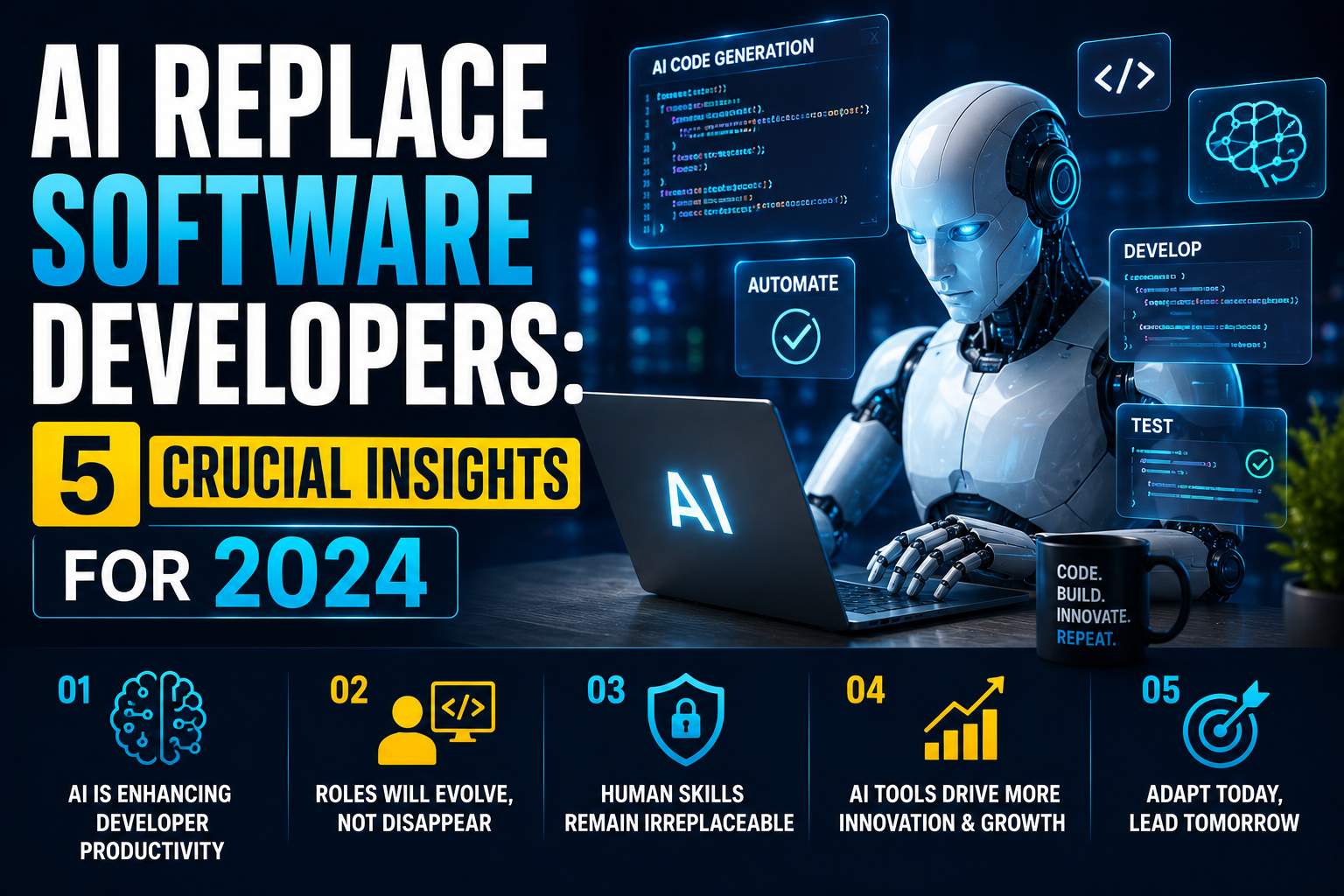
Given AI’s current capabilities and limitations, it’s more accurate to envision a future where AI augments rather than replaces software developers. The role of the developer will evolve, shifting focus towards higher-level tasks and leveraging AI as a powerful tool.
From Coder to Architect/Strategist
As AI handles more of the mundane coding, developers will spend more time on high-level design, architectural decisions, and strategic planning. Their focus will shift from “how to write this code” to “what problem are we trying to solve and what’s the best overall approach?”
- Impact: Developers will become more like system architects, product strategists, and problem domain experts.
AI Prompt Engineering and Oversight
Working with AI tools like code generators will become a core skill. Developers will need to learn how to effectively “prompt” AI, guide its output, validate its suggestions, and integrate AI-generated code responsibly.
- Impact: A new specialization will emerge for “AI whisperers” or “AI architects” who can harness AI’s power effectively.
Specialization in Complex Systems
Developers will increasingly specialize in tackling problems that AI cannot handle, such as designing highly complex, distributed, secure, or real-time systems, or integrating cutting-edge technologies. They will be the ones pushing the boundaries of what’s possible.
- Impact: Demand for developers with deep expertise in niche, challenging domains will likely increase.
Interdisciplinary Skills
The future developer will need a broader skill set, combining technical expertise with business acumen, design thinking, and strong communication skills. They will act as a bridge between technology and business needs.
- Impact: Developers will be expected to understand the “why” behind their code, not just the “how.”
Continuous Learning and Adaptation
The pace of technological change, driven in part by AI, will accelerate. Developers will need to be lifelong learners, constantly adapting to new tools, frameworks, and methodologies.
- Impact: The ability to learn and unlearn quickly will be a critical differentiator.
The Human Element of Collaboration
Teamwork, mentorship, communication, and leadership will remain crucial. Developers will still need to collaborate with peers, mentor junior team members, and communicate effectively with stakeholders.
- Impact: Soft skills will become even more valuable as technical tasks become more automated.
Scenarios for the Future: Replacement vs. Augmentation
The debate often frames AI as an “either/or” scenario: either it replaces developers entirely, or it has no impact. The reality is far more nuanced, leaning heavily towards augmentation.
Tasks Most Vulnerable to Automation
Certain tasks within software development are highly repetitive, rule-based, or require minimal creativity, making them prime candidates for AI automation:
- Boilerplate Code Generation: Creating standard project structures, CRUD (Create, Read, Update, Delete) operations, or common API endpoints.
- Basic Unit Test Generation: Writing simple tests for well-defined functions.
- Syntax Correction and Linting: Identifying and fixing minor coding errors.
- Data Transformation Scripts: Generating scripts for routine data manipulation.
- Simple Bug Fixing: Suggesting fixes for common, well-understood errors.
- Automated Deployment Tasks: Managing CI/CD pipelines.
Tasks Least Vulnerable
Conversely, tasks requiring deep understanding, creativity, human interaction, and strategic thinking are least likely to be fully automated:
- High-Level System Design and Architecture: Conceptualizing complex systems, making strategic technology choices.
- Requirements Elicitation and Refinement: Understanding ambiguous business needs, negotiating scope.
- Innovative Problem Solving: Developing novel algorithms or solutions for unprecedented challenges.
- Ethical Decision-Making: Ensuring software is fair, unbiased, and responsible.
- User Experience (UX) Design: Empathizing with users, designing intuitive interfaces.
- Complex Debugging and Root Cause Analysis: Diagnosing intricate issues in distributed systems.
- Team Leadership and Mentorship: Guiding and developing human talent.
- Strategic Planning and Product Vision: Defining the long-term direction of a product or service.
The Augmentation Hypothesis
The most probable future is one where AI acts as a powerful co-pilot, enhancing developer productivity and allowing them to focus on higher-value activities. Developers will leverage AI tools to:
- Accelerate Development: Write code faster, generate tests, and automate repetitive tasks.
- Improve Quality: Catch bugs earlier, refactor code more efficiently, and ensure consistency.
- Reduce Cognitive Load: Free up mental resources from mundane tasks to focus on complex problem-solving.
- Explore New Solutions: Use AI to quickly prototype ideas or explore different implementation approaches.
This augmentation will likely lead to a significant increase in developer productivity, allowing smaller teams to achieve more, or existing teams to tackle more ambitious projects.
The Specialization Shift
As AI takes over some tasks, there will be a shift in demand for specific developer skills. There might be less demand for entry-level developers whose primary role is writing boilerplate code, and increased demand for:
- AI-Savvy Developers: Those who can effectively use, integrate, and manage AI tools in their workflow.
- Architects and System Designers: Developers capable of designing complex, scalable, and resilient systems.
- Domain Experts: Developers with deep knowledge of specific industries (e.g., healthcare, finance) who can translate complex business needs into technical solutions.
- Ethical AI Developers: Specialists focused on ensuring AI-generated code is unbiased and responsible.
- Human-Computer Interaction (HCI) Specialists: Professionals focused on the interface between humans and AI development tools.
Preparing for an AI-Driven Development Landscape
For current and aspiring software developers, the key is not to fear AI but to embrace it and adapt.
Embrace AI Tools
Actively learn and integrate AI-powered development tools into your workflow. Experiment with code generators, intelligent debuggers, and automated testing frameworks. Understand their strengths and weaknesses. The developers who master these tools will be the most productive and sought-after.
Focus on Higher-Order Skills
Double down on the skills that AI cannot replicate:
- Problem-Solving: Sharpen your ability to break down complex problems, think critically, and devise innovative solutions.
- System Design: Develop expertise in architectural patterns, scalability, security, and maintainability.
- Communication: Improve your ability to articulate ideas, gather requirements, and collaborate effectively with diverse teams and stakeholders.
- Critical Thinking: Learn to evaluate AI-generated output, identify potential flaws or biases, and make informed decisions.
Understand Business Context
Move beyond just writing code to truly understanding the business objectives, user needs, and market dynamics that drive software development. The ability to translate technical solutions into business value will be invaluable.
Cultivate Soft Skills
Empathy, emotional intelligence, leadership, adaptability, and negotiation skills will become even more critical. These are the human elements that foster successful teams and client relationships.
Lifelong Learning
The technology landscape will continue to evolve at an unprecedented pace. Commit to continuous learning, staying updated with new technologies, methodologies, and AI advancements.
Conclusion: A Symbiotic Future
The question “Can Artificial Intelligence replace software developers in the future?” is best answered with a resounding “Not entirely, but it will profoundly transform the role.” Full replacement of human software developers by AI is highly unlikely in the foreseeable future due to AI’s inherent limitations in true understanding, creativity, ethical reasoning, and human interaction.
Instead, we are moving towards a symbiotic future where AI acts as a powerful assistant, augmenting human capabilities and automating the more repetitive and mundane aspects of software development. This shift will elevate the role of the human developer, allowing them to focus on higher-level strategic thinking, complex problem-solving, architectural design, innovation, and the crucial human elements of collaboration and communication.
The future software developer will not be an individual competing against AI, but rather an AI-empowered professional who leverages intelligent tools to build more sophisticated, efficient, and impactful software than ever before. Those who embrace this evolution, adapt their skill sets, and focus on uniquely human strengths will not only survive but thrive in the AI-driven landscape of tomorrow.
Have any thoughts?
Share your reaction or leave a quick response — we’d love to hear what you think!
-
 0
0
-
 0
0
-
 0
0
-
 0
0
-
 0
0
-
 0
0
