
Table of Contents
‘Tone Deaf and Short Sighted’: Apple Maps Gets First Ads Pop-Up in iOS 26.5 Beta — and Users Are Fuming
For over a decade, Apple Maps has been the poster child for Apple’s “redemption arc.” After a disastrous launch in 2012 that saw misplaced landmarks and melting bridges, the service evolved into a sleek, privacy-focused, and highly reliable alternative to Google Maps. For many, the primary draw wasn’t just the integration with the Apple ecosystem, but the absence of the “clutter” that defines its competitors.
That era of purity appears to be coming to a crashing halt.
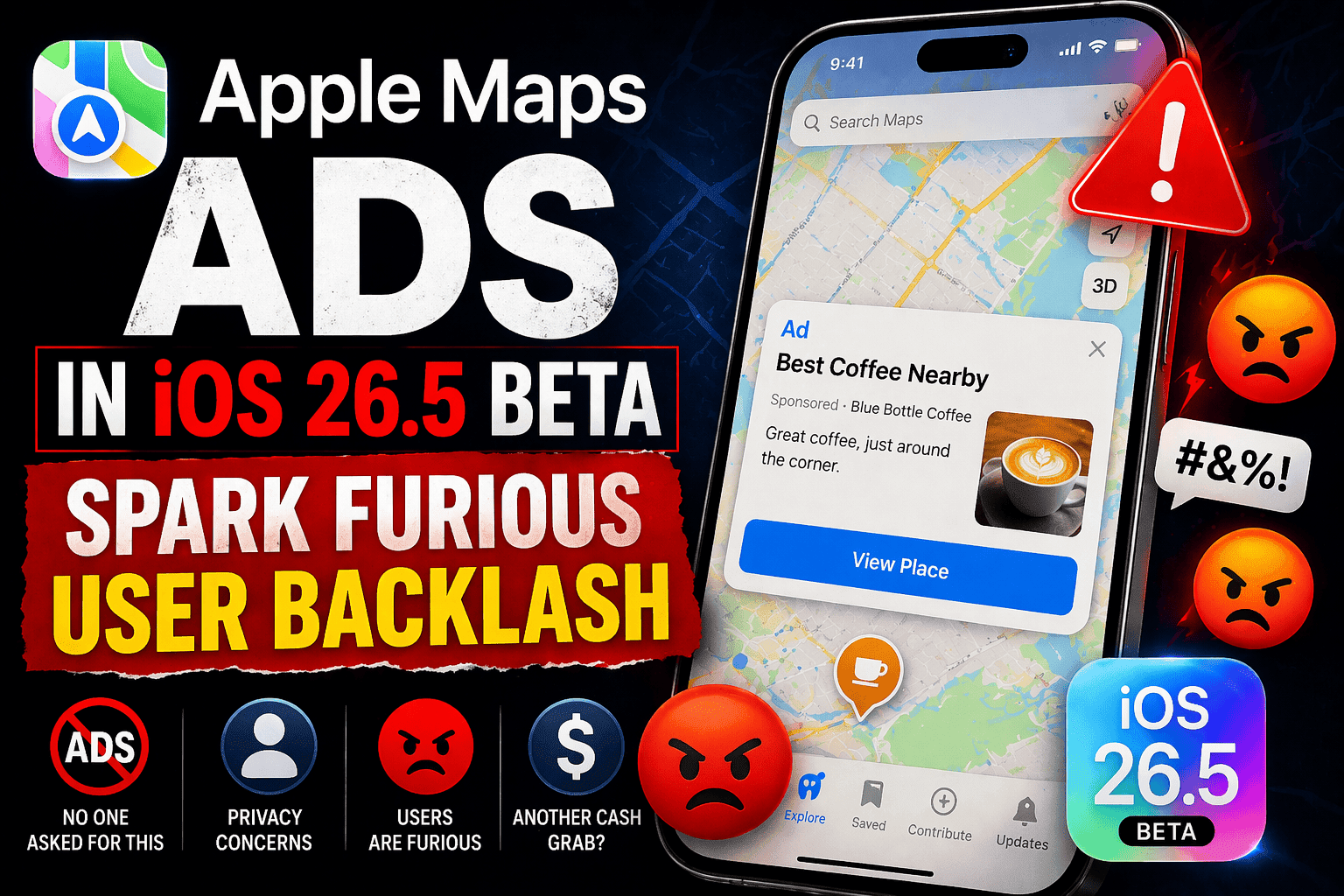
With the release of the first developer beta for iOS 26.5, users have discovered something they never thought they’d see in a native Apple utility: intrusive, full-screen, and contextually triggered advertisements. The backlash was instantaneous. Critics and long-time fans alike have labeled the move “tone deaf” and “short-sighted,” sparking a firestorm of debate over the future of the iPhone’s user experience and Apple’s commitment to its core values.
The Discovery: What the iOS 26.5 Beta Reveals
The controversy began when developers diving into the iOS 26.5 beta noticed a new framework titled “Siri-Suggested Destinations (Promoted).” While Apple has experimented with subtle “Search Ads” in the App Store for years, this implementation is far more aggressive.
According to early reports and screenshots circulating on social media, the ads manifest in three primary ways:
- The “Before You Go” Pop-up: When a user enters a destination, a small card occasionally slides up from the bottom suggesting a “Quick Stop” at a sponsored partner (e.g., a specific coffee chain or gas station) that is “conveniently on your route.”
- Highlighted Map Pins: Certain businesses now appear with larger, branded icons on the map, even if the user hasn’t searched for them.
- The Post-Trip Suggestion: Upon arriving at a destination, a notification may appear suggesting a related service nearby, such as a parking garage or a retail outlet, explicitly marked as “Sponsored.”
One beta tester, whose post on Reddit garnered over 50,000 upvotes in six hours, described the experience as “an affront to the premium price tag of the iPhone.” The user noted that while navigating to a local park, a pop-up appeared for a nearby fast-food franchise, obscuring the next turn instruction for several seconds.
“Tone Deaf”: The Erosion of the Premium Experience
The phrase “tone deaf” has become the rallying cry for the opposition. To understand why, one must look at Apple’s marketing strategy over the last five years. Apple has positioned itself as the “un-Google”—the company that doesn’t sell your data and doesn’t treat your eyeballs as a commodity.
By introducing ads into a critical safety tool like Maps, Apple is perceived to be breaking a silent contract with its users.
The Safety Concern
Navigation is not a leisure activity; it is a high-stakes utility. When a user is driving at 65 mph on a multi-lane highway, the last thing they need is a “Sponsored Suggestion” for a latte. Critics argue that any distraction within a navigation app is inherently dangerous.
“Apple has spent years refining the ‘Do Not Disturb While Driving’ feature,” says automotive UX designer Sarah Jenkins. “To then introduce a pop-up ad that requires a mental context switch—or worse, a physical tap to dismiss—is the definition of tone deaf. It contradicts their own safety guidelines.”
The Aesthetic Betrayal
Apple’s design philosophy has always leaned toward minimalism. The “clean” look of Apple Maps was its greatest competitive advantage against the information-dense (and often cluttered) interface of Google Maps. By adding branded pins and promotional cards, Apple is diluting its visual identity. For many users, the “premium” feel of an iPhone is tied to the lack of “bloatware” and “adware” found on cheaper Android alternatives.
“Short-Sighted”: Trading Long-Term Trust for Short-Term Revenue
The second half of the viral critique calls the move “short-sighted.” This refers to the potential long-term damage to the Apple brand in exchange for a boost in the company’s Services revenue.
The Services Pressure
It is no secret that Apple is under immense pressure from Wall Street to grow its Services division. As hardware cycles lengthen and iPhone sales plateau in saturated markets, the company has turned to subscriptions (Apple TV+, Music, Fitness+) and advertising to maintain its growth trajectory.
However, analysts argue that placing ads in Maps is a “low-yield, high-risk” strategy. While it may generate billions in incremental revenue, it risks driving users toward third-party alternatives like Waze or even back to Google Maps. If the user experience degrades, the “stickiness” of the Apple ecosystem weakens.
The Privacy Paradox
Apple’s “Privacy. That’s iPhone.” campaign is one of the most successful in tech history. The company has built a fortress around the idea that “what happens on your iPhone, stays on your iPhone.”
The introduction of context-aware ads in Maps raises uncomfortable questions:
- How is Apple targeting these ads?
- Is the device tracking real-time location patterns to serve “relevant” sponsors?
- Even if the processing is done on-device, does the mere presence of ads make users feel watched?
Trust is a fragile commodity. For a company that has made privacy its primary differentiator, even the perception of data monetization can be devastating.
User Reactions: A Community in Revolt
The feedback from the tech community has been overwhelmingly negative. On X (formerly Twitter), the hashtag #CleanMaps began trending shortly after the beta release.
“I pay $1,200 for a phone so I don’t have to see ads in my basic utilities,” wrote one prominent tech influencer. “If I wanted a subsidized experience filled with pop-ups, I’d buy a $200 burner. This is a massive step backward for iOS.”
In various Apple-centric forums, users are threatening to switch to “dumb” GPS units or paper maps—a hyperbolic but telling sign of the frustration. The sentiment isn’t just about the ads themselves, but about the direction Apple is heading. Users fear that if Maps is fair game, then Messages, Photos, and the Settings app might be next.
Examples of User Complaints:
- The “Intrusive” Factor: “I was trying to find a hospital in an emergency, and the first result was a ‘Sponsored’ urgent care clinic that was 10 miles further away. That’s not helpful; it’s predatory.”
- The “Clutter” Factor: “The map looks like a digital billboard now. I can’t see the street names because there are too many ‘Starbucks’ and ‘McDonald’s’ logos blocking the view.”
- The “Slippery Slope” Factor: “First it was ‘Suggestions’ in the App Store. Now it’s ‘Promotions’ in Maps. By iOS 30, we’ll be watching a 15-second unskippable ad before we can unlock our front door with HomeKit.”
Apple’s Defense: “Enhancing Discovery”
While Apple has not issued a formal press release regarding the iOS 26.5 beta features, sources close to the development team suggest the company views these not as “ads,” but as “enhanced discovery features.”
The internal logic is that users often look for places to eat or fuel up during a trip. By partnering with brands, Apple claims it can provide “verified, high-quality suggestions” that are integrated into the UI more seamlessly than a standard search. They argue that these features are designed to be “helpful, not harmful,” and that the user remains in control of their data.
However, this “discovery” narrative is a hard sell to a user base that has spent a decade enjoying an ad-free environment.
The Competitive Landscape: A Gift to Google?
Ironically, this move might do the one thing Apple has tried to avoid for years: send users back to Google.
Google Maps has had ads for a long time, but they are generally perceived as “part of the deal” with a free service. Google users expect to be the product. Apple users, who pay a premium for hardware, expect to be the customer.
If Apple Maps becomes as cluttered as Google Maps, the primary reason to choose Apple’s offering disappears. In fact, Google’s AI-driven search and superior points-of-interest database might actually make it the better ad-supported experience. By entering the ad space, Apple is choosing to compete on Google’s home turf, where Google has a twenty-year head start in data and ad-tech optimization.
Samsung Galaxy S26 Ultra vs Samsung Galaxy S25 Ultra: What’s the Difference?
Samsung Warns of Fake SSDs in Europe Amid Major CPU Sales Slump
RAM Crisis Hits Samsung Galaxy Phones and Microsoft Surface Laptops, Prices Soar
The Impact on Small Businesses
There is also a growing concern about what this means for local, independent businesses. If the “pins” on Apple Maps are determined by who pays the most, the local “mom-and-pop” coffee shop will be invisible compared to the global conglomerate with a multi-million dollar ad budget.
Apple Maps was previously seen as a somewhat level playing field, where the “Best Reviewed” or “Closest” results won out. A pay-to-play model shifts the geography of our cities in favor of those with the deepest pockets, further homogenizing the urban experience.
Expert Analysis: Is This a Beta “Trial Balloon”?
Industry analysts are divided on whether this feature will make it to the final public release of iOS 26.5.
“Apple often uses the beta cycle to test the ‘outrage threshold’ of its users,” says market analyst Mark Vinsen. “They push a feature to the extreme in the developer beta, gauge the blowback, and then dial it back for the public release. We might see the full-screen pop-ups disappear, replaced by more subtle ‘suggested’ icons in the search bar.”
However, others believe the die is cast. Apple’s aggressive revenue targets for its advertising arm (reportedly aiming for $10 billion annually) necessitate a wider rollout of ad inventory. Maps is simply too valuable a piece of digital real estate to leave unmonetized.
What This Means for the Future of iOS
The “ad-pocalypse” in Apple Maps represents a pivotal moment in the history of the iPhone. It signals a shift from a company that sells “tools for the mind” to a company that manages a “digital attention economy.”
If iOS 26.5 launches with these features intact, it will mark the end of the “clean” OS era. It suggests that no part of the user interface is sacred if it can be leveraged for recurring revenue. For the “Pro” user who prides themselves on a streamlined, efficient workflow, this is a significant downgrade.
Potential Mitigations
There is a slim hope that Apple will provide a way to opt-out, perhaps as part of an “iCloud+ Premium” tier. This would create a “pay-for-privacy” or “pay-for-cleanliness” model, which itself would be controversial but perhaps more palatable than forced advertisements.
Conclusion
The introduction of ads in the iOS 26.5 beta of Apple Maps is more than just a minor UI change; it is a fundamental shift in the relationship between Apple and its users. By prioritizing short-term ad revenue over the principles of safety, minimalism, and user trust, Apple risks alienating its most loyal advocates.
The labels “tone deaf” and “short-sighted” are not just insults; they are warnings. They reflect a community that feels betrayed by a brand they trusted to protect them from the very “noise” that defines the rest of the internet. As the beta cycle progresses, all eyes will be on Cupertino to see if they listen to the fuming masses or if they continue down the path of total monetization.
For now, the message from the users is clear: A map should tell you where to go, not what to buy. If Apple forgets that distinction, they may find their users navigating toward the exit.
Have any thoughts?
Share your reaction or leave a quick response — we’d love to hear what you think!
-
 0
0
-
 0
0
-
 0
0
-
 0
0
-
 0
0
-
 0
0
