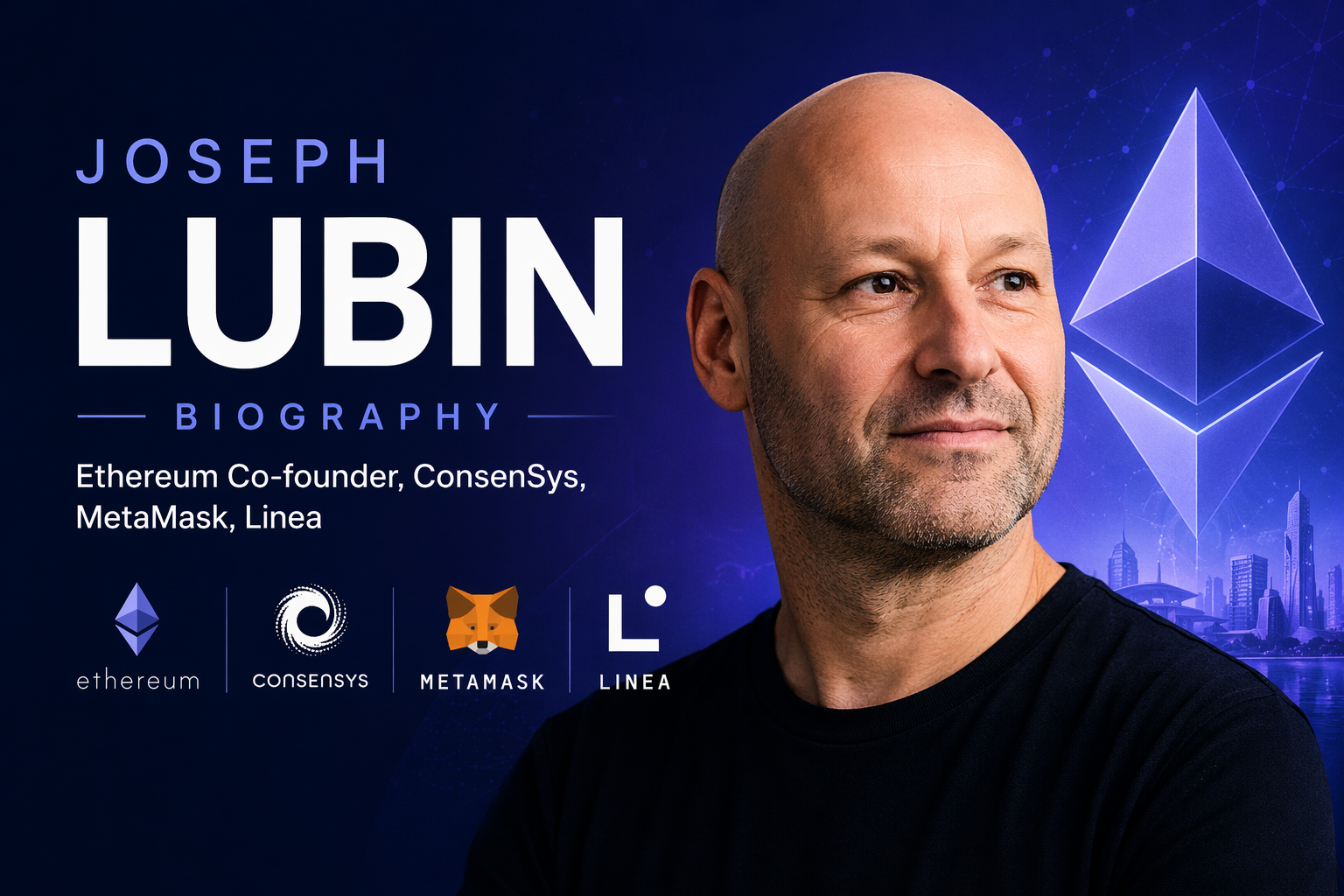
Joseph Lubin Biography: The Quiet Force Behind Ethereum, ConsenSys, MetaMask & Linea
In the fast-paced, often boisterous world of blockchain and cryptocurrency, certain figures stand out not for their bombastic pronouncements or celebrity status, but for their profound, foundational contributions. Joseph Lubin is unequivocally one such individual. Often described as the “quiet force” or the “architect of the Ethereum ecosystem,” Lubin’s influence stretches across nearly every facet of the decentralized web. From co-founding Ethereum itself to building the sprawling ConsenSys empire that birthed MetaMask and now champions Linea, his work has been instrumental in translating ambitious decentralized visions into tangible, user-friendly realities.
This article delves into the remarkable journey of Joseph Lubin, tracing his path from a curious technologist to a pivotal figure in the blockchain revolution. We will explore his early life and influences, his critical role in the genesis of Ethereum, the strategic vision behind ConsenSys, and the transformative impact of its flagship products like MetaMask and the innovative Layer 2 solution, Linea. Through his story, we uncover the enduring power of quiet determination, strategic foresight, and an unwavering commitment to a decentralized future.
Early Life and the Seeds of Decentralization
Joseph Lubin’s intellectual curiosity and entrepreneurial spirit were evident long before the advent of blockchain technology. Born and raised in Toronto, Canada, Lubin exhibited a keen interest in technology and complex systems from a young age. His academic pursuits led him to Princeton University, where he graduated with a Bachelor of Science in Electrical Engineering and Computer Science in 1987. This foundational education provided him with a robust understanding of computing, networks, and the intricate logic that underpins modern technology – skills that would prove invaluable in his later endeavors.
Following his graduation, Lubin embarked on a diverse career path that spanned several cutting-edge fields. He worked in robotics, machine vision, and artificial intelligence, gaining hands-on experience with the nascent technologies that were shaping the future. His career also took him into the financial sector, where he held positions at prominent firms like Goldman Sachs, specializing in private wealth management. This exposure to traditional finance, coupled with his deep technical expertise, gave him a unique perspective on the inefficiencies and centralized vulnerabilities inherent in existing global systems.
Crucially, Lubin’s pre-blockchain career was marked by a consistent thread: an interest in distributed systems and the potential for technology to empower individuals. He co-founded several technology companies, including a music software firm and a distributed peer-to-peer network for financial data. These ventures, while not directly blockchain-related, honed his understanding of network effects, decentralized architectures, and the challenges of building robust, scalable digital infrastructure. He was, in essence, preparing the ground for a paradigm shift he hadn’t yet fully encountered. This period of exploration and diverse experience laid the intellectual and practical groundwork for his eventual deep dive into the world of cryptocurrency and decentralized networks.
The Genesis of Ethereum: A Visionary Partnership
The year 2013 marked a pivotal turning point for Joseph Lubin and, arguably, for the entire digital world. It was then that he first encountered Bitcoin, the revolutionary cryptocurrency that introduced the concept of a decentralized, trustless digital ledger. While Bitcoin’s innovation was profound, Lubin, with his background in complex systems, quickly recognized its limitations. He saw the potential for a more generalized blockchain – one that could do much more than just facilitate peer-to-peer digital cash.
This insight led him to Vitalik Buterin, the young prodigy who had published the Ethereum whitepaper. Buterin’s vision for a “world computer” – a decentralized platform capable of running any application – resonated deeply with Lubin’s long-held interest in distributed systems and his desire to build more equitable and efficient digital infrastructure. Lubin quickly became one of the earliest and most significant contributors to the Ethereum project.
His involvement was multi-faceted and critical:
- Strategic Advisor and Co-founder: Lubin joined the small, international team that was coalescing around Buterin’s idea. He brought not only his technical acumen but also crucial experience in business development, project management, and fundraising – skills that were vital for transforming a theoretical concept into a viable global project. While Buterin focused on the core protocol, Lubin helped lay the organizational groundwork.
- Early Financial Support: Lubin was a significant early financial backer of the Ethereum project, providing essential capital during its formative stages. This personal investment underscored his deep belief in Ethereum’s potential.
- Operational and Organizational Structure: As the project grew, Lubin played a key role in establishing the Ethereum Foundation, the non-profit entity responsible for overseeing the development of the core protocol. He helped navigate the complexities of an international, open-source project, ensuring that the nascent ecosystem had the structure it needed to flourish.
- Advocacy and Evangelism: Lubin became a tireless advocate for Ethereum, explaining its groundbreaking potential to developers, investors, and the broader tech community. His ability to articulate complex technical concepts in an accessible manner was crucial in garnering support and understanding for the ambitious project.
The early days of Ethereum were a whirlwind of intense development, intellectual debate, and the challenges inherent in building a global, decentralized network from scratch. Lubin was a steady hand throughout this period, contributing significantly to the vision, funding, and organizational structure that allowed Ethereum to launch successfully in 2015. His contributions were not always in the spotlight, but they were undeniably foundational, setting the stage for Ethereum to become the dominant smart contract platform it is today.
Founding ConsenSys: Building the Ethereum Ecosystem
While his role in co-founding Ethereum was monumental, Joseph Lubin’s most enduring legacy might well be ConsenSys. Recognizing that a powerful protocol like Ethereum would only reach its full potential if there was a robust ecosystem of tools, applications, and infrastructure built upon it, Lubin founded ConsenSys in 2014, even before Ethereum officially launched. His vision was audacious: to create a “venture production studio” dedicated entirely to building the decentralized future on Ethereum.
ConsenSys was conceived not just as a single company, but as a constellation of projects, products, and services designed to accelerate the adoption and development of the Ethereum network. Lubin understood that for Ethereum to move beyond niche developer circles and into mainstream enterprise and consumer use, it needed:
- Developer Tools: To make it easier for programmers to build decentralized applications (dApps).
- Infrastructure: To support the running and scaling of these applications.
- User Interfaces: To allow everyday users to interact with dApps seamlessly.
- Enterprise Solutions: To bridge the gap between blockchain technology and traditional businesses.
- Education and Consulting: To help individuals and organizations understand and implement blockchain solutions.
Under Lubin’s leadership, ConsenSys adopted a unique “spoke and hub” model. The “hub” provided shared resources, strategic guidance, and funding, while the “spokes” were independent teams working on specific products or services. This structure fostered innovation and allowed for rapid experimentation across a wide array of use cases.
Over the years, ConsenSys has been instrumental in developing many of the foundational components of the Ethereum ecosystem:
- Infura: A crucial piece of infrastructure that provides developers with easy access to the Ethereum network without needing to run their own full nodes. It has become an essential backbone for countless dApps.
- Truffle Suite: A comprehensive development environment for smart contracts, making it easier for developers to build, test, and deploy applications on Ethereum.
- Codefi: A suite of products designed for institutional and enterprise use, covering areas like decentralized finance (DeFi), digital assets, and supply chain management.
- Quorum: An enterprise-grade version of Ethereum, initially developed by J.P. Morgan and later acquired by ConsenSys, tailored for privacy and permissioned blockchain networks.
ConsenSys’s journey hasn’t been without its challenges. The volatile nature of the crypto market, particularly during “crypto winters,” forced the company to undergo significant restructuring and strategic pivots. However, Lubin’s unwavering commitment to the long-term vision of Ethereum allowed ConsenSys to weather these storms, emerging leaner, more focused, and ultimately stronger. His ability to adapt, retain talent, and continue building through difficult periods is a testament to his resilient leadership and deep conviction in the transformative power of decentralization.
MetaMask: The Gateway to Web3
Among ConsenSys’s many successful ventures, MetaMask stands out as arguably its most impactful and widely recognized product. Launched in 2016, MetaMask quickly became the de facto wallet and browser extension for interacting with the Ethereum blockchain and, by extension, the broader Web3 ecosystem.
Before MetaMask, interacting with decentralized applications was a cumbersome process, often requiring users to run their own Ethereum nodes or navigate complex command-line interfaces. MetaMask revolutionized this experience by providing a simple, intuitive, and secure interface that acted as a bridge between traditional web browsers and the decentralized web.
Key aspects of MetaMask’s impact include:
- User Onboarding: MetaMask significantly lowered the barrier to entry for millions of users wanting to explore dApps, NFTs, and DeFi. Its familiar browser extension format made it accessible to anyone comfortable with traditional web browsing.
- Secure Key Management: It provides users with a secure way to manage their cryptographic keys and digital assets, abstracting away much of the underlying complexity while maintaining user control.
- dApp Interaction: MetaMask allows users to seamlessly connect to dApps, sign transactions, and manage their digital identities without exposing their private keys directly to every application. This became the standard interaction model for Web3.
- Ecosystem Growth: By making dApp interaction easy, MetaMask fueled the growth of the entire Ethereum ecosystem. Developers could build applications knowing there was a widely adopted, user-friendly interface for their users.
- Evolution and Expansion: Over the years, MetaMask has continually evolved, introducing features like a mobile app, an in-wallet swap function (MetaMask Swaps), and enhanced security protocols. It has also expanded its support to other EVM-compatible networks, solidifying its position as a multi-chain Web3 gateway.
Today, MetaMask boasts tens of millions of monthly active users, making it one of the most critical pieces of infrastructure in the decentralized world. It is a testament to Lubin’s foresight in understanding that for blockchain to go mainstream, the user experience had to be paramount. MetaMask is not just a wallet; it is the primary on-ramp for most people into the world of Web3, a direct result of ConsenSys’s commitment to building practical, user-centric solutions.
Charles Hoskinson Biography: Cardano, Ethereum Co-founder & Privacy Pioneer
Mint Mobile Samsung Galaxy S26 Deal: Save Up To $900
How to Create a Quiz App with Next.js and Tailwind CSS
Linea: Scaling Ethereum for the Future
As Ethereum grew in popularity, so did its challenges, particularly concerning scalability. High transaction fees (gas costs) and network congestion became significant hurdles, limiting its ability to handle a truly global volume of users and transactions. Recognizing this, ConsenSys, under Lubin’s direction, has made a strategic bet on Layer 2 scaling solutions, culminating in the development of Linea.
Linea is a zk-EVM (zero-knowledge Ethereum Virtual Machine) rollup, a cutting-edge Layer 2 solution designed to significantly increase Ethereum’s transaction throughput and reduce costs while inheriting its robust security. Here’s what makes Linea a crucial development:
- Scalability: Linea processes transactions off the main Ethereum chain (Layer 1) and then bundles them into a single, compact proof that is submitted back to Layer 1. This drastically reduces the load on the mainnet.
- zk-EVM Technology: The “zk” in zk-EVM stands for “zero-knowledge,” referring to a cryptographic proof system that allows one party to prove to another that a statement is true, without revealing any information beyond the validity of the statement itself. A zk-EVM specifically means that it is fully compatible with the Ethereum Virtual Machine, allowing developers to seamlessly migrate existing dApps or build new ones using familiar tools and languages (like Solidity). This is a significant advantage over other Layer 2 solutions that might require code rewrites.
- Ethereum Security Inheritance: Unlike some sidechains, zk-rollups like Linea derive their security directly from the Ethereum mainnet. The validity of transactions processed on Linea is cryptographically proven on Layer 1, ensuring a high degree of trust and decentralization.
- Developer-Friendly: By being a zk-EVM, Linea aims to provide an experience as close to developing on Ethereum mainnet as possible. This reduces friction for developers and accelerates the deployment of new applications.
- Enterprise Focus: With its robust security and scalability, Linea is positioned not just for consumer dApps but also for enterprise-grade applications that require high throughput and predictable costs. Lubin envisions Linea as a key component in bringing large-scale institutional adoption to Ethereum.
Linea represents the next frontier in ConsenSys’s mission to build out the Ethereum ecosystem. It addresses one of the network’s most pressing challenges and underscores Lubin’s long-term vision for a scalable, secure, and universally accessible decentralized internet. By investing heavily in advanced Layer 2 technology, ConsenSys is actively shaping the future architecture of Web3, ensuring Ethereum remains at the forefront of innovation.
Joseph Lubin’s Philosophy and Leadership Style
Joseph Lubin’s impact extends beyond the products and companies he has built; it is deeply rooted in his unique philosophy and leadership style. In an industry often characterized by maximalism and public rivalries, Lubin maintains a remarkably consistent and understated approach.
- Long-Term Vision for Decentralization: At the core of Lubin’s philosophy is an unwavering belief in the transformative power of decentralization. He views blockchain not merely as a financial innovation but as a fundamental shift in how societies organize, interact, and exchange value. His work is driven by the conviction that decentralized systems can lead to more equitable, transparent, and resilient global structures.
- Builder, Not Just a Speculator: Unlike many who entered the crypto space primarily for financial gain, Lubin has always positioned himself as a builder. His focus has consistently been on creating the foundational tools, infrastructure, and applications necessary for the decentralized web to flourish. He is less concerned with short-term market fluctuations and more with the long-term utility and adoption of the technology.
- Collaboration and Open Source: Lubin is a strong advocate for collaboration and open-source development. ConsenSys, under his guidance, has contributed significantly to the open-source community, understanding that the strength of a decentralized network lies in its collective effort and shared innovation. He believes in fostering an ecosystem where different projects can interoperate and build upon each other.
- Resilience Through Market Cycles: Lubin has navigated multiple “crypto winters” – periods of significant market downturns – with remarkable resilience. During these challenging times, while many projects faltered, ConsenSys continued to build, restructure, and innovate. His ability to maintain focus and motivate teams through adversity speaks volumes about his leadership and deep conviction.
- Quiet Force: He is often described as a “quiet force” because he rarely seeks the limelight. His public appearances are typically focused on educating and articulating the potential of blockchain rather than self-promotion. This humble yet impactful approach contrasts sharply with some of the more flamboyant personalities in the space, allowing his work to speak for itself.
- Pragmatism and Adaptability: While deeply idealistic about decentralization, Lubin is also a pragmatist. He understands that the path to a decentralized future involves integrating with existing systems and solving real-world problems. This pragmatism has allowed ConsenSys to adapt its strategies, pivot when necessary, and develop solutions that bridge the gap between the nascent Web3 and the established Web2 world.
Joseph Lubin’s leadership is characterized by strategic foresight, a deep technical understanding, and an unshakeable commitment to a future where individuals have greater autonomy and control over their digital lives. He has consistently demonstrated the ability to identify critical needs within the nascent blockchain ecosystem and then assemble the teams and resources to address them effectively.
Impact and Legacy
Joseph Lubin’s impact on the blockchain and Web3 landscape is profound and multifaceted. His contributions have not only shaped the technical architecture of the decentralized web but also influenced its adoption, development culture, and strategic direction.
- Architect of Ethereum’s Ecosystem: As a co-founder of Ethereum, he played a crucial role in its inception. As the founder of ConsenSys, he then built the scaffolding around it, transforming a powerful protocol into a vibrant, functional ecosystem. Without ConsenSys’s efforts in developer tools, infrastructure, and user interfaces, Ethereum’s growth would have been significantly hampered.
- Pioneer of Web3 User Experience: MetaMask stands as a testament to his understanding that technology, no matter how revolutionary, must be accessible to gain widespread adoption. By creating an intuitive gateway, he onboarded millions to the decentralized web, making Web3 a tangible reality for everyday users.
- Champion of Scalability and Innovation: With projects like Linea, Lubin continues to push the boundaries of what’s possible on Ethereum, addressing its critical challenges and ensuring its long-term viability as a global computing platform. His commitment to zk-EVM technology places ConsenSys at the forefront of Layer 2 innovation.
- Enduring Visionary: Through market booms and busts, Lubin has remained a steadfast advocate for the long-term vision of decentralization. His resilience, strategic thinking, and dedication to building foundational infrastructure have provided stability and direction in a volatile industry.
- Mentor and Enabler: ConsenSys has served as a launchpad for countless projects and careers within the blockchain space. Lubin has fostered an environment that encourages innovation, collaboration, and the development of talent, thereby multiplying his influence across the industry.
Joseph Lubin’s legacy is one of quiet, persistent, and strategic building. He didn’t just envision a decentralized future; he actively constructed the pathways and tools necessary to bring it to fruition. His work has laid much of the groundwork for the decentralized applications, financial systems, and digital economies that are emerging today, making him one of the most significant, albeit often understated, architects of the modern Web3 era.
Conclusion
Joseph Lubin stands as a towering figure in the blockchain world, a true pioneer whose influence is woven into the very fabric of the Ethereum ecosystem. From his pivotal role in co-founding Ethereum to meticulously building ConsenSys into a powerhouse of Web3 development, he has consistently demonstrated foresight, resilience, and an unwavering commitment to decentralization. Through groundbreaking products like MetaMask, which opened the gates of Web3 to millions, and innovative scaling solutions like Linea, which promise to unlock Ethereum’s full potential, Lubin has translated ambitious visions into tangible realities. His quiet, builder-focused approach, coupled with a deep philosophical conviction, has cemented his status as a foundational architect of the decentralized future. As Web3 continues to evolve, Joseph Lubin’s enduring legacy will undoubtedly continue to shape its trajectory, proving that profound impact often comes from the most dedicated and understated forces.