
Table of Contents
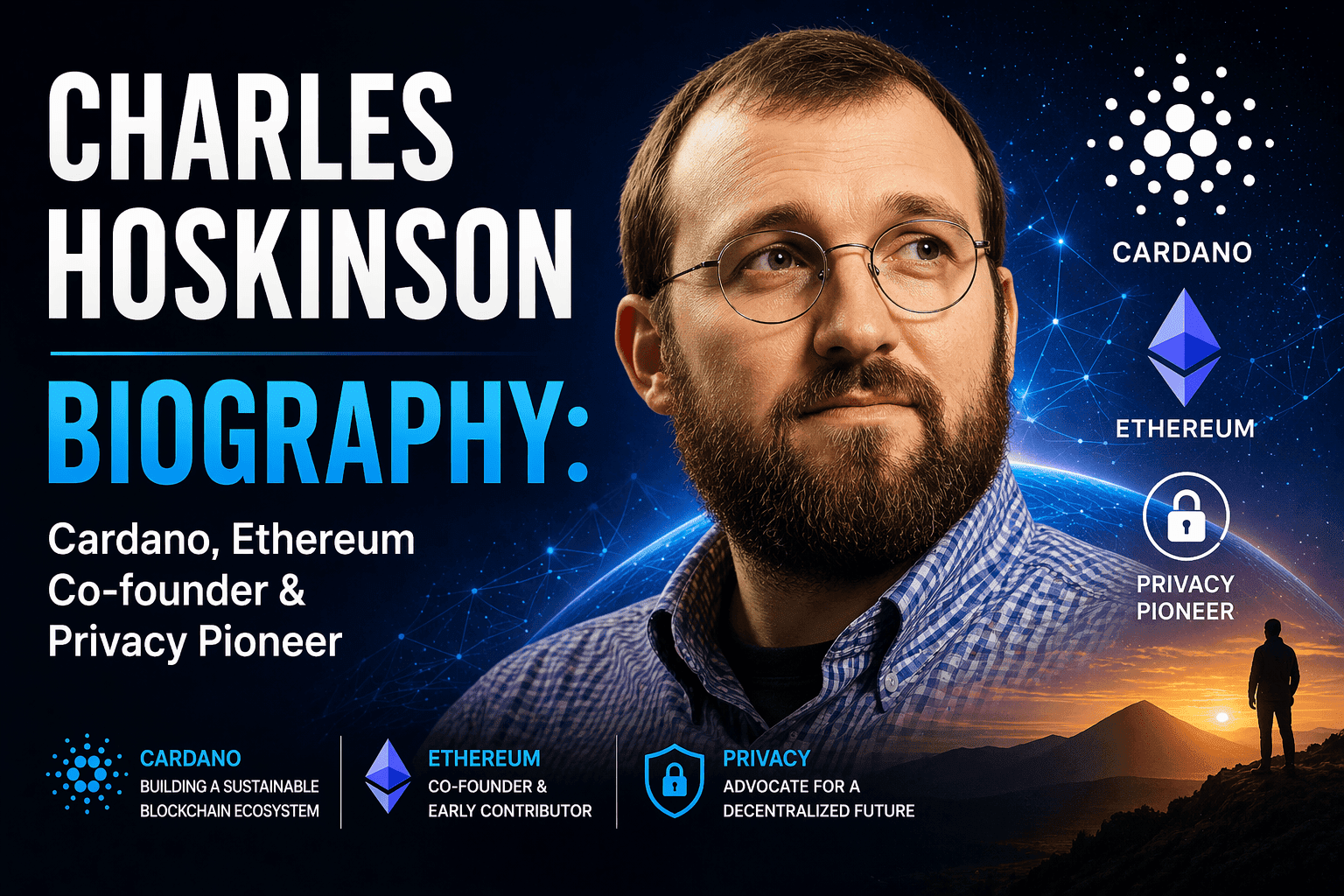
Charles Hoskinson Biography: Best Privacy Pioneer, Cardano & Ethereum Founder
In the burgeoning landscape of blockchain technology, few figures command as much attention and influence as Charles Hoskinson. A mathematician, entrepreneur, and visionary, Hoskinson stands as a pivotal architect of the decentralized future, having co-founded two of the most significant blockchain platforms: Ethereum and Cardano. His journey is a testament to intellectual rigor, unwavering conviction, and a relentless pursuit of a more equitable and transparent digital world.
This article delves into the life and work of Charles Hoskinson, exploring his early intellectual awakenings, his foundational role in Ethereum, his subsequent creation of Cardano through IOHK, and his broader contributions as a thought leader and advocate for privacy and decentralized governance. Through his endeavors, Hoskinson has not merely built technologies but has championed a philosophy that seeks to empower individuals and reshape the very fabric of digital interaction.
Early Life and Intellectual Awakening
Charles Hoskinson’s intellectual journey began far from the digital frontier of cryptocurrencies. Born in Colorado, his early life was marked by a profound curiosity and an innate aptitude for mathematics and logic. His academic pursuits led him to the Metropolitan State University of Denver and later the University of Colorado Boulder, where he delved into analytical number theory, a field that would subtly underpin his later work in cryptography and distributed systems.
Beyond the confines of traditional academia, Hoskinson was drawn to a broader intellectual current: the Austrian School of economics and libertarian philosophy. These schools of thought, emphasizing individual liberty, free markets, and skepticism towards centralized authority, resonated deeply with him. He became an ardent student of thinkers like Ludwig von Mises and Friedrich Hayek, whose ideas about spontaneous order and the limitations of central planning would later inform his vision for decentralized networks.
Crucially, Hoskinson also immersed himself in the cypherpunk movement. This informal group of activists, cryptographers, and computer scientists advocated for the widespread use of strong cryptography as a means to protect privacy and promote political and economic freedom. The cypherpunks’ emphasis on digital privacy, self-sovereignty, and resistance to surveillance laid a significant philosophical groundwork for Hoskinson’s future endeavors. While his projects, particularly Cardano, are built on public ledgers, his intellectual lineage firmly places him within the tradition that values cryptographic security and individual control over one’s digital life.
These diverse influences – mathematical rigor, economic philosophy, and cypherpunk ideals – converged to shape a mind uniquely prepared for the advent of blockchain technology. Hoskinson wasn’t just looking for a new technology; he was seeking a fundamental shift in how societies organize and interact, grounded in principles of transparency, security, and individual empowerment.
The Genesis of a Vision: Entering the Crypto Space
Hoskinson’s encounter with Bitcoin in 2011 was, for many in the nascent crypto community, a revelation. For Hoskinson, it was the tangible manifestation of many of the abstract ideals he had been exploring. Bitcoin, with its decentralized ledger, cryptographic security, and resistance to censorship, offered a glimpse into a world where financial transactions could occur without reliance on trusted third parties.
He quickly recognized Bitcoin’s profound implications, not just as a digital currency but as a proof-of-concept for a new form of distributed governance and trust. His early engagement with the crypto space was characterized by a fervent desire to understand, contribute, and improve upon the foundational ideas. He became involved in various early crypto projects and communities, sharing his insights and debating the future trajectory of this revolutionary technology.
However, Hoskinson also identified limitations within Bitcoin’s design. While revolutionary, its scripting language was restrictive, making it difficult to build complex applications beyond simple transactions. The scalability challenges and the energy consumption of Proof-of-Work also became apparent. This recognition fueled a desire to build something more flexible, more powerful, and more sustainable – a platform that could extend the promise of decentralization beyond mere currency to a vast array of applications. This ambition would soon lead him to a pivotal collaboration that would change the course of blockchain history.
The Ethereum Chapter: A Foundational Split
The year 2013 marked a significant turning point in Hoskinson’s career and in the history of blockchain. It was then that he encountered Vitalik Buterin, a young programmer who had conceived of a “world computer” – a blockchain platform capable of executing arbitrary code through smart contracts. Hoskinson immediately grasped the profound potential of Buterin’s vision.
Recognizing the need for a robust organizational structure to bring such an ambitious project to fruition, Hoskinson joined Buterin, Gavin Wood, Anthony Di Iorio, Joseph Lubin, and others to co-found Ethereum. His role was crucial in the early days, particularly in establishing the legal and business framework for the project. He served as the initial CEO of the Ethereum Foundation, leveraging his entrepreneurial acumen to navigate the complexities of launching a global, open-source initiative. He was instrumental in securing early funding and structuring the project as a non-profit entity, a decision that reflected the idealistic goals of the founding team.
Hoskinson’s vision for Ethereum was expansive. He saw it as a platform that could not only facilitate decentralized applications but also address real-world problems on a global scale, particularly in developing nations. He advocated for a more structured, long-term approach to development, emphasizing formal methods and sustainable scaling solutions.
However, as Ethereum progressed, philosophical and strategic differences emerged among the co-founders. A primary point of contention revolved around the project’s organizational structure and funding model. Hoskinson advocated for a for-profit entity, believing it would provide the necessary resources and incentives for rapid development and professional execution. In contrast, Buterin and others favored a non-profit foundation, prioritizing decentralization and open-source ethos above commercial interests.
This fundamental disagreement, coupled with differing views on governance and the technical roadmap, ultimately led to Hoskinson’s departure from Ethereum in June 2014. While the split was amicable in principle, it represented a significant fork in his professional path. Despite his exit, his contributions to Ethereum’s genesis were undeniable, helping to lay the groundwork for what would become the second-largest cryptocurrency by market capitalization and a cornerstone of the decentralized web. His experience with Ethereum, both its successes and its internal challenges, provided invaluable lessons that would profoundly influence his next, even more ambitious, undertaking.
IOHK and the Birth of Cardano: A New Paradigm
Following his departure from Ethereum, Charles Hoskinson took time to reflect on the lessons learned and to refine his vision for the future of blockchain. He recognized the immense potential of smart contract platforms but also identified critical areas where existing solutions, including Ethereum, faced significant challenges, particularly regarding scalability, security, and sustainability.
In 2015, Hoskinson co-founded Input Output Hong Kong (IOHK) with Jeremy Wood. IOHK was conceived as an engineering company dedicated to building cryptocurrencies and blockchains for academic institutions, government entities, and corporations. Its core philosophy was to apply rigorous, peer-reviewed academic research to the development of blockchain protocols, aiming to create systems that were provably secure and mathematically sound.
From this foundation, Cardano was born. Launched in 2017, Cardano was designed from the ground up to be a third-generation blockchain, addressing the perceived shortcomings of Bitcoin (first generation) and Ethereum (second generation). Hoskinson envisioned Cardano as a platform that could offer:
- Scalability: The ability to handle a high volume of transactions efficiently.
- Interoperability: The capacity to interact with other blockchains and traditional financial systems.
- Sustainability: A self-funding and self-governing treasury system to ensure long-term development.
- Security: Achieved through formal verification and a mathematically provable Proof-of-Stake consensus mechanism.
Cardano’s architecture is unique, featuring a layered approach:
- Cardano Settlement Layer (CSL): Handles ADA transactions and acts as the base layer.
- Cardano Computation Layer (CCL): Designed to support smart contracts, DApps, and programmable logic.
This separation allows for greater flexibility and easier upgrades without disrupting the core ledger. At the heart of Cardano’s security and efficiency is Ouroboros, its Proof-of-Stake consensus algorithm. Developed through extensive academic research, Ouroboros is the first Proof-of-Stake protocol to be formally verified, offering a level of security comparable to Proof-of-Work while being significantly more energy-efficient.
Hoskinson’s commitment to a research-first, peer-reviewed methodology set Cardano apart. Every major component of the protocol undergoes rigorous academic scrutiny before implementation, a process that, while slower, aims to ensure unparalleled robustness and reliability. Cardano was not merely another blockchain; it was an ambitious attempt to build a global financial operating system, designed for precision, longevity, and mass adoption.
Cardano’s Evolution: Eras of Development
Cardano’s development roadmap is structured into distinct “eras,” each focusing on a specific set of functionalities and advancements. This phased approach reflects Hoskinson’s commitment to a methodical, research-driven development process.
Byron: The Foundation (2017-2020)
The Byron era marked the launch of the Cardano network and the ADA cryptocurrency. During this phase, the network was federated, meaning it was primarily run by IOHK and its partners. The focus was on establishing the foundational infrastructure, developing the wallet (Daedalus), and building the initial community. This era laid the groundwork for future decentralization and functionality.
Shelley: Decentralization (2020-2021)
Shelley was a monumental era, transitioning Cardano from a federated network to a truly decentralized one. Key achievements included:
- Implementation of Ouroboros Praos: A significant upgrade to the Proof-of-Stake protocol, enabling community-run stake pools.
- Staking: Allowing ADA holders to delegate their tokens to stake pools and earn rewards, thereby participating in network security and governance.
- Increased decentralization: The majority of blocks began to be produced by community stake pools, reducing reliance on IOHK.
This era was crucial in fulfilling Cardano’s promise of being a community-driven network, empowering its users to secure and govern the platform.
Goguen: Smart Contracts (2021-Present)
The Goguen era introduced smart contract capabilities to the Cardano blockchain, transforming it into a programmable platform for decentralized applications (DApps).
- Plutus: Cardano’s native smart contract platform, enabling developers to write secure and robust smart contracts.
- Marlowe: A domain-specific language designed to make financial smart contracts accessible to a broader audience, even those without extensive programming knowledge.
- Native Tokens: The ability to create custom tokens directly on the Cardano blockchain without requiring complex smart contracts.
Goguen opened the floodgates for developers to build a wide array of applications, from DeFi protocols to NFT marketplaces, on Cardano.
Basho: Scaling (Ongoing)
The Basho era focuses on optimizing Cardano’s performance, scalability, and interoperability. This phase aims to significantly enhance the network’s capacity and efficiency to support widespread adoption.
- Hydra: A layer-2 scaling solution designed to process transactions off-chain, dramatically increasing throughput.
- Sidechains: Enabling the creation of auxiliary blockchains that can interact with the main Cardano chain, allowing for specialized functionalities and further scaling.
- Performance Improvements: Ongoing optimizations to the core protocol to enhance transaction finality and overall network speed.
Basho is critical for positioning Cardano as a viable platform for global, enterprise-level applications.
Voltaire: Governance (Future)
The Voltaire era represents the final stage of Cardano’s journey towards complete decentralization and self-sustainability.
- Project Catalyst: An innovative decentralized funding mechanism that allows the community to propose and vote on projects to be funded from the Cardano treasury.
- Treasury System: A portion of transaction fees and staking rewards are directed into a decentralized treasury, managed by the community.
- On-chain Governance: Enabling ADA holders to vote on key protocol parameters and future development initiatives.
Voltaire will establish a fully decentralized governance model, ensuring that Cardano’s future evolution is entirely in the hands of its community, a vision that aligns perfectly with Hoskinson’s long-held libertarian and cypherpunk ideals.
Charles Hoskinson as a “Privacy Pioneer”
The label “privacy pioneer” for Charles Hoskinson might seem counterintuitive to some, given that Cardano, like most public blockchains, operates on a transparent ledger where all transactions are publicly verifiable. However, Hoskinson’s advocacy for privacy stems from a deeper philosophical understanding of individual sovereignty and the tools required to protect it in a digital age.
His “privacy pioneering” is not solely about transactional anonymity, but about:
- Cryptographic Security as a Foundation for Autonomy: Hoskinson’s background in mathematics and cryptography underpins his belief that strong, provable cryptography is the ultimate guarantor of individual liberty. By building systems like Cardano with formal verification and robust cryptographic primitives, he aims to create platforms where individuals can control their data and interactions without relying on centralized, fallible, or potentially malicious intermediaries. This aligns directly with the cypherpunk ethos: “Privacy is necessary for an open society in the electronic age.”
- Self-Sovereign Identity (SSI): Hoskinson is a staunch advocate for Self-Sovereign Identity, exemplified by IOHK’s development of Atala PRISM. This technology allows individuals to own and control their digital identities, choosing what information to share, with whom, and when. Instead of relying on centralized identity providers (like governments or tech giants), users can cryptographically prove aspects of their identity without revealing unnecessary personal data. This shifts the power dynamic from institutions to individuals, a fundamental step towards digital privacy.
- Resistance to Censorship and Centralized Control: A core tenet of decentralized blockchains is their resistance to censorship. By removing single points of control, Hoskinson’s work aims to create systems where individuals can transact and interact freely, without fear of arbitrary blocking or surveillance by powerful entities. This architectural privacy – the privacy of not being subject to arbitrary control – is a crucial aspect of his vision.
- Data Ownership and Consent: Hoskinson frequently speaks about the importance of individuals owning their data rather than having it harvested by corporations. Cardano’s design principles indirectly support this by providing a framework for decentralized applications where users have greater control over their information and can grant or revoke consent for its use.
- Research into Privacy-Enhancing Technologies (PETs): While not always implemented at the base layer for all transactions, IOHK and Hoskinson’s broader work involve extensive research into PETs such as zero-knowledge proofs (ZKPs). These technologies allow one party to prove that they know a piece of information without revealing the information itself. As these technologies mature, they can be integrated into blockchain systems to offer selective privacy for specific transactions or data points, providing a powerful tool for compliance and confidentiality without sacrificing the benefits of a public ledger.
In essence, Hoskinson’s approach to privacy is holistic. It’s about empowering individuals with the cryptographic tools, decentralized platforms, and identity solutions necessary to navigate the digital world with autonomy and control, minimizing their reliance on centralized authorities who might compromise their data or freedom. He champions the right to privacy and builds the infrastructure that makes it technologically feasible.
Beyond Cardano: Philanthropy, Education, and Advocacy
Charles Hoskinson’s influence extends far beyond the technical development of Cardano. He is a prolific educator, a passionate advocate, and a committed philanthropist, leveraging his platform to promote the broader adoption and understanding of blockchain technology.
His YouTube channel serves as a primary conduit for his thoughts, where he regularly provides updates on Cardano, discusses industry trends, and engages in deep dives on philosophical and technical topics. He is a sought-after speaker at conferences worldwide, articulating his vision for a decentralized future to diverse audiences, from developers to policymakers.
Hoskinson is particularly passionate about the potential of blockchain to uplift developing nations. He has spearheaded initiatives to bring Cardano-based solutions to Africa, believing that decentralized identity, financial services, and supply chain management can revolutionize economies and empower populations in regions historically underserved by traditional financial systems. Partnerships with governments and educational institutions in countries like Ethiopia and Georgia underscore this commitment.
He is also a vocal proponent of responsible regulation and collaboration between the blockchain industry and governments. While advocating for decentralization, he recognizes the need for clear legal frameworks that foster innovation while protecting consumers. His approach often involves engaging with regulators to educate them on the nuances of blockchain and to advocate for policies that support the growth of the decentralized ecosystem.
Furthermore, Hoskinson is a significant benefactor to academic research in cryptography and distributed systems. He believes that continuous, peer-reviewed research is essential for the long-term health and security of the blockchain industry, echoing the foundational principles of IOHK and Cardano.
Mint Mobile Samsung Galaxy S26 Deal: Save Up To $900
Gavin Wood Biography: Coiner of Web3, Builder of Polkadot & Kusama
How to Create a Quiz App with Next.js and Tailwind CSS
Leadership Style and Public Persona
Charles Hoskinson’s leadership style is characterized by a unique blend of intellectual rigor, uncompromising vision, and a direct, often unfiltered, communication approach.
- Academic and Research-Driven: At his core, Hoskinson is an academic. He approaches problems with a deep respect for formal methods, peer review, and mathematical proofs. This translates into a methodical, often slower, development process for Cardano, which prioritizes correctness and security over speed.
- Long-Term Visionary: He operates with a decades-long perspective, often speaking about the “internet of blockchains” and the profound societal shifts that decentralized technologies will bring. He is not swayed by short-term market fluctuations or fleeting trends, maintaining a steadfast focus on Cardano’s original mission.
- Direct and Unfiltered Communication: Hoskinson is known for his candid and often provocative communication style. He engages directly with his community, critics, and industry peers, sometimes leading to spirited debates. While this can occasionally be controversial, it also fosters a strong sense of transparency and authenticity, allowing his community to understand his thought process and the challenges faced by the project.
- Inspiring Community Builder: Despite his academic leanings, Hoskinson has a remarkable ability to inspire and rally a dedicated global community around Cardano. His passion, intellectual depth, and unwavering belief in the project’s mission resonate deeply with developers, stakers, and enthusiasts alike.
Challenges and Criticisms
No project of Cardano’s ambition, nor any figure of Hoskinson’s prominence, is without its share of challenges and criticisms.
One of the most frequent criticisms leveled against Cardano is its slower development pace. The research-first, peer-reviewed approach, while ensuring robustness, means that features often take longer to implement compared to more agile, less formally verified projects. Critics argue this can hinder adoption and allow competitors to gain an advantage. Hoskinson and IOHK maintain that this methodical approach is a feature, not a bug, ensuring the long-term stability and security of the platform.
Another point of contention has been Cardano’s adoption relative to its market capitalization. For a project consistently ranked among the top cryptocurrencies, some argue that the number of DApps and active users has historically lagged behind competitors like Ethereum. However, with the rollout of Goguen and subsequent scaling solutions, this narrative is beginning to shift, with a growing ecosystem emerging.
Hoskinson’s direct and sometimes confrontational public persona has also drawn criticism. While appreciated by many for his honesty, his outspokenness can occasionally lead to friction within the broader crypto community.
Despite these challenges, Hoskinson and the Cardano community remain steadfast, believing that the foundational strength and long-term vision will ultimately prevail.
The Enduring Legacy and Future Outlook
Charles Hoskinson’s legacy in the blockchain space is already profound and continues to evolve. As a co-founder of Ethereum, he played a crucial role in establishing the smart contract paradigm that underpins much of today’s decentralized web. As the founder of Cardano, he has pioneered a new model for blockchain development, emphasizing academic rigor, formal verification, and sustainable governance.
His contributions extend beyond technology, encompassing a philosophical commitment to decentralization, individual sovereignty, and the use of cryptography to protect privacy and empower the disenfranchised. He has tirelessly advocated for blockchain as a tool for global good, particularly in regions that can benefit most from transparent and efficient digital infrastructure.
Looking ahead, Hoskinson remains at the forefront of blockchain innovation. With Cardano’s roadmap progressing through its Basho and Voltaire eras, the platform is poised to achieve unprecedented levels of scalability, interoperability, and true decentralized governance. His continued leadership at IOHK ensures that the commitment to cutting-edge research and development will persist.
Charles Hoskinson is not just a builder of blockchains; he is a visionary who challenges the status quo, pushing the boundaries of what’s possible in a decentralized world. His work reflects a deep belief in the power of technology to reshape society for
Have any thoughts?
Share your reaction or leave a quick response — we’d love to hear what you think!
-
 0
0
-
0
-
0
-
0
-
0
-
0


