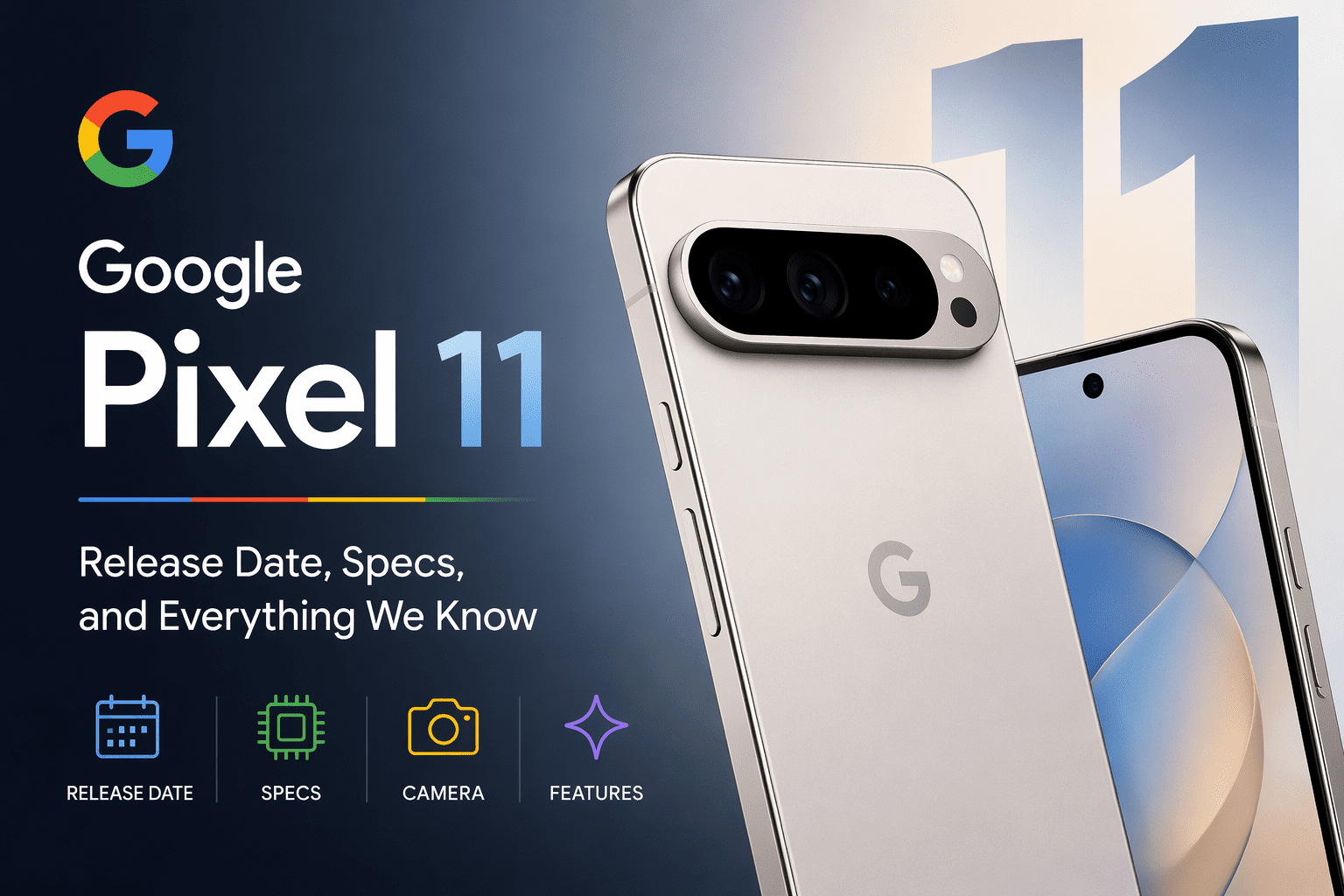
Google Pixel 11: Everything We Know So Far
The smartphone industry moves at a breakneck pace, but few devices generate as much long-term anticipation as Google’s Pixel lineup. While the tech world is still digesting the innovations of the most recent releases, the rumor mill for the Google Pixel 11 is already churning. Expected to arrive in late 2026, the Pixel 11 represents a pivotal moment for Google. It is the point where the company’s “long game” in custom silicon, artificial intelligence, and hardware integration is expected to reach full maturity.
In this comprehensive guide, we dive into the leaks, supply chain reports, and logical progressions to paint a picture of what the Google Pixel 11 series will look like.
The Roadmap: When Will the Pixel 11 Arrive?
Google has established a remarkably consistent rhythm for its flagship launches. Since the inception of the Pixel line, the “Made by Google” event has almost exclusively taken place in the autumn.
Expected Release Date
Based on historical data, we expect the Google Pixel 11 to be announced in October 2026. While Google surprised the industry by moving the Pixel 9 launch to August, most analysts believe this was a strategic move to get ahead of the iPhone cycle for that specific year. For the Pixel 11, a return to the October window—aligning with the final stable release of Android 17—is the most probable scenario.
The Lineup
Following the strategy established with the Pixel 9 and 10 series, the Pixel 11 family will likely consist of four distinct models:
- Google Pixel 11: The “entry-level” flagship with a compact form factor.
- Google Pixel 11 Pro: A smaller device with “Pro” level camera specs.
- Google Pixel 11 Pro XL: The large-screen powerhouse with maximum battery and display real estate.
- Google Pixel 11 Pro Fold: The third or fourth generation of Google’s foldable ambitions, fully integrated into the flagship numbering.
The “Malibu” Revolution: Tensor G6 and TSMC
The most significant upgrade for the Pixel 11 isn’t something you’ll see on the outside; it’s the silicon beating at its heart. For years, Google’s Tensor chips (G1 through G4) were designed in collaboration with Samsung and manufactured using Samsung Foundry’s processes. While capable, these chips often lagged behind Apple and Qualcomm in terms of thermal efficiency and raw power.
The Shift to TSMC
The Pixel 10 (Tensor G5) is slated to be the first chip fully designed by Google and manufactured by TSMC. By the time the Tensor G6 (codenamed “Malibu”) arrives in the Pixel 11, Google will have had a full year to refine this new architecture.
2nm Architecture
Rumors suggest that the Tensor G6 will be built on TSMC’s 2nm process. This is a generational leap from the 3nm process expected in 2024/2025.
- Efficiency: A 2nm chip could offer up to 25-30% better power efficiency, potentially solving the “Pixel battery drain” issues once and for all.
- Performance: We expect a significant jump in multi-core performance, bringing the Pixel 11 within striking distance of Apple’s A-series chips.
- Thermal Management: TSMC’s nodes are historically much cooler than Samsung’s, meaning the Pixel 11 should be able to sustain high-performance gaming and 8K video recording without throttling.
Design Evolution: The End of the Camera Bar?
Google’s “Camera Bar” has become the most recognizable design element in the smartphone world. However, design languages usually refresh every three to four years.
Under-Display Technology
By 2026, under-display camera (UDC) technology is expected to reach a level of quality that meets Google’s stringent photography standards. There is speculation that the Pixel 11 Pro models might finally ditch the “hole-punch” cutout in favor of a truly edge-to-edge display.
Materials and Durability
We expect Google to lean further into sustainable luxury. This includes:
- Recycled Titanium: Following the trend set by the Pro models, a refined titanium frame for the 11 Pro and Pro XL.
- Ceramic Finishes: Rumors suggest a return to a specialized ceramic back for the highest-end models to improve heat dissipation.
- Micro-curved Displays: While the industry has moved toward flat screens, the Pixel 11 may introduce “micro-curves” on all four edges to make the device feel thinner and more ergonomic without the distortion of traditional curved screens.
The Display: M15 OLED and Beyond
Google has consistently used high-quality panels from Samsung Display, and the Pixel 11 will likely feature the Samsung M15 OLED material set.
Key Display Specs:
- Peak Brightness: We are looking at potential peak brightness levels of 3,500 to 4,000 nits, making the screen perfectly legible even in direct tropical sunlight.
- Variable Refresh Rate: A refined LTPO (Low-Temperature Polycrystalline Oxide) panel that can scale from 1Hz to 144Hz. The jump to 144Hz would be a first for the Pixel line, targeting the mobile gaming market.
- PWM Dimming: Improved pulse-width modulation to reduce eye strain for users sensitive to screen flickering at low brightness.
The Camera: AI-First Imaging
The Pixel brand is synonymous with photography. While the hardware is important, Google’s “HDR+” computational photography is the real star. For the Pixel 11, the focus will likely shift from increasing megapixels to increasing sensor size and AI integration.
The Main Sensor
There are whispers that Google will finally move to a 1-inch type sensor for the Pixel 11 Pro XL. A larger sensor allows for:
- Natural “bokeh” (background blur) without software intervention.
- Massive improvements in low-light performance.
- Reduced noise in shadows.
Ultra-Telephoto Capabilities
While the Pixel 9 Pro introduced impressive zoom, the Pixel 11 is rumored to feature a “Liquid Lens” or “Dual-Prism” periscope system. This could allow for 10x optical zoom and “Super Res Zoom” that remains crisp up to 100x, rivaling the best from Samsung and Ultra-tier Chinese flagships.
Video Revolution: Cinematic AI 2.0
Video has historically been the one area where the iPhone outperformed the Pixel. Google intends to close this gap with the Pixel 11 by using the Tensor G6’s NPU (Neural Processing Unit) to perform:
- Real-time 8K Video HDR: Processing every frame of an 8K video with the same complexity as a still photo.
- Night Sight Video 2.0: Near-instantaneous processing of low-light video without the need to upload to the cloud (on-device Video Boost).
AI and Software: Android 17 and Gemini 3.0
The Pixel 11 will be the flagship vessel for Android 17. By 2026, the concept of a “smartphone” will have evolved into an “AI agent.”
Gemini Integration
The Pixel 11 will likely feature Gemini 3.0 (or whatever the iteration is at that time), running almost entirely on-device. This means:
- Zero-latency Voice Interaction: A Google Assistant that sounds indistinguishable from a human and understands context across all your apps.
- Project Astra: Google’s vision for a multimodal AI that can “see” through your camera and answer questions about the world in real-time will be a core feature of the Pixel 11.
- Generative Productivity: Features that can draft entire documents, edit videos based on text prompts, and manage your schedule autonomously.
The 7-Year Promise
Google will continue its industry-leading commitment to 7 years of OS, security, and Feature Drop updates. A Pixel 11 purchased in 2026 would theoretically be supported until 2033, making it a highly sustainable investment.
Battery and Charging: Solving the Achilles’ Heel
If there is one consistent complaint about Pixels, it is charging speed. While competitors offer 100W+ charging, Google has remained conservative.
Expected Battery Improvements:
- Stacked Battery Technology: Borrowing tech from the electric vehicle industry, the Pixel 11 may use stacked battery cells to increase energy density without increasing the phone’s physical size.
- 65W Wired Charging: A much-needed bump from the current 30W-45W range.
- Qi2 Implementation: Full support for the Qi2 wireless charging standard, including magnetic alignment for faster and more efficient wireless charging and a new ecosystem of “MagSafe-like” accessories.
Connectivity and Security
Satellite Connectivity
Following the lead of the Pixel 9, the Pixel 11 will feature second or third-generation Satellite SOS. This won’t just be for emergencies; by 2026, we may see “Satellite Messaging” for non-emergencies when you are off the grid.
Wi-Fi 8 Ready
While Wi-Fi 7 is just becoming standard, the Tensor G6 modem will likely be Wi-Fi 8 ready, ensuring the device is future-proofed for the next decade of home networking.
Titan M3 Security
A new iteration of the Titan security chip will likely debut, offering hardware-level protection against quantum computing-based decryption—a forward-looking security measure.
Pricing and Market Positioning
In an era of rising component costs (especially for 2nm chips), pricing remains a point of speculation.
| Model | Estimated Starting Price (USD) |
|---|---|
| Pixel 11 | $799 – $849 |
| Pixel 11 Pro | $999 – $1,049 |
| Pixel 11 Pro XL | $1,199 |
| Pixel 11 Pro Fold | $1,799 – $1,899 |
Google has traditionally tried to undercut Apple and Samsung by $50-$100, but as the hardware becomes more “bespoke” (with the custom TSMC silicon), we may see the Pixel 11 line move firmly into the premium pricing tier.
Dell XPS 16 Review: Why It’s My New Favorite Windows Laptop
Huawei’s Wide Foldable Beats Samsung and Apple, but Is It Necessary?
Vitalik Buterin Biography: Ethereum Founder’s Life, Achievements & Future Plans
Comparison: Pixel 11 vs. The Competition
To understand why the Pixel 11 matters, we have to look at its likely contemporaries: the iPhone 18 and the Samsung Galaxy S26.
- Vs. iPhone 18: While Apple will likely lead in raw CPU benchmarks, Google’s advantage will be in “Proactive AI.” The Pixel 11 won’t just wait for you to ask; it will anticipate your needs based on your Google ecosystem data (Calendar, Gmail, Maps).
- Vs. Galaxy S26: Samsung often wins on hardware “specs” (more RAM, more cameras). However, the Pixel 11 will offer a “cleaner” software experience and likely superior still-image photography, particularly in capturing moving subjects (like kids and pets).
What We Want to See (The Wishlist)
While the leaks give us a technical foundation, there are several “quality of life” improvements fans are hoping for:
- Ultrasonic Fingerprint Sensor across all models: Ensuring fast, reliable unlocking even with wet fingers.
- Better Modem Performance: While the move to TSMC helps, the modem needs to be as efficient as Qualcomm’s X-series to prevent signal drops in rural areas.
- Desktop Mode: A robust “Pixel Desktop” mode (similar to Samsung DeX) that allows users to plug their Pixel 11 into a monitor and use it as a workstation.
Conclusion
The Google Pixel 11 is shaping up to be the “final form” of Google’s smartphone vision. By moving to a 2nm TSMC-manufactured Tensor G6 chip, Google is finally removing the hardware shackles that have occasionally held back its world-class software.
With a focus on on-device AI, a potential 1-inch camera sensor, and a more efficient architecture, the Pixel 11 isn’t just another annual refresh—it’s the culmination of a decade of learning. While we are still some time away from the official launch, the roadmap suggests that 2026 will be the year Google truly challenges the smartphone status quo.
Whether you are a photography enthusiast, an AI power user, or someone looking for a phone that will last seven years, the Pixel 11 is the device to watch. As more leaks emerge, one thing is certain: Google is no longer just playing in the hardware space; they are looking to define it.